

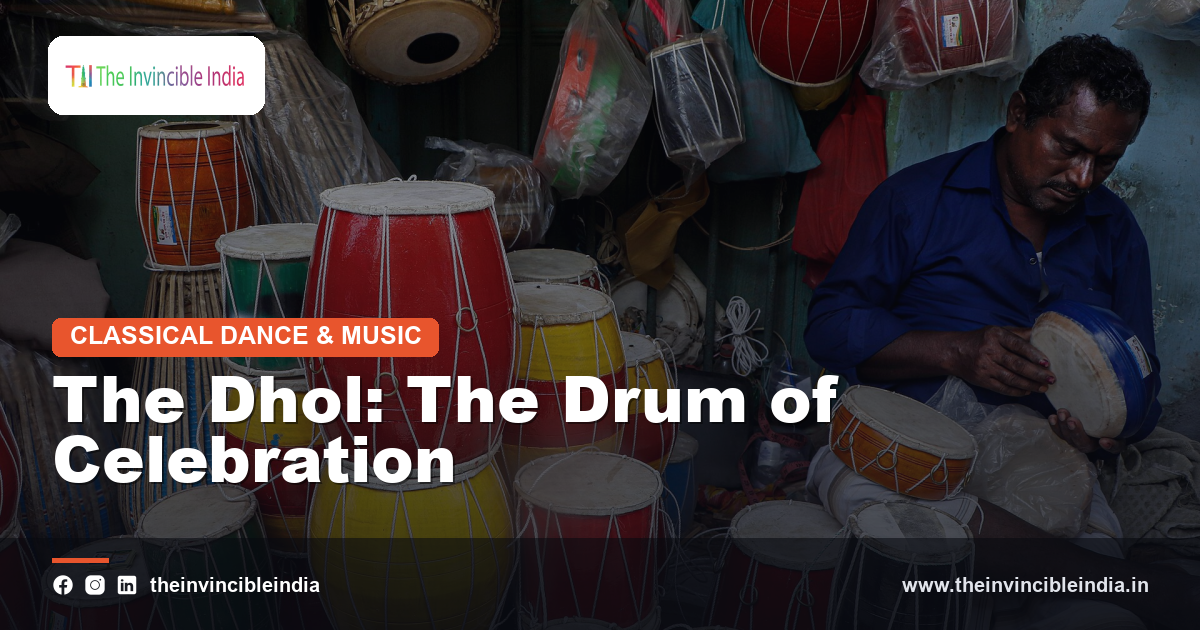
The dhol is a large, barrel-shaped drum with two skin heads, carried on a strap across the shoulder and struck with a pair of wooden sticks to produce a deep, powerful beat that can be heard over considerable distance. It is one of the most recognisable percussion instruments of North India, closely associated with Punjab, where it drives the energetic rhythms of bhangra and accompanies weddings, harvest festivals and community celebrations of every kind. Its loud, resonant voice and portability have made it a natural companion to open-air festivity and dance, distinguishing it from the quieter percussion instruments used in seated classical performance, such as the smaller dholak. This guide examines the dhol’s construction, technique and enduring cultural role.
Quick Facts
| Detail | Information |
|---|---|
| Type | Double-headed cylindrical drum (membranophone) |
| Origin | Punjab and North India |
| Body | Wooden shell, traditionally mango or shesham wood |
| Heads | Two skins of differing thickness for bass and treble |
| Played with | A pair of wooden sticks, dagga and tilli |
| Role | Lead rhythm instrument of bhangra and folk celebration |
What Is the Dhol
The dhol is a large, cylindrical, double-headed drum, wider than it is tall, carried horizontally across the body on a strap so that a player can move, dance and beat it at the same time. Its two heads are stretched across opposite ends of a barrel-shaped wooden shell, and each is struck differently: one hand plays a thick, curved stick against the bass head while the other uses a thinner stick to bring out sharper, higher tones on the opposite head. This combination gives the dhol a commanding, layered sound that carries easily over singing, other instruments and the noise of a crowd. Because it can be played standing and in motion, it has become inseparable from outdoor festivity and dance across North India, particularly Punjab, where its beat is often the first sound associated with celebration itself.
Origins and Regional Family
The dhol belongs to a very old and widespread family of barrel drums found in various forms across South Asia, each shaped by the musical needs and materials of its own region. While the instrument most closely associated with the name today comes from Punjab, related double-headed drums appear under different names and with somewhat different proportions in Bengal, Nepal and elsewhere on the subcontinent, reflecting a shared ancestry of large hand-carried drums developed for open-air use. This regional family shares the basic principle of two skin heads on a single shell, struck by hand or stick to produce a loud, carrying rhythm suited to processions and outdoor gatherings. The Punjabi dhol, distinguished by its size, tone and central place in bhangra, has become by far the most widely recognised member of this broader drum family, both within India and internationally.
Construction and Materials
A traditional dhol is built around a cylindrical wooden shell, historically turned or carved from mango, shesham or a similarly dense, resonant hardwood chosen for its strength and tonal qualities. Skins are stretched tightly across both open ends of the shell, traditionally made from animal hide and tensioned using ropes or cords that run the length of the drum, allowing a maker or player to adjust tightness and, to a degree, pitch. This combination of a solid wooden body and two tensioned skins gives the dhol both the volume and the depth of tone it needs to remain audible during energetic outdoor performance. Careful selection of wood and skin, along with skilled lacing, has long distinguished a well-made dhol from a merely functional one, and experienced makers are valued for the balance and resonance they can achieve.
The Two Drumheads
The dhol’s two heads are deliberately unequal, each suited to a different musical purpose within the instrument’s overall sound. One head, typically thicker and made to produce a low, resonant bass tone, is struck with a heavier curved stick to provide the deep pulse that anchors the rhythm. The other, thinner head produces brighter, sharper strokes played with a slim cane stick, adding decorative rhythmic detail and accents above the bass line. Together the two heads allow a single player to generate both the foundation and the ornamentation of a rhythmic pattern simultaneously, a hallmark of dhol playing that distinguishes it from single-headed drums, which typically rely on more than one player or hand to achieve a similar layered effect. Balancing the two heads well is central to a convincing, danceable dhol performance.
The Wooden Shell
The dhol’s shell forms the resonating body of the instrument, and its shape, thickness and wood all influence the volume and tonal character produced once the heads are struck. A well-proportioned shell must be light enough to be carried comfortably on a strap for extended periods of dancing and playing, yet solid enough to project sound clearly across an open space filled with other noise. Traditional makers select seasoned hardwood for its stability and resistance to cracking under the tension of the laced skins, since a warped or split shell can seriously affect the drum’s tone and playability. The shell’s cylindrical shape, wider in the middle than the depth of a typical frame drum, is part of what gives the dhol its distinctively loud, carrying voice, well suited to outdoor festive use rather than quiet indoor performance.
Tensioning and Lacing
Traditional dhols are tensioned using a system of ropes or cords laced in a criss-crossing pattern between the two heads, allowing the skins to be tightened evenly around the shell. This lacing must be adjusted carefully and evenly, since uneven tension can distort the drum’s pitch or cause one side of a head to sound differently from the rest. Skilled players and makers periodically retighten this lacing, particularly in humid conditions that can loosen animal-hide skins, to keep both heads responsive and correctly balanced against each other. The physical work of stretching and tensioning a dhol is considered a specialised skill in its own right, closely tied to the instrument’s overall sound quality, and it reflects the close, hands-on relationship between traditional Indian drum making and the musicians who depend on that craftsmanship.
Carrying and Playing Posture
Because the dhol is played standing and often while dancing, it is carried horizontally in front of the body using a strap slung over one shoulder, positioning the two heads at a convenient angle for both hands to reach comfortably. This posture allows a player considerable freedom of movement, an essential quality given that dhol players frequently perform among dancers, moving through a crowd or procession rather than remaining seated in one place. Good posture and a well-adjusted strap are important not only for comfort during long performances but also for consistent playing technique, since an unstable or poorly positioned drum makes it difficult to strike both heads accurately. This physically active playing style sets the dhol apart from most classical Indian drums, which are typically played seated.
Playing Technique and Sticks
Dhol technique relies on two sticks of different weight and shape, traditionally called the dagga and the tilli, each suited to one of the drum’s two heads. The heavier, curved dagga strikes the bass head to produce deep, resonant beats that establish the underlying pulse of a rhythm, while the slender tilli strikes the treble head rapidly to add bright, syncopated accents and decorative patterns above that pulse. Coordinating both sticks independently, often at speed and while moving, requires considerable practice and physical stamina, since a skilled player must maintain a steady combined rhythm for extended stretches of a celebration or performance. This two-handed, two-stick approach gives a single dhol player the capacity to produce a remarkably full and layered rhythmic texture on their own.
Rhythmic Patterns
Dhol players draw on a repertoire of established rhythmic patterns, each suited to particular moods, dances or moments within a celebration, built from combinations of bass strokes on the dagga and lighter accents on the tilli. These patterns are typically passed down through direct observation and practice within families or communities of players rather than through formal written notation, preserving a living oral tradition of rhythm. A skilled player can vary tempo, intensity and pattern in response to the energy of dancers or the mood of an event, making the dhol as much a responsive, interactive instrument as a purely rhythmic one. This flexibility and immediacy is part of why the dhol remains central to lively, participatory occasions rather than more formal, seated musical settings.
The Dhol in Bhangra
Nowhere is the dhol more central than in bhangra, the energetic folk dance and music tradition of Punjab, where its driving beat sets the tempo and energy for dancers throughout a performance. The relationship between dhol and dancer is close and reciprocal, with the drummer often responding to the dancers’ movements and energy just as the dancers move in time with the drum’s accents and pauses. This dynamic interplay has helped make the dhol synonymous with bhangra itself in popular imagination, both within Punjab and among audiences who encounter the dance through festivals, films or diaspora celebrations abroad. The instrument’s loud, propulsive sound is widely considered essential to an authentic bhangra performance, and a bhangra troupe without a dhol player is rarely considered complete.
The Dhol in Giddha and Folk Dance
Beyond bhangra, the dhol accompanies a range of other Punjabi folk dances and communal celebrations, including giddha, in which its rhythm supports the dancers’ claps, verses and circular movements even when other instruments are also present. Its role in these settings is similar to its role in bhangra, providing a strong, steady pulse around which singers, clappers and dancers organise their own contributions. Because folk celebrations in Punjab often bring together singing, dance and instrumental music in an informal, participatory setting, the dhol’s loud and flexible rhythm makes it particularly well suited to holding such varied performances together. Its presence at these gatherings reflects its broader identity as an instrument of shared, communal celebration rather than solitary or formal concert performance.
Dhol in Weddings and Festivals
The dhol holds a central place in Punjabi weddings and seasonal festivals, where its beat traditionally announces and accompanies key moments of celebration, from processions to communal dancing among guests. Its loud, unmistakable sound carries easily through crowded courtyards and streets, making it an effective way to gather attention and set a festive mood at outdoor events. Harvest festivals such as Baisakhi have long been associated with dhol playing and bhangra performance, linking the instrument to the agricultural calendar as well as to family celebration. This association with major life events and seasonal turning points has reinforced the dhol’s symbolic role as an instrument of joy, marking transitions and communal gatherings across Punjabi cultural life.
Regional Variants Across India
Variants of the large double-headed drum family related to the dhol appear across other regions of India, each adapted in size, material and playing style to local musical traditions and festive occasions. Bengal and parts of eastern India, for instance, have their own distinctive drums used in religious processions and festival contexts, sharing the basic principle of a barrel-shaped shell with two heads but differing in proportion and technique from the Punjabi dhol. These regional variants demonstrate how a broadly similar instrument type has been adapted independently to suit different musical needs, from devotional processions to secular festive dancing. Recognising this wider family helps situate the Punjabi dhol within a larger pattern of large, loud, hand-carried drums developed across the subcontinent for outdoor, communal use.
Dhol Beyond India
As Punjabi communities settled in countries around the world, the dhol travelled with them, becoming a familiar sound at diaspora weddings, festivals and cultural events in places such as the United Kingdom, Canada and beyond. Bhangra’s growing international popularity, supported by films, music and dedicated dance troupes, has introduced the dhol’s rhythms to audiences well beyond South Asia, often blended with other musical styles in fusion performances. This international spread has not diminished the instrument’s strong association with Punjabi identity; rather, it has extended that identity to new communities and contexts while keeping the dhol’s core role, driving lively communal dance, intact. The instrument today serves as a recognisable marker of Punjabi culture on stages far from its regional origins.
Dhol in Contemporary and Fusion Music
In recent decades the dhol has found a place well beyond traditional folk settings, appearing in popular film music, fusion bands and contemporary recordings that combine its powerful acoustic beat with electronic or Western instrumentation. Producers and musicians have valued the dhol for the immediate energy and distinctly Indian character it brings to a track, often using it to anchor dance-oriented compositions or to add a festive accent to otherwise different musical styles. Some modern instruments use synthetic heads or reinforced shells to withstand frequent touring and recording use, while still aiming to preserve the drum’s traditional tone. This adaptability has helped keep the dhol musically relevant far beyond its original folk and festival context.
The Dhol Today
Today the dhol remains one of the most immediately recognisable instruments of Punjabi and North Indian culture, as central to weddings, festivals and bhangra performance now as it has long been. Skilled players continue to pass on its technique and repertoire through direct practice and community performance, ensuring that its loud, joyful voice remains a living tradition rather than a historical curiosity. Its spread through diaspora communities and popular music has only broadened its reach, introducing new audiences worldwide to a sound closely tied to celebration itself. Whichever setting it appears in, the dhol continues to serve its oldest and clearest purpose: bringing people together in rhythm and dance.
Sources & Further Reading
- Sangeet Natak Akademi, national academy for music, dance and drama (sangeetnatak.gov.in).
- Ministry of Culture, Government of India (indiaculture.gov.in).
Frequently Asked Questions
What is a dhol?
The dhol is a large, cylindrical, double-headed drum from North India, carried on a strap and played with two sticks. It is best known as the driving rhythm instrument of Punjabi bhangra.
How is the dhol played?
The dhol is played with two sticks of different weight, a heavier curved stick striking the bass head and a slimmer stick striking the treble head, allowing one player to produce a full rhythmic pattern.
What is the dhol traditionally made from?
A traditional dhol has a wooden shell, often mango or shesham wood, with two animal-hide skins stretched over its ends and tensioned with laced rope.
Why is the dhol associated with bhangra?
The dhol’s loud, powerful beat sets the tempo and energy for bhangra dancers, and the drummer often responds directly to the dancers’ movements, making it central to an authentic performance.
Is the dhol played outside Punjab?
Yes. Related double-headed drums appear in other Indian regions, and the Punjabi dhol itself is now played at Punjabi diaspora events and in fusion music around the world.


