

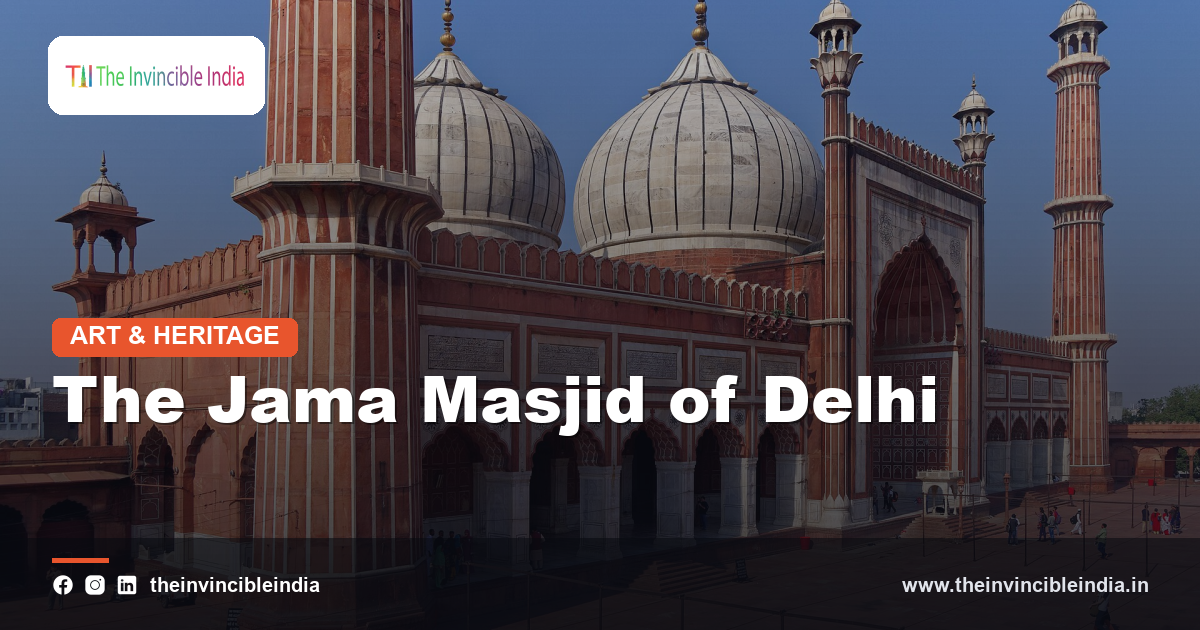
The Jama Masjid of Delhi stands as one of the largest and most significant mosques in India, commissioned by the Mughal emperor Shah Jahan and completed in the mid-seventeenth century as part of his ambitious building program in the imperial capital. Built from red sandstone and white marble, the mosque combines a vast courtyard with soaring gateways and twin minarets, embodying the mature expression of Mughal architecture that also produced the nearby Red Fort. Situated in the heart of Old Delhi, the mosque remains an active center of worship, drawing thousands of devotees for Friday prayers and continuing to serve as one of the city’s most recognizable historic landmarks.
Quick Facts
| Detail | Information |
|---|---|
| Location | Old Delhi, India |
| Commissioned by | Emperor Shah Jahan |
| Completed | 1656 |
| Materials | Red sandstone and white marble |
| Architectural style | Mughal Indo-Islamic |
| Status | Active mosque |
The Great Mosque of Old Delhi
The Jama Masjid rises above the crowded lanes of Old Delhi as one of the largest mosques in India, its expansive courtyard and towering gateways forming a dramatic contrast to the dense urban fabric surrounding it. Positioned near the historic Red Fort, the mosque has long served as a spiritual and architectural anchor for the old walled city.
Its scale and prominence reflect its original purpose as the principal congregational mosque of the Mughal capital, designed to accommodate large numbers of worshippers for communal prayer. This role as a central gathering place has continued largely unbroken since the mosque’s completion, making it one of Delhi’s most enduring institutions.
Shah Jahan's Building Program
The Jama Masjid was commissioned by the Mughal emperor Shah Jahan, whose reign is remembered as a high point of Mughal architectural patronage, encompassing celebrated projects across the empire. Alongside the mosque, Shah Jahan also oversaw the construction of the nearby Red Fort and relocated the imperial capital to the newly built city of Shahjahanabad.
The mosque’s construction formed part of this broader vision for a grand imperial capital, intended to project both religious devotion and dynastic authority through monumental architecture. Its scale and prominent placement within the new city underscore the importance Shah Jahan placed on religious architecture as a component of imperial prestige.
Construction and Completion
Construction of the Jama Masjid took place over several years during the mid-seventeenth century, employing a large workforce of laborers and skilled craftsmen drawn from across the Mughal Empire. The project required substantial resources, reflecting the scale of ambition behind the mosque’s design.
Upon its completion, the mosque immediately became the principal congregational site for the new capital, a role it has retained through the centuries since. Its construction stands as one of the major architectural undertakings of Shah Jahan’s reign, alongside his other celebrated building projects.
The Vast Courtyard
At the heart of the Jama Masjid lies an immense open courtyard capable of holding a very large number of worshippers at once, particularly during major congregational prayers. Paved in red sandstone, the courtyard is bordered on three sides by covered arcades and dominated on the fourth by the mosque’s main prayer hall.
This expansive open space reflects the practical requirements of a congregational mosque intended to serve as the primary gathering place for a major capital city’s Muslim population. The courtyard’s scale remains one of the most immediately striking aspects of the mosque for visitors today.
The Great Gateways
The mosque is approached through three grand gateways, each rising above wide flights of steps and serving as a monumental threshold between the surrounding city and the sacred space of the courtyard within. The largest of these gateways traditionally served as the entrance used by the emperor and his court.
These gateways are built with the same combination of red sandstone and marble used throughout the mosque, their scale and elevation designed to impress visitors as they ascend from the streets of Old Delhi into the mosque’s elevated courtyard. They remain among the most photographed features of the complex today.
Twin Minarets
Flanking the main prayer hall are two tall minarets built of alternating bands of red sandstone and white marble, a striking visual feature that distinguishes the mosque’s silhouette against the Delhi skyline. These towers rise well above the surrounding courtyard and gateways, historically serving to call the faithful to prayer.
Visitors have traditionally been permitted to climb one of the minarets, from which sweeping views of Old Delhi and the surrounding cityscape are visible. This vantage point offers a particularly vivid sense of the mosque’s central position within the historic layout of the old walled city.
The Main Prayer Hall
The mosque’s main prayer hall stands along the western side of the courtyard, its facade composed of a series of arched openings crowned by three prominent domes built from white marble with black striping. Within, the hall provides covered prayer space oriented toward Mecca, accommodating worshippers alongside the vast open courtyard outside.
The hall’s design, combining arched bays with domed roofing, follows established conventions of Mughal mosque architecture, balancing structural function with the aesthetic refinement characteristic of imperial religious buildings from this period.
Red Sandstone and White Marble
The Jama Masjid is built predominantly from red sandstone, with white marble used selectively for domes, minaret banding, and decorative detailing, a material combination closely associated with the mature phase of Mughal architecture. This pairing creates a striking visual contrast that has become closely identified with the imperial building style of Shah Jahan’s reign.
The same material palette appears across several of Shah Jahan’s other major architectural projects, reflecting a consistent aesthetic vision applied across his building program. This shared material language helps unify the Jama Masjid visually with other Mughal monuments of the same era.
Mughal Architectural Vocabulary
The mosque exemplifies the mature Mughal architectural vocabulary, characterized by symmetrical planning, bulbous domes, pointed arches, and the extensive use of red sandstone paired with white marble accents. This vocabulary developed over generations of Mughal patronage, reaching a refined synthesis during Shah Jahan’s reign.
The Jama Masjid’s scale and formal clarity make it one of the clearest surviving expressions of this architectural style applied specifically to congregational mosque design, distinguishing it from earlier or smaller mosques built under previous Mughal rulers.
Relationship to the Red Fort
The Jama Masjid stands in close proximity to the Red Fort, the seat of Mughal imperial power in Shahjahanabad, reflecting a deliberate spatial relationship between religious and political authority within the new capital’s layout. Both structures were built under Shah Jahan’s patronage and share elements of the same architectural language.
This physical closeness between mosque and fort reinforced the intertwined nature of religious observance and imperial governance in Mughal political culture, with the emperor’s authority symbolically supported by his role as patron of the empire’s principal religious institutions.
Friday Prayers and Daily Worship
The Jama Masjid remains an active mosque, hosting daily prayers as well as especially large congregations for the weekly Friday prayer, when the courtyard fills with worshippers from across the city. This continuous religious function distinguishes it from monuments preserved solely for their historical value.
The mosque’s ongoing role as a place of active worship reflects centuries of continuous religious practice at the site, sustaining a direct link between the mosque’s Mughal-era origins and the everyday religious life of Delhi’s contemporary Muslim community.
The Mosque in Old Delhi's Urban Fabric
The Jama Masjid sits at the center of a dense network of narrow lanes and markets in Old Delhi, an area that developed historically around the mosque and the nearby Red Fort. The surrounding neighborhood remains one of the city’s most vibrant commercial and residential districts.
This close integration between the mosque and its urban surroundings reflects broader patterns seen in historic Islamic cities, where major congregational mosques often served as focal points around which markets, residences, and civic life naturally clustered over time.
Historical Events at the Mosque
Over the centuries, the Jama Masjid has witnessed numerous significant historical events tied to the broader political history of Delhi, including periods of upheaval that affected the wider city and its landmarks. As one of the most prominent public spaces in the old capital, the mosque frequently found itself at the center of civic life during moments of historical significance.
These historical associations have added further layers of significance to the mosque beyond its religious function, embedding it within the wider narrative of Delhi’s transformation across the centuries since its construction.
Conservation and Maintenance
As one of India’s most visited historic mosques, the Jama Masjid requires ongoing conservation to address the effects of pollution, weathering, and heavy foot traffic on its sandstone and marble surfaces. Periodic restoration work has been undertaken to preserve its domes, minarets, and courtyard paving.
Maintaining an actively used religious building of this scale presents particular challenges, since conservation work must generally proceed without disrupting ongoing worship. This balance between preservation and continued religious use reflects a common challenge faced by many of India’s great historic mosques.
Visiting the Jama Masjid
Visitors to the Jama Masjid typically enter through one of its grand gateways before exploring the vast courtyard, prayer hall, and, where permitted, one of the minarets for panoramic views over Old Delhi. The mosque remains open to visitors outside of prayer times, subject to appropriate dress and conduct.
The experience of standing within its immense courtyard, surrounded by red sandstone arcades and marble domes, offers a vivid sense of the scale and ambition of Mughal religious architecture at its height, making it a compelling stop for visitors exploring Old Delhi’s historic core.
The Mosque's Capacity for Worshippers
The Jama Masjid was designed with capacity in mind, its vast courtyard and covered prayer hall together able to accommodate a very large number of worshippers during major congregational occasions such as Friday prayers and religious festivals. This scale reflects its intended role as the principal mosque for an entire imperial capital.
Such capacity requirements shaped many aspects of the mosque’s design, from the width of its courtyard to the depth of its covered prayer hall, ensuring that the structure could serve as a functional gathering space rather than a purely ceremonial monument. This practical dimension remains evident in the mosque’s continued use today.
Comparisons with Other Mughal Mosques
The Jama Masjid is often compared with other major mosques built under Mughal patronage, sharing common design elements such as red sandstone and marble construction, domed prayer halls, and expansive courtyards. These shared features reflect a consistent imperial architectural language developed across Shah Jahan’s building program.
Despite these similarities, the Jama Masjid is generally regarded as one of the largest and most architecturally accomplished examples of this mosque type, distinguished by its scale and its prominent position within the former Mughal capital. This comparison underscores its significance within the broader history of Mughal religious architecture.
The Jama Masjid Today
The Jama Masjid continues to serve as one of Delhi’s most important active mosques and a defining monument of Mughal architecture, its courtyard and gateways as impressive today as when Shah Jahan first commissioned the project. Its enduring role in the religious life of the city speaks to the strength of its original design and construction.
As both a place of daily worship and a major historic landmark, the Jama Masjid remains central to any understanding of Old Delhi’s architectural and religious heritage, standing alongside the Red Fort as one of the twin monuments that define Shah Jahan’s legacy in the capital.
Sources & Further Reading
- Archaeological Survey of India (asi.nic.in).
- Ministry of Culture, Government of India (indiaculture.gov.in).
Frequently Asked Questions
Where is the Jama Masjid located?
The Jama Masjid is located in Old Delhi, near the Red Fort, in the heart of India’s capital.
Who commissioned the Jama Masjid?
It was commissioned by the Mughal emperor Shah Jahan, who also built the Red Fort and the Taj Mahal.
When was the Jama Masjid completed?
The mosque was completed in the mid-seventeenth century, around 1656.
What materials was the Jama Masjid built from?
It was built primarily from red sandstone, with white marble used for its domes and decorative detailing.
Is the Jama Masjid still used for worship?
Yes, it remains an active mosque, hosting daily prayers and large Friday congregations.


