

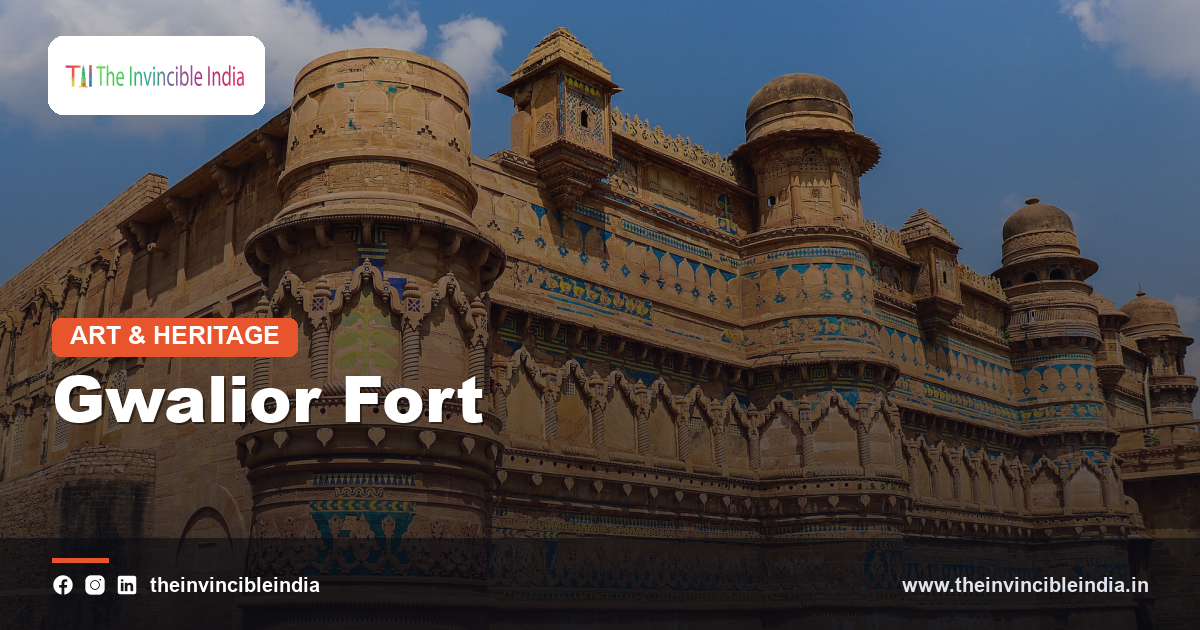
Gwalior Fort commands a long, steep-sided sandstone hill rising abruptly above the city of Gwalior in Madhya Pradesh, its ramparts and palaces reflecting centuries of dynastic rule across central India. Long regarded as one of the most formidable strongholds in the region, the fort combines defensive engineering with remarkable architectural refinement, most visibly in the tile-covered Man Singh Palace. Its historical importance places it firmly among the notable great forts of India that shaped the political landscape of the subcontinent. Today the fort remains a striking landmark, its walls and palaces continuing to testify to the successive powers that once held it.
Quick Facts
| Detail | Information |
|---|---|
| Location | Gwalior, Madhya Pradesh |
| Setting | Isolated sandstone hill |
| Notable structure | Man Singh Palace |
| Associated dynasty | Tomar dynasty, later Scindia rule |
| Notable temples | Sas-Bahu temples, Teli ka Mandir |
| Status | Protected historical monument |
A Fort on an Isolated Hill
Gwalior Fort sits atop a long, narrow sandstone hill that rises sharply above the surrounding plains, its steep cliffs forming a natural barrier that made the site exceptionally difficult to approach or besiege. This isolated elevation has long been recognized as one of the most strategically advantageous fort locations in central India.
The hill’s shape allowed builders to construct a fortification that stretched along its length, enclosing palaces, temples, and water reservoirs within a single defensible perimeter. This combination of natural defense and expansive hilltop space made Gwalior one of the most valued strongholds among regional rulers for centuries.
Ancient Origins
The fortification of the Gwalior hill is understood to date back many centuries, with successive rulers recognizing the strategic value of the site long before its most celebrated structures were built. Early references to fortification at the site situate it among the older strongholds of central India.
Over time, the site passed through the hands of various regional dynasties, each contributing to its defenses and internal structures. This long and layered history is characteristic of major Indian hill forts, which often evolved over centuries rather than being the product of a single ruling power.
The Tomar Dynasty
Gwalior Fort reached one of its most significant architectural periods under the Tomar dynasty, which ruled the region during the medieval period and is credited with constructing many of the fort’s most celebrated palace structures. Their patronage brought a flourishing of architectural and artistic activity to the site.
The Tomar rulers are particularly remembered for their contributions to the fort’s palace architecture, blending defensive necessity with refined aesthetic sensibilities. Their era is often regarded as a high point in the fort’s long architectural evolution, setting the stage for the structures that continue to define its character today.
The Man Singh Palace
The most celebrated structure within Gwalior Fort is the Man Singh Palace, built under the Tomar ruler Man Singh Tomar and named in his honor. The palace is renowned for its facade, adorned with brightly colored glazed tilework arranged in geometric and floral patterns that remain vivid even after centuries of exposure.
Beyond its striking exterior, the palace contains a series of interconnected courtyards and chambers, including underground rooms designed to remain cool during the region’s hot summers. The palace’s architectural sophistication reflects the artistic ambitions of its patron and remains one of the finest surviving examples of its era’s palace design.
Glazed Tilework and Ornamentation
The extensive use of glazed tiles on the Man Singh Palace’s exterior walls is among its most distinctive features, employing blue, yellow, and green ceramic tiles arranged in patterns depicting elephants, ducks, and geometric motifs. This decorative technique gives the palace a vibrant visual character unusual among fort structures of its period.
Such tilework required specialized craftsmanship and reflects broader artistic influences that circulated across medieval India, blending regional decorative traditions with techniques associated with wider trade and cultural exchange. The surviving tiles offer a rare glimpse into the ornamental sophistication achieved by craftsmen of the period.
The Sas-Bahu Temples
Within the fort complex stand the Sas-Bahu temples, a pair of ornately carved Hindu shrines dating to an earlier period of the fort’s history. Despite their popular name, which translates loosely as “mother-in-law and daughter-in-law,” the temples are understood to have been dedicated to Vishnu, reflecting the devotional practices of their original patrons.
The temples are noted for their intricate carving, including detailed pillars and richly decorated ceilings that showcase the sculptural skill of the artisans who built them. Though partially in ruins, the surviving structures continue to convey the architectural ambition invested in these earlier temple constructions.
The Teli ka Mandir
Among the oldest surviving structures within the fort is the Teli ka Mandir, a tall temple whose architectural style is notable for combining elements associated with both northern and southern Indian temple traditions. Its unusually shaped roof distinguishes it from other structures within the fort complex.
The temple’s blended architectural vocabulary has made it a subject of particular interest among scholars studying the interaction between different regional temple styles in ancient India. As one of the oldest structures at Gwalior, the Teli ka Mandir offers insight into the fort’s earliest phases of religious architecture.
Jain Rock-Cut Sculptures
The cliffs surrounding Gwalior Fort contain numerous rock-cut sculptures associated with Jain religious traditions, carved directly into the sandstone rock face at various points around the hill. These sculptures, many depicting Jain tirthankaras, vary considerably in scale, including some of considerable size.
These carvings reflect a distinct devotional tradition that developed around the fort’s periphery, separate from the fort’s primary defensive and palace structures. Their presence adds another layer to the site’s religious and artistic history, illustrating the diversity of traditions that found expression around Gwalior’s dramatic hillside.
Defensive Architecture
Gwalior Fort’s defensive design takes full advantage of the hill’s natural cliffs, with fortified walls running along the edges of the plateau and gateways positioned to control the limited routes of ascent. This combination of natural and constructed defenses made the fort exceptionally difficult to capture by direct assault.
Successive rulers reinforced and adapted these defenses over time, adding bastions and strengthening gateways as military technology and strategic needs evolved. The fort’s long survival as a contested stronghold reflects the effectiveness of its defensive design across many centuries of regional conflict.
Water Management Systems
To sustain its population during sieges, Gwalior Fort incorporated a network of tanks and reservoirs designed to collect and store rainwater across the hilltop. These water systems were essential to the fort’s ability to withstand prolonged periods of isolation from outside supply.
The engineering behind these systems reflects careful planning by the fort’s builders, who recognized that a defensible stronghold required more than strong walls alone. This attention to sustainable water supply is a recurring theme among India’s major hill forts, and Gwalior’s systems remain a notable example of this practical ingenuity.
Later Rule and the Scindia Dynasty
In later centuries, Gwalior Fort and the surrounding region came under the rule of the Scindia dynasty, who established Gwalior as an important center of their power in central India. Under their governance, the fort continued to hold strategic and symbolic significance, even as the broader political landscape of India shifted.
The Scindia era added further layers to the fort’s long history, reinforcing its status as a site of continuous political relevance across multiple ruling dynasties. This extended history of successive rule underscores Gwalior’s enduring importance as a stronghold in the region.
Cultural Significance
Beyond its military and architectural importance, Gwalior Fort holds significant cultural resonance, having witnessed centuries of regional history unfold within and around its walls. It is often described in traditional accounts as one of the most formidable and impressive forts of India, a reputation reinforced by its imposing scale and hilltop dominance.
This reputation has been sustained through generations of regional memory and scholarship, cementing Gwalior’s place among India’s most historically significant fortifications and ensuring its continued recognition as a landmark of central Indian heritage.
Conservation of the Fort Complex
Given its long history and diverse structures, Gwalior Fort requires ongoing conservation attention across its palaces, temples, and defensive walls. Efforts focus on preserving the fragile tilework of the Man Singh Palace as well as stabilizing older structures such as the Sas-Bahu temples and Teli ka Mandir.
These conservation efforts must account for the varied construction periods and materials found throughout the complex, requiring specialized approaches for different structures. Sustained preservation work helps ensure that Gwalior’s architectural and historical legacy remains accessible to future generations of visitors and scholars.
Sound and Light Presentation
Gwalior Fort is also known for an evening sound and light program that narrates the fort’s history against the illuminated backdrop of its walls and palaces, offering visitors an engaging way to learn about the site’s long and layered past.
Such presentations have become a popular complement to daytime visits, helping convey the scale of Gwalior’s history to audiences who might otherwise find the site’s many overlapping dynastic periods difficult to follow. This blend of heritage and modern presentation reflects the fort’s ongoing role as a major cultural attraction.
Visiting Gwalior Fort
A visit to Gwalior Fort typically involves ascending the hill through fortified gateways before exploring the Man Singh Palace, the Sas-Bahu temples, and the Teli ka Mandir, each representing a different chapter of the fort’s architectural history. The scale of the complex rewards a leisurely, thorough exploration.
Panoramic views over the city of Gwalior from the fort’s ramparts offer a further sense of the site’s strategic significance, illustrating why successive rulers valued this commanding hilltop position for so many centuries of regional history.
Gwalior in Regional Memory
Gwalior Fort has long occupied a prominent place in the historical memory of central India, frequently cited among the region’s most formidable and admired strongholds. Its dramatic hilltop setting and the visual impact of the Man Singh Palace have contributed to a lasting reputation that extends well beyond the immediate vicinity of the city.
Generations of travelers, chroniclers, and scholars have described the fort in terms that emphasize its imposing scale and architectural refinement, reinforcing its status as a landmark of central Indian heritage. This sustained reputation reflects the fort’s unusual combination of formidable defenses and genuine artistic accomplishment.
The Fort's Many Gateways
Access to Gwalior Fort is controlled through a succession of fortified gateways built along the winding approach road that climbs the hillside, each designed to slow and expose any potential attacker before they could reach the summit. These gates reflect a layered defensive philosophy applied consistently throughout the fort’s long construction history.
Passing through these gateways today, visitors retrace the same route once used by rulers, soldiers, and officials moving between the city below and the palaces above, gaining a tangible sense of the fort’s scale and the deliberate design choices that shaped movement through its defenses.
Gwalior Fort Today
Today Gwalior Fort stands as one of central India’s most significant historical monuments, its palaces and temples reflecting centuries of architectural achievement under successive dynasties. The tile-covered Man Singh Palace, in particular, remains one of the most visually striking survivals of medieval Indian palace architecture.
As a protected heritage site, Gwalior Fort continues to draw visitors, scholars, and history enthusiasts, its walls and structures offering a tangible connection to the long and layered political history of the region it has overlooked for so many generations.
Sources & Further Reading
- Archaeological Survey of India (asi.nic.in).
- Ministry of Culture, Government of India (indiaculture.gov.in).
Frequently Asked Questions
Where is Gwalior Fort located?
Gwalior Fort is located on a sandstone hill overlooking the city of Gwalior in Madhya Pradesh.
What is the Man Singh Palace known for?
The Man Singh Palace is known for its facade covered in colorful glazed tilework depicting geometric and animal motifs.
Which dynasty built the Man Singh Palace?
The palace was built under the Tomar dynasty, specifically during the rule of Man Singh Tomar.
What are the Sas-Bahu temples?
The Sas-Bahu temples are a pair of ornately carved Hindu shrines within the fort complex, believed to have been dedicated to Vishnu.
Who ruled Gwalior Fort in later centuries?
In later centuries the fort and surrounding region came under the rule of the Scindia dynasty.


