

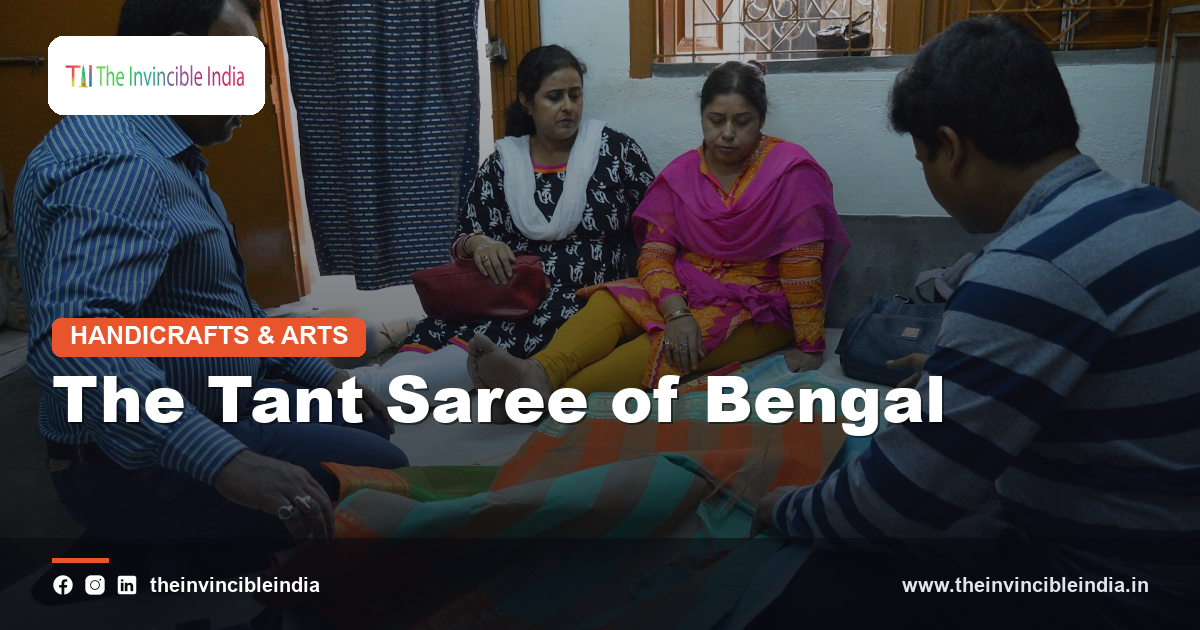
The Tant saree is one of Bengal’s most cherished textile traditions, a handwoven cotton saree prized for its light, breathable weave and its crisp, distinctive finish. Woven on handlooms across various towns of West Bengal, Tant sarees are recognised by their fine cotton body, wide contrasting borders and richly patterned pallu, worn for both everyday occasions and important festivals. The tradition sits alongside other celebrated regional weaves such as those explored in the Pochampally Ikat guide, each representing a distinct strand of India’s vast handloom heritage. This guide examines the materials, weaving process, regional centres, motifs and continuing cultural significance of the Tant saree.
Quick Facts
| Detail | Information |
|---|---|
| Type | Handwoven cotton saree |
| Region | West Bengal |
| Primary material | Fine cotton yarn |
| Distinctive feature | Light, crisp, starched finish |
| Key weaving centres | Shantipur, Phulia, Dhonekhali, Begampur |
| Traditional occasions | Durga Puja and other Bengali festivals |
What Is a Tant Saree
A Tant saree is a handwoven cotton saree native to Bengal, distinguished by its light weight, fine texture and a characteristically crisp, starched finish that sets it apart from many other Indian cotton weaves. The word tant itself refers broadly to handloom weaving in Bengali, and the saree that carries this name has become one of the most recognisable expressions of the region’s textile tradition. Typically woven with a plain or lightly patterned body and a more elaborately designed border and pallu, the Tant saree balances everyday comfort with festive elegance. Its enduring popularity across generations of Bengali women reflects both its practical suitability for the region’s climate and its deep cultural resonance.
Bengal's Handloom Heritage
Bengal has long been recognised as one of India’s most accomplished centres of cotton handloom weaving, with a history of fine textile production that extends back many centuries and includes some of the subcontinent’s most celebrated cloth traditions. This broader heritage forms the backdrop against which the Tant saree developed, drawing on generations of accumulated weaving skill, yarn preparation knowledge and design sensibility specific to the region. Bengali weavers have historically been noted for their ability to produce exceptionally fine, lightweight cotton cloth suited to the area’s hot, humid climate. The Tant saree stands as one of the clearest living continuations of this long regional tradition of cotton weaving excellence.
Cotton Yarn and Materials
The defining material of the Tant saree is fine cotton yarn, chosen and prepared with care to achieve the lightweight, breathable quality for which the saree is known. Weavers traditionally select yarn of a suitable fineness, or count, balancing durability with the delicate, almost translucent texture prized in a well-made Tant saree. The quality of the yarn directly affects both the drape and the comfort of the finished garment, making careful sourcing and preparation an essential early stage in production. This attention to material sets the foundation for everything that follows in the weaving process, from the smoothness of the body to the definition of the border.
The Handloom Weaving Process
Tant sarees are woven on traditional handlooms, often pit looms operated by hand and foot, requiring considerable skill and physical coordination from the weaver to maintain even tension and consistent pattern across the length of the cloth. The weaving process typically begins with careful warping and threading of the loom according to the intended border and pallu design, a preparatory stage that can take considerable time before actual weaving begins. Skilled weavers are able to introduce extra decorative threads for the border and pallu while maintaining the plain weave of the main body, a technique that demands close attention throughout the process. This combination of preparation and sustained skill defines the handloom character of every genuine Tant saree.
The Distinctive Crisp Finish
One of the most recognisable qualities of a Tant saree is its crisp, slightly stiff finish, achieved through traditional starching methods applied to the finished cotton cloth. This starched texture gives the saree body and a distinctive rustle when worn, along with a clean, structured drape that many wearers consider central to the Tant saree’s appeal. Over repeated washing, the starch softens and the saree develops a more relaxed, supple feel, a transformation familiar to regular wearers of handwoven cotton. This particular finishing quality, more than any single motif or colour, is often what most immediately identifies a saree as genuinely of the Tant tradition.
Borders and Pallu Design
The border and pallu of a Tant saree are typically its most decorative elements, woven in a contrasting colour and often featuring more elaborate patterning than the comparatively plain body of the saree. Common border widths and styles vary by weaving centre and by the intended occasion, ranging from narrow, understated borders suited to daily wear to broad, richly patterned borders reserved for festive use. The pallu, the decorative end-piece draped over the shoulder, frequently carries the most intricate designs, serving as a visual focal point for the entire garment. This deliberate contrast between a simple body and an ornamented border and pallu is a defining structural feature of the Tant saree.
Common Motifs and Patterns
Tant sarees draw on a recognisable repertoire of woven motifs, including temple-inspired border patterns, paisley forms, floral sprays and geometric designs, often rendered in a single contrasting colour against the plain cotton ground. These motifs are typically woven directly into the structure of the cloth using extra-weft or dobby techniques rather than printed or embroidered afterward, giving them a textured, integral quality. Regional weaving centres often favour particular motifs or combinations, allowing knowledgeable buyers to associate certain patterns with specific towns or workshops. This shared but locally varied design vocabulary gives the Tant tradition both a recognisable overall identity and considerable internal diversity.
Regional Weaving Centres
Several towns across West Bengal are particularly well known for Tant saree production, each associated with subtly distinct styles, finishes or specialisations within the broader tradition. Towns such as Shantipur, Phulia, Dhonekhali and Begampur have long-standing reputations as centres of fine handloom weaving, home to generations of weaver families who have refined their own local approaches to yarn, border design and finishing. This concentration of skilled weaving communities in specific towns has helped sustain both technical expertise and market recognition for Tant sarees from particular regions. Buyers familiar with the tradition often seek out sarees by their town of origin as a mark of authenticity and quality.
The Weaver's Loom and Tools
The traditional pit loom used for weaving Tant sarees is typically set into the floor of a weaver’s workshop, allowing the weaver to operate foot pedals that control the shedding of warp threads while the hands manage the shuttle and beating comb. Additional tools, including bobbins, warping frames and simple dobby attachments for patterned borders, support the various stages of preparation and weaving. Though modest compared with industrial machinery, these tools in skilled hands are capable of producing the fine, even cloth characteristic of quality Tant work. The relationship between weaver and loom, built over years of practice, remains central to the craft’s continued handmade character.
Colour Traditions
Tant sarees traditionally favour a plain white or off-white body paired with a contrasting coloured border, a combination long associated with everyday and semi-formal Bengali wear. Certain colour combinations, such as a red border on a white ground, carry particular cultural association with auspicious or festive occasions, while more muted or pastel combinations suit daily use. Over time, weavers and designers have expanded the available colour palette considerably, introducing multicoloured borders and more elaborate pallu designs to meet changing tastes. This evolving colour tradition allows the Tant saree to remain relevant across a wide range of settings, from simple daily wear to festive celebration.
Tant Saree in Festivals and Rituals
The Tant saree holds a particularly prominent place during Durga Puja and other major Bengali festivals, when women across the region traditionally wear fresh, often white-and-red Tant sarees as part of festive dress. This association with festival wear has helped keep the tradition vibrant, as demand for new sarees rises predictably around the festive calendar each year. Beyond Durga Puja, Tant sarees are also worn for other religious and family occasions, reflecting their broader role in marking significant cultural and personal moments. This close connection between the saree and festival life underscores its importance well beyond simple clothing.
Everyday and Ceremonial Wear
Beyond festive occasions, the Tant saree has long served as practical, comfortable everyday wear for Bengali women, valued for its light weight and breathability in the region’s warm, humid climate. Simpler, less elaborately bordered Tant sarees are commonly worn for routine daily activities, while more ornate versions are reserved for special outings, family gatherings or workplace wear. This dual role, spanning both the everyday and the ceremonial, distinguishes the Tant saree from more exclusively festive textiles and helps explain its sustained, widespread popularity across generations. Its versatility remains one of the saree’s most valued practical qualities.
Comparison with Other Bengal Textiles
The Tant saree exists alongside other celebrated Bengal textile traditions, including richly patterned silk weaves and figured brocades, each occupying a distinct place within the region’s textile culture. Where such silk traditions are typically reserved for the most formal or ceremonial occasions, the Tant saree’s cotton construction makes it more versatile for daily and semi-formal wear, while still allowing for festive elaboration in its finer forms. Comparing these traditions highlights the breadth of Bengal’s handloom heritage, in which different materials and techniques serve complementary roles within the same cultural wardrobe. This context helps clarify the particular, everyday-yet-cherished status the Tant saree occupies.
Weaver Communities and Livelihoods
Tant saree production remains closely tied to hereditary weaver communities across West Bengal, many of whom have practised handloom weaving across multiple generations within the same families and villages. For these weavers, saree production is both a cultural inheritance and a primary source of livelihood, dependent on continued market demand and fair remuneration for handwoven cloth. Economic pressures, including competition from power-loom and mill-produced imitations, have posed ongoing challenges for many weaving households. Cooperative structures, government schemes and direct-to-consumer marketing have all played roles in helping sustain these communities and their traditional skills.
Challenges from Mechanised Production
The rise of power-loom and mill-made sarees imitating the Tant style has created significant challenges for traditional handloom weavers, who often cannot match the lower prices and faster production speeds of mechanised manufacturing. Distinguishing an authentic handwoven Tant saree from a machine-made imitation can be difficult for casual buyers, placing genuine artisans at a competitive disadvantage despite the superior texture and craftsmanship of true handloom work. This pressure has prompted various efforts to raise consumer awareness, promote handloom marks of authenticity and support fair pricing for genuine handwoven sarees. Addressing this challenge remains important to the continued viability of traditional Tant weaving.
Recognition and Revival Efforts
In response to these pressures, various cultural organisations, cooperatives and government bodies have supported initiatives to document, promote and revive traditional Tant weaving, including training programmes, design collaborations and marketing support for genuine handloom products. Handloom fairs, exhibitions and dedicated retail outlets have helped connect weavers directly with buyers who value authentic, handmade cloth. Such efforts aim to preserve not only the technical skills involved in Tant weaving but also the livelihoods of the communities who sustain the tradition. These revival initiatives reflect a broader national interest in protecting India’s diverse handloom heritage from the pressures of industrial competition.
Tant Saree Today
Today the Tant saree remains a vibrant and widely worn part of Bengali dress, valued equally for its practical comfort in daily life and its festive significance during Durga Puja and other celebrations. Weaver communities in towns such as Shantipur and Phulia continue to produce sarees using traditional handloom methods, even as designers introduce new colour combinations and border patterns to appeal to contemporary tastes. Continued consumer appreciation for genuine handwoven cloth, along with institutional support for weaver livelihoods, will remain important to the tradition’s future. As both an everyday textile and a cultural symbol, the Tant saree continues to embody the enduring craftsmanship of Bengal’s handloom heritage.
Sources & Further Reading
- Ministry of Textiles, Government of India, on handloom weaving traditions of Bengal (texmin.nic.in).
- Ministry of Culture, Government of India, on the textile heritage of India (indiaculture.gov.in).
Frequently Asked Questions
What is a Tant saree?
A Tant saree is a handwoven cotton saree from Bengal, known for its light, breathable weave, crisp starched finish and contrasting woven border and pallu.
What makes Tant sarees different from other cotton sarees?
Tant sarees are distinguished by their fine handloom-woven cotton, characteristic crisp finish achieved through starching, and their distinctive contrast borders often featuring temple or paisley motifs.
Where are Tant sarees traditionally woven?
Tant sarees are woven in several towns across West Bengal, including Shantipur, Phulia, Dhonekhali and Begampur, each known for its own subtle style and finish.
When are Tant sarees typically worn?
Tant sarees are worn both as everyday attire and, especially in white-and-red combinations, as festive wear during Durga Puja and other Bengali celebrations.
Is the Tant saree still handwoven today?
Yes, genuine Tant sarees continue to be handwoven on traditional looms by weaver communities in Bengal, though they now compete with power-loom and mill-made imitations in the market.


