

When India became independent in August 1947, the map of the subcontinent was far from settled. Alongside the provinces ruled directly by the British lay hundreds of kingdoms, each with its own ruler, army, laws and traditions. The integration of the princely states was the process by which these territories, more than 560 in number, were brought into the Indian Union within roughly two years, and it remains one of the most remarkable feats of modern Indian statecraft.
It was achieved without a prolonged civil war, through a blend of negotiation, legal paperwork, patriotic appeal and, in a few cases, the use of force. This explainer walks through the background, the people who shaped the outcome, the legal instruments they used, the three hard cases of Junagadh, Hyderabad and Jammu and Kashmir, and the longer-term consolidation that followed.
Quick Facts
| Topic | Detail |
|---|---|
| Number of princely states | Around 565 at the time of independence |
| Key legal event | Lapse of British paramountcy on 15 August 1947 |
| Main architect | Sardar Vallabhbhai Patel, Home Minister and head of the States Department |
| Chief secretary of the effort | V.P. Menon, Secretary of the States Department |
| States Department created | 5 July 1947 |
| Legal instrument | Instrument of Accession (defence, external affairs, communications) |
| Sweetener offered to rulers | Privy purses, titles and personal privileges |
| Hard cases | Junagadh, Hyderabad, Jammu and Kashmir |
| Privy purses abolished | 1971, by the 26th Constitutional Amendment |
A Patchwork Empire: India Before 1947
British India was never a single political unit. A large part of the subcontinent was governed directly through provinces such as Bengal, Madras, Bombay and the United Provinces. The rest, roughly two-fifths of the land area and a substantial minority of the population, was made up of princely states, ruled by hereditary maharajas, nawabs, nizams, rajas and chiefs who recognised the British Crown as the supreme power.
The states differed enormously. Hyderabad was larger than many European countries and had its own currency, railways and postal system. Mysore, Baroda, Travancore and Gwalior were considered well-administered and modernising. At the other extreme were hundreds of tiny estates, especially in Kathiawar in present-day Gujarat, some of them only a few villages in size. Rulers were known by many titles, and the dynasties ranged from ancient Rajput houses to Maratha, Sikh, Muslim and tribal lineages.
How the princes were tied to the Crown
- Treaties and engagements signed over the nineteenth century gave the British control over defence and foreign affairs of each state.
- A British Resident or Political Agent was posted at most courts to advise, and often to supervise, the ruler.
- The Chamber of Princes, set up in 1921, gave rulers a consultative forum, though real power stayed with the Crown.
- The Government of India Act 1935 envisaged an all-India federation including the states, but the princes never agreed to join, and it was never put into effect.
Paramountcy and the Danger of Balkanisation
The legal glue holding this system together was called paramountcy. It was the doctrine that the British Crown, as the paramount power, could regulate the relations of the states with one another and with the outside world, and could intervene in their internal affairs when it saw fit. Crucially, the states were never part of British India in a formal sense. Their relationship was with the Crown, not with the Indian government that was about to take over.
In 1946 the Cabinet Mission made clear that when British rule ended, paramountcy would not be passed on to any successor government. The Indian Independence Act 1947 confirmed this: with effect from 15 August 1947, the suzerainty of the Crown over the states would lapse, and the states would be free of treaty obligations. In theory, each ruler could then join India, join Pakistan, or remain independent.
Why this alarmed Indian leaders
The prospect of several hundred sovereign entities scattered across the map was alarming. Many states were landlocked within Indian territory, and some, like the Kathiawar principalities, were tiny and economically unviable. Independent states would have created customs barriers, divided railways and rivers, and offered safe havens to separatist ideas. Observers at the time spoke of the risk of “Balkanisation”, a reference to the fragmentation of southeastern Europe into rival small states. Preventing it became a top priority of the new government.
The Architects: Sardar Patel and V.P. Menon
The task fell to Vallabhbhai Patel, who became Deputy Prime Minister, Home Minister and, from July 1947, head of the newly created States Department. Born in 1875 in Gujarat, Patel had earned his reputation as a lawyer, as a leader of the Bardoli satyagraha, and as an organiser of the Congress party. His firm, practical temperament later led to him being called the “Iron Man of India”.
Alongside him worked V.P. Menon, a senior civil servant who served as Secretary of the States Department. Menon understood the legal and constitutional machinery of the British Raj better than almost anyone and drafted much of the paperwork that made accession possible. His later book on the subject remains a standard account of the period.
Mountbatten’s role
Lord Mountbatten, the last Viceroy and independent India’s first Governor-General, also played a part. As a member of the royal family, he had personal credibility with the princes. In a speech to the Chamber of Princes on 25 July 1947, he urged them to accede to whichever dominion their geography and the wishes of their people pointed to, and to do so before 15 August. His advice that geography could not be ignored carried weight with many wavering rulers.
The Instrument of Accession and the Carrot of the Privy Purse
The legal tool at the centre of the process was the Instrument of Accession. It was a short, standard document through which a ruler transferred control over only three subjects to the Indian Dominion: defence, external affairs and communications. In all other matters, the ruler retained internal autonomy for the time being. This modest ask was deliberate, because it was easier for a prince to sign away three subjects than to surrender his entire kingdom.
A companion document, the Standstill Agreement, allowed existing arrangements in matters such as trade, transport and postal services to continue while longer-term arrangements were worked out. It gave states time and gave India breathing space.
What the princes received in return
- Privy purses: annual payments to rulers and their families, fixed according to the size and revenue of each state, in recognition of the loss of sovereignty.
- Titles and privileges: rulers kept their titles, palaces, private property, and certain ceremonial honours such as gun salutes.
- Succession rights: the right of succession according to custom was recognised.
Patel presented this as a fair bargain rather than a conquest. He appealed to the princes’ sense of patriotism and common heritage, famously writing to them as a friend rather than as a minister, and reminding them that their long-term interests lay in joining a stable, united country.
How Most States Acceded Peacefully
The speed of the outcome surprised even sceptics. By 15 August 1947, the great majority of the princely states, including the large Rajput kingdoms, had signed the Instrument of Accession to India. Others, particularly in the northwest, acceded to Pakistan on the basis of geography and population.
Some rulers needed convincing. The ruler of Travancore, supported by his Dewan, first declared an intention to stay independent, but later changed course and acceded in July 1947. Jodhpur’s young ruler briefly considered options with Pakistan but chose India after counsel from the Viceroy and Indian leaders. The Nawab of Bhopal hesitated for longer and finally acceded in 1949. In many places, popular movements for democratic rights, often called the states’ people’s movements, strengthened Patel’s hand by showing that the people themselves wanted to be part of India.
Why most rulers agreed
- Geography left them surrounded by Indian territory with no realistic route to independence.
- The guarantee of privy purses and privileges softened the loss of power.
- Public opinion in many states favoured joining the new nation.
- The weight of the Viceroy’s advice and Patel’s persuasive diplomacy.
The Three Hard Cases
Three states did not fit the pattern. In each, the ruler’s religion differed from that of most subjects, or the ruler leaned towards a different outcome from the one geography suggested. These cases required a mixture of diplomacy, military action and legal reasoning.
| State | Ruler and situation | Resolution |
|---|---|---|
| Junagadh | Muslim Nawab, Hindu-majority population, acceded to Pakistan in September 1947 | Indian intervention in November 1947, plebiscite in February 1948 in favour of India |
| Hyderabad | Nizam wanted independence; Standstill Agreement broke down; Razakar violence | Operation Polo, 13 to 17 September 1948; state joined India |
| Jammu and Kashmir | Hindu Maharaja, Muslim-majority population; tribal invasion in October 1947 | Accession to India on 26 October 1947; first India-Pakistan war |
Junagadh
Junagadh was a small state on the Kathiawar coast, ruled by a Muslim Nawab but populated largely by Hindus. It was not contiguous with Pakistan, though it had a sea route to Karachi. In September 1947, the Nawab announced accession to Pakistan, which Pakistan accepted. This was seen in India as a challenge to the principle that geography and the people’s wishes mattered. Two of its dependencies, Mangrol and Babariawad, declared their accession to India, and Indian forces moved in to secure them.
The state’s finances collapsed under economic pressure and unrest, the Nawab left for Karachi, and the state’s Dewan, Shah Nawaz Bhutto, invited India to take charge. Indian authorities assumed administration in November 1947. A plebiscite held in February 1948 produced an overwhelming vote in favour of joining India. Junagadh was merged into the Saurashtra union and later became part of Gujarat.
Hyderabad
Hyderabad was the largest and wealthiest princely state, ruled by the Nizam, Mir Osman Ali Khan. Surrounded entirely by Indian territory, it had a Hindu-majority population and a Muslim ruling elite. The Nizam wished to remain independent. In November 1947, a Standstill Agreement was signed for a year, but negotiations over closer ties made little progress.
Tensions rose as a paramilitary group called the Razakars, led by Qasim Razvi, grew in strength and was accused of violence against civilians, while communist-led agrarian unrest added to the instability. On 13 September 1948, the Indian Army entered Hyderabad in an operation officially described as a police action and codenamed Operation Polo. The state’s forces surrendered within five days, on 17 September 1948. Hyderabad then formally joined the Indian Union, and the Nizam was retained as ceremonial head of the state for a period.
Jammu and Kashmir
Jammu and Kashmir was ruled by Maharaja Hari Singh, a Hindu ruler governing a state with a Muslim-majority population. At independence, he did not accede to either dominion and signed a standstill agreement with Pakistan. In October 1947, tribal fighters from the northwest, supported from Pakistan, entered the state and advanced towards Srinagar.
The Maharaja appealed for Indian help and signed the Instrument of Accession on 26 October 1947. Indian troops were flown in the next day, and the Governor-General accepted the accession while expressing the wish that the people’s will be ascertained once order was restored. Fighting continued for more than a year and became the first India-Pakistan war. India took the matter to the United Nations in January 1948, and a ceasefire came into effect on 1 January 1949. The status of the territory remains a subject of dispute between the two countries.
The Later Consolidation: Unions and Constitutional Categories
Accession of the three subjects was only the first stage. Many states were too small to function on their own, so between 1947 and 1950 they were merged or grouped into larger units. Some were integrated into neighbouring provinces. Others were combined into new unions of states, such as Saurashtra, Madhya Bharat, the Patiala and East Punjab States Union (PEPSU), Rajasthan and Travancore-Cochin. Some larger states, such as Mysore, Hyderabad and Jammu and Kashmir, continued as separate units.
When the Constitution came into force on 26 January 1950, the resulting units were grouped into four categories.
- Part A states: former British Indian provinces, governed by an elected Governor-led system.
- Part B states: former princely states and unions, headed by a Rajpramukh, often the former ruler.
- Part C states: smaller units administered by a Chief Commissioner for the Centre.
- Part D: the Andaman and Nicobar Islands.
This stage turned a patchwork of treaty relationships into a constitutional structure in which former princely territories were governed in the same way as the rest of the country.
The End of the Privy Purses
Privy purses had been guaranteed in the Constitution as a part of the settlement that brought the states into India. Over time, however, the arrangement came to be questioned on the grounds that it was out of step with the principle of equality in a democratic republic. In 1970, an attempt to end the payments by constitutional amendment passed the Lok Sabha but fell short in the Rajya Sabha. A presidential order withdrawing recognition of the rulers was then struck down by the Supreme Court in December 1970.
The matter was settled in 1971. The 26th Amendment to the Constitution removed the earlier guarantees, inserted Article 363A, and abolished the recognition of rulers and the privy purses. This closed the final financial and ceremonial chapter of princely India, although the former ruling families continue to play an active part in Indian public life, business and heritage tourism.
States Reorganisation and the Remaining Pieces
The unions of the late 1940s were practical solutions rather than final answers. Pressure for states formed on linguistic lines led to the creation of the States Reorganisation Commission in 1953, with Fazl Ali, K.M. Panikkar and H.N. Kunzru as members. Following its report, the States Reorganisation Act 1956 redrew the map, abolishing the Part A, B and C distinction and creating states largely on linguistic lines. Several old princely territories, including Hyderabad, were divided or merged into new states as a result. You can read more in our explainer on the States Reorganisation Act.
Territories outside the princely framework
- French possessions: Pondicherry and other enclaves passed to India in 1954 in practice and were formally merged in 1962.
- Portuguese territories: Goa, Daman and Diu joined India in 1961 after a military operation.
- Sikkim: a protectorate with a ruler of its own, it became an Indian state in 1975 following a vote of its people.
Legacy: A United India and the Statue of Unity
The integration of the princely states gave independent India its geographic shape and its sense of political continuity. A country that might have been a loose grouping of hundreds of entities became a single republic with a common Constitution, army, currency and citizenship. Patel’s role in this is widely recognised. He died on 15 December 1950, just months after the Constitution took effect, and was posthumously awarded the Bharat Ratna in 1991.
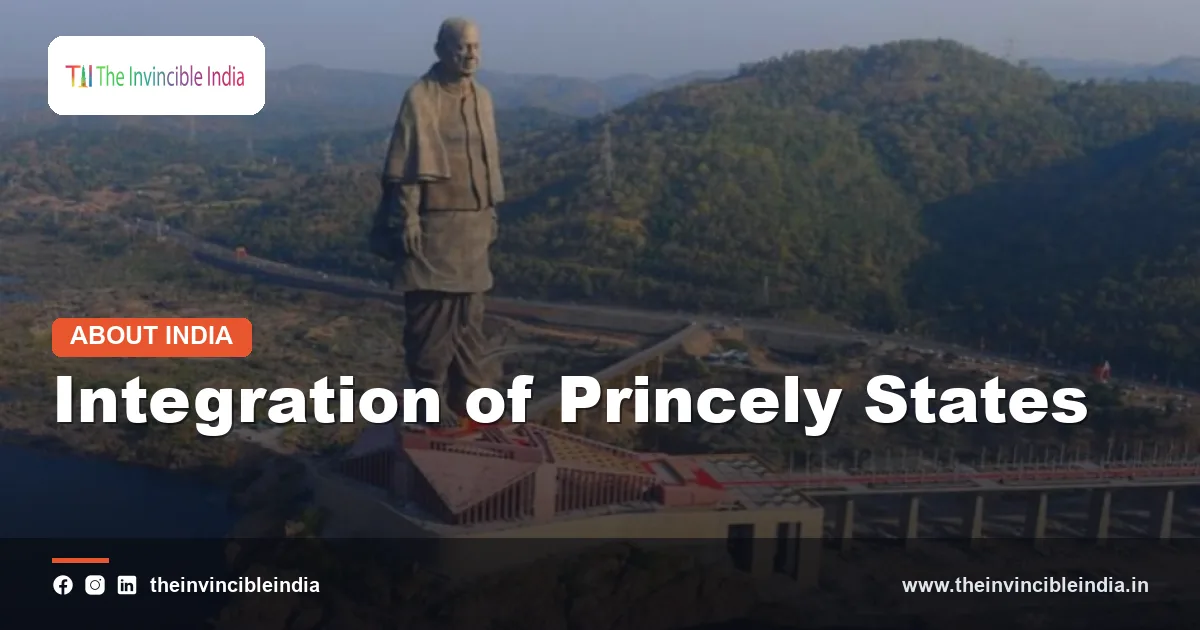
His legacy is commemorated in several ways. His birth anniversary, 31 October, is observed as National Unity Day (Rashtriya Ekta Diwas). The Statue of Unity, a monumental figure of Patel standing in Gujarat near the Narmada river, was inaugurated on 31 October 2018 and is among the tallest statues in the world. Historians also stress that the achievement was collective, involving Nehru, Mountbatten, Menon, state administrators, and the people of the states themselves.
What If India Had Fragmented?
It is worth asking why other regions with similar patchworks found the transition far harder. When large empires break up, such as in parts of Europe or the Middle East in the twentieth century, successor states often struggle with border disputes and rival claims. In India, the lapse of paramountcy created the same risk on a smaller map: hundreds of units, divided loyalties, and two new dominions competing for territory.
The speed of the settlement, completed in large part within a few months, prevented the situation from hardening. The combination of a simple legal instrument, financial guarantees, popular pressure and a credible willingness to act decisively when required avoided the outcome many outsiders had predicted. The experience also shaped India’s approach to federalism, in which states are constituent parts of a single Union rather than sovereign partners.
Conclusion
The integration of the princely states turned a political cliff-edge into a founding achievement of independent India. It rested on law, negotiation and timing, on leaders such as Patel and Menon, and on the willingness of most rulers and their subjects to see their future in a larger nation. The hard cases of Junagadh, Hyderabad and Kashmir show that it was not entirely smooth, but the overall result, a united country within a single constitutional framework, remains one of the defining accomplishments of the independence era. Last reviewed: 1 October 2026.
Frequently Asked Questions
How many princely states were there in India at independence?
There were around 565 princely states at the time of independence in 1947. They ranged from very large states like Hyderabad and Mysore to tiny estates of a few villages. Together they covered roughly two-fifths of the subcontinent’s area.
What was paramountcy and why did it matter?
Paramountcy was the authority of the British Crown over the princely states, covering their external relations, defence and, when needed, internal matters. It lapsed on 15 August 1947, which meant the states were technically free to join India or Pakistan or remain independent. This created the risk that India might fragment.
What was the Instrument of Accession?
The Instrument of Accession was a legal document signed by a ruler to join India or Pakistan. For India, it transferred only three subjects to the Union: defence, external affairs and communications. Rulers kept internal autonomy at first and received privy purses and privileges.
How did India deal with Junagadh and Hyderabad?
In Junagadh, the Nawab acceded to Pakistan, but India took over administration in November 1947 after the Nawab left, and a plebiscite in February 1948 favoured joining India. In Hyderabad, the Nizam wanted independence, and after talks and a Standstill Agreement failed and the Razakar violence grew, the Indian Army carried out Operation Polo in September 1948.
When were the privy purses abolished?
Privy purses were abolished in 1971 by the 26th Amendment to the Constitution. An earlier attempt in 1970 failed in the Rajya Sabha, and a presidential order withdrawing recognition of the rulers was struck down by the Supreme Court. The amendment inserted Article 363A and ended the payments and official recognition.
Why is Sardar Patel called the Iron Man of India?
Patel earned the title because of his firm and practical leadership, especially in bringing the princely states into the Indian Union. As head of the States Department, he combined persuasion with resolve. His birth anniversary, 31 October, is observed as National Unity Day, and the Statue of Unity honours him.


