

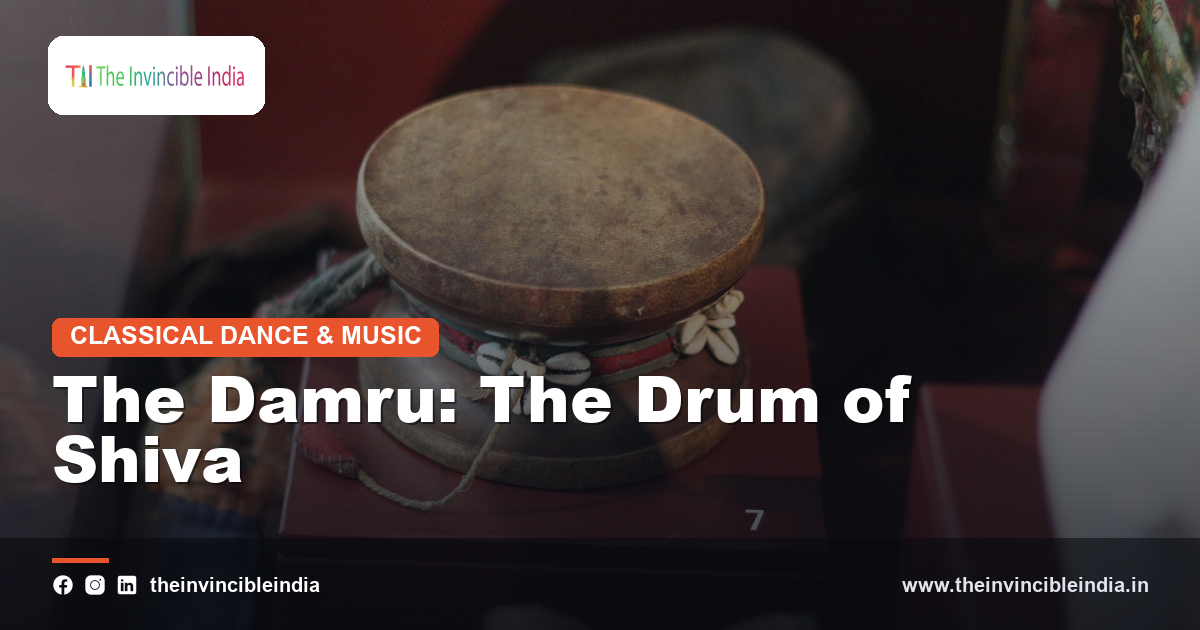
The damru is a small, hourglass-shaped drum with two skin heads, held in one hand and sounded by a quick twisting motion of the wrist that swings knotted cords against its faces. Although modest in size, it is among the most sacred percussion instruments of the subcontinent, for tradition places it in the hand of Lord Shiva, where it signifies the primal sound from which creation unfolds. It is also a living instrument of street performers, wandering ascetics and Himalayan ritualists, and it stands apart from the larger drums of festivity such as the dholak in both scale and purpose. This guide explores the damru’s form, technique, symbolism and enduring cultural role.
Quick Facts
| Detail | Information |
|---|---|
| Type | Two-headed hourglass drum (membranophone) |
| Also called | Damaru, damroo |
| Body | Two small cups joined at a narrow waist |
| Sounded by | Twisting the wrist so knotted cords strike the heads |
| Divine link | Instrument of Lord Shiva and Nataraja |
| Role | Ritual, folk and street performance |
What Is the Damru
The damru is a compact, two-headed drum whose body narrows sharply at the middle, giving it the unmistakable outline of an hourglass. It is small enough to be held comfortably in a single hand, and it is played not with sticks or fingers striking the skin but by a rhythmic rotation of the wrist. Two short cords, each ending in a knot or small bead, hang from the waist of the drum, and as the instrument is turned back and forth they swing outward and tap the heads in quick succession. The result is a crisp, rattling, pulsing sound that is instantly recognisable. Because it is simple to carry and needs no accompanying equipment, the damru has travelled easily across villages, pilgrimage routes and mountain paths. It is at once an everyday instrument of performers and a sacred emblem of the divine, and this dual character explains its lasting presence in Indian life.
Shiva and the Sacred Origin of the Damru
In Hindu tradition the damru belongs to Lord Shiva, who is often described as the master of dance and of sound. Devotional literature and popular belief associate the drum with the very beginning of the cosmos, holding that creation emerged from the first vibration, and that this vibration is echoed in the beat of the damru. Within the Shaiva tradition the instrument is therefore far more than a musical object; it is an emblem of the moment when stillness gives way to movement and form. Various stories and hymns celebrate the god as the one who sets the world in motion with rhythm. Because the drum is said to accompany the cosmic dance, it is treated with reverence by devotees, who regard its sound as an echo of the divine. The damru thus links music directly to the deepest ideas of Indian spiritual thought.
Shape and Construction
The construction of the damru is elegant in its simplicity. Two small cup-shaped or conical halves are joined at their narrow ends to form a single body, with a slender waist connecting the two wide mouths. Each open end is covered by a thin membrane, stretched taut and secured so that it vibrates freely when struck. The two skins are tied together by cords that run along the outside of the body, and the tension of these cords helps to keep both heads firm and responsive. The overall proportions are light and balanced, so that the drum feels almost weightless in the hand and can be turned rapidly without effort. Its small size is deliberate, for the instrument must be spun quickly and continuously by the wrist alone. In this way the physical design of the damru serves its playing technique, and every element of its shape has a practical purpose.
Materials Used in the Damru
Traditional damrus are made from natural materials that vary with region, craft and purpose. The body is commonly shaped from wood, though hollowed gourds, clay and metal have also been used, and some ritual instruments are crafted from special materials chosen for their sacred associations. The heads are usually made of animal skin or, in more recent times, of alternative membranes, stretched across the mouths of the drum and fastened with thin cord or thread. The striking cords are typically made of twisted string or leather, and each ends in a small knot, bead or weight that gives the stroke its crispness. Decorative elements such as painted patterns, coloured thread or small ornaments may be added, particularly on instruments made for festivals and devotional use. The choice of materials affects both the tone and the meaning of the drum, and makers select them with care. This reliance on local, natural materials keeps the damru closely tied to the communities that produce it.
The Striking Cords and Beads
What makes the damru unusual among drums is that its sound is produced by attached strikers rather than by a separate stick or the hand. Two lengths of cord are fixed to the waist of the drum, and at the free end of each is a small knot or bead that acts as a beater. When the wrist rotates, the centrifugal motion carries the beads outward so that they strike the skin on one side and then the other in a continuous alternation. The length and weight of the cords are carefully adjusted, since cords that are too long will tangle or lose control, while those that are too short will not reach the heads with enough force. A well-balanced pair produces an even, rolling pattern of taps that sounds almost like a single continuous flutter. The strikers are therefore central to the identity of the instrument, and their careful tuning is part of the maker’s craft.
Playing Technique
The damru is held in one hand, gripped at its narrow waist, and played by a repeated twist of the wrist that swings the drum to and fro. Each turn flings the knotted cords against the opposing heads, and the speed and regularity of the motion determine the pattern of the sound. A slow, measured rotation produces a deliberate, spaced beat, while a rapid rotation creates a dense, buzzing roll that seems to shimmer in the air. Skilled players can vary the rhythm smoothly, pausing, accelerating or creating groups of beats, and they often coordinate the drum with their voice or with movements of the body. The technique demands a relaxed wrist, steady timing and a sensitive feel for balance, since a stiff grip would spoil the rhythm. Although the motion looks easy, control comes only with practice, and mastery of the damru lies in this subtle command of movement.
Pitch and Tone Control
One of the most distinctive musical features of the damru is that its pitch can be altered while it is being played. The cords that bind the two heads run along the waist of the drum, and when the player squeezes them with the fingers the tension on the membranes increases, raising the pitch of the sound. Releasing the pressure lowers it again. By varying this grip in time with the rotation of the wrist, a performer can produce a fluttering, rising and falling tone that has a characteristic expressive quality. This capacity for pitch modulation places the damru in a family of hourglass drums known for their speech-like voice. Although it cannot play a full melody, the damru can suggest shape and inflection within its rhythm, and skilled hands can make it sound almost like a call. This ability to change pitch gives the small drum a musical range far greater than its size would suggest.
Sound as the Source of Creation
Indian philosophical thought has long placed sound at the heart of existence, and the damru gives that idea a tangible form. Ancient traditions speak of a primal vibration from which all things emerge, and this concept is closely associated with the drum of Shiva. In this view the beat of the damru represents the rhythm of creation, the first pulse that brings the world into being and sustains its cycles. Language, too, is linked to this idea, for tradition holds that the sacred syllables and the sounds of Sanskrit arise from the divine drum. Whether understood devotionally or philosophically, the symbol expresses a deep conviction that sound is a creative force, not merely a passing noise. The damru therefore stands for the moment where silence turns into meaning, and its steady rattle is heard by believers as a reminder of the order that underlies the universe.
The Damru in the Iconography of Nataraja
The most celebrated image of the damru appears in the form of Shiva as Nataraja, the Lord of the Dance. In this iconic figure, widely represented in bronze and stone, the god holds the small drum in one of his upper hands, raised as he performs the cosmic dance within a circle of flames. The drum is placed in balance with the flame held in another hand, and together they express the two great movements of the universe: the sounding forth of creation and the fire that brings dissolution. The damru in this image signifies the beginning of existence, while its counterpart signals its end and renewal. Artists across many centuries have depicted this composition with great care, ensuring that the drum is clearly visible. Through Nataraja, the damru has become one of the most recognised symbols of Indian art, carrying meaning far beyond the world of music.
The Damru in Shaiva Worship and Ritual
Within Shaiva devotional practice the damru is used as a sacred instrument, sounded to invoke the presence of the deity and to sanctify a ritual space. Devotees and ascetics associated with Shiva often carry the drum, and its rattle is heard during chanting, meditation, processions and observances dedicated to the god. Its sound is regarded as auspicious and as capable of focusing attention, calling worshippers into a heightened state of awareness. In many temples and shrines, and on occasions of special devotion, the damru accompanies hymns and prayers, adding a distinctive rhythmic texture to the atmosphere. Some traditions treat the drum itself as an object of worship, displaying it beside images of the deity or offering it as a votive gift. In each of these settings the damru serves as a bridge between the human and the divine, its steady beat turning music into an act of reverence and devotion.
Street Performers and Folk Traditions
Beyond the temple, the damru has long been a working instrument of travelling entertainers. Itinerant showmen have carried it through towns and villages, using its bright rattle to gather a crowd and to accompany their performances, which often include storytelling, animal acts, juggling and small feats of skill. The sound of the damru announces that a performance is about to begin, drawing children and adults alike into a circle. Because the instrument is light, inexpensive and easy to carry, it suits the mobile life of these performers, who move from place to place with little more than a few possessions. This folk usage has made the drum familiar even to those who have never seen it in a sacred context. The damru thus lives in two worlds at once, serving as the emblem of a god in one setting and as the voice of the roadside entertainer in another.
The Damaru in Himalayan and Buddhist Traditions
The hourglass drum is not confined to the Hindu world, for a closely related instrument known as the damaru plays an important role in Tibetan Buddhist and wider Himalayan ritual. In these traditions it is used in ceremonies and meditative practices, often alongside a bell, and its sound is valued for its power to focus the mind and to mark the stages of a rite. Some ritual versions are made from special materials and are decorated to reflect their sacred function, and their form may differ in size and detail from the drum of the plains. Nevertheless the basic principle, an hourglass body with two heads sounded by striking cords, remains the same. The presence of this instrument across religious boundaries reveals how musical forms travel through the mountains and take on new meanings. The damaru thereby illustrates the shared cultural heritage of the Himalayan region and the Indian subcontinent.
The Damru in Festivals and Processions
Festivals dedicated to Shiva are among the most important occasions on which the damru is heard. During observances devoted to the god, devotees assemble in temples and streets, and the drum accompanies chanting, singing and the movement of processions. Its sharp, rolling sound cuts clearly through the noise of a crowd and gives a rhythmic pulse to the collective devotion of pilgrims. In some regions groups of worshippers carry the instrument on long journeys of pilgrimage, sounding it as they walk, so that its beat becomes part of the rhythm of the journey itself. The drum may also appear in costumes and tableaux, where performers dress as the god or his attendants and hold the damru as a sign of identity. On such occasions the instrument reinforces the sense of shared faith, and its familiar sound marks the celebration as sacred and communal in equal measure.
The Damru and the Family of Hourglass Drums
The damru belongs to a broad family of hourglass-shaped drums found across India and beyond, all sharing the narrow waist and two heads that allow the pitch to be changed by squeezing the cords. Larger relatives are played under the arm or in the hands with sticks, and are used in classical, devotional and folk music, where their expressive tone helps them accompany singing. In these drums the tension cords serve the same function as in the damru, but the playing method differs, since they are struck rather than spun. Compared with barrel drums such as the dhol, which produce a fixed and powerful beat, the hourglass drums are valued for their flexibility. The damru is the smallest and simplest member of this family, and its lineage shows how a single structural idea has produced many different instruments for many different purposes.
Symbolism Beyond Music
The damru carries symbolic meanings that extend well beyond its role as a musical instrument. Its hourglass form is often read as a picture of balance, with two triangular halves meeting at a single point and suggesting the union of opposites such as creation and dissolution, sound and silence, or matter and spirit. The alternating beat of the two cords against the two heads is seen as an image of rhythm and duality, the constant interplay that shapes the world. Because Shiva is worshipped as the source of both order and transformation, the drum has become a compact emblem of his nature. Its image appears in sacred art, in decorative motifs and in devotional objects, where it functions as a recognised sign of the god without any need for words. This rich symbolism explains why so small an instrument holds such a large place in the Indian imagination.
Craft, Makers and Preservation
The making of damrus remains a small, specialised craft passed down through families and communities of artisans. Makers shape the body, prepare and stretch the skins, tie the cords and adjust the strikers so that the drum responds correctly to the turn of the wrist. Each stage requires practised judgment, since small differences in tension or balance affect how the instrument sounds and feels. Many of these craftspeople work in villages and small workshops, and their products are sold at fairs, temple markets and pilgrimage centres. Changing tastes, new materials and competition from mass-produced goods present challenges to the trade, yet the steady religious and cultural demand for the drum has helped to sustain it. Cultural institutions and folk performers continue to keep the tradition visible through demonstrations and festivals. Preserving the craft of the damru means safeguarding both a skilled livelihood and a meaningful piece of living heritage.
The Damru Today
Today the damru continues to be heard in temples, on pilgrimage routes, at festivals and in the hands of roadside performers, while its image remains one of the most familiar symbols in Indian art and religion. Musicians and composers sometimes include its distinctive rattle in devotional and contemporary works, drawn by its unmistakable sound and rich associations. Dancers portraying Shiva often hold the drum as an essential prop, keeping the iconography of Nataraja alive on stage. Small replicas are widely kept as devotional objects and cultural souvenirs, carrying the symbol into homes and shops. The instrument endures because it unites simplicity of form with depth of meaning, and because its sound is recognised by many communities as sacred. As a result, the damru remains a vivid link between the music of the everyday world and the ancient idea of sound as creation.
Sources & Further Reading
- Ministry of Culture, Government of India (indiaculture.gov.in).
- Sangeet Natak Akademi (sangeetnatak.gov.in).
Frequently Asked Questions
What is a damru?
The damru is a small, two-headed hourglass drum held in one hand and sounded by twisting the wrist so that knotted cords strike the skins. It is best known as the instrument of Lord Shiva and is also used by folk performers and ritualists.
Why is the damru associated with Lord Shiva?
In Hindu tradition Shiva holds the damru as a symbol of the primal sound from which creation emerges. It appears in the iconography of Nataraja, where it stands for the beginning of existence and the rhythm of the universe.
How is a damru played?
The player grips the narrow waist of the drum and rotates the wrist back and forth, so that the beads on the cords tap the two heads alternately. Squeezing the cords with the fingers raises the pitch, allowing a fluttering, expressive tone.
What is the difference between the damru and the dhol?
The damru is a tiny hourglass drum sounded by wrist motion and used mainly in ritual, folk and street performance. The dhol is a large barrel drum struck with sticks and is associated with bhangra and festive celebration.
Is the damru used outside Hinduism?
Yes, a related instrument called the damaru is used in Tibetan Buddhist and Himalayan ritual, often together with a bell. Its form is similar, although the size, materials and decoration may differ from those of the drum used in India.


