

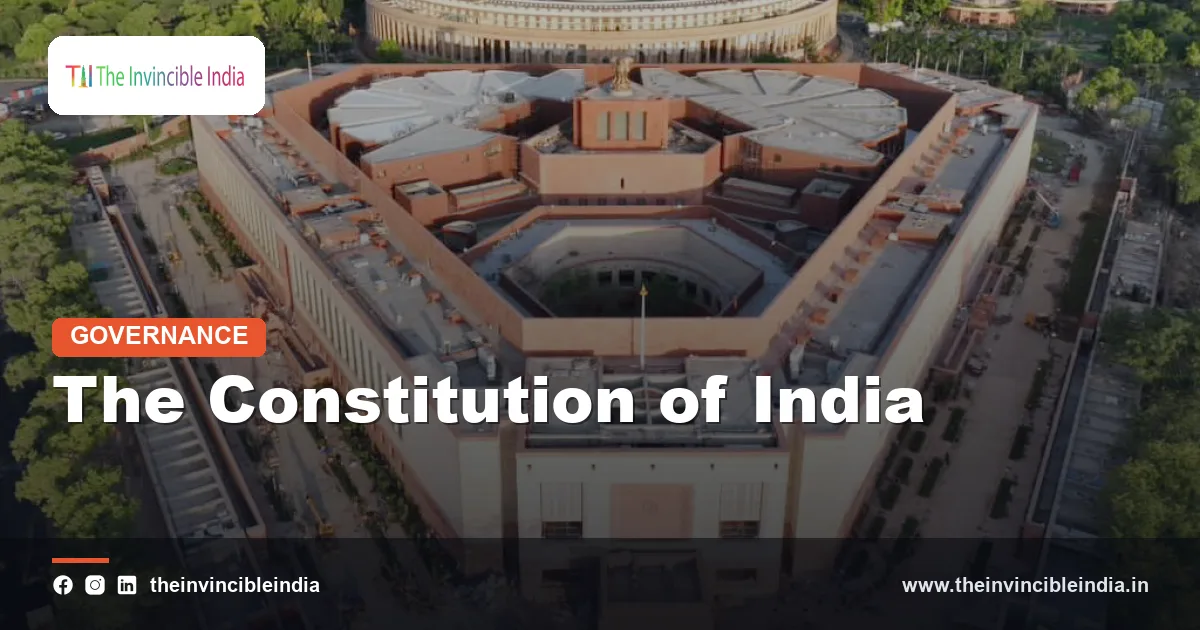
The Constitution of India is the supreme law of the land. It defines what kind of country India is, who holds power and how far that power extends, and what every citizen can expect from the State. Every law passed by Parliament or a state legislature, and every action taken by a government official, must ultimately pass the test of this one document. It came into force on 26 January 1950, the day India became a republic.
What makes it remarkable is not only its size but its ambition. Written in the aftermath of Partition, by a country that was poor, diverse and newly free, it promised justice, liberty, equality and fraternity to hundreds of millions of people who had never voted before. This explainer walks through how the Constitution was made, how it is organised, what its most important features are, and how it has been kept alive through amendments and court rulings. It was last reviewed on 29 September 2026.
Quick Facts: The Constitution of India
| Feature | Detail |
|---|---|
| Body that framed it | Constituent Assembly of India (first met 9 December 1946) |
| Chair of the Drafting Committee | Dr B. R. Ambedkar |
| President of the Constituent Assembly | Dr Rajendra Prasad |
| Adopted | 26 November 1949 |
| Came into force | 26 January 1950 (celebrated as Republic Day) |
| Original structure | 395 Articles, 22 Parts and 8 Schedules |
| Present structure | Over 440 Articles, 25 Parts and 12 Schedules (after many amendments) |
| Amendment provision | Article 368, in Part XX |
| Distinction | Often described as the longest written constitution of any sovereign country |
The Making of the Constitution
The idea that Indians should frame their own constitution was demanded well before Independence, and it was formally accepted under the Cabinet Mission Plan of 1946. Members of the Constituent Assembly were chosen indirectly, by the elected members of the provincial legislatures, and the Assembly held its first sitting on 9 December 1946. Dr Sachchidananda Sinha served as its temporary chairman, and Dr Rajendra Prasad was elected its President a couple of days later. After Partition the Assembly became a body representing the Indian Dominion, with roughly three hundred members drawn from many communities, regions and shades of political opinion.
The Objectives Resolution
On 13 December 1946, Jawaharlal Nehru moved the Objectives Resolution, which declared India to be an independent sovereign republic and set out the principles of justice, equality and freedom that would guide the drafters. The Assembly adopted it on 22 January 1947, and its language later shaped the Preamble.
The Drafting Committee
The Assembly set up many committees for subjects such as fundamental rights, union powers and provincial constitutions. On 29 August 1947 it appointed a Drafting Committee, chaired by Dr B. R. Ambedkar, to turn the decisions into a coherent text. B. N. Rau, the Constitutional Adviser, prepared the initial draft that guided its work. The Assembly spent close to three years in deliberation, debating the draft clause by clause. It adopted the final text on 26 November 1949, and members signed it on 24 January 1950. The date 26 January was chosen deliberately, because it recalled the Purna Swaraj declaration of 1930.
The World’s Longest Written Constitution
The Constitution of India is usually described as the longest written constitution of any independent country. There are good reasons why it grew so large. The drafters had to create a workable government for a vast federation, but they also chose to include details that other countries leave to ordinary laws or to convention.
- Adoption of existing law: A large part of the administrative machinery was carried over from the Government of India Act, 1935, which was itself a long and detailed statute.
- Diversity: Special provisions were needed for Scheduled Castes, Scheduled Tribes, minorities, tribal areas and different regions.
- Federal detail: The division of powers between the Union and the States, and the arrangements for finance and trade, are spelt out at length.
- Social goals: Along with rights, the document includes a list of directive principles that describe the kind of society India hoped to build.
- Distrust of silence: The framers preferred to write down detailed safeguards rather than depend on future goodwill.
The original English text ran to well over a lakh of words, and the amended version is longer still. The original copies were handwritten in calligraphy, with illustrations by artists from Shantiniketan led by Nandalal Bose, and are preserved in Parliament. Despite its length, the document has proved flexible, and this flexibility is a large part of why it has survived for more than seven decades.
The Preamble: The Soul of the Constitution
The Preamble is a short introductory statement that begins with the words “We, the people of India”. It declares the source of the Constitution’s authority, the nature of the State and the ideals it hopes to secure. Courts often turn to it as a guide when a provision is unclear.
Its key words
- Sovereign: India makes its own decisions on internal and external matters, with no outside authority above it.
- Socialist: Added in 1976, it points to the goal of reducing inequality and securing economic and social justice.
- Secular: Also added in 1976, it means the State has no official religion and treats all faiths equally, while the freedom to practise religion is protected.
- Democratic: Power rests with the people, who choose their governments through regular and free elections.
- Republic: The head of state, the President, is elected and not hereditary.
The four ideals
The Preamble promises to secure to all citizens justice (social, economic and political), liberty of thought, expression, belief, faith and worship, equality of status and opportunity, and fraternity that assures the dignity of the individual and the unity and integrity of the nation. The words “socialist”, “secular” and “integrity” were inserted by the 42nd Amendment in 1976. In the Kesavananda Bharati case of 1973, the Supreme Court held that the Preamble is part of the Constitution, which settled an earlier doubt.
Structure of the Constitution: Parts, Articles and Schedules
The Constitution is organised in three layers. Articles are the numbered provisions, Parts group Articles by subject, and Schedules are lists and tables that support the main text. The original document had 395 Articles, 22 Parts and 8 Schedules. Amendments have added new Parts (such as IVA, IXA, IXB and XIVA), removed Part VII, and added Schedules, so the present text has 25 Parts and 12 Schedules. Instead of renumbering, new provisions have been inserted with letters, for example Article 21A or Article 243A.
Parts at a glance
| Part | Subject | Articles |
|---|---|---|
| I | The Union and its territory | 1 to 4 |
| II | Citizenship | 5 to 11 |
| III | Fundamental Rights | 12 to 35 |
| IV | Directive Principles of State Policy | 36 to 51 |
| IVA | Fundamental Duties | 51A |
| V | The Union (President, Parliament, Union judiciary) | 52 to 151 |
| VI | The States (Governor, legislature, High Courts) | 152 to 237 |
| IX | Panchayats | 243 to 243O |
| XI | Relations between the Union and the States | 245 to 263 |
| XV | Elections | 324 to 329A |
| XVIII | Emergency provisions | 352 to 360 |
| XX | Amendment of the Constitution | 368 |
The Schedules
The First Schedule names the States and Union Territories. The Third gives the forms of oaths. The Sixth provides for the administration of tribal areas in certain north-eastern states. The Seventh contains the Union, State and Concurrent Lists. The Eighth lists the recognised languages, currently 22. The Ninth (added in 1951) protects certain laws, and the Tenth (added in 1985) deals with disqualification on the ground of defection. The Eleventh and Twelfth, added in 1992, list the functions of panchayats and municipalities.
Fundamental Rights: The Constitution’s Guarantee to Citizens
Part III, running from Article 12 to Article 35, contains the Fundamental Rights. These are enforceable claims against the State, and a person whose right is violated can go directly to the Supreme Court under Article 32 or to a High Court under Article 226. Dr Ambedkar called Article 32 the heart and soul of the Constitution.
- Right to Equality (Articles 14 to 18): Equality before the law, no discrimination on grounds such as religion, caste, sex or place of birth, equal opportunity in public employment, and abolition of untouchability and titles.
- Right to Freedom (Articles 19 to 22): Freedom of speech and expression, assembly, association, movement, residence and profession, along with protection of life and personal liberty under Article 21 and safeguards against arbitrary arrest.
- Right against Exploitation (Articles 23 and 24): A ban on trafficking, forced labour and the employment of children in hazardous work.
- Right to Freedom of Religion (Articles 25 to 28): Freedom of conscience and the right to profess, practise and propagate religion, subject to public order, morality and health.
- Cultural and Educational Rights (Articles 29 and 30): Protection for the language, script and culture of minorities and their right to run educational institutions.
- Right to Constitutional Remedies (Article 32): The right to move the Supreme Court to enforce the other rights.
The right to property was originally a Fundamental Right, but the 44th Amendment (1978) removed it from Part III and made it a constitutional right under Article 300A. The right to education for children between six and fourteen years was added as Article 21A by the 86th Amendment in 2002. These rights are not absolute, and the Constitution allows reasonable restrictions in the interest of public order, security and other stated grounds.
Directive Principles and Fundamental Duties
Part IV, covering Articles 36 to 51, sets out the Directive Principles of State Policy. Unlike Fundamental Rights, these are not enforceable in a court, but Article 37 says they are fundamental in the governance of the country and that the State must apply them in making laws. The idea was borrowed from the Irish Constitution.
What the Directive Principles ask of the State
- Securing an adequate means of livelihood and equal pay for equal work.
- Preventing the concentration of wealth and resources in a few hands.
- Promoting the right to work, education and public assistance.
- Organising village panchayats as units of self-government.
- Working towards a uniform civil code for all citizens.
- Protecting the environment, forests and wildlife.
- Separating the judiciary from the executive in public services.
- Promoting international peace and respect for international law.
Over time the courts have read the two Parts together, holding that Fundamental Rights and Directive Principles complement each other, and many Directive Principles have been turned into ordinary laws.
Fundamental Duties
Fundamental Duties were added by the 42nd Amendment in 1976 on the recommendation of the Swaran Singh Committee, and now appear in Article 51A. They ask citizens to respect the Constitution, the national flag and the national anthem, to cherish the ideals of the freedom struggle, to uphold the unity and integrity of India, to promote harmony, to protect the environment, to develop a scientific temper, and to safeguard public property. A duty to provide opportunities for education to one’s child was added in 2002, making eleven in all. These duties are moral obligations and are not directly enforceable by courts.
The Three Organs of Government and Separation of Powers
Like most modern democracies, the Constitution divides State power among three organs. Each has its own sphere, but the separation is not as rigid as in the United States, because India follows the parliamentary system, in which the executive is drawn from and answerable to the legislature.
The Legislature
At the Union level, Parliament consists of the President, the Lok Sabha (House of the People) and the Rajya Sabha (Council of States). The Lok Sabha is directly elected and holds the greater financial power, because money bills originate there. The Rajya Sabha represents the States and is a permanent house, with one-third of its members retiring every second year. Each state has its own legislature, and a few have two houses.
The Executive
The President is the constitutional head of state, and Article 74 provides for a Council of Ministers headed by the Prime Minister to aid and advise the President. In practice the Council of Ministers exercises real executive power and is collectively responsible to the Lok Sabha. At the state level, the Governor is the constitutional head, and the Chief Minister leads the government.
The Judiciary
India has a single integrated judicial system, with the Supreme Court at the top, High Courts in the States, and subordinate courts below. The judiciary is independent, decides disputes between the Union and the States, and can strike down laws that violate the Constitution through the power of judicial review. The checks and balances between the three organs prevent any one of them from becoming supreme.
A Federal Structure with a Unitary Bias
Article 1 describes India as “a Union of States”. The word “Union” was chosen with care, since it signals that the States did not agree to form the country and cannot secede from it. The Constitution divides powers through the Seventh Schedule into three lists: the Union List, the State List and the Concurrent List, on which both Parliament and state legislatures can make laws. Where the two conflict on a Concurrent subject, the Union law generally prevails, and residuary powers rest with Parliament.
Why it is called quasi-federal
Many scholars describe India as federal in form but unitary in spirit. The framers, wary of the disruption of Partition, wanted a strong Centre that could hold the country together in a crisis.
- The Governor is appointed by the President.
- Parliament can redraw state boundaries or change state names by ordinary law.
- Emergency provisions, including Article 356 on failure of constitutional machinery in a State, allow the Centre to take over administration.
- There are All-India Services, such as the IAS and IPS, whose officers serve both the Union and the States.
- There is a single, integrated judiciary and a common Election Commission.
In the S. R. Bommai case (1994), the Supreme Court held that federalism is part of the basic structure and placed limits on the misuse of Article 356. The Constitution is often described as federal in normal times and unitary in times of emergency.
Amending the Constitution: Article 368
A constitution written in 1949 could not remain frozen forever, so the framers provided a way to change it. Article 368 sets out the procedure, and it strikes a balance between rigidity and flexibility. There are three routes, depending on the provision being changed.
- Simple majority: Some provisions, such as the creation of new States or the rules for Parliament’s procedure, can be changed by an ordinary law and are not treated as amendments under Article 368.
- Special majority: Most provisions need a majority of the total membership of each House plus a two-thirds majority of members present and voting.
- Special majority plus ratification: Provisions that affect the federal structure, such as the distribution of powers, representation of States in Parliament, or the amendment procedure itself, also need approval by the legislatures of at least half of the States.
The Constitution has been amended more than a hundred times since 1950. The First Amendment (1951) added the Ninth Schedule and restrictions on some freedoms. The 42nd (1976) was so wide-ranging that it is often called a “mini-Constitution”. The 73rd and 74th (1992) gave constitutional status to panchayats and municipalities, the 86th (2002) made elementary education a right, and the 101st (2016) brought in the Goods and Services Tax. The 106th (2023) provided for reservation of seats for women in the Lok Sabha and state assemblies. Each amendment must be assented to by the President, and can be reviewed by the courts.
The Basic Structure Doctrine
Can Parliament amend anything at all? For years this question divided the courts. In Shankari Prasad (1951) and Sajjan Singh (1965), the Supreme Court held that Parliament could amend even Fundamental Rights. In Golaknath (1967), it reversed course and said Fundamental Rights could not be curtailed. Parliament responded with amendments of its own, and the conflict came to a head in Kesavananda Bharati v. State of Kerala (1973).
A bench of thirteen judges, the largest ever assembled by the Supreme Court, decided the case by a narrow majority. It held that Parliament has wide power to amend the Constitution under Article 368, but cannot alter or destroy its “basic structure”. The Court did not give a complete list of what forms this structure, and left it to be identified case by case.
Features recognised as basic
- Supremacy of the Constitution and the rule of law.
- Republican and democratic form of government.
- Secular character of the State.
- Separation of powers among the three organs.
- Federalism.
- Judicial review.
- Free and fair elections.
- Balance between Fundamental Rights and Directive Principles (Minerva Mills, 1980).
The doctrine has been reaffirmed many times, including in the Indira Gandhi election case (1975), Minerva Mills (1980) and S. R. Bommai (1994). It is regarded as one of the most important contributions of Indian courts to constitutional law, and it acts as a safeguard against changes that might hollow out the Constitution while remaining within its letter.
Features Borrowed from Other Constitutions
The framers studied constitutions from around the world, and Dr Ambedkar noted that borrowing was not something to be ashamed of, as nobody could claim patent rights over the ideas of a constitution. Many features were adapted to suit Indian conditions rather than copied directly.
| Source | Features adopted |
|---|---|
| Government of India Act, 1935 | Federal scheme, Governors, public service commissions, emergency provisions and much administrative detail |
| United Kingdom | Parliamentary system, Cabinet government, rule of law, single citizenship, the office of the Speaker, writs |
| United States | Fundamental Rights, judicial review, independent judiciary, Vice-President as chair of the Rajya Sabha, removal of judges |
| Ireland | Directive Principles, nomination of members to the Rajya Sabha, method of electing the President |
| Canada | Federation with a strong Centre, residuary powers with the Union |
| Australia | Concurrent List, freedom of trade and commerce, joint sitting of Parliament |
| Germany (Weimar Constitution) | Suspension of Fundamental Rights during an emergency |
| Soviet Union | Fundamental Duties (added later) |
| France | Republican ideals of liberty, equality and fraternity |
| South Africa | Amendment procedure and election of Rajya Sabha members |
Together these borrowings were combined with India’s own experience of the freedom movement, and the result is a document that is far more than a patchwork.
Single Citizenship and Independent Constitutional Bodies
One citizenship for all
Although India is a federation, it has only one citizenship, unlike the United States, where a person is a citizen of both the country and a state. Part II of the Constitution (Articles 5 to 11) defines who became a citizen at the commencement of the Constitution, and Parliament regulates the acquisition and loss of citizenship through the Citizenship Act, 1955. A citizen of India enjoys the same rights whether born in Kerala or Kashmir, and a State cannot create its own class of citizens.
Independent bodies
The Constitution also creates several bodies designed to work free of day-to-day political pressure.
- Election Commission of India (Article 324): Superintends, directs and controls elections to Parliament, state legislatures and the offices of President and Vice-President. It was set up on 25 January 1950, and the day is now observed as National Voters’ Day.
- Comptroller and Auditor General (Article 148): Audits the accounts of the Union and the States and reports to Parliament and legislatures, acting as a guardian of public money.
- Union Public Service Commission (Article 315): Conducts examinations for recruitment to the All-India and central services, along with State Public Service Commissions for the States.
- Finance Commission (Article 280): Constituted every five years to recommend how tax revenue should be shared between the Union and the States.
The tenure and removal of such officials are protected by the Constitution, so that they can act without fear of the government of the day.
Conclusion
The Constitution of India is at once a legal document, a political charter and a social promise. It created a democratic republic with universal adult franchise from the very first election, at a time when many older democracies still restricted the vote. It has been amended to meet new needs, tested by courts, and defended by the basic structure doctrine. Its long list of rights, its directive principles and its carefully balanced institutions are a reminder that a constitution works only as well as the people who live by it. Understanding its structure is the first step towards understanding how India is governed.
Frequently Asked Questions
When was the Constitution of India adopted and when did it come into force?
The Constituent Assembly adopted the Constitution on 26 November 1949, and it came into force on 26 January 1950. A few provisions, such as those on citizenship and elections, took effect earlier, on the date of adoption. 26 November is observed as Constitution Day, and 26 January as Republic Day.
Who is called the architect of the Indian Constitution?
Dr B. R. Ambedkar, who chaired the Drafting Committee, is widely regarded as the chief architect of the Constitution. He guided the draft through the Constituent Assembly and defended it in debate. Many others contributed too, including Dr Rajendra Prasad as President of the Assembly, B. N. Rau as Constitutional Adviser, and several committee members.
How many Articles, Parts and Schedules does the Constitution have?
The original Constitution had 395 Articles, 22 Parts and 8 Schedules. After many amendments, it now has over 440 Articles, 25 Parts and 12 Schedules. New Articles were inserted with letter suffixes instead of renumbering the old ones.
What is the basic structure doctrine?
It is a principle laid down by the Supreme Court in Kesavananda Bharati v. State of Kerala (1973). Parliament can amend the Constitution under Article 368, but it cannot destroy or alter its basic features, such as democracy, secularism, federalism, judicial review and the rule of law. Any amendment that does so can be struck down by the courts.
What is the difference between Fundamental Rights and Directive Principles?
Fundamental Rights in Part III are legally enforceable, and citizens can approach the courts if they are violated. Directive Principles in Part IV are guidelines for the State that cannot be enforced in court, but they are meant to shape policy and lawmaking. Courts have often read the two together to give effect to the Constitution’s social goals.
How can the Constitution of India be amended?
Article 368 lays down the procedure. Most amendments require a special majority in both Houses of Parliament, while those affecting the federal structure also need ratification by at least half of the state legislatures. Some matters, such as the formation of new States, can be changed by a simple majority.
{“@context”:”https://schema.org”,”@graph”:[{“@type”:”FAQPage”,”mainEntity”:[{“@type”:”Question”,”name”:”When was the Constitution of India adopted and when did it come into force?”,”acceptedAnswer”:{“@type”:”Answer”,”text”:”The Constituent Assembly adopted the Constitution on 26 November 1949, and it came into force on 26 January 1950. A few provisions, such as those on citizenship and elections, took effect earlier, on the date of adoption. 26 November is observed as Constitution Day, and 26 January as Republic Day.”}},{“@type”:”Question”,”name”:”Who is called the architect of the Indian Constitution?”,”acceptedAnswer”:{“@type”:”Answer”,”text”:”Dr B. R. Ambedkar, who chaired the Drafting Committee, is widely regarded as the chief architect of the Constitution. He guided the draft through the Constituent Assembly and defended it in debate. Many others contributed too, including Dr Rajendra Prasad as President of the Assembly, B. N. Rau as Constitutional Adviser, and several committee members.”}},{“@type”:”Question”,”name”:”How many Articles, Parts and Schedules does the Constitution have?”,”acceptedAnswer”:{“@type”:”Answer”,”text”:”The original Constitution had 395 Articles, 22 Parts and 8 Schedules. After many amendments, it now has over 440 Articles, 25 Parts and 12 Schedules. New Articles were inserted with letter suffixes instead of renumbering the old ones.”}},{“@type”:”Question”,”name”:”What is the basic structure doctrine?”,”acceptedAnswer”:{“@type”:”Answer”,”text”:”It is a principle laid down by the Supreme Court in Kesavananda Bharati v. State of Kerala (1973). Parliament can amend the Constitution under Article 368, but it cannot destroy or alter its basic features, such as democracy, secularism, federalism, judicial review and the rule of law. Any amendment that does so can be struck down by the courts.”}},{“@type”:”Question”,”name”:”What is the difference between Fundamental Rights and Directive Principles?”,”acceptedAnswer”:{“@type”:”Answer”,”text”:”Fundamental Rights in Part III are legally enforceable, and citizens can approach the courts if they are violated. Directive Principles in Part IV are guidelines for the State that cannot be enforced in court, but they are meant to shape policy and lawmaking. Courts have often read the two together to give effect to the Constitution’s social goals.”}},{“@type”:”Question”,”name”:”How can the Constitution of India be amended?”,”acceptedAnswer”:{“@type”:”Answer”,”text”:”Article 368 lays down the procedure. Most amendments require a special majority in both Houses of Parliament, while those affecting the federal structure also need ratification by at least half of the state legislatures. Some matters, such as the formation of new States, can be changed by a simple majority.”}}]}]}


