

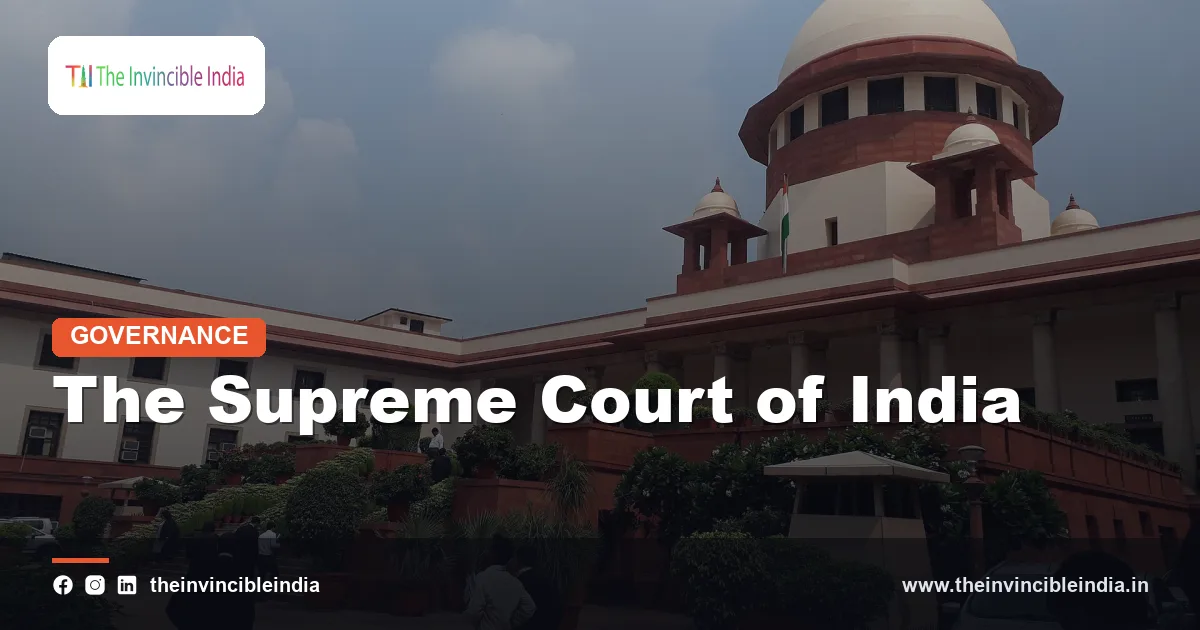
The Supreme Court of India is the highest judicial authority in the country and the final court of appeal in the Indian legal system. Established under Part V of the Constitution, it sits at the top of a single, integrated judiciary and has the last word on the interpretation of the Constitution and the laws of the land. Its judgments shape how citizens, governments and institutions relate to one another, from fundamental rights to the balance of power between the Centre and the states.
This guide explains how the Court is structured, how its judges are chosen and removed, what kinds of cases it hears, and why doctrines such as judicial review and the basic structure of the Constitution matter so much. It also looks at Public Interest Litigation, the Court’s landmark rulings and the safeguards that protect its independence. Last updated: 29 September 2026.
Quick Facts
| Fact | Detail |
|---|---|
| Inaugurated | 28 January 1950, two days after the Constitution came into force |
| Constitutional basis | Part V, Chapter IV (Articles 124 to 147) |
| Predecessor | Federal Court of India (established 1937) |
| Seat | Tilak Marg, New Delhi (building inaugurated on 4 August 1958) |
| Head of the Court | Chief Justice of India (CJI) |
| Sanctioned strength | 34 judges including the CJI (since the 2019 amendment) |
| Retirement age of judges | 65 years |
| Appointment system | Collegium, after the NJAC was struck down in 2015 |
| Motto | Yato Dharmastato Jayah (where there is dharma, there is victory) |
The Supreme Court as India’s Apex Court
India follows a unified judicial structure. Unlike the United States, where federal and state courts run in parallel, India has one hierarchy: subordinate courts at the district level, High Courts at the state or regional level, and the Supreme Court at the summit. Decisions of the apex court are binding on every other court in the country, and this gives it a unifying role in a large and diverse federation.
The Court’s history begins before independence. The Regulating Act of 1773 created a Supreme Court at Calcutta, and later Supreme Courts were set up at Madras and Bombay. The Government of India Act, 1935 led to the Federal Court of India, which began functioning in 1937 in Delhi. It heard limited disputes and appeals, and appeals against its decisions could still go to the Privy Council in London.
After independence, the Constituent Assembly decided that India needed a fully sovereign apex court. Appeals to the Privy Council were abolished, and the new Supreme Court was formally inaugurated on 28 January 1950. Its first sitting was held in the Chamber of Princes in the old Parliament building, and the first Chief Justice was H. J. Kania. The Court thus became both the successor to the Federal Court and the guardian of a brand new Constitution.
Constitutional Foundation: Articles 124 to 147
Chapter IV of Part V, titled “The Union Judiciary”, contains the core provisions on the Court. Article 124 declares that there shall be a Supreme Court of India consisting of a Chief Justice and other judges, and it lays down the mode of appointment, qualifications, oath and removal. The remaining articles define the Court’s powers, procedure and relationship with other organs of the state.
Key Articles at a Glance
- Article 124: establishment and constitution of the Court.
- Article 125: salaries and allowances of judges.
- Article 127 and 128: appointment of ad hoc judges and attendance of retired judges.
- Article 129: the Court as a court of record.
- Article 130: seat of the Court in Delhi, or other places as the Chief Justice decides with the President’s approval.
- Articles 131 to 136: original, appellate and special leave jurisdiction.
- Article 137: power to review its own judgments.
- Article 141: law declared by the Court is binding on all courts.
- Article 142: power to do “complete justice” in any matter before it.
- Article 143: advisory jurisdiction.
- Article 145: power to make rules of procedure.
Outside this chapter, Article 32 in Part III gives citizens the right to move the Court directly for the enforcement of fundamental rights. Dr B. R. Ambedkar famously described it as the very soul of the Constitution, because a right without a remedy would remain only a promise on paper.
Composition and Sanctioned Strength of the Court
When the Court began in 1950, it had a Chief Justice and seven other judges. The Constitution allowed Parliament to increase this number by law, and Parliament has done so several times as the volume of litigation grew. The strength was raised to 11 in 1956, to 14 in 1960, to 18 in 1978, to 26 in 1986 and to 31 in 2008. The Supreme Court (Number of Judges) Amendment Act, 2019 raised the sanctioned strength to 34, including the Chief Justice of India.
The Chief Justice of India
The Chief Justice of India is the head of the judiciary. Besides deciding cases, the CJI heads the collegium, allocates cases to benches and decides the composition of benches. This administrative authority is often described as being the “master of the roster”. By long-standing convention, the senior-most judge of the Supreme Court is recommended for appointment as the next Chief Justice, and the outgoing CJI makes that recommendation.
Benches and Constitution Benches
Most cases are heard by benches of two or three judges. Article 145(3) requires a minimum of five judges for a case involving a substantial question of law about the interpretation of the Constitution, and such a bench is called a Constitution Bench. Larger benches of seven, nine, eleven or thirteen judges have been formed when earlier rulings needed reconsideration or when questions were of exceptional importance.
Ad Hoc and Retired Judges
If there is no quorum of judges available, the Chief Justice can request a High Court judge to sit as an ad hoc judge, and can also request retired judges to sit and act with the President’s consent. These provisions are used rarely, but they show that the framers wanted the Court to remain functional in all situations.
Appointment of Judges: The Collegium System and the NJAC
The Constitution says that judges of the Supreme Court are appointed by the President after consultation with such judges of the Supreme Court and High Courts as the President considers necessary. What “consultation” meant became one of the most debated questions in Indian constitutional law, and the answer evolved through three landmark cases known as the Judges Cases.
The Three Judges Cases
- First Judges Case (S. P. Gupta, 1981): held that “consultation” did not mean “concurrence”, which gave the executive a greater say.
- Second Judges Case (Supreme Court Advocates-on-Record Association, 1993): reversed this view, held that the opinion of the Chief Justice had primacy and created the collegium system.
- Third Judges Case (1998): arising from a Presidential reference under Article 143, it expanded the collegium for the Supreme Court to the Chief Justice and the four senior-most judges.
Under the collegium system, this body recommends names, and the government processes those recommendations before formal appointment by the President. Supporters argue that it protects judges from political pressure, while critics point to a lack of transparency and formal criteria.
The NJAC Judgment of 2015
In 2014, Parliament passed the 99th Constitutional Amendment and the National Judicial Appointments Commission (NJAC) Act to replace the collegium with a commission that included members from the executive and civil society. In October 2015, a five-judge Constitution Bench struck down both by a 4:1 majority. The Court held that the primacy of the judiciary in appointments is part of the basic structure, because it is essential to judicial independence. The collegium system therefore continues to this day.
Qualifications, Tenure and Removal of Judges
Article 124(3) lays down who can become a Supreme Court judge. A person must be a citizen of India and satisfy at least one of three conditions.
- Has been a judge of a High Court, or of two or more such courts in succession, for at least five years.
- Has been an advocate of a High Court, or of two or more such courts in succession, for at least ten years.
- Is, in the opinion of the President, a distinguished jurist.
Before entering office, each judge takes an oath or affirmation before the President or a person appointed by the President, in the form given in the Third Schedule.
Tenure
Judges of the Supreme Court hold office until the age of 65. There is no fixed term for the Chief Justice as such, so the length of a CJI’s tenure depends on the age at which the judge became Chief Justice. A judge may resign by writing to the President. After retirement, Article 124(7) bars a judge from practising before any court or authority in India, which protects against conflicts of interest.
Removal by Impeachment
Removing a judge is deliberately difficult. Under Article 124(4), a judge can be removed only by an order of the President, passed after an address by each House of Parliament. The address must be supported by a majority of the total membership of that House and by at least two-thirds of the members present and voting. The only grounds are proved misbehaviour or incapacity. The procedure for investigation is governed by the Judges (Inquiry) Act, 1968. No Supreme Court judge has ever been removed through this process.
Jurisdiction of the Supreme Court
The powers of the Court can be grouped into several heads. The table below summarises them, and the sub-sections that follow explain the most important ones.
| Type of Jurisdiction | Article | What It Covers |
|---|---|---|
| Original (exclusive) | 131 | Disputes between the Centre and states, or among states |
| Original (writ) | 32 | Enforcement of fundamental rights by writs |
| Appellate (constitutional) | 132 | Appeals from High Courts involving substantial questions of constitutional law |
| Appellate (civil) | 133 | Appeals in civil matters involving a substantial question of law of general importance |
| Appellate (criminal) | 134 | Appeals in criminal matters, such as where a High Court has imposed a death sentence on reversal of an acquittal |
| Special Leave Petition | 136 | Discretionary appeal against almost any judgment or order of any court or tribunal |
| Advisory | 143 | Opinion on questions of law or fact referred by the President |
| Review and curative | 137 | Reconsideration of its own judgments |
Original Jurisdiction
Under Article 131, the Court has exclusive power to decide disputes involving the Government of India and one or more states, or between states, where the dispute concerns a legal right. Article 32 gives the Court original power to issue writs such as habeas corpus, mandamus, prohibition, certiorari and quo warranto. High Courts have similar writ powers under Article 226, but the right to approach the Supreme Court directly is itself a fundamental right.
Appellate Jurisdiction
Articles 132, 133 and 134 provide for appeals from High Courts in constitutional, civil and criminal matters. Article 134A deals with the certificate that a High Court may issue to allow such an appeal. In practice, most of the Court’s docket comes through appeals rather than through original petitions.
Special Leave Petition
Article 136 is a wide discretionary power. The Court may grant special leave to appeal from any judgment, decree or order of any court or tribunal in India, other than those relating to the armed forces. It is used where a serious miscarriage of justice is alleged or an important question of law arises.
Advisory Jurisdiction
Under Article 143, the President may refer a question of law or fact of public importance to the Court for its opinion. The Court is not bound to give an opinion in every case, and the President is not bound to follow the advice, though it carries great persuasive weight. The Third Judges Case was decided through such a reference.
Judicial Review: Guardian of the Constitution
Judicial review is the power of courts to examine whether laws and executive actions comply with the Constitution, and to declare them void if they do not. Article 13 states that laws inconsistent with fundamental rights are void, and Articles 32 and 226 give the courts the tools to enforce this. The Supreme Court is therefore regarded as the guardian of the Constitution and the protector of fundamental rights.
The power extends to central and state legislation, to executive orders and even to constitutional amendments, as the basic structure doctrine shows. The Court has also used judicial review to settle federal disputes, for example on the limits of the powers of state governments and the Governor. At the same time, it has developed self-restraint, such as respecting the separation of powers and avoiding purely political questions.
The Basic Structure Doctrine and Kesavananda Bharati
The question of whether Parliament can amend any part of the Constitution, including fundamental rights, led to a long contest. In Golaknath (1967) the Court held that Parliament could not amend fundamental rights. Parliament responded with amendments asserting its authority, which set the stage for a historic confrontation.
In Kesavananda Bharati v. State of Kerala, decided on 24 April 1973 by a bench of 13 judges, the Court ruled by a narrow 7:6 majority that Parliament has wide power to amend the Constitution under Article 368, but cannot destroy or alter its “basic structure”. The judgment did not list the basic features exhaustively. Over the decades, the Court has recognised elements such as the supremacy of the Constitution, the rule of law, judicial review, federalism, secularism, free and fair elections and separation of powers.
The doctrine was strengthened in later cases such as Indira Gandhi v. Raj Narain (1975) and Minerva Mills v. Union of India (1980). It remains the central check on the constituent power of Parliament, and it is often called one of the most significant contributions of Indian constitutional law to the world.
Public Interest Litigation: Opening the Doors of Justice
Public Interest Litigation (PIL) allows any public-spirited person or organisation to approach the Court on behalf of those who cannot do so themselves because of poverty, ignorance or social disadvantage. It emerged in the late 1970s and early 1980s, when judges such as Justice P. N. Bhagwati and Justice V. R. Krishna Iyer relaxed the traditional rule of locus standi, which required the petitioner to be personally affected.
Evolution of PIL
- Hussainara Khatoon (1979): concerned undertrial prisoners languishing in Bihar jails for years, and led to recognition of the right to speedy trial.
- S. P. Gupta (1981): affirmed wide standing for public-spirited citizens.
- Epistolary jurisdiction: the Court began treating letters and postcards as writ petitions.
- Environmental cases: M. C. Mehta and other petitions expanded the right to a clean environment under Article 21.
Caution and Reform
Over time, the Court has warned against misuse of PIL by those seeking publicity or pursuing private interests. It has tightened scrutiny and imposed costs on frivolous petitions, while continuing to protect genuine public causes. PIL has made the Court more accessible, though it has also raised debates about judicial overreach.
A Court of Record and Its Special Powers
Article 129 declares the Supreme Court a court of record. This has two meanings. First, its proceedings and judgments are preserved as permanent records, and they can be cited as precedents in other courts. Second, it has the power to punish for contempt of itself. This power protects the authority of the judicial system and the dignity of its proceedings.
Binding Precedent and Complete Justice
Under Article 141, the law declared by the Supreme Court is binding on all courts within India. This makes the Court’s interpretation the law of the land, and it allows a coherent legal system across states. Article 142 empowers the Court to pass any decree or order necessary for doing “complete justice” in any case before it. It has been used to fill legal gaps, though the Court has itself said the power cannot be used to override express statutory provisions.
Review and Curative Petitions
Article 137 allows the Court to review its own judgments, subject to rules. Beyond this, the Court developed the curative petition in the Rupa Ashok Hurra case (2002) as a last remedy to correct a gross miscarriage of justice after a review petition has been dismissed.
Landmark Judgments That Shaped India
Some judgments have changed the course of Indian law and society. The following are among the best known.
| Case | Year | Significance |
|---|---|---|
| Kesavananda Bharati v. State of Kerala | 1973 | Established the basic structure doctrine limiting Parliament’s power to amend |
| Maneka Gandhi v. Union of India | 1978 | Held that the procedure under Article 21 must be fair, just and reasonable; linked Articles 14, 19 and 21 |
| Vishaka v. State of Rajasthan | 1997 | Laid down guidelines against sexual harassment at the workplace, later followed by the 2013 law |
| K. S. Puttaswamy v. Union of India | 2017 | A nine-judge bench recognised the right to privacy as a fundamental right |
Why These Cases Matter
Maneka Gandhi transformed Article 21 from a narrow guarantee against arbitrary executive action into a broad source of rights, including the right to live with dignity. Vishaka showed the Court stepping in to create binding guidelines in the absence of legislation, a role that continued until Parliament passed the Sexual Harassment of Women at Workplace Act in 2013. Puttaswamy, decided on 24 August 2017, held that privacy is intrinsic to life and liberty and forms part of Part III of the Constitution.
Together, these rulings show the Court acting as interpreter, protector and, at times, an innovator in expanding the meaning of fundamental rights.
The Seat in New Delhi and How the Court Works
Article 130 provides that the Court sits in Delhi or at such other place as the Chief Justice, with the approval of the President, may decide. In practice, the Court has always sat in New Delhi. It began in the Chamber of Princes and moved to its present building on Tilak Marg in 1958. The building, designed by architect Ganesh Bhikaji Deolalikar, was inaugurated by President Rajendra Prasad on 4 August 1958 and is known for its central dome and colonnaded wings that echo the symbol of scales.
The Court functions through benches. It also holds partial working days in summer, which replaced the older long vacation, and vacation benches hear urgent matters. Proceedings are conducted mostly in English, and the Court has increasingly used technology, such as e-filing and live-streaming of important hearings, to improve access.
Over the years, there have been proposals for regional benches to reduce the burden on litigants from distant states, as well as for a separate Constitution Bench and a court of appeal. These proposals have been debated by the Law Commission and by the Court, but the seat has remained in the capital.
Safeguards for the Independence of the Judiciary
An independent judiciary is essential for a constitutional democracy, and the Constitution builds in several protections. Some are listed below.
- Security of tenure: a judge can be removed only through the difficult impeachment process under Article 124(4).
- Fixed salaries: salaries and allowances are charged on the Consolidated Fund of India, so they are not subject to a vote in Parliament, and they cannot be reduced to a judge’s disadvantage after appointment, except during a financial emergency.
- Restriction on discussion: Article 121 bars Parliament from debating the conduct of a judge in the discharge of duties, except on a motion for removal.
- Post-retirement bar: Article 124(7) prevents practice before any court or authority after retirement.
- Power to punish for contempt: Article 129 protects the authority of the Court.
- Control over staff and rules: Articles 145 and 146 let the Court make its own rules and appoint its own officers and staff.
- Separation from the executive: Article 50, a Directive Principle, calls for separating the judiciary from the executive in public services.
These safeguards, along with the collegium system for appointments, are intended to let judges decide cases without fear or favour. Independence, however, comes with accountability, and debates on transparency, pendency and appointment practices continue.
Conclusion
The Supreme Court of India has grown from a court of eight judges in 1950 into a powerful institution that interprets the Constitution, protects rights and resolves disputes among the organs of the state. Its jurisdiction is among the widest of any apex court in the world, covering original, appellate, advisory and special leave matters. Through judicial review, the basic structure doctrine and Public Interest Litigation, it has shaped the character of Indian democracy. Understanding how it is composed and how it works is essential for any citizen who wants to understand the constitutional order of the country.
Frequently Asked Questions
When was the Supreme Court of India established?
The Supreme Court of India was inaugurated on 28 January 1950, two days after the Constitution came into force. It replaced the Federal Court of India, which had functioned since 1937. Its first sitting was held in the Chamber of Princes in the old Parliament building.
How many judges does the Supreme Court have?
The sanctioned strength is 34 judges including the Chief Justice of India, fixed by the Supreme Court (Number of Judges) Amendment Act, 2019. The Court began with eight judges in 1950, and Parliament has raised the number several times as the workload grew. The actual number of sitting judges can be lower when vacancies exist.
How are Supreme Court judges appointed?
Judges are appointed by the President, but in practice the names are recommended by the collegium, headed by the Chief Justice of India and including the four senior-most judges. The National Judicial Appointments Commission, which would have replaced this system, was struck down by the Supreme Court in 2015. The collegium therefore remains in place.
At what age do Supreme Court judges retire, and how can they be removed?
Judges retire at the age of 65. They can be removed only for proved misbehaviour or incapacity, through an address by both Houses of Parliament supported by a special majority. This rigorous process, laid down in Article 124(4), protects judicial independence.
What is the basic structure doctrine?
It is a principle laid down in Kesavananda Bharati v. State of Kerala (1973), which says that Parliament can amend the Constitution but cannot destroy its basic features. These include the supremacy of the Constitution, the rule of law, judicial review, federalism and secularism. It acts as a limit on Parliament’s amending power.
What is a Public Interest Litigation?
A Public Interest Litigation is a case filed in a court by a person or group acting for the benefit of the public or of people who cannot approach the court themselves. It began in India in the late 1970s and early 1980s and has been used in matters such as prisoners’ rights, environmental protection and workplace safety. The Court may even treat a letter as a petition.
{“@context”:”https://schema.org”,”@graph”:[{“@type”:”FAQPage”,”mainEntity”:[{“@type”:”Question”,”name”:”When was the Supreme Court of India established?”,”acceptedAnswer”:{“@type”:”Answer”,”text”:”The Supreme Court of India was inaugurated on 28 January 1950, two days after the Constitution came into force. It replaced the Federal Court of India, which had functioned since 1937. Its first sitting was held in the Chamber of Princes in the old Parliament building.”}},{“@type”:”Question”,”name”:”How many judges does the Supreme Court have?”,”acceptedAnswer”:{“@type”:”Answer”,”text”:”The sanctioned strength is 34 judges including the Chief Justice of India, fixed by the Supreme Court (Number of Judges) Amendment Act, 2019. The Court began with eight judges in 1950, and Parliament has raised the number several times as the workload grew. The actual number of sitting judges can be lower when vacancies exist.”}},{“@type”:”Question”,”name”:”How are Supreme Court judges appointed?”,”acceptedAnswer”:{“@type”:”Answer”,”text”:”Judges are appointed by the President, but in practice the names are recommended by the collegium, headed by the Chief Justice of India and including the four senior-most judges. The National Judicial Appointments Commission, which would have replaced this system, was struck down by the Supreme Court in 2015. The collegium therefore remains in place.”}},{“@type”:”Question”,”name”:”At what age do Supreme Court judges retire, and how can they be removed?”,”acceptedAnswer”:{“@type”:”Answer”,”text”:”Judges retire at the age of 65. They can be removed only for proved misbehaviour or incapacity, through an address by both Houses of Parliament supported by a special majority. This rigorous process, laid down in Article 124(4), protects judicial independence.”}},{“@type”:”Question”,”name”:”What is the basic structure doctrine?”,”acceptedAnswer”:{“@type”:”Answer”,”text”:”It is a principle laid down in Kesavananda Bharati v. State of Kerala (1973), which says that Parliament can amend the Constitution but cannot destroy its basic features. These include the supremacy of the Constitution, the rule of law, judicial review, federalism and secularism. It acts as a limit on Parliament’s amending power.”}},{“@type”:”Question”,”name”:”What is a Public Interest Litigation?”,”acceptedAnswer”:{“@type”:”Answer”,”text”:”A Public Interest Litigation is a case filed in a court by a person or group acting for the benefit of the public or of people who cannot approach the court themselves. It began in India in the late 1970s and early 1980s and has been used in matters such as prisoners’ rights, environmental protection and workplace safety. The Court may even treat a letter as a petition.”}}]}]}


