

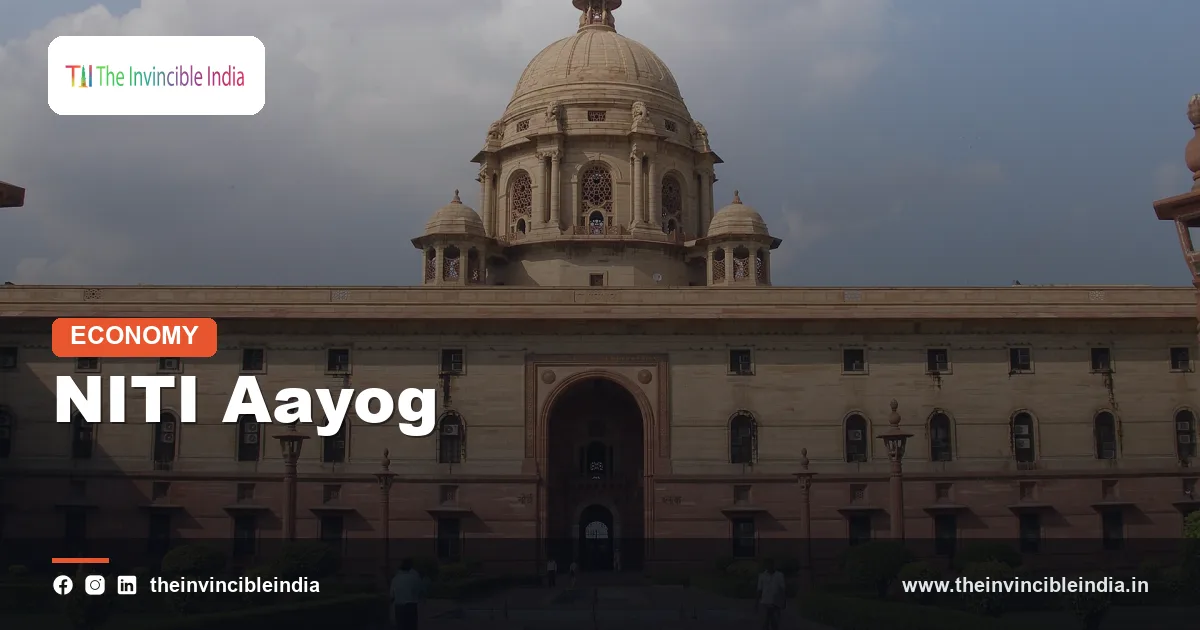
NITI Aayog, short for the National Institution for Transforming India, is the Government of India’s premier policy think tank. It was created on 1 January 2015 to replace the Planning Commission, which for sixty-four years had shaped the country’s economic direction through Five-Year Plans. Where the old body allocated funds and prepared centrally drawn blueprints, the new one advises, researches, convenes and monitors.
The change was more than a rename. It marked a shift in how the Union government thinks about development: away from top-down command planning and towards a partnership with states, in which ideas, data and competition are supposed to do the work that financial allocation once did. This explainer walks through NITI Aayog’s origins, legal status, structure, functions, flagship programmes and indices, and how it differs from the institution it replaced. Last updated: 29 September 2026.
| Full name | National Institution for Transforming India (NITI Aayog) |
|---|---|
| Established | 1 January 2015, by a Union Cabinet resolution |
| Replaced | The Planning Commission (set up in March 1950) |
| Legal status | Executive body; neither constitutional nor statutory |
| Chairperson | The Prime Minister of India |
| Apex forum | Governing Council of all state Chief Ministers and Lieutenant Governors of Union Territories |
| Administrative head | Chief Executive Officer, of the rank of Secretary to the Government of India |
| Core role | Policy advice, strategy, cooperative federalism, monitoring and evaluation |
| Headquarters | New Delhi |
What Is NITI Aayog?
The word “Aayog” simply means commission in Hindi, while “NITI” doubles as an acronym and as the Sanskrit-derived word for policy or guiding principle. The institution describes itself as the government’s think tank and directional adviser, offering strategic and technical inputs to both the Union and the states. It does not run large ministries, disburse plan grants or approve state budgets.
A think tank inside government
Unlike independent research institutions, NITI Aayog sits at the heart of the executive. Its Chairperson is the Prime Minister, and its work feeds directly into decisions taken by the Union Cabinet and by ministries. That closeness gives its recommendations weight, but it also means the body is advisory: its reports do not bind any ministry or any state.
The stated purpose
The founding resolution positioned the body as a platform for cooperative federalism, a resource centre for good governance practices, and a repository of knowledge on development. It was also meant to design long-term policy frameworks, monitor their progress, and nudge government departments to work in a more coordinated manner rather than in silos.
The Planning Commission Before NITI Aayog
To understand NITI Aayog, it helps to recall what came before. The Planning Commission was established in March 1950 through an executive resolution of the Government of India, shortly after the Constitution came into force. Jawaharlal Nehru, as Prime Minister, served as its chairman, and a Deputy Chairman handled day-to-day leadership. It, too, was neither a constitutional nor a statutory body.
The era of Five-Year Plans
The Commission’s most visible product was the Five-Year Plan, modelled loosely on the planning practice of the Soviet Union but adapted to a mixed economy. The First Plan ran from 1951 to 1956 and focused heavily on agriculture, irrigation and power. The Second Plan, associated with the Mahalanobis model, emphasised heavy industry and public sector expansion. Later plans tackled poverty, self-reliance, employment and, after the economic reforms of 1991, a more indicative style of planning.
Why it came under criticism
Over time, critics argued that the Commission had become a rigid, centralised body. It decided how much money each state would receive for Plan schemes, often with schemes designed in Delhi for a country of enormous regional variety. As the economy liberalised and states grew more assertive, the argument that a single national planning body should micro-manage development grew harder to sustain.
Birth of NITI Aayog in 2015
In August 2014, in his first Independence Day address from the Red Fort, the Prime Minister announced that the Planning Commission would be replaced by a new institution. After a period of consultation, a Cabinet resolution dated 1 January 2015 formally created NITI Aayog and dissolved the older body. The Planning Commission’s staff, buildings and functions were redistributed, and a new secretariat began operating.
The guiding idea
The slogan attached to the transition was to move from “planning” to “thinking”, and from a one-size-fits-all approach to policies that recognise state-level differences. The new institution was expected to bring in outside expertise, work with states as equal stakeholders, and act as a bridge between ideas and implementation.
Key milestones at a glance
- March 1950: Planning Commission established by a Cabinet resolution.
- 1951-56: First Five-Year Plan.
- 1991: Economic liberalisation begins; planning becomes more indicative.
- 2012-17: Twelfth Five-Year Plan, the last in the series.
- 1 January 2015: NITI Aayog is formed.
- 2017-18: The Plan and Non-Plan classification in the Union Budget is discontinued.
Legal Status: An Executive Body
A frequent exam question, and a genuine point of confusion, is the legal standing of NITI Aayog. It is an executive creation, set up by a resolution of the Union Cabinet. It is not established by any article of the Constitution, and it does not derive powers from an Act of Parliament. In that sense it resembles its predecessor.
Constitutional, statutory and executive bodies
- A constitutional body is created directly by the Constitution, such as the Election Commission of India or the Finance Commission under Article 280.
- A statutory body is created by a law of Parliament, such as the Competition Commission of India.
- An executive body is created by a government resolution or order, and can be reshaped or wound up by the executive itself. NITI Aayog belongs to this category.
What this means in practice
Because it has no statutory backing, NITI Aayog cannot compel states or ministries to follow its advice, and it has no fund-distribution powers of its own. Its influence rests on the quality of its analysis, the seniority of its leadership, and the Prime Minister’s chairmanship.
Structure and Composition
NITI Aayog has a compact but layered structure. The main components, as set out in the original resolution, are listed below.
Leadership and members
- Chairperson: the Prime Minister of India.
- Vice-Chairperson: appointed by the Prime Minister, holding the rank of a Cabinet Minister and functioning as the operational head, much like the Deputy Chairman of the Planning Commission.
- Full-time members: experts and specialists in different domains, holding the rank of Minister of State.
- Part-time members: a limited number of leading academics and research institution representatives, serving on rotation.
- Ex-officio members: a small number of Union Council of Ministers members nominated by the Prime Minister.
- Chief Executive Officer: appointed by the Prime Minister for a fixed term, of the rank of Secretary to the Government of India, responsible for administration and the secretariat.
The Governing Council
The Governing Council is the institution’s broadest forum. It brings together the Chief Ministers of all states and of Union Territories with legislatures, along with the Lieutenant Governors of the other Union Territories, under the Prime Minister. It meets to discuss national priorities, share experiences and seek agreement on common development goals.
Regional councils and special invitees
Regional Councils are formed for a specific time period to address issues that affect more than one state or region, such as water sharing or infrastructure corridors. They are convened by the Prime Minister and consist of the Chief Ministers and Lieutenant Governors of the concerned areas, chaired by the Chairperson or a nominee. In addition, experts with relevant domain knowledge can be invited as special invitees.
Cooperative and Competitive Federalism
Two phrases run through almost every official description of NITI Aayog: cooperative federalism and competitive federalism. They are related but distinct ideas.
Cooperative federalism
Cooperative federalism means that the Union and the states work together as partners on national goals. The Governing Council, regional councils and consultative processes are meant to give states a real voice in shaping policy. Under the old system, states often complained that they received Plan allocations in a way that left them little say in scheme design.
Competitive federalism
Competitive federalism encourages states to compete with one another on measurable outcomes, whether in health, education, water management or innovation. NITI Aayog’s indices, discussed below, are the main tool for this. By ranking states and districts, they put public pressure on governments to learn from the best performers and address their weak spots.
The bottom-up approach
The institution was also expected to adopt a bottom-up approach, developing mechanisms to formulate credible plans at village level and aggregating them progressively at higher levels of government. Whether that vision has been fully realised is debated, but it remains a defining aspiration of the design.
NITI Aayog vs the Planning Commission
The clearest way to see the change is a side-by-side comparison. The table below sets out the key differences in role, funding power and method.
| Feature | Planning Commission | NITI Aayog |
|---|---|---|
| Period | 1950 to 2014 | From 1 January 2015 |
| Legal status | Executive body (Cabinet resolution) | Executive body (Cabinet resolution) |
| Main role | Preparing Five-Year Plans and allocating resources | Think tank; policy advice, strategy and monitoring |
| Fund allocation | Decided Plan assistance to states and ministries | No power to allocate funds |
| Approach | Top-down, centralised | Bottom-up, consultative |
| Head | Prime Minister as Chairman, with a Deputy Chairman | Prime Minister as Chairperson, with a Vice-Chairperson |
| State role | Limited, mostly through the National Development Council | Chief Ministers form the Governing Council |
| Plan/Non-Plan expenditure | Central to budgeting | Distinction discontinued |
| Expertise | Largely internal staff | Open to outside experts, academics and specialists |
Money now flows elsewhere
With the end of the Plan and Non-Plan split, budgetary decisions are made by the Ministry of Finance, while the constitutionally mandated Finance Commission recommends how tax revenue is shared between the Union and the states. NITI Aayog does not sit in that chain of financial authority, and this is perhaps the single biggest difference.
Functions and Working Groups
The Cabinet resolution listed a broad set of tasks for the new institution. In simple terms they fall into four groups.
Strategy and vision
NITI Aayog was asked to develop a shared vision of national development priorities, sectors and strategies, with the active involvement of states. Early on, it was expected to produce a Fifteen-Year Road Map, a Seven-Year Strategy and a Three-Year Action Agenda, though the emphasis later shifted toward sector-specific strategy documents and vision papers.
Cooperation and knowledge
The body is meant to foster cooperative federalism, to design strategic and long-term policy frameworks, and to create a knowledge and innovation hub. It also runs the “Team India Hub” as an interface with states, and a “Knowledge and Innovation Hub” as its internal think-tank capability.
Resolving inter-sectoral issues
It provides a platform for resolving inter-sectoral and inter-departmental issues so that programmes move faster. It also gives advice on technology, capacity building and institutional design where states ask for help.
Monitoring and evaluation
Finally, it monitors the implementation of programmes and initiatives, including the identification of the resources needed, so that the delivery chain can be strengthened. Evaluation feeds back into policy design, allowing schemes to be reshaped or closed.
Flagship Programmes, Missions and Indices
Beyond papers and conferences, NITI Aayog has taken on some direct programmes that put its ideas into practice.
Aspirational Districts Programme
Launched in January 2018, the Aspirational Districts Programme identified a set of districts, just over a hundred in its initial list, that lagged behind on development indicators. It focuses on a limited number of areas: health and nutrition, education, agriculture and water resources, financial inclusion and skill development, and basic infrastructure. Districts are ranked using data and are encouraged to learn from one another, with senior officers assigned to guide their progress.
Atal Innovation Mission
The Atal Innovation Mission was launched in 2016 to promote a culture of innovation and entrepreneurship. Its best-known components are Atal Tinkering Labs in schools, which give students access to tools for building prototypes, and Atal Incubation Centres that support start-ups.
Support for state reforms
NITI Aayog has also prepared model frameworks and advisory papers, for example on agricultural reforms, land leasing, and health and education governance, which states can adapt to their own conditions. It has issued vision and strategy documents on themes such as energy, transport, urban development and digital governance. Adoption remains a matter for each state.
Indices and rankings
Data-driven indices are perhaps the most public face of NITI Aayog. They turn complex sets of indicators into simple, comparable rankings and support the competitive federalism agenda.
| Index | What it measures | Notes |
|---|---|---|
| SDG India Index | Progress of states and Union Territories on the United Nations Sustainable Development Goals | First released in 2018; updated periodically |
| Health Index (Healthy States, Progressive India) | Overall performance and year-on-year improvement in health outcomes | Developed with partners such as the World Bank and the health ministry |
| School Education Quality Index | Learning outcomes, access, infrastructure and governance in school education | Introduced in 2019 |
| Composite Water Management Index | State performance on water resource management | Launched in 2018 to encourage better water practices |
| India Innovation Index | Innovation capacity and performance of states | Prepared with the Institute for Competitiveness |
| National Multidimensional Poverty Index | Non-income deprivation across health, education and living standards | Baseline report released in 2021 |
Why the indices matter
Rankings encourage healthy rivalry among states and give citizens a way to compare their governments’ performance. They also help highlight data gaps, since a good index depends on reliable statistics. At the same time, critics note that indices can oversimplify local realities, and methodologies are refined over time, so it is sensible to check the latest edition for current rankings rather than rely on old ones.
Monitoring, evaluation and the DMEO
Monitoring and evaluation is one of the less glamorous but more important tasks. The Development Monitoring and Evaluation Office, or DMEO, functions as an attached office of NITI Aayog and evolved out of the older Programme Evaluation Organisation of the Planning Commission. Its mandate is to assess how well government schemes deliver, using data and field studies.
What evaluation looks like
- Studies of centrally sponsored schemes to see whether they meet their stated goals.
- Development of outcome-focused dashboards and data systems for tracking progress.
- Recommendations on continuing, restructuring or closing schemes.
- Capacity-building for state governments in data use and evaluation.
By insisting on outcomes rather than outlays, this function aims to answer a fundamental governance question: is public money achieving what it was meant to achieve?
The End of Five-Year Plans
A natural question is what happened to the Five-Year Plans. The Twelfth Five-Year Plan, covering 2012 to 2017, turned out to be the last. With the Planning Commission gone, no Thirteenth Plan was drawn up, and the government moved to a model in which medium-term strategy documents and annual budgets guide spending.
The Plan and Non-Plan shift
Under the old system, government spending was divided into Plan expenditure, linked to Five-Year Plan schemes, and Non-Plan expenditure, which covered routine costs like salaries, interest and subsidies. Critics felt the split encouraged new schemes over maintenance and made it harder to see the total cost of a service. From 2017-18, the Union Budget adopted a classification based on revenue and capital expenditure instead.
The National Development Council
The National Development Council, another extra-constitutional body of the older era, had been the forum where Five-Year Plans were approved by the Union and states. With plans discontinued, the role of a broad forum for Union-state discussion on development is now played chiefly by the Governing Council of NITI Aayog.
Criticism, Debate and Conclusion
NITI Aayog has both admirers and critics, and any balanced account should mention both. Supporters point to its data-driven approach, its innovation initiatives, and its willingness to work with states. Critics argue that without financial powers or statutory backing, its influence over states is limited, and that the shift from planning to advice has left some regional inequalities without a dedicated body to address them.
What is not disputed is the significance of the change. India moved from an institution that told the states how much they would get and what to do, to one that suggests, benchmarks and coordinates. Whether one prefers the older model or the newer, understanding NITI Aayog is essential to understanding how Indian development policy is now framed: it is a think tank at the heart of government, without the power of the purse, but with a strong voice in the conversation.
Frequently Asked Questions
What does NITI Aayog stand for?
NITI Aayog stands for the National Institution for Transforming India. It is the Government of India’s policy think tank, created on 1 January 2015 to replace the Planning Commission.
Is NITI Aayog a constitutional or statutory body?
No. NITI Aayog is an executive body, created by a Cabinet resolution. It is not mentioned in the Constitution and was not established by an Act of Parliament, which means the government itself can reshape its structure.
Who heads NITI Aayog?
The Prime Minister is the Chairperson. A Vice-Chairperson, appointed by the Prime Minister, acts as the operational head, and a Chief Executive Officer of the rank of Secretary to the Government of India manages the administration.
Who are the members of the Governing Council?
The Governing Council includes the Prime Minister, the Chief Ministers of all states, the Chief Ministers of Union Territories with legislatures, and the Lieutenant Governors of the other Union Territories. It is the institution’s main forum for Union-state consultation.
How is NITI Aayog different from the Planning Commission?
The Planning Commission prepared Five-Year Plans and decided the allocation of funds to states and ministries. NITI Aayog has no such financial powers and works as an advisory think tank that promotes cooperative and competitive federalism, publishes indices and monitors programmes.
Are Five-Year Plans still being made?
No. The Twelfth Five-Year Plan, which covered 2012 to 2017, was the last. The Planning Commission was dissolved in 2015, and the Plan and Non-Plan classification in the Union Budget was discontinued from 2017-18.
{“@context”:”https://schema.org”,”@graph”:[{“@type”:”FAQPage”,”mainEntity”:[{“@type”:”Question”,”name”:”What does NITI Aayog stand for?”,”acceptedAnswer”:{“@type”:”Answer”,”text”:”NITI Aayog stands for the National Institution for Transforming India. It is the Government of India’s policy think tank, created on 1 January 2015 to replace the Planning Commission.”}},{“@type”:”Question”,”name”:”Is NITI Aayog a constitutional or statutory body?”,”acceptedAnswer”:{“@type”:”Answer”,”text”:”No. NITI Aayog is an executive body, created by a Cabinet resolution. It is not mentioned in the Constitution and was not established by an Act of Parliament, which means the government itself can reshape its structure.”}},{“@type”:”Question”,”name”:”Who heads NITI Aayog?”,”acceptedAnswer”:{“@type”:”Answer”,”text”:”The Prime Minister is the Chairperson. A Vice-Chairperson, appointed by the Prime Minister, acts as the operational head, and a Chief Executive Officer of the rank of Secretary to the Government of India manages the administration.”}},{“@type”:”Question”,”name”:”Who are the members of the Governing Council?”,”acceptedAnswer”:{“@type”:”Answer”,”text”:”The Governing Council includes the Prime Minister, the Chief Ministers of all states, the Chief Ministers of Union Territories with legislatures, and the Lieutenant Governors of the other Union Territories. It is the institution’s main forum for Union-state consultation.”}},{“@type”:”Question”,”name”:”How is NITI Aayog different from the Planning Commission?”,”acceptedAnswer”:{“@type”:”Answer”,”text”:”The Planning Commission prepared Five-Year Plans and decided the allocation of funds to states and ministries. NITI Aayog has no such financial powers and works as an advisory think tank that promotes cooperative and competitive federalism, publishes indices and monitors programmes.”}},{“@type”:”Question”,”name”:”Are Five-Year Plans still being made?”,”acceptedAnswer”:{“@type”:”Answer”,”text”:”No. The Twelfth Five-Year Plan, which covered 2012 to 2017, was the last. The Planning Commission was dissolved in 2015, and the Plan and Non-Plan classification in the Union Budget was discontinued from 2017-18.”}}]}]}


