

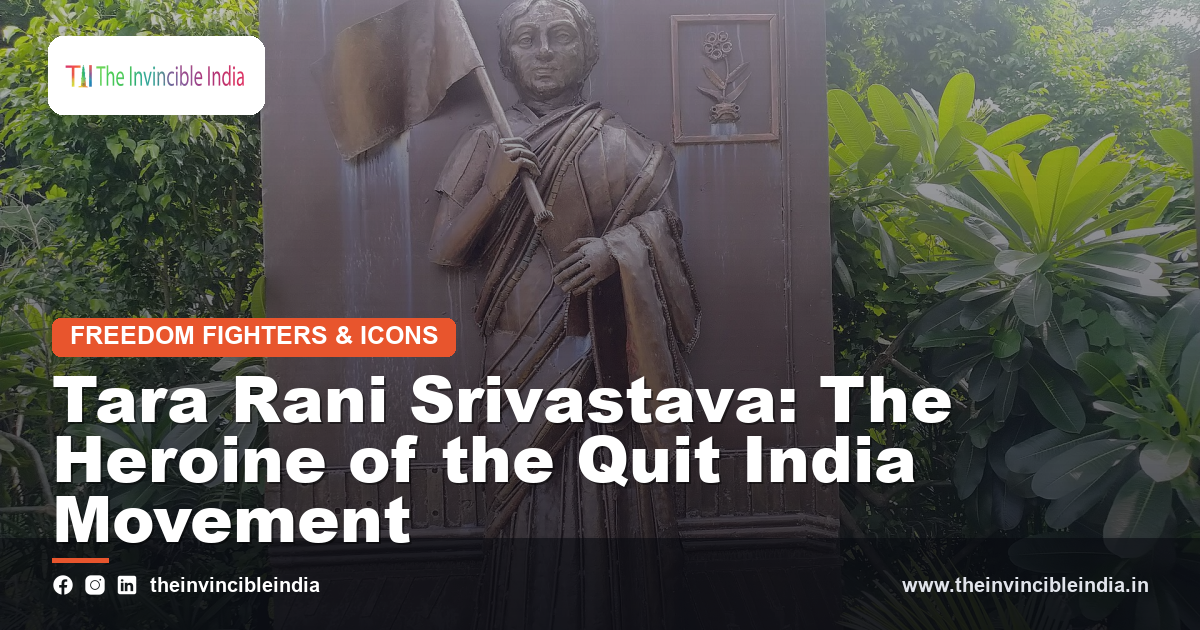
Among the many women who joined India’s final great mass movement against colonial rule, Tara Rani Srivastava of Bihar holds a place of special honour. During the Quit India Movement of 1942, she took part in a procession in the Saran region alongside her husband, and her steadiness in the face of police action has been remembered ever since as an emblem of quiet, determined courage. Her story sits comfortably beside those of Matangini Hazra and other women who placed the nation above personal safety. This guide looks at the context of her life, the movement that shaped it, and the reasons her example endures in regional memory and in the wider story of India’s freedom struggle.
Quick Facts
| Detail | Information |
|---|---|
| Name | Tara Rani Srivastava |
| Known as | Heroine of the Quit India Movement in Bihar |
| Region | Saran district, Bihar (Siwan area) |
| Movement | Quit India Movement, 1942 |
| Partner in service | Her husband, Phulendu Babu |
| Legacy | Symbol of women’s courage and sacrifice |
Who Was Tara Rani Srivastava
Tara Rani Srivastava was a freedom fighter from Bihar who took an active part in the Quit India Movement of 1942. She is associated with the Saran region, in and around the town of Siwan, where she joined the public agitation alongside her husband. Her name has come down through regional memory as that of a woman who stepped out of the household into public life at a decisive moment in the national struggle.
Like many participants in the movement, she was not a national leader in the usual sense, yet her conduct carried a force that leaders themselves admired in others. Accounts of her life describe steadiness, discipline, and a readiness to continue the work even after personal hardship. These qualities explain why she is remembered not merely as a participant but as a heroine whose example encouraged many others to keep faith with the cause.
Saran and Siwan: The Setting
The Saran region lies in the western part of Bihar, in the fertile plains near the Ganga and the Gandak, and Siwan is one of its important towns. This was a settled agricultural landscape with a long tradition of village life, markets, and local political awareness. Such a setting shaped the character of the freedom movement in Bihar, which drew strength from ordinary farmers, students, teachers, and professionals who lived close to the land.
In the early decades of the twentieth century, the region had already felt the influence of Gandhian campaigns that had begun nearby in Champaran. Public meetings, spinning, boycotts, and volunteer work became familiar features of social life. The story of Tara Rani Srivastava unfolds against this background, in a community where the language of swaraj was already understood and where a call for action could quickly gather a crowd.
Bihar in the Freedom Struggle
Bihar occupies a significant place in the history of Indian nationalism. The early Gandhian experiments in Champaran placed the state at the centre of the national conversation, and its leaders, lawyers, students, and peasants went on to contribute to every major phase of the movement. Noncooperation, civil disobedience, and later the Quit India Movement all found committed followers across its districts.
In 1942, the state became one of the regions where the movement grew with great intensity. Processions, meetings, and acts of public defiance took place in towns and villages alike. Participation was broad, involving people of many communities and walks of life. It is within this wider current of popular energy that individual stories such as that of Tara Rani Srivastava should be understood, as local expressions of a truly mass national awakening.
The Quit India Movement of 1942
The Quit India Movement was launched in August 1942 when the Indian National Congress, under the guidance of Mahatma Gandhi, called upon the British to end their rule in India. The slogan of the movement urged people to act decisively, and the resolution was adopted at a session in Bombay. Soon afterwards, many of the senior leaders were arrested, and the movement continued in large part through the initiative of ordinary people.
With the top leadership imprisoned, local communities organised their own processions, strikes, and demonstrations. The movement became remarkable for this spontaneous and widely spread character. It carried the demand for independence into towns and villages that had not been reached so directly before. The participation of Tara Rani Srivastava belongs to this phase, when leadership passed to the courage of countless individuals acting in their own localities.
Women in the Quit India Movement
Women played a notable role in the Quit India Movement. They joined processions, carried messages, sheltered volunteers, and sometimes led public demonstrations. The movement widened the range of public roles available to women, building on earlier campaigns in which figures such as Sarojini Naidu and Kasturba Gandhi had shown what women could accomplish in national life.
In many parts of the country, women who had never before stepped into political activity found themselves on the streets, flags in hand, facing the authority of the state. Their involvement changed how communities understood both women and politics. Tara Rani Srivastava is counted among those women of Bihar who took part in this shift. Her conduct demonstrated that patriotism was not confined to any single section of society and that courage could come from the most unexpected households.
A Partnership in Service
Tara Rani Srivastava took part in the movement together with her husband, Phulendu Babu, who was himself a committed worker in the freedom struggle. Theirs is remembered as a partnership of shared purpose, in which both stood together in the public agitation rather than one supporting the other from the background. This companionship of conviction is part of why their story has been retold with such respect.
In a period when public politics was still largely the domain of men, a couple acting together in a movement was a powerful image. It showed that the ideals of the freedom struggle could be carried as a family commitment and that a household could become a small unit of the nation’s resolve. The shared sacrifice of the couple gives the account its particular emotional weight and its lasting place in local tradition.
The Procession Toward Siwan
The best-known episode in the life of Tara Rani Srivastava is her participation in a procession in the Siwan area during the Quit India Movement. Such processions were a central method of the agitation, in which people gathered with flags and slogans to express the demand for freedom and to show the strength of public feeling. They were intended to be peaceful demonstrations of collective will.
Accounts recall that the procession moved toward the police station of Siwan, a symbol of colonial authority in the locality. To march in such a group required resolve, since participants knew that the authorities might respond with force. The willingness of Tara Rani Srivastava and her husband to join the gathering, in full awareness of the possible consequences, speaks to the seriousness with which ordinary people took the call of 1942.
Courage Under Police Action
Across India, the Quit India processions were frequently met with police action, and the gathering in the Siwan area is remembered in that context. During the confrontation, her husband was seriously injured by the police. The moment tested the determination of everyone present, and it is at this point that the account of Tara Rani Srivastava acquires its enduring moral force.
What is remembered is not only the violence of the encounter but the composure with which she responded to it. She did not retreat in fear. The episode has been recounted in Bihar as an example of the courage that turns a moment of danger into an act of witness. By holding steady, she gave the procession a dignity that outlasted the immediate confrontation and became part of the region’s shared memory.
Bandaging the Wounds and Moving On
One of the most frequently recalled details of her story is that she tended to her injured husband by bandaging his wounds and then chose to continue with the procession toward the police station. This gesture combines two qualities that are rarely seen together in such a moment: tender care for a loved one and unshaken commitment to a public cause.
The act has been told and retold because it captures a whole philosophy of sacrifice. It shows that she did not treat personal suffering as a reason to abandon the larger purpose, yet she did not set compassion aside either. In the Gandhian tradition, service to the individual and service to the nation were meant to be part of one moral life, and this episode is often cited as a vivid illustration of that ideal.
Loss and Resolve
The account of Tara Rani Srivastava is also one of profound personal loss. Her husband did not survive the injuries he suffered in the events at Siwan, and he is remembered as a martyr of the Quit India Movement. For her, the cause had now demanded the most painful sacrifice that any family could be asked to bear.
Tradition holds that her resolve did not dissolve in grief. The loss became part of the meaning she attached to the movement, and her story is read as one of endurance in the face of bereavement. Such accounts do not seek to glorify suffering for its own sake. Instead, they honour the dignity of those who carried their sorrow with restraint and continued to stand for the principles that had brought them into public life.
Symbolism of Her Act
The story of Tara Rani Srivastava has become symbolic in Bihar and beyond. The image of a woman tending a wounded husband and then moving forward with the procession compresses the spirit of the Quit India Movement into a single scene. It speaks of care, courage, and an unwillingness to be intimidated by force.
Symbols like this matter in the life of a nation because they allow generations to grasp abstract ideals through concrete human action. Freedom, sacrifice, and duty become easier to understand when they are embodied in a recognisable person making a difficult choice. Her story serves as a teaching image in schools, commemorations, and local storytelling, reminding listeners that the freedom of India was built through countless decisions of this kind, taken by people whose names are not always found in national textbooks.
Gandhian Ideals of Nonviolence and Satyagraha
The Quit India Movement was guided by the ideals of satyagraha and nonviolence associated with Mahatma Gandhi. These ideals asked participants to resist injustice with moral force, to accept hardship rather than inflict it, and to maintain discipline even under provocation. A procession conducted in this spirit was meant to be a peaceful assertion of the right to freedom.
Tara Rani Srivastava’s conduct is often read in this light. Her refusal to be turned back, combined with her care for the wounded, reflects the belief that strength lies in steadfast conviction rather than in aggression. Whether or not every participant shared the same interpretation, the moral vocabulary of the movement shaped how people understood their own actions. In this sense her story is a practical example of Gandhian principles lived under extreme pressure.
Unsung Heroines and Historical Memory
The history of the freedom struggle contains many heroines who are remembered mainly in their own regions. Historians and communities have worked in recent decades to bring such figures to wider attention, recognising that national history is enriched when local stories are preserved. Tara Rani Srivastava is frequently mentioned in this context as a woman whose contribution deserves to be known across the country.
Memory of this kind is sustained by storytelling, commemoration, and education. Families, schools, and local organisations pass on accounts of people like her, often long before they appear in formal histories. The effort to remember them is itself a form of respect, acknowledging that independence was won not only by famous leaders but by men and women whose courage was exercised in small towns and villages.
Commemoration in Bihar
In Bihar, the memory of the Quit India Movement is preserved through memorials, public events, and the retelling of local history. The story of Tara Rani Srivastava is commonly cited during commemorations of the movement, alongside the stories of others who took part in the agitation of 1942 across the state.
These observances serve an important civic purpose. They connect present communities with the sacrifices that shaped their political inheritance and invite younger people to consider what freedom required of earlier generations. Regional literature, speeches, and school lessons all contribute to this continuing remembrance. By naming Tara Rani Srivastava among the honoured figures of the movement, Bihar affirms that the courage of its women belongs at the centre of its historical identity.
Lessons for Contemporary India
The life of Tara Rani Srivastava offers several lessons that remain relevant to modern India. The first is the value of civic courage, the willingness to take a public stand for a principle even when it carries personal cost. The second is the union of compassion and conviction, shown in the way she cared for her husband without abandoning her purpose.
A third lesson concerns the importance of participation by all sections of society. The freedom movement succeeded because it drew in people from many backgrounds, including women who broke with expected roles. Reflecting on her example encourages citizens to value the rights and responsibilities of democratic life and to remember that these were secured at real cost. Her story thus works as both history and quiet moral guidance for the present.
Tara Rani Srivastava Today
Today, Tara Rani Srivastava is remembered as a heroine of the Quit India Movement whose courage at Siwan reflected the spirit of an entire generation. Her name appears in discussions of women freedom fighters, in regional commemorations, and in efforts to preserve the stories of lesser-known patriots.
Her legacy is not one of titles or offices but of character. She stood with her husband in a moment of danger, acted with composure, and carried the cause forward through loss. For students of Indian heritage, her story is a reminder that the independence of the country rests on the personal sacrifices of ordinary citizens. Exploring her life alongside the broader account of India’s freedom fighters helps restore a fuller and more human picture of the national struggle, in which every act of courage deserves its place in memory.
Sources & Further Reading
- Ministry of Culture, Government of India (indiaculture.gov.in).
- National Archives of India (nationalarchives.nic.in).
Frequently Asked Questions
Who was Tara Rani Srivastava?
Tara Rani Srivastava was a freedom fighter from Bihar who took part in the Quit India Movement of 1942. She is associated with the Saran region around Siwan and is remembered for her courage during a procession there.
What is she best known for?
She is best known for joining a Quit India procession toward the Siwan police station with her husband, Phulendu Babu. After he was injured, she bandaged his wounds and continued, an episode that has become a symbol of women’s courage.
What was the Quit India Movement?
The Quit India Movement was a mass agitation launched in August 1942, led by the Indian National Congress under Mahatma Gandhi, demanding an end to British rule. With many senior leaders arrested, ordinary people carried the movement forward through processions and demonstrations.
Why is her story important today?
Her story shows how women and ordinary citizens contributed to India’s independence. It is often used to illustrate civic courage, compassion, and sacrifice in the freedom struggle.
How is she remembered in Bihar?
She is remembered through regional commemorations of the Quit India Movement, local storytelling, and discussions of women freedom fighters. Her example is cited as part of Bihar’s proud role in the national struggle.


