

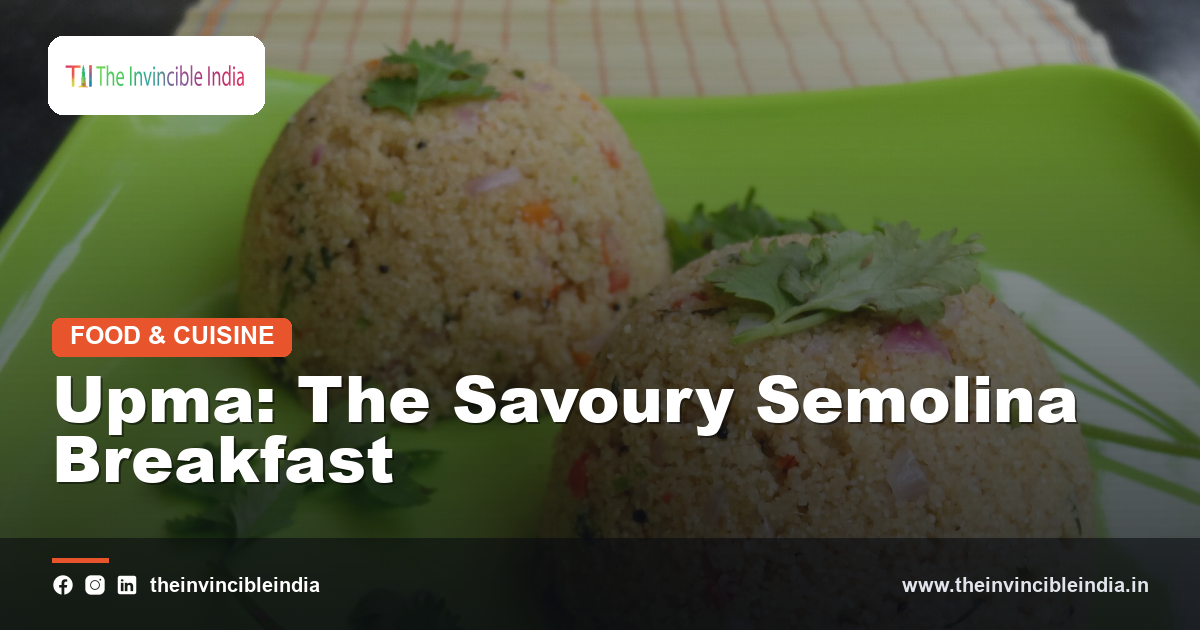
Upma is one of the most familiar and dependable breakfast dishes in Indian homes, especially across the southern states. Made from roasted semolina cooked into a soft, fluffy porridge with a fragrant tempering of mustard seeds, lentils, curry leaves and chillies, it is valued for being quick, filling and gentle on the stomach. It sits comfortably beside other classics described in our guide to South Indian breakfast, yet it has a character of its own: savoury, slightly nutty and endlessly adaptable. This guide looks at what upma is, how it is prepared, how it varies from region to region and why this modest dish holds such a warm place in the Indian kitchen.
Quick Facts
| Detail | Information |
|---|---|
| Dish type | Savoury breakfast and light meal |
| Main ingredient | Roasted semolina (rava or sooji) |
| Key tempering | Mustard seeds, lentils, curry leaves, chillies |
| Region | Widely eaten across South India and beyond |
| Diet | Usually vegetarian, easily made vegan |
| Typical pairing | Coconut chutney, pickle or a hot cup of tea or coffee |
What Is Upma?
Upma is a thick, savoury porridge made by cooking roasted semolina in hot water after it has been seasoned in a pan with aromatics. The result is a soft, slightly grainy mound that holds its shape on the plate and carries the flavours of the tempering through every spoonful. It is eaten mainly in the morning, but it also appears as an evening snack and as a simple meal when time is short.
What makes the dish remarkable is its simplicity. A few pantry staples, a single pan and a few minutes of attention are enough to produce something nourishing and satisfying. Because it is neither heavily spiced nor heavily sauced, upma is often the first savoury dish offered to children and a reassuring choice for anyone who wants a light but sustaining start to the day. In short, upma is everyday comfort food in its purest form.
Origins and Name
The name upma is widely understood to come from the Tamil word uppumavu, which broadly means salted flour, a reference to the seasoned semolina at the heart of the dish. In Kannada the same preparation is commonly called uppittu, in Marathi it is known as upit, and other regions have their own local names for closely related dishes. These names show how the idea of a seasoned cooked semolina travelled across language boundaries while keeping its essential character.
The precise early history of the dish is not something that can be stated with certainty, and it is better to describe it in general terms. What is clear is that upma grew into a staple of home cooking in the southern states and western India, and that it later became familiar across the whole country. Its long presence in household kitchens speaks to its practicality and broad appeal.
The Core Ingredients
The foundation of upma is semolina, sold in Indian shops as rava, sooji or suji. It is usually coarse or medium grained and is dry roasted until it gives off a light aroma, which prevents stickiness and adds a gentle nutty note. Alongside the semolina come water, salt and a cooking fat, which may be oil or ghee depending on the household and the region.
The flavour of the dish is built from the tempering. Mustard seeds, split black gram, split Bengal gram, dried or fresh green chillies, curry leaves and sometimes cashew nuts are fried until fragrant. Onion, ginger and seasonal vegetables often follow. Each element contributes a distinct texture or aroma, and together they lift a plain grain into a complete and balanced dish. The ingredients are humble, but their combination is carefully considered.
The Art of Tempering
Tempering, known in many Indian languages as tadka, popping or seasoning, is the technique that gives upma its identity. Fat is heated in the pan until hot, and then mustard seeds are added and allowed to crackle. The lentils follow and are fried until they turn a pale golden colour, releasing a toasty fragrance that signals the base is ready.
Curry leaves, chillies and ginger are added next, and they sizzle briefly in the hot fat. The order and timing matter because burnt spices turn bitter, while under-fried ones taste raw. Cooks learn by sight and smell to judge the right moment. When the tempering is done well, it perfumes the entire pan and sets the tone for the dish, showing how a small step at the start shapes the quality of the finished upma.
How Upma Is Cooked
The cooking of upma follows a simple sequence. The semolina is first roasted in a dry pan until it is lightly fragrant and then set aside. The tempering is prepared in the same pan, the vegetables are sautéed, and hot water is added with salt. When the water is at a rolling boil, the roasted semolina is poured in steadily while being stirred.
Steady stirring is the key to avoiding lumps. As the grains absorb the water they swell and the mixture thickens within a short time. The pan is then covered and left on a low flame so that the steam finishes the cooking, after which a spoonful of ghee or a squeeze of lemon may be added. The entire process is swift, and that speed is one reason upma is so often chosen for busy mornings. Careful roasting, balanced water and gentle stirring produce a soft, fluffy result.
Getting the Texture Right
Texture is the quality by which home cooks judge a plate of upma. The ideal version is soft and moist without being pasty, with individual grains still faintly distinct. If too much water is used, the dish turns sticky and heavy, while too little leaves it dry and crumbly. Families often develop their own measure of water to semolina based on the type of rava they buy and the consistency they prefer.
Some cooks like a looser, almost porridge-like upma, while others prefer it firm enough to be shaped into a neat dome on the plate. Both styles are valid and both are loved. The point is that upma rewards attention: a little practice teaches the hand how much water the semolina will take. Good texture is therefore the mark of a cook who understands the grain, not merely one who follows a measure.
Regional Names and Styles
Across India, upma takes on local colour. In Tamil Nadu the dish is often simple and lightly spiced, with a generous tempering of lentils and curry leaves. In Karnataka, uppittu is commonly served alongside sweet kesari bath in the combination known as chow chow bath, a pairing that contrasts savoury and sweet on the same plate.
In Maharashtra, upit may include peanuts and a touch of grated coconut, while in Andhra Pradesh and Telangana the dish may be made a little spicier with extra green chillies. Coastal homes often add fresh coconut, and some kitchens finish the dish with a squeeze of lemon and a scatter of chopped coriander. These variations reveal how a single basic method adapts to local tastes and ingredients. The shared idea remains constant even as the seasoning shifts from one kitchen to the next.
Popular Variations
Because the base is so neutral, upma invites endless variation. Vegetable upma includes carrots, peas, beans and capsicum, turning the dish into a colourful and nutritious meal. Tomato upma adds a mild tang, while onion upma leans on sweetness from slowly cooked onions. Some households prepare a version enriched with grated coconut or finished with roasted cashews for extra richness.
There are also variants made from grains other than semolina. Broken wheat, vermicelli, flattened rice, oats and millets are all cooked in the same style and are popular choices for people seeking a wholesome alternative. Each grain changes the flavour and texture, but the method of tempering and steaming stays familiar. The wide range of upma varieties proves that the dish is less a fixed recipe than a flexible technique that adapts to what is available and preferred.
Accompaniments and Serving
Upma is usually served hot, directly from the pan, on a plate or a banana leaf. Coconut chutney is a classic companion, its cool creaminess balancing the warm spiced semolina. Others enjoy it with a spoon of pickle, a dab of sugar, a ripe banana or a cup of sambar, and some families simply add a little ghee on top for richness.
In many homes a glass of filter coffee or a cup of tea completes the morning meal. At restaurants and canteens upma is often part of a breakfast menu beside idli, dosa and vada, which makes it a familiar sight to anyone who has eaten a southern meal. The pairing choices are flexible, yet the intent is the same: to round out a humble dish with contrasting flavours so the plate feels complete and balanced.
Nutrition and Everyday Appeal
Upma is valued as a light but sustaining meal. Semolina is a wheat product and provides carbohydrate energy, while the lentils in the tempering add a modest amount of protein and the vegetables contribute fibre and vitamins. Because it is cooked with relatively little fat and is not fried, it is often considered a gentle alternative to heavier breakfast items.
The dish also appeals for practical reasons. It can be prepared in a short time, uses ingredients that most kitchens keep in stock and travels well in a lunch box. Elderly family members and children alike find it easy to eat. Its reputation as a dependable, unfussy meal explains why it remains a fixture of Indian homes, hostels and offices, valued for convenience as much as for taste.
Upma in Indian Homes and Memory
For many Indians, upma is bound up with memories of school mornings, hostel kitchens and train journeys. It is the dish that appears when there is little time, when guests arrive unexpectedly or when a simple supper is needed. Its familiarity is so strong that it has become a gentle shorthand in popular culture for plain, reliable home cooking.
Opinions about upma are famously varied, and some people treat it with affectionate teasing, but that very fact shows how deeply it is woven into everyday life. A dish that is talked about so warmly, even when it is criticised, has clearly earned a place in the shared memory of households. Upma thus stands for the quiet, unglamorous food that nourishes families day after day.
Upma and Indian Breakfast Culture
Indian breakfast traditions differ widely by region, yet many of them favour freshly cooked, lightly spiced food. Upma belongs to a family of dishes that includes idli, dosa, pongal and poha, each built on a cereal base and seasoned with simple aromatics. Within this family upma is notable for being the fastest to prepare, since it needs no fermentation, soaking or grinding.
That convenience has allowed upma to travel beyond the south. In northern and western cities it appears on breakfast tables and in tiffin boxes, often with local tweaks such as green peas or extra lemon. Its presence on menus across the country illustrates how regional foods can become national favourites. Upma demonstrates the way Indian breakfast culture values practicality without giving up flavour.
Tips for Preparing Good Upma
Cooks who make upma regularly share a few simple habits. Roasting the semolina until it smells nutty but has not browned gives the best flavour. Using hot water rather than cold helps the grains cook evenly, and adding them slowly while stirring prevents lumps from forming. Salt should be tasted in the water before the semolina goes in, because it is difficult to correct afterwards.
A generous tempering is another secret, since the lentils, curry leaves and chillies provide most of the character. Finishing with a little ghee, lemon juice and fresh coriander brightens the dish and adds aroma. Letting the covered pan rest for a minute or two lets the steam settle the texture. These small practices turn a basic preparation into a consistently pleasing one, and they reflect the patient attention that good home cooking depends on.
Upma Beyond the Home Kitchen
Upma is not confined to households. Small eateries, railway canteens and breakfast counters across India serve it alongside other quick dishes, and it is a regular item at weddings, conferences and festival mornings where a large group needs to be fed simply. In many southern cities it is part of the standard breakfast fare that travellers and students rely on.
The dish has also found a place in packaged and instant forms, where ready mixes allow cooks to prepare it in minutes. While convenience versions have their place, many people still prefer the freshly tempered version made in a home pan. The continued existence of both shows that upma suits modern life as well as tradition. Its journey from a household staple to a widely available meal reflects how easily it adapts to changing routines.
Upma Today
Today upma remains a cornerstone of everyday Indian eating. Health-conscious cooks experiment with millets, oats and vegetables, while restaurants sometimes present it in more polished forms with plated garnishes. Yet the heart of the dish is unchanged: roasted grain, fragrant tempering and a soft, warm texture that comforts without fuss.
Its longevity is a reminder that a dish does not need elaborate technique or costly ingredients to earn affection. Upma survives because it is practical, adaptable and deeply familiar, connecting generations of cooks and eaters through a shared morning ritual. As Indian food continues to evolve, this humble semolina breakfast will likely keep its place on the table, quietly and reliably, as one of the country’s most recognised everyday dishes.
Sources & Further Reading
- Ministry of Culture, Government of India (indiaculture.gov.in).
- Food Safety and Standards Authority of India (fssai.gov.in).
Frequently Asked Questions
What is upma made of?
Upma is made mainly from roasted semolina, known as rava or sooji, cooked in water with a tempering of mustard seeds, lentils, curry leaves, chillies and often onion and vegetables. Salt and a little oil or ghee complete the basic recipe.
Is upma healthy?
Upma is generally regarded as a light, filling meal because it is cooked with little fat and can include vegetables and lentils. Its nutritional value depends on the ingredients and the amount of oil used, and versions made with millets or broken wheat add extra fibre.
Which regions of India eat upma?
Upma is especially popular across South India, where it is known by names such as uppittu and uppumavu, and in Maharashtra, where it is called upit. It is also commonly eaten in cities all over the country as a quick breakfast.
What is the difference between upma and poha?
Upma is made from roasted semolina cooked into a soft porridge, while poha is made from flattened rice that is softened and lightly tempered. Both are savoury breakfast dishes, but their grains, textures and flavours differ.
What goes well with upma?
Coconut chutney, pickle, sambar, ghee, a ripe banana and a hot cup of tea or filter coffee are all popular accompaniments. In Karnataka it is often paired with sweet kesari bath on the same plate.


