

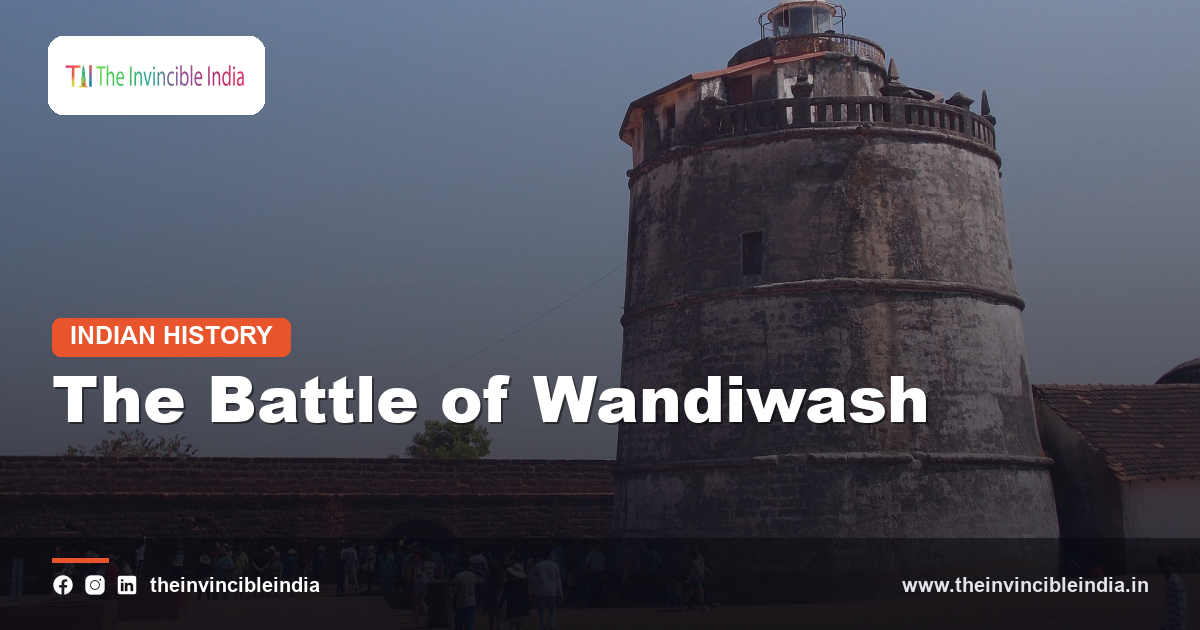
In the middle of the eighteenth century, the southeastern coast of India became a stage on which two European trading powers fought for influence, allied with local rulers and supported by Indian soldiers. The Battle of Wandiwash, fought near a fort in present-day Tamil Nadu, was the decisive land engagement of this rivalry during the Third Carnatic War. Its outcome broke the military strength of the French East India Company in the region and helped clear the path for British dominance. The conflict belongs to the same broader age of transformation as the Battle of Buxar in the north, when commercial companies gradually became political powers.
Quick Facts
| Detail | Information |
|---|---|
| Conflict | Third Carnatic War, linked to the Seven Years’ War |
| Location | Wandiwash (Vandavasi), northern Tamil Nadu |
| Opposing Sides | British East India Company versus the French East India Company |
| Key Commanders | Sir Eyre Coote and the Comte de Lally |
| Notable Capture | French officer Bussy was taken prisoner |
| Result | Decisive British victory that ended French political ambitions in India |
South India in the Mid Eighteenth Century
The Coromandel coast in the eighteenth century was a busy commercial region, famous for textiles, ports and the fortified settlements of European companies. Political authority in the Carnatic, the territory lying between the Eastern Ghats and the sea, was formally linked to the Mughal system through the Nawabs of Arcot, who in turn looked towards the Nizam of Hyderabad. As central Mughal control weakened, regional rulers competed for power and sought allies wherever they could find them. European companies, originally interested in trade, found themselves drawn into these rivalries. The region offered rich revenues and strategic harbours, which made it attractive to ambitious officials. This combination of local disputes and foreign commercial interests created the conditions in which the Carnatic Wars took place.
British and French Rivalry in India
The British East India Company and the French East India Company had both established trading posts in India, with Madras as the main British settlement in the south and Pondicherry as the principal French base. Their competition in Europe carried over into Asia, since wars between Britain and France often triggered fighting in their overseas territories. Each company maintained fortified settlements, warehouses and small armies, and each relied increasingly on Indian troops trained in European drill. What began as commercial competition developed into a contest for political influence. The struggle was not simply between two foreign powers, because it involved local rulers who sought to use European strength for their own purposes. This entanglement shaped the course of events throughout the Carnatic region.
The First Carnatic War
The First Carnatic War arose from the wider European conflict known as the War of the Austrian Succession, and it brought the rivalry in India into open fighting. French forces under the governor Dupleix and naval commanders captured the British settlement at Madras, demonstrating that European-trained troops could overcome local forces. The Nawab of Arcot tried to intervene but was defeated by a smaller French army, which impressed observers across the region. The conflict ended in Europe by treaty, and Madras was returned to the British. Even so, the war revealed a crucial lesson: disciplined infantry supported by artillery could change the balance of power. This insight influenced the ambitions of both companies in the years that followed.
The Second Carnatic War
The Second Carnatic War was driven by succession disputes at Hyderabad and in the Carnatic itself, where rival claimants sought European backing. The French, guided by Dupleix, supported one set of candidates, while the British supported another, with Robert Clive emerging as a notable figure through his daring defence of Arcot. Military fortunes swung between the two companies, and neither achieved a clear and lasting victory. In the end the French leadership in Paris, concerned about the cost, recalled Dupleix, and a compromise arrangement was reached. The episode showed how local succession struggles could be turned into wider conflicts when foreign companies became involved. It also demonstrated that influence over Indian courts, rather than trade alone, had become the real prize of the contest.
The Third Carnatic War Begins
The Third Carnatic War formed part of the global struggle known as the Seven Years’ War, in which Britain and France fought on several continents. France sent reinforcements to India under the Comte de Lally, an officer of Irish descent who was given command of French forces and authority over their affairs. He arrived with clear ambitions to drive the British from the Coromandel coast and restore the French position. Early operations brought some French successes, including the capture of British positions, but these victories strained resources and tested Lally’s leadership. Meanwhile the British, strengthened by their recent successes in Bengal, could draw on greater financial backing. The scene was set for a confrontation in which the outcome would depend on supplies, morale and command.
The Importance of Bengal
Events in Bengal had a direct influence on the contest in the south, even though the two theatres were far apart. After the British victory at Plassey and the consolidation of Company influence in Bengal, the British gained access to revenue and resources that the French could not match. This financial strength allowed them to send men, money and supplies to Madras while their rivals struggled to pay troops and keep their army supplied. The French position in India therefore rested on weaker foundations, despite the courage of their officers. Command of the sea also favoured the British, because their naval presence limited the arrival of French reinforcements. The wider balance of resources made it increasingly difficult for France to sustain a long campaign in the Carnatic.
Sir Eyre Coote and the British Command
The British forces in the Carnatic were led by Sir Eyre Coote, an experienced officer who had already served in India and had gained recognition in earlier campaigns. He was known for discipline, careful planning and a steady approach to battle, qualities that contrasted with the sharp disputes that troubled the French camp. His army combined European infantry and artillery with Indian sepoy units and cavalry drawn from regional allies. Coote aimed to bring the French to a decisive engagement rather than allow the war to continue in scattered skirmishes. His leadership gave the British campaign a clear sense of direction at a critical time. The appointment of a capable field commander proved to be one of the significant advantages enjoyed by the Company in this phase.
The Comte de Lally and French Difficulties
The Comte de Lally was a determined soldier, but his command suffered from problems that went beyond the battlefield. French finances in India were strained, and supplies and pay for the troops were often late, which damaged morale. Lally’s relations with other French officials and with local allies were difficult, and his forceful manner did not help. He relied on a collection of European regiments, Indian troops and regional cavalry whose loyalty depended on regular payment. Without dependable revenue and cooperation, even well-planned operations became hard to sustain. These internal weaknesses meant that France entered the decisive engagement at a disadvantage. The difficulties of the French command are often emphasised as a major reason for the eventual collapse of their effort in the south.
The Fort and Terrain at Wandiwash
Wandiwash, known today as Vandavasi in the Tiruvannamalai district of Tamil Nadu, held a fort of considerable strategic value in the northern Carnatic. The fort controlled movement on routes inland from the coast and helped secure the surrounding countryside and its revenues. The region is characterised by open plains dotted with rocky hills and tanks, terrain suited to manoeuvre by infantry, artillery and cavalry. Control of the fort meant control of nearby supply lines, making it an obvious objective for both commanders. The French held the fort at the outset, while the British sought to capture it and then to defend it against a counter-attack. The geography of the place therefore shaped the course of operations leading to the main battle.
The Siege and the Decisive Engagement
The British moved against Wandiwash and succeeded in taking the fort, which drew Lally into an attempt to recover it by fighting a major battle in the open. Accounts describe an engagement in which artillery and disciplined infantry played a central role, while cavalry movements sought to exploit openings on both sides. The British line held firm under pressure, and the French were unable to break it or to maintain the coordination needed for a successful attack. As the day progressed, the French lost cohesion and were compelled to withdraw, leaving the field in British hands. Historians treat the battle as decisive not because of the numbers involved, which remain debated, but because of what followed. The result settled the direction of the war in the Carnatic.
The Capture of Bussy
Among the notable outcomes of the battle was the capture of the Marquis de Bussy, one of the most experienced French officers in India. Bussy had served for many years at the court of Hyderabad and was regarded as a skilled diplomat as well as a soldier, with deep knowledge of the political landscape of the Deccan. His loss deprived the French cause of an important figure whose influence had helped sustain their position among Indian rulers. The capture was a heavy blow to French morale and prestige, and it underlined the completeness of the British success. It also removed one of the few individuals capable of rallying allies to the French side. The fate of Bussy thus became a symbol of the wider French collapse after Wandiwash.
The Fall of Pondicherry
After Wandiwash, the British pressed their advantage by moving against French strongholds along the coast, and the principal target was Pondicherry. The French capital in India was fortified and had long served as the centre of their administration, but it was now cut off from reinforcements and short of supplies. A prolonged siege followed, during which the garrison endured severe hardship before finally surrendering. The loss of Pondicherry ended any realistic French prospect of political mastery in the subcontinent. The town was later restored to France under the terms of a peace settlement, but only as a trading base with limited military power. The capture nevertheless marked the practical end of French imperial ambitions in India.
The Treaty of Paris and Its Consequences
The wider Seven Years’ War concluded with the Treaty of Paris, which settled many territorial questions between Britain and France across the world. In India, France was permitted to retain certain trading posts, including Pondicherry, but was restricted from maintaining armed forces or building fortifications in the old manner. This arrangement confirmed the shift that had taken place on the battlefield, leaving the French as commercial participants rather than rivals for political control. The British East India Company, by contrast, emerged with its strategic position much strengthened. The treaty therefore translated the military result at Wandiwash into a lasting diplomatic reality. From this point, the main competition for power in India would come from Indian states rather than from another European company.
Indian Rulers and Soldiers in the Conflict
The Carnatic Wars are sometimes described as a story of Europeans alone, yet Indian participants were central at every stage. The Nawabs of Arcot, the Nizam of Hyderabad, regional chiefs and the powerful state of Mysore all pursued their own interests and shifted their support as circumstances changed. Sepoys trained in European methods formed the backbone of both armies, serving for pay and sometimes for loyalty to their commanders. Merchants, bankers and interpreters also played important roles in financing and supplying the campaigns. The conflict thus drew on the political and economic networks of the whole region. Recognising this Indian dimension gives a fuller and more accurate picture of how the British eventually built their influence.
Military Lessons of the Carnatic Wars
The Carnatic Wars left important military lessons that shaped later conflicts in India. They showed that small forces of disciplined infantry, backed by artillery and supported by reliable finance, could defeat much larger but less coordinated armies. They also revealed that supply, pay and naval control were often more decisive than individual courage or brilliant tactics. Indian rulers studied these developments closely, and some, including later rulers of Mysore, worked to modernise their own forces in response. The European companies, for their part, learned that success depended on securing local revenues and political alliances. These lessons influenced the campaigns of the following decades and contributed to the changing nature of warfare across the subcontinent.
The Battle of Wandiwash Today
The Battle of Wandiwash remains a standard subject in the study of modern Indian history, taught as a turning point in the rivalry between European powers in the subcontinent. The fort and the town of Vandavasi in Tamil Nadu are associated with this memory, and the broader region preserves forts, churches and colonial-era remains that recall the Carnatic Wars. Historians continue to examine the conflict from British, French and Indian perspectives, seeking a balanced understanding of its causes and effects. Its legacy is often summarised in a simple phrase, that it decided which European company would shape India’s future. A full view, however, also recognises the role of Indian rulers, soldiers and merchants. Wandiwash endures as a key chapter in the story of colonial South Asia.
Sources & Further Reading
- Archaeological Survey of India (asi.nic.in).
- Ministry of Culture, Government of India (indiaculture.gov.in).
Frequently Asked Questions
What was the Battle of Wandiwash?
It was the decisive land battle of the Third Carnatic War, fought near the fort of Wandiwash in present-day Tamil Nadu. A British force under Sir Eyre Coote defeated the French army led by the Comte de Lally.
Why was the battle important?
The victory broke French military power in southern India and opened the way for the British capture of Pondicherry. It left the British East India Company as the dominant European power in the region.
Who was Bussy and what happened to him?
The Marquis de Bussy was a veteran French officer with deep influence at the court of Hyderabad. His capture after the battle was a serious loss for French prestige and diplomacy.
How did the wider Seven Years' War affect India?
The global war between Britain and France extended to India through the Third Carnatic War. Britain’s naval strength and its resources from Bengal gave it a lasting advantage over France.
What happened to the French in India afterwards?
Under the peace settlement France kept trading posts such as Pondicherry but could not maintain a large army or major fortifications. French ambitions for political control in India effectively ended.


