

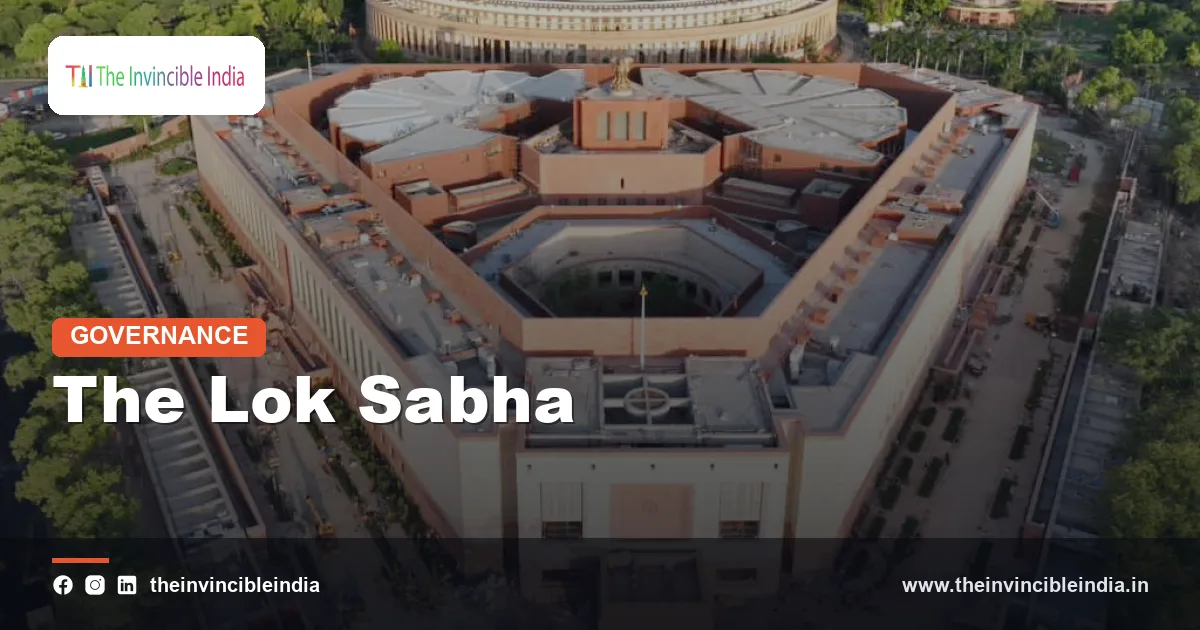
The Lok Sabha, literally the “House of the People”, is the lower house of India’s Parliament and the chamber where the will of the electorate is most directly expressed. Its members are chosen by citizens in general elections, it decides which party or coalition can form the government, and it holds that government accountable day after day. When people talk about “Parliament passing a law” or “the government losing its majority”, they are usually talking about what happens on the floor of the Lok Sabha.
Together with the Rajya Sabha and the President, the Lok Sabha forms the Union Parliament described in Part V of the Constitution. Of the two houses, it is the more powerful one, especially on money matters and in the life of the executive. This explainer walks through how the Lok Sabha is built, how its members are elected, what the Speaker does, how sessions run and where it stands in relation to the Rajya Sabha.
Quick Facts
| Feature | Detail |
|---|---|
| Constitutional basis | Part V of the Constitution (Articles 79 to 122; strength under Article 81) |
| Also called | House of the People; the lower house of Parliament |
| Maximum strength | 552 (up to 530 from States and up to 20 from Union Territories, plus 2 formerly nominated) |
| Elected seats in practice | 543 members |
| Mode of election | Direct, by universal adult suffrage; first-past-the-post in single-member constituencies |
| Normal term | Five years from its first sitting, unless dissolved earlier |
| Presiding officer | The Speaker, assisted by the Deputy Speaker |
| Minimum age to contest | 25 years (the voting age is 18) |
| First Lok Sabha constituted | 1952, after the first general election of 1951-52 |
What Is the Lok Sabha and Where Does It Fit?
India follows the parliamentary system, in which the executive is drawn from the legislature and answers to it. Article 79 of the Constitution says that the Union Parliament consists of the President and two houses, the Council of States (Rajya Sabha) and the House of the People (Lok Sabha). While the Rajya Sabha represents the States and Union Territories and is a permanent body that is never dissolved, the Lok Sabha represents the people at large and is renewed through general elections.
The name reflects the philosophy behind the chamber. The framers of the Constitution wanted at least one house whose members would owe their seats directly to voters, without any intermediary electoral college. That is why the Lok Sabha is described as the popular chamber. The first Lok Sabha assembled in April 1952, after the country’s first general election, and the numbering of Lok Sabhas has continued ever since, with each newly elected house being counted as the next one in the sequence.
Why the lower house holds the real levers
- The Prime Minister must, in convention and practice, command the confidence of a majority in the Lok Sabha.
- The Council of Ministers is collectively responsible to this house, not to the Rajya Sabha.
- Money bills and the annual budget can only originate here.
- In a deadlock between the houses over an ordinary bill, the larger numbers of the Lok Sabha tend to prevail in a joint sitting.
Composition and Strength of the Lok Sabha
Article 81 sets the ceiling for the size of the house. Not more than 530 members can be chosen from the States, and not more than 20 members can be chosen from the Union Territories, which gives a maximum of 550 elected members. Earlier, the Constitution also allowed the President to nominate two members of the Anglo-Indian community if he or she felt the community was inadequately represented, which brought the theoretical maximum to 552. That nomination provision was discontinued by the 104th Constitutional Amendment, which took effect in January 2020, so the house now consists only of elected members.
In practice, the number of elected seats has been fixed at 543 for a long time. The allocation of seats among the States is based on population, but the Constitution froze the number of seats on the basis of the 1971 census, so that States which did well in population control would not lose representation. The 84th Amendment of 2001 extended the freeze on readjusting the total seats and their distribution until the first census taken after the year 2026.
Seats through the decades
- The first Lok Sabha of 1952 had 489 seats.
- The strength was raised over the years as States were reorganised and the population grew, reaching 543 elected seats by the 1970s.
- Delimitation commissions redraw constituency boundaries within States, but the total for each State has stayed frozen for decades.
Because constituencies vary widely in geography and population, some are compact urban seats while others cover vast, thinly populated regions. The Election Commission of India conducts the polls, while the Delimitation Commission is a separate body that adjusts boundaries and decides which seats are reserved.
How Members Are Elected: Constituencies and Reserved Seats
Every citizen aged 18 or above who is registered on the electoral roll can vote in a Lok Sabha election. The voting age was lowered from 21 to 18 by the 61st Amendment in 1988. To contest, a person must be a citizen of India and at least 25 years old, must not be barred by any disqualification such as certain convictions or holding an office of profit, and must be registered as a voter in some constituency of the country.
The country is divided into single-member territorial constituencies. Each constituency sends exactly one member to the house, and the candidate who gets more votes than any other candidate wins, even without an absolute majority of the votes cast. This is the first-past-the-post system, sometimes called the plurality system. It is simple to operate for an electorate of India’s size and usually produces clear winners, although it can also mean that the share of seats a party wins does not exactly match its share of votes.
Reserved seats for Scheduled Castes and Scheduled Tribes
Article 330 provides for the reservation of seats in the Lok Sabha for Scheduled Castes (SCs) and Scheduled Tribes (STs), roughly in proportion to their share in the population of each State or Union Territory. In these reserved constituencies, only candidates belonging to the concerned community may stand, but every voter in the constituency, whatever their community, takes part in choosing among them. The reservation was originally meant to last for ten years but has been extended several times by constitutional amendments, most recently by the 104th Amendment, which carried it forward to 2030.
These seats are not separate electorates. They are ordinary constituencies with a restriction on who can be a candidate.
Term, Extension and Dissolution
Under Article 83(2), the Lok Sabha continues for five years from the date of its first meeting, and the expiry of that period automatically dissolves the house. The five-year clock therefore begins not on the day of the election result but on the day the newly elected members meet for the first time.
Early dissolution
The President can dissolve the Lok Sabha before the end of its term, usually acting on the advice of the Prime Minister and the Council of Ministers. This has happened several times in the history of the republic, sometimes because a government lost its majority and no alternative could be formed, and sometimes because a ruling party chose to seek a fresh mandate.
Extension during an Emergency
While a Proclamation of Emergency is in operation, Parliament may by law extend the term of the Lok Sabha for a period of one year at a time. Such an extension cannot continue beyond six months after the Emergency has ended. The term of the house was extended in this way during the Emergency of the 1970s, which is why the fifth Lok Sabha ran longer than five years.
What happens to pending business?
- A bill pending in the Lok Sabha lapses when the house is dissolved.
- A bill that has been passed by the Lok Sabha but is pending in the Rajya Sabha also lapses.
- A bill pending in the Rajya Sabha that has not yet been passed by the Lok Sabha does not lapse, since the Rajya Sabha is not dissolved.
The Speaker and Deputy Speaker
Article 93 requires the Lok Sabha to choose two of its members as Speaker and Deputy Speaker as soon as may be. Both are elected by the members from among themselves, usually after each general election, by a simple majority of members present and voting. By tradition, a pro tem Speaker first administers the oath to new members before the election of the regular Speaker. The first Speaker of the Lok Sabha was G. V. Mavalankar, often called the father of the Lok Sabha.
Role and powers of the Speaker
- Presides over sittings, decides who may speak and for how long, and maintains order and decorum in the chamber.
- Interprets the Constitution and the Rules of Procedure as they apply to the house; the Speaker’s rulings on procedure are generally final.
- Does not vote in the first instance but has a casting vote in the case of a tie.
- Decides whether a bill is a money bill, and the Speaker’s certificate on this point is final under Article 110.
- Presides over a joint sitting of the two houses of Parliament.
- Decides questions of disqualification of members on grounds of defection under the Tenth Schedule.
- Acts as the guardian of the rights and privileges of the house and its committees, and nominates the chairpersons of many of its committees.
Tenure, removal and the Deputy Speaker
The Speaker stays in office until the first meeting of the next Lok Sabha, even if the house is dissolved, which ensures continuity. The Speaker can be removed by a resolution passed by a majority of all the then members of the house, and fourteen days’ notice of the resolution is required. While such a resolution is under consideration, the Speaker may attend and speak but cannot preside. The Deputy Speaker performs the Speaker’s duties when the office is vacant or the Speaker is absent, and by convention the post has often been offered to the opposition side.
| Aspect | Speaker |
|---|---|
| Constitutional articles | Article 93 (election), 94 (vacation, resignation, removal), 95 and 96 (duties and restrictions) |
| Elected by | Members of the Lok Sabha from among themselves |
| Removal | Resolution by a majority of all members, on 14 days’ notice |
| Vote in the house | Only a casting vote, in a tie |
| Salary | Charged on the Consolidated Fund of India |
| Special duties | Certifies money bills; presides over joint sittings |
Control over the Government: Collective Responsibility
The most important function of the Lok Sabha is not merely to pass laws but to hold the executive answerable. Article 75(3) says that the Council of Ministers is collectively responsible to the House of the People. This means that the ministry rises and falls together, and that it can remain in office only so long as it enjoys the confidence of a majority of the Lok Sabha.
Tools of accountability
- Questions: Members can put questions to ministers on any matter of public administration.
- Debates and motions: Discussion on the President’s Address, on the budget and on important issues gives members chances to critique policy.
- Committees: Standing committees, the Public Accounts Committee and the Estimates Committee examine expenditure and administration in detail.
- No-confidence motion: A motion that “this house has no confidence in the Council of Ministers” can be moved with the support of the required number of members. If it is carried by a majority, the government must resign.
The no-confidence motion is unique to the Lok Sabha; it cannot be moved in the Rajya Sabha. Likewise, the defeat of a major government measure, such as the budget or a confidence vote, is treated in the parliamentary tradition as a sign that the government has lost the house’s trust.
The Lok Sabha also has a role in other constitutional processes. Its elected members take part in electing the President, its members join those of the Rajya Sabha in electing the Vice-President, and it participates in the removal of judges and in other processes that require the consent of both houses.
Money Bills and the Budget
Financial matters are where the supremacy of the Lok Sabha is clearest. Article 109 provides that a money bill cannot be introduced in the Rajya Sabha; it can only be introduced in the Lok Sabha, and only on the recommendation of the President. Article 110 defines a money bill as one dealing solely with matters such as taxation, borrowing by the government, and the custody and expenditure of money from the Consolidated Fund of India.
The limited role of the Rajya Sabha
After the Lok Sabha passes a money bill, it is sent to the Rajya Sabha, which can only make recommendations. The Rajya Sabha must return the bill within fourteen days. The Lok Sabha may then accept or reject any of those recommendations, and if the Rajya Sabha does not return the bill in time, it is deemed to have been passed by both houses in the form in which the Lok Sabha passed it.
The annual financial statement
Under Article 112, the President causes an annual financial statement, the Union Budget, to be laid before Parliament each year. It is presented in the Lok Sabha. Demands for grants, which authorise spending by different ministries, are voted upon by the Lok Sabha alone; the Rajya Sabha may discuss the budget but does not vote on those demands. Members may also move cut motions to reduce the amount of a demand, which are seen as a way of drawing attention to a particular policy or expenditure. The Appropriation Bill, which authorises the withdrawal of money from the Consolidated Fund, and the Finance Bill, which gives effect to tax proposals, follow the same pattern.
Because money is the lifeblood of any government, control over the budget is one of the strongest levers the house has over the executive. A government that cannot get its budget passed cannot function.
Lok Sabha vs Rajya Sabha: A Comparison
The two houses complement each other but are not equal. The Rajya Sabha provides a federal voice and a chance for more reflective scrutiny, while the Lok Sabha holds the decisive power over the government and finances.
| Feature | Lok Sabha | Rajya Sabha |
|---|---|---|
| Also known as | House of the People | Council of States |
| Maximum strength | 552 (530 States + 20 UTs + 2 formerly nominated) | 250 (238 representatives + 12 nominated) |
| Mode of election | Direct, by the people | Indirect, by elected members of State legislatures (and some UT bodies) |
| Dissolution | Can be dissolved | Permanent house; one-third of members retire every two years |
| Members’ term | Five years | Six years |
| Minimum age | 25 years | 30 years |
| Presiding officer | Speaker | Chairman (the Vice-President of India, ex officio) |
| Money bills | Introduced and finally decided here | Can only recommend changes within 14 days |
| No-confidence motion | Can be moved; ministry is responsible to it | Cannot be moved |
| Demands for grants | Votes on them | Does not vote |
Joint sittings
Under Article 108, when the two houses disagree over an ordinary bill, and certain conditions are met, the President may summon a joint sitting of both houses, presided over by the Speaker. The matter is then decided by a majority of the total members present and voting. Because the Lok Sabha has more than twice as many members as the Rajya Sabha, its view generally prevails. Joint sittings do not apply to money bills, which the Lok Sabha decides on its own, nor to constitutional amendment bills, which must be passed by both houses separately. Only three joint sittings have been held in India’s history, on the Dowry Prohibition Bill in 1961, the Banking Service Commission Repeal Bill in 1978 and the Prevention of Terrorism Bill in 2002.
Sessions, Quorum, Question Hour and Motions
The President summons Parliament, and Article 85 requires that no more than six months pass between the last sitting of one session and the first sitting of the next. In practice, the Lok Sabha meets in three main sessions each year.
- Budget Session: The longest session, generally beginning early in the year and stretching into spring. It opens with the President’s Address and includes the presentation and passing of the Union Budget.
- Monsoon Session: Held roughly between July and September, devoted largely to legislative business and discussion of current issues.
- Winter Session: A shorter session usually held in the last part of the year, running into December.
Quorum
Article 100 fixes the quorum, the minimum number of members needed to conduct business, at one-tenth of the total membership of the house. If the quorum is missing, the presiding officer must adjourn the house or suspend the meeting until a quorum is present.
Question Hour and Zero Hour
The first hour of a normal sitting is traditionally reserved for Question Hour, when ministers answer questions put by members. Questions are of different types: starred questions, which require an oral answer and allow supplementary questions; unstarred questions, which receive written replies; and short notice questions, which concern matters of urgent public importance and can be asked with less than the usual notice. Question Hour is one of the most direct tools for scrutiny of the government’s work.
Zero Hour is not mentioned in the rulebook but is a parliamentary innovation of India. It refers to the time immediately after Question Hour when members can raise matters of urgent public importance without prior notice, subject to the Speaker’s permission. Together, the two make the first part of a sitting a lively window into the country’s concerns.
Types of motions in brief
A motion is a formal proposal placed before the house for a decision. The Lok Sabha considers several types, each with its own purpose.
- Motion of thanks: A debate on the President’s Address to Parliament, in which the government’s policies are discussed and which must be passed.
- Adjournment motion: Seeks to draw the house’s attention to a definite matter of urgent public importance, and if admitted, it interrupts regular business.
- Calling attention notice: Brings a matter of urgent public importance to a minister’s notice, and the minister then makes a statement.
- No-confidence motion: Tests whether the government retains the confidence of the house.
- Censure motion: Expresses disapproval of a particular policy or act of the government.
- Privilege motion: Raised when a member believes that the privileges of the house or a member have been breached.
- Cut motions: Moved on demands for grants to reduce the amount, as a form of protest or to seek economy.
Beyond motions, the house also passes resolutions, and it holds discussions on subjects such as the working of ministries and short-duration issues. Private members may also introduce bills and resolutions on specified days, although very few private members’ bills have become law.
The Anti-Defection Law and the Lok Sabha
Party discipline is a central feature of Indian parliamentary life, and it was given legal force by the Tenth Schedule of the Constitution, inserted by the 52nd Amendment in 1985. The law aims to prevent elected members from changing sides for personal gain, which had destabilised governments in earlier decades.
When can a member be disqualified?
- If a member voluntarily gives up membership of the party on whose ticket he or she was elected.
- If a member votes or abstains from voting in the house contrary to the party’s direction, without prior permission and without the party condoning it within fifteen days.
- If an independent member joins a political party after being elected.
- If a nominated member joins a party after the expiry of six months from taking a seat.
The Speaker’s decisive role
Questions of disqualification under the Tenth Schedule are decided by the presiding officer of the house, which in the Lok Sabha is the Speaker. In Kihoto Hollohan v. Zachillhu in 1992, the Supreme Court held that the Speaker’s decision acts as a tribunal and is subject to judicial review, although courts would not ordinarily interfere at an interim stage. The 91st Amendment in 2003 removed the earlier exception that protected a split of one-third of a party’s legislators, and it now permits protection only in the case of a merger of at least two-thirds of the legislature party with another party.
The law has been praised for bringing stability and criticised for restricting the independence of individual members, and it remains an important topic in Indian constitutional discussion.
Conclusion
The Lok Sabha is the democratic engine of the Union Parliament. It is elected directly by the people, decides which government can stay in power, controls the purse strings and, through the Speaker’s office, follows a body of rules and traditions that has grown since 1952. Its structure, with 543 elected seats, single-member constituencies, reserved seats for SCs and STs and a five-year term, reflects both the size and the diversity of the country. Understanding how it works is the first step to understanding how India is governed. Last reviewed: 30 September 2026.
Frequently Asked Questions
How many members does the Lok Sabha have?
The Constitution allows a maximum strength of 552, made up of up to 530 members from the States and up to 20 from the Union Territories, plus two nominated Anglo-Indian members. The nomination provision was discontinued by the 104th Amendment in 2020, and the house currently has 543 elected seats.
How long is the term of the Lok Sabha?
The normal term is five years from the date of its first meeting, after which the house stands dissolved. The President can dissolve it earlier, and during a national Emergency Parliament can extend its term by one year at a time, though not beyond six months after the Emergency ends.
How is the Speaker of the Lok Sabha chosen and removed?
The Speaker is elected by the members of the Lok Sabha from among themselves, usually soon after the house first meets following a general election. The Speaker can be removed by a resolution passed by a majority of all the then members of the house, moved after giving fourteen days’ notice.
Why is the Lok Sabha considered more powerful than the Rajya Sabha?
The Council of Ministers is collectively responsible to the Lok Sabha, which alone can vote a government out through a no-confidence motion. Money bills can only be introduced in the Lok Sabha, the Rajya Sabha can only make recommendations on them, and in a joint sitting the larger strength of the Lok Sabha usually prevails.
What is the difference between Question Hour and Zero Hour?
Question Hour is the formally recognised first hour of a sitting in which ministers answer questions from members, either orally or in writing. Zero Hour is an informal, uniquely Indian practice that follows it, allowing members to raise urgent matters of public importance without prior notice, with the Speaker’s permission.
What does the anti-defection law say about Lok Sabha members?
The Tenth Schedule, added in 1985, provides for disqualification of a member who voluntarily gives up party membership or defies the party whip on a vote. The Speaker decides such cases, subject to judicial review, and the protection for a party split was removed in 2003, leaving only a merger of two-thirds of the legislature party as an exception.
{“@context”:”https://schema.org”,”@graph”:[{“@type”:”FAQPage”,”mainEntity”:[{“@type”:”Question”,”name”:”How many members does the Lok Sabha have?”,”acceptedAnswer”:{“@type”:”Answer”,”text”:”The Constitution allows a maximum strength of 552, made up of up to 530 members from the States and up to 20 from the Union Territories, plus two nominated Anglo-Indian members. The nomination provision was discontinued by the 104th Amendment in 2020, and the house currently has 543 elected seats.”}},{“@type”:”Question”,”name”:”How long is the term of the Lok Sabha?”,”acceptedAnswer”:{“@type”:”Answer”,”text”:”The normal term is five years from the date of its first meeting, after which the house stands dissolved. The President can dissolve it earlier, and during a national Emergency Parliament can extend its term by one year at a time, though not beyond six months after the Emergency ends.”}},{“@type”:”Question”,”name”:”How is the Speaker of the Lok Sabha chosen and removed?”,”acceptedAnswer”:{“@type”:”Answer”,”text”:”The Speaker is elected by the members of the Lok Sabha from among themselves, usually soon after the house first meets following a general election. The Speaker can be removed by a resolution passed by a majority of all the then members of the house, moved after giving fourteen days’ notice.”}},{“@type”:”Question”,”name”:”Why is the Lok Sabha considered more powerful than the Rajya Sabha?”,”acceptedAnswer”:{“@type”:”Answer”,”text”:”The Council of Ministers is collectively responsible to the Lok Sabha, which alone can vote a government out through a no-confidence motion. Money bills can only be introduced in the Lok Sabha, the Rajya Sabha can only make recommendations on them, and in a joint sitting the larger strength of the Lok Sabha usually prevails.”}},{“@type”:”Question”,”name”:”What is the difference between Question Hour and Zero Hour?”,”acceptedAnswer”:{“@type”:”Answer”,”text”:”Question Hour is the formally recognised first hour of a sitting in which ministers answer questions from members, either orally or in writing. Zero Hour is an informal, uniquely Indian practice that follows it, allowing members to raise urgent matters of public importance without prior notice, with the Speaker’s permission.”}},{“@type”:”Question”,”name”:”What does the anti-defection law say about Lok Sabha members?”,”acceptedAnswer”:{“@type”:”Answer”,”text”:”The Tenth Schedule, added in 1985, provides for disqualification of a member who voluntarily gives up party membership or defies the party whip on a vote. The Speaker decides such cases, subject to judicial review, and the protection for a party split was removed in 2003, leaving only a merger of two-thirds of the legislature party as an exception.”}}]}]}


