

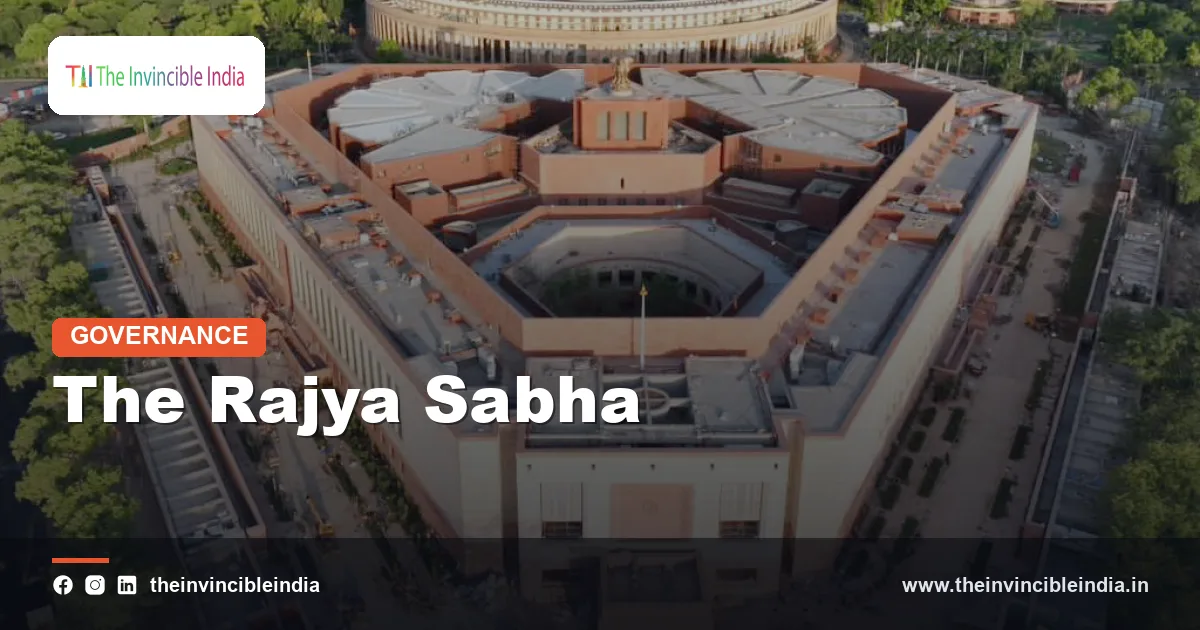
The Rajya Sabha, literally the “Council of States”, is the upper house of India’s Parliament. Where the Lok Sabha speaks for the people directly, the Rajya Sabha speaks for the states and union territories that together make up the Indian Union. It is a house of review and reflection, designed to slow down hasty lawmaking, bring experienced voices into the legislative process and give the federal units of the country a permanent seat at the national table.
Unlike the Lok Sabha, the Rajya Sabha is never dissolved. It renews itself gradually, one-third of its members at a time, which gives Indian democracy an element of continuity even when a general election changes the government. This explainer walks through how the house came into being, who sits in it, how they are chosen, what powers it holds, where it differs from the Lok Sabha, and why it matters for Indian federalism. It was last reviewed on 30 September 2026.
Rajya Sabha at a Glance: Quick Facts
| Feature | Detail |
|---|---|
| Official name | Rajya Sabha (Council of States) |
| Constitutional basis | Articles 79, 80, 83 and 89 of the Constitution of India |
| First constituted | 3 April 1952 (first sitting on 13 May 1952) |
| Maximum strength | 250 members (238 representing states and union territories, 12 nominated by the President) |
| Method of election | Elected members of State Legislative Assemblies, by proportional representation using the single transferable vote |
| Term of a member | Six years, with one-third of the house retiring every second year |
| Dissolution | Never dissolved; a permanent house |
| Presiding officer | Chairman, who is the Vice-President of India (ex officio) |
| Minimum age to be a member | 30 years |
Origins and Name of the Rajya Sabha
The idea of a second chamber in India goes back to the colonial period. The Government of India Act 1919 created a Council of State alongside the Central Legislative Assembly, and the Government of India Act 1935 planned a federal legislature with two houses. When the Constituent Assembly took up the question after independence, its members debated at length whether a country of India’s size needed an upper house at all. The argument that prevailed was practical. A large, diverse federation needed a chamber that could represent the states, offer second thoughts on legislation passed in the heat of popular politics, and provide a home for distinguished individuals who might not wish to fight direct elections.
Article 79 of the Constitution therefore says that Parliament consists of the President and two Houses, the Council of States and the House of the People. The Rajya Sabha was first constituted on 3 April 1952, following the first general elections, and held its first sitting on 13 May 1952. Dr Sarvepalli Radhakrishnan, then Vice-President, became its first Chairman.
Why “Rajya Sabha”?
The Constitution’s own English name is the Council of States. On 23 August 1954 the Chairman announced that the house would henceforth be known by the Hindi name Rajya Sabha, and the Lok Sabha adopted its own Hindi name shortly afterwards. Both names are now used across official and public life.
Composition and Strength of the Council of States
Article 80 sets the outer limit of the Rajya Sabha at 250 members. Of these, up to 238 represent the states and union territories, and 12 are nominated by the President. The actual number of elected seats has varied over the decades as states were reorganised, new states were created and populations changed, so the exact figure at any given time depends on the Fourth Schedule of the Constitution.
How seats are shared
Seats are not divided equally among states, as they are in the United States Senate. They are allotted broadly in proportion to population, which means larger states send many more members than smaller ones. Uttar Pradesh, for instance, has the largest delegation, while small states send only a handful of members. This design reflects the Indian view that the upper house should represent the states while still respecting demographic weight. Some union territories, including Delhi and Puducherry, also have representation, and the arrangement for Jammu and Kashmir was revised after the 2019 reorganisation.
Twelve nominated members
The President nominates 12 persons who have special knowledge or practical experience in literature, science, art and social service. On the advice of the government, these seats have been used to bring into Parliament writers, scientists, artists, musicians, sportspersons and social workers who might never have entered electoral politics. Nominated members can take part in debates and vote on ordinary legislation just like elected ones, but they do not vote in the election of the President of India. They may, however, vote in the election of the Vice-President.
How Members of the Rajya Sabha Are Elected
Members representing the states are not elected by the general public. They are chosen by the elected members of the State Legislative Assemblies. This indirect method is a key reason the Rajya Sabha is described as the voice of the states rather than of the electorate at large.
Proportional representation and the single transferable vote
The election follows the system of proportional representation by means of the single transferable vote (STV). Each voting legislator ranks candidates in order of preference. A candidate must secure a fixed quota of votes to win, and surplus or eliminated votes are transferred according to the voters’ next preferences. When several seats from one state fall vacant together, the method allows parties to win seats broadly in proportion to their strength in the Assembly, rather than one party sweeping every seat.
Eligibility
- The candidate must be a citizen of India.
- The candidate must be at least 30 years old, compared with 25 for the Lok Sabha.
- The candidate must not hold an office of profit and must not be disqualified under the Constitution or by law.
- Until 2003, a candidate had to be an ordinary resident of the state from which he or she was contesting. That requirement was removed by an amendment to the Representation of the People Act.
Members representing a union territory that has a legislature are chosen by an electoral college created for that purpose. A casual vacancy caused by death or resignation is filled through a by-election, and the new member serves only the remainder of the predecessor’s term.
A Permanent House: Terms and Rotation
Article 83 states that the Council of States is not subject to dissolution. This is one of the most distinctive features of the house and separates it sharply from the Lok Sabha, which runs for five years unless dissolved earlier. The Rajya Sabha exists continuously from the day it was first constituted.
The rule of one-third
Every member serves a term of six years, but the terms are staggered. As nearly as possible, one-third of the members retire every second year, and elections are held to fill their seats. In practice, this means there is a round of Rajya Sabha elections roughly every two years, with each state’s seats falling due in a rotating cycle. A member who retires is eligible to be re-elected.
Why permanence matters
The staggered structure means that a change of government in a single general election does not immediately change the balance of the upper house. It also ensures institutional memory. A substantial proportion of members are always experienced legislators who have seen earlier debates. This continuity is valuable when a new Lok Sabha assembles and needs a stable partner in the legislature, and it also means that a government without a majority in the upper house may find it harder to pass its agenda quickly.
Even during a national emergency, the constitutional provision that can extend the life of the Lok Sabha applies only to that house; the Rajya Sabha has no fixed life to extend.
Chairman, Deputy Chairman and Officers of the House
Under Article 89, the Vice-President of India is the ex officio Chairman of the Rajya Sabha. This is a unique arrangement in the Indian system, because the Chairman is not a member of the house. The Chairman presides over sittings, maintains order, decides points of procedure and ensures the rules of the house are followed. The Chairman does not vote in the first instance but has a casting vote in the event of a tie.
The Deputy Chairman
The house elects one of its own members as Deputy Chairman. The Deputy Chairman presides in the absence of the Chairman and also when the Vice-President is discharging the functions of the President. In addition, the house maintains a panel of Vice-Chairmen who can chair proceedings when required.
Other key figures
- Leader of the House: a minister, usually a senior member of the Cabinet, who represents the government in the house and helps organise its business.
- Leader of the Opposition: the leader of the largest party not in government, who speaks for the opposition.
- Secretary-General: the senior permanent official who heads the Rajya Sabha Secretariat and advises the Chairman on procedure.
The Vice-President can be removed from office only by a resolution passed by the Rajya Sabha by a majority of all its then members and agreed to by the Lok Sabha. This is one of the few matters in which the upper house takes the lead.
Legislative Powers of the Rajya Sabha
For ordinary legislation, the Rajya Sabha is largely co-equal with the Lok Sabha. A bill other than a money bill can be introduced in either house, and it must be passed by both before it goes to the President for assent. Ministers can be drawn from either house, and both can discuss policy, ask questions and set up committees.
Resolving disagreements
If the two houses cannot agree on an ordinary bill, Article 108 allows the President to summon a joint sitting, which is presided over by the Speaker of the Lok Sabha. Because the Lok Sabha has far more members, the government of the day usually prevails in a joint sitting, but it remains a rare tool. Joint sittings have been held only three times: in 1961 for the Dowry Prohibition Bill, in 1978 for the Banking Services Commission (Repeal) Bill and in 2002 for the Prevention of Terrorism Bill. A joint sitting cannot be used for a money bill or a constitutional amendment bill.
Constitutional amendments and other roles
- A constitutional amendment under Article 368 must be passed by both houses by the required special majority, so the Rajya Sabha has a full and equal say.
- Both houses take part in the impeachment of the President and the removal of judges of the Supreme Court and High Courts.
- Elected members of the Rajya Sabha are part of the electoral college that elects the President, and all members vote in the election of the Vice-President.
- A proclamation of national emergency or of President’s Rule in a state must be approved by both houses.
Money Bills: Where the Rajya Sabha’s Power Is Limited
The Constitution deliberately restricts the upper house in financial matters. Article 110 defines a money bill as one dealing with taxation, government borrowing, the Consolidated Fund of India and similar financial subjects, and the Speaker of the Lok Sabha certifies whether a bill qualifies. A money bill can be introduced only in the Lok Sabha.
The 14-day rule
Once the Lok Sabha passes a money bill, it is sent to the Rajya Sabha, which has a maximum of 14 days to return it with recommendations. Under Article 109, the Lok Sabha is free to accept or reject any of these recommendations. If the Rajya Sabha does not return the bill within 14 days, it is deemed to have been passed by both houses in the form in which the Lok Sabha passed it. In effect, the Rajya Sabha can debate, suggest and delay by at most a fortnight, but it cannot block.
The reasoning
The principle is that control over the government’s purse belongs to the house that is directly elected and to which the government is answerable. The same reasoning explains why the demands for grants in the annual budget are voted on only in the Lok Sabha, although the Rajya Sabha may discuss the budget in general terms.
Alongside this, the Rajya Sabha has no role in bringing down the government. The Council of Ministers is collectively responsible only to the Lok Sabha, under Article 75(3), and a motion of no confidence can be moved and voted on only there. An adverse vote in the Rajya Sabha, however embarrassing, does not force a government to resign.
Special Powers: Article 249 and Article 312
Although the Rajya Sabha is weaker than the Lok Sabha on money bills and confidence votes, the Constitution also gives it two exclusive powers that the Lok Sabha does not share. Both are tied to its role as the representative of the states.
Article 249: legislating on a State List subject
India’s Seventh Schedule divides subjects into the Union List, the State List and the Concurrent List. Normally Parliament cannot legislate on State List subjects. Article 249 creates an exception. If the Rajya Sabha passes a resolution supported by not less than two-thirds of the members present and voting, declaring that it is necessary or expedient in the national interest for Parliament to make laws on a matter in the State List, Parliament becomes competent to do so.
- The resolution remains in force for a period of up to one year and can be renewed for further periods of one year at a time.
- Any law made under it ceases to have effect six months after the resolution lapses.
- Because the initiative lies with the house that represents the states, the provision is seen as a safeguard for federalism rather than a threat to it.
Article 312: creating All India Services
Article 312 allows Parliament to create new All India Services, common to the Union and the states, if the Rajya Sabha passes a resolution by a two-thirds majority of members present and voting that it is in the national interest. The Indian Administrative Service and the Indian Police Service were already recognised at the start of the Constitution, and the Indian Forest Service was created in 1966 under this framework. The requirement of a Rajya Sabha resolution ensures that the states, which will host and share the control of such services, have a voice in creating them.
The Rajya Sabha as Revising Chamber and Voice of the States
Beyond its formal powers, the Rajya Sabha performs several practical roles in Indian democracy that are easy to overlook.
A house of review
Bills coming from the Lok Sabha get a second reading in a smaller, more deliberative setting. The house can suggest amendments, refer bills to committees and expose weaknesses in drafting. Because members are not facing direct election every five years, many argue that they can take a longer view of legislation. Many important debates on economic and social policy have taken place here.
A federal voice
Members elected from a state carry that state’s concerns to the national stage. Questions on water sharing, central funds, natural disasters, language and regional development are regularly raised in the house. Although party discipline often shapes how members vote, the very structure of the house keeps state-level interests in the conversation.
A home for expertise and continuity
Nominated members and experienced statespersons bring specialised knowledge to the house. The house has also been an important route for leaders who did not contest direct elections. Indira Gandhi, H. D. Deve Gowda, I. K. Gujral and Manmohan Singh were all members of the Rajya Sabha when they served as Prime Minister, showing that the upper house can supply the head of the government as well.
Rajya Sabha vs Lok Sabha: The Key Differences
The two houses share the task of making laws but differ in composition, tenure and powers. The table below summarises the main contrasts.
| Point of comparison | Rajya Sabha | Lok Sabha |
|---|---|---|
| Meaning | Council of States, upper house | House of the People, lower house |
| Represents | States and union territories | The people of India directly |
| Maximum strength | 250 (238 elected/representative + 12 nominated) | Larger; well over 500 members |
| Election | Indirect, by state legislators through STV | Direct, by adult citizens through first-past-the-post |
| Term | Six years for each member; house is permanent | Five years unless dissolved earlier |
| Dissolution | Not subject to dissolution | Can be dissolved by the President |
| Minimum age | 30 years | 25 years |
| Presiding officer | Chairman (the Vice-President), with a Deputy Chairman | Speaker and Deputy Speaker, elected from among members |
| Money bills | Can only recommend changes within 14 days | Has the final say; only house where they are introduced |
| No-confidence motion | Cannot be moved | Can be moved and can remove the government |
| Ordinary bills | Equal power, with joint sitting in case of deadlock | Equal power, with joint sitting in case of deadlock |
| Special powers | Articles 249 and 312 resolutions | Not available |
The differences are best understood together. The Lok Sabha holds the power over the government and the budget, because that is where democratic accountability is strongest. The Rajya Sabha holds continuity, federal representation and the special constitutional levers that connect Parliament to the states.
Conclusion
The Rajya Sabha is often overshadowed by the more visible Lok Sabha, but its place in the Constitution is deliberate and important. It gives the states a voice in national lawmaking, ensures that legislation is examined by a second body, and provides a stable and permanent institution that survives every general election. Its powers are balanced with care. It matches the Lok Sabha on most legislation and constitutional amendments, yields on money and confidence, and alone holds the keys to Articles 249 and 312.
For students, voters and anyone following Indian politics, understanding the Rajya Sabha is essential to understanding how Indian federalism actually works. It is a chamber where the balance between the Union and the states is discussed, negotiated and, when necessary, adjusted through law.
Frequently Asked Questions
What is the maximum strength of the Rajya Sabha?
The Constitution sets the maximum strength at 250 members. Of these, 238 represent the states and union territories, and 12 are nominated by the President from among people with special knowledge or experience in art, literature, science and social service.
How are Rajya Sabha members elected?
Members from the states are elected by the elected members of the State Legislative Assemblies. The election uses proportional representation by the single transferable vote, in which voters rank candidates in order of preference. Representatives of union territories with legislatures are chosen through a similar process by an electoral college.
Can the Rajya Sabha be dissolved?
No. The Rajya Sabha is a permanent house and is not subject to dissolution. Each member serves a six-year term, and one-third of the members retire every second year, so the house is renewed continuously in stages.
Can the Rajya Sabha reject a money bill?
No, not in a way that stops it. A money bill can be introduced only in the Lok Sabha, and the Rajya Sabha can only return it with recommendations within 14 days. The Lok Sabha may accept or reject those recommendations, and if the Rajya Sabha does not act in time, the bill is deemed passed.
What are the special powers of the Rajya Sabha?
Two powers belong to the Rajya Sabha alone. Under Article 249, a two-thirds resolution allows Parliament to legislate on a State List subject in the national interest. Under Article 312, a similar resolution allows Parliament to create a new All India Service.
Can the Rajya Sabha bring down the government?
No. The Council of Ministers is collectively responsible only to the Lok Sabha, and a no-confidence motion can be moved only there. The Rajya Sabha can criticise the government, question ministers and vote against its bills, but it cannot force the government to resign.
{“@context”:”https://schema.org”,”@graph”:[{“@type”:”FAQPage”,”mainEntity”:[{“@type”:”Question”,”name”:”What is the maximum strength of the Rajya Sabha?”,”acceptedAnswer”:{“@type”:”Answer”,”text”:”The Constitution sets the maximum strength at 250 members. Of these, 238 represent the states and union territories, and 12 are nominated by the President from among people with special knowledge or experience in art, literature, science and social service.”}},{“@type”:”Question”,”name”:”How are Rajya Sabha members elected?”,”acceptedAnswer”:{“@type”:”Answer”,”text”:”Members from the states are elected by the elected members of the State Legislative Assemblies. The election uses proportional representation by the single transferable vote, in which voters rank candidates in order of preference. Representatives of union territories with legislatures are chosen through a similar process by an electoral college.”}},{“@type”:”Question”,”name”:”Can the Rajya Sabha be dissolved?”,”acceptedAnswer”:{“@type”:”Answer”,”text”:”No. The Rajya Sabha is a permanent house and is not subject to dissolution. Each member serves a six-year term, and one-third of the members retire every second year, so the house is renewed continuously in stages.”}},{“@type”:”Question”,”name”:”Can the Rajya Sabha reject a money bill?”,”acceptedAnswer”:{“@type”:”Answer”,”text”:”No, not in a way that stops it. A money bill can be introduced only in the Lok Sabha, and the Rajya Sabha can only return it with recommendations within 14 days. The Lok Sabha may accept or reject those recommendations, and if the Rajya Sabha does not act in time, the bill is deemed passed.”}},{“@type”:”Question”,”name”:”What are the special powers of the Rajya Sabha?”,”acceptedAnswer”:{“@type”:”Answer”,”text”:”Two powers belong to the Rajya Sabha alone. Under Article 249, a two-thirds resolution allows Parliament to legislate on a State List subject in the national interest. Under Article 312, a similar resolution allows Parliament to create a new All India Service.”}},{“@type”:”Question”,”name”:”Can the Rajya Sabha bring down the government?”,”acceptedAnswer”:{“@type”:”Answer”,”text”:”No. The Council of Ministers is collectively responsible only to the Lok Sabha, and a no-confidence motion can be moved only there. The Rajya Sabha can criticise the government, question ministers and vote against its bills, but it cannot force the government to resign.”}}]}]}


