

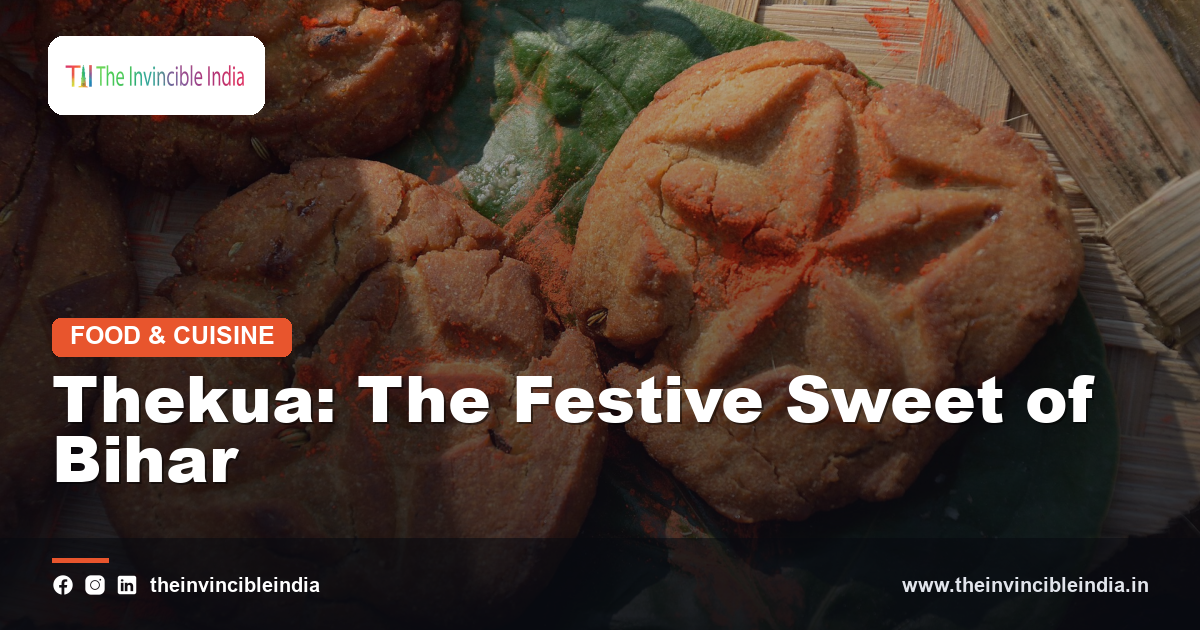
Thekua is a crisp, golden, lightly sweet delicacy of Bihar, made from wheat flour, jaggery and ghee and deep-fried into firm, long-keeping biscuits. Its surface is often pressed with decorative patterns from a carved wooden mould, and its taste combines the nuttiness of wheat with the warm caramel of jaggery. Most closely associated with the festival of Chhath Puja, it is also made for other celebrations and as a treat for travellers. Humble in ingredients yet rich in meaning, it holds a cherished position in Bihari cuisine. This guide explores thekua, its ingredients, its preparation, its symbolism and its lasting place in Indian food heritage.
Quick Facts
| Detail | Information |
|---|---|
| Type | Deep-fried wheat and jaggery sweet |
| Region | Bihar, with presence in Jharkhand and eastern Uttar Pradesh |
| Main ingredients | Whole wheat flour, jaggery, ghee |
| Flavourings | Cardamom, fennel, grated coconut |
| Festival link | Offered as prasad during Chhath Puja |
| Character | Crisp, firm, lightly sweet and long-lasting |
What Is Thekua
Thekua is a traditional sweet from the Bihar region, prepared by combining whole wheat flour with jaggery and ghee, shaping the dough into flat rounds or ovals, and deep-frying them until firm and golden brown. The finished pieces are crisp on the outside, slightly crumbly within and richly aromatic, with a flavour that balances wheat and caramelised sugar. Because they contain no milk or water-rich fillings, they remain good for many days, making them ideal for gifting and travel. Straightforward in its components but deeply satisfying in taste, thekua is a quintessential festive sweet of eastern India, loved for its rustic honesty.
Thekua and Chhath Puja
Thekua is most strongly associated with Chhath Puja, the major festival celebrated in Bihar, Jharkhand and parts of eastern Uttar Pradesh and the Nepal Terai, in which devotees offer prayers to the Sun. Thekua forms one of the principal offerings, prepared in advance by the household and placed in bamboo baskets along with fruit and other items for presentation at the riverside or water’s edge. After the offering, the thekua is distributed as prasad among family, friends and neighbours. Its importance in the rituals is so great that the festival is hardly imagined without it. As sacred prasad, thekua carries both religious significance and a deep emotional resonance for those who celebrate.
Origins and the Name
The precise origins of thekua are not documented, and like many folk sweets of the Gangetic plains, it developed through generations of home cooking rather than any recorded invention. The name is understood to derive from regional speech, and in some areas the sweet is known by other names, such as khajuria, in reference to its date-like sweetness or form in certain styles. What is certain is that the sweet is deeply rooted in agrarian life, since its main ingredients, wheat and jaggery, are staples of the region’s farms. This practical foundation explains its simplicity and durability, and it reveals thekua as a food shaped by landscape and rural tradition.
Wheat Flour as the Foundation
The base of thekua is whole wheat flour, known as atta, which gives the sweet its characteristic earthy flavour and firm, biscuit-like body. The flour is usually mixed with ghee in a process that coats the grains of flour in fat, creating a crumbly dough that becomes tender and crisp on frying. Wheat is among the principal grains of Bihar and the neighbouring plains, so it is natural that this staple should become the basis of a festive sweet. Some modern cooks mix in a little semolina for extra crispness, though the traditional version relies on atta alone. Wheat therefore gives thekua its body, its flavour and its strong link to the agricultural heartland of the region.
Jaggery and Its Sweetness
Jaggery, an unrefined cane sugar, supplies both the sweetness and the golden colour of thekua. It is usually melted in warm water to form a syrup, which is then used to bind the flour into dough, distributing the sweetness evenly. Jaggery brings a deep, slightly molasses-like flavour that refined sugar cannot replicate, and it has long been valued in Indian cooking and in festival food. Its use here reflects the region’s sugarcane-growing tradition and its preference for natural sweeteners in ritual offerings. The warmth and depth of jaggery are central to the taste of thekua, defining its flavour and giving it a character that is rustic yet immensely comforting.
Ghee and Flavourings
Ghee is essential to authentic thekua, contributing richness, aroma and the crumbly texture prized by those who make it. Many households use pure ghee both in the dough and, for festival preparations, sometimes for frying as well. The sweet is commonly flavoured with ground cardamom and fennel seeds, which add fragrance and a gentle freshness, and with grated dried coconut, which brings a mild nuttiness and texture. Some cooks also add a few chopped dry fruits or sesame seeds. These flavourings are used lightly so that the wheat and jaggery remain prominent. The modest, aromatic seasoning is what lifts thekua above a simple fried biscuit into a thoughtfully balanced festive sweet.
Making the Dough
The preparation of thekua begins with the dough. The flour is mixed with ghee until it resembles breadcrumbs, a stage often called moyan, and the jaggery syrup is then added gradually to bind it into a stiff, firm dough, much stiffer than that used for bread. The dough is kneaded briefly and left to rest so that the flour can absorb the liquid evenly. A stiff dough is crucial, since a soft one would absorb too much oil and lose its crispness. Getting the proportions and consistency right is a skill learned through experience, and it is the most important stage in producing perfect thekua.
The Wooden Mould
A distinctive feature of many thekua is the pattern pressed onto its surface by a carved wooden mould, sometimes called a sancha. The mould is dusted lightly, a piece of dough is pressed firmly into it, and the shaped piece is gently released, carrying floral, leaf or geometric designs. This decoration is both practical and beautiful, and it gives the sweet a recognisable, handcrafted look. Where moulds are not available, the dough is simply flattened and marked with the back of a fork or a knife. The patterned surface also fries to a slightly varied texture. The carved mould turns an ordinary fried sweet into an object of folk craftsmanship and household pride.
Frying to a Golden Finish
Once shaped, the pieces of thekua are deep-fried in ghee or oil over a gentle flame. Moderate heat is essential, because the dense, stiff dough must cook through to the centre without darkening on the outside. The pieces are turned occasionally until they reach an even golden-brown colour, then lifted out and left to cool and firm up. As they cool, they develop their characteristic crispness. Frying thekua demands patience and attention, as too high a flame would leave the interior raw while too low a flame would make them greasy. A properly fried thekua is evenly golden, crisp and fragrant, and it keeps well after cooling.
The Traditional Festive Preparation
The thekua prepared for Chhath is made with great care and observance. Households are cleaned thoroughly beforehand, and those preparing the offering follow strict rules of purity, using freshly washed ingredients and often cooking on a clay stove fuelled by wood. The wheat is washed and dried, then ground at home or at a trusted mill, and the sweets are made without tasting them, since they are first intended as an offering. Family members, neighbours and relatives often gather to help, turning the preparation into a communal event. This devotion in preparation gives festival thekua a special sanctity, setting it apart from the sweet made for ordinary enjoyment.
Thekua Beyond Chhath
Though most closely tied to Chhath, thekua is enjoyed throughout the year and at many other occasions. It is made for other festivals, given as a gift to guests and relatives and packed for journeys, thanks to its long shelf life. Many migrants from Bihar carry boxes of thekua with them as a reminder of home, and sweet shops across the region sell it daily. It is also served with tea as an everyday snack. This versatility has made thekua more than a ritual food, establishing it as a beloved symbol of Bihari identity and hospitality that travels well and brings comfort wherever it is eaten.
Regional Variations
Thekua differs subtly across the regions where it is made. In some places, it is larger and flatter, while in others it is smaller and thicker. Certain versions use more coconut or fennel, others emphasise cardamom, and a few add sesame or dry fruits. The balance of jaggery, the amount of ghee and the thickness of the pieces all vary by family and locality, giving each kitchen a signature taste. In some communities a sweeter, softer type is preferred, whereas others favour a harder, more biscuit-like version. These variations show the way a folk recipe adapts to taste while preserving its essential identity and ritual significance.
Storage and Shelf Life
One of the great practical advantages of thekua is its durability. Because it is made without milk or wet fillings and is fried until dry and firm, it can be stored for a considerable period in an airtight container without spoiling. This quality made it ideal for rural households in the past, when sweets had to survive travel and the absence of refrigeration. It remains valuable today for gifting and for sending to relatives living far away. Proper storage preserves its crispness, while exposure to damp air can soften it. The remarkable keeping quality of thekua is one reason it has remained a favourite for generations.
Nutritional Notes
Thekua is an energy-dense sweet, combining the complex carbohydrates of whole wheat with the natural sugars of jaggery and the fats of ghee. Whole wheat flour provides fibre, and jaggery is traditionally considered a more wholesome alternative to refined sugar in Indian food culture, though it remains a sugar and should be enjoyed in moderation. Cardamom and fennel are valued for their digestive properties in traditional practice. Because it is rich and filling, a small piece is usually sufficient. As a sweet made from simple, natural ingredients, thekua offers both comfort and sustenance, and fits naturally into festive eating when taken in measured amounts.
Thekua Today
Today, thekua continues to flourish, both as a sacred offering and as a popular snack and gift. Sweet shops, home bakers and small enterprises in Bihar and beyond make and sell it, and it is increasingly available in packaged form for distant customers. Some creators experiment with healthier or flavoured versions, yet the traditional jaggery and ghee recipe remains the most treasured. Its association with Chhath keeps it firmly rooted in religious and family life. As a humble yet meaningful emblem of Bihar’s food heritage, thekua endures as a sweet that unites devotion, community and the simple pleasures of home cooking.
Sources & Further Reading
- Ministry of Culture, Government of India (indiaculture.gov.in).
- Bihar Tourism, Government of Bihar (tourism.bihar.gov.in).
Frequently Asked Questions
What is thekua?
Thekua is a crisp, deep-fried sweet from Bihar made with whole wheat flour, jaggery and ghee. It is flavoured with cardamom, fennel and coconut and has a firm, biscuit-like texture.
Why is thekua important in Chhath Puja?
Thekua is one of the main offerings made to the Sun during Chhath Puja. After the offering, it is distributed as prasad among family, friends and neighbours.
What gives thekua its patterned surface?
Many thekua are pressed into a carved wooden mould, sometimes called a sancha, which imprints floral or geometric designs. Where no mould is available, the surface is marked with a fork or knife.
Does thekua stay fresh for long?
Yes, because it is fried dry and contains no milk or wet filling, thekua keeps well for many days in an airtight container. This durability makes it ideal for gifting and travel.
What is the difference between thekua and other fried sweets?
Thekua uses whole wheat flour and jaggery rather than refined flour and sugar syrup, giving it an earthy, caramel-like flavour. Its dough is stiff and its texture is dry and crisp rather than syrupy.


