

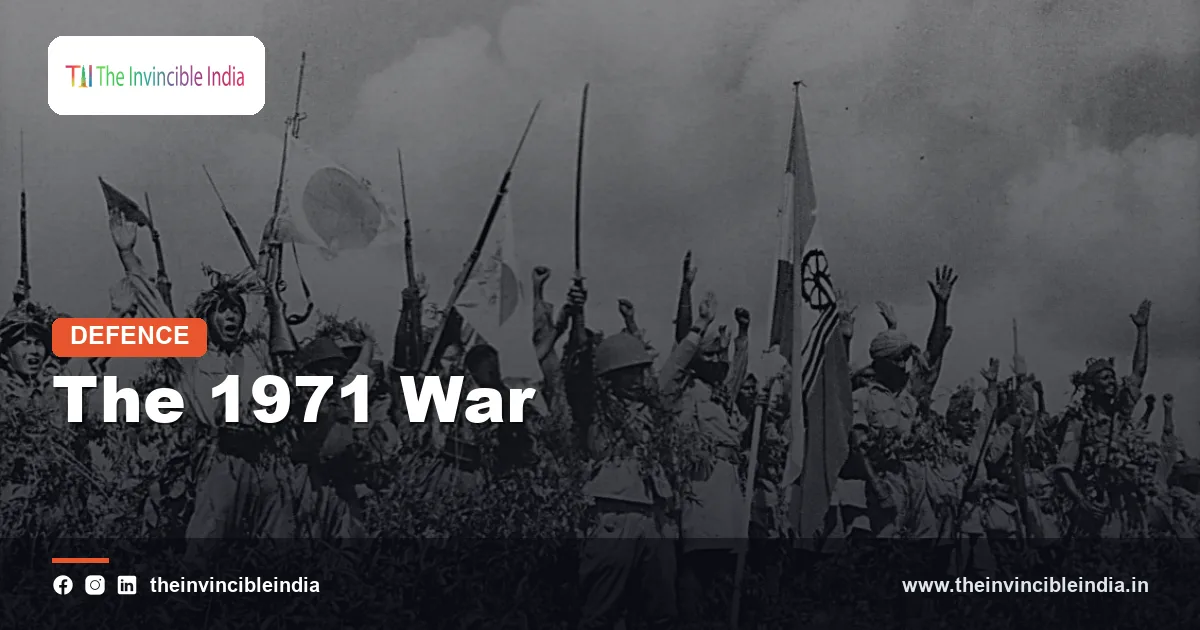
The 1971 war between India and Pakistan lasted only thirteen days, yet it redrew the map of South Asia. Fought between 3 and 16 December 1971, the 1971 war ended with the surrender of Pakistani forces in Dhaka and the emergence of Bangladesh as an independent country. It remains one of the shortest and most decisive conflicts in modern military history.
The war did not begin as a border dispute. It grew out of a political crisis inside Pakistan, a brutal military crackdown in its eastern wing, and a refugee exodus of extraordinary scale that spilled into India. This explainer traces the background, the campaign on land, sea and air, the surrender, and the lasting consequences, with respect for the soldiers and civilians whose lives were changed.
Quick Facts
| Aspect | Details |
|---|---|
| Duration | 3 December to 16 December 1971 (13 days) |
| Belligerents | India and the Mukti Bahini versus Pakistan |
| Immediate trigger | Pakistani pre-emptive air strikes on 3 December 1971 (Operation Chengiz Khan) |
| Indian Army Chief | General Sam Manekshaw (made Field Marshal in 1973) |
| Eastern Command commander | Lt Gen Jagjit Singh Aurora |
| Pakistani commander in the East | Lt Gen A.A.K. Niazi |
| Surrender | 16 December 1971, Dhaka; about 93,000 Pakistani personnel became prisoners of war |
| Outcome | Creation of Bangladesh; Simla Agreement signed in July 1972 |
The Roots of the Crisis: East and West Pakistan
When Pakistan came into being in 1947, it consisted of two wings separated by roughly 1,600 kilometres of Indian territory. East Pakistan, the former East Bengal, held more than half of the country’s population, yet political power, the army and the bureaucracy were dominated by West Pakistan. Differences of language, culture and economic interest were present from the very beginning, and they widened with each passing decade.
Grievances that accumulated
- Language: The 1952 Language Movement began after attempts to make Urdu the sole national language, even though Bengali was the mother tongue of most Pakistanis.
- Economic disparity: Many Bengalis felt that revenue earned from East Pakistan’s exports, notably jute, was spent mainly in the west.
- Representation: Bengalis were thinly represented in the armed forces and civil services relative to their numbers.
- Autonomy: In 1966 Sheikh Mujibur Rahman of the Awami League announced a Six-Point programme demanding far greater provincial autonomy.
By the late 1960s the tension had hardened into a mass political movement, and military rule under General Yahya Khan promised elections in order to defuse it.
The 1970 Election and the Refusal to Transfer Power
Pakistan’s first general election on the basis of adult franchise was held in December 1970. The Awami League won almost every seat allotted to East Pakistan, which gave it an outright majority in the National Assembly. In the western wing, Zulfikar Ali Bhutto’s Pakistan Peoples Party emerged as the largest party.
On a purely democratic reading, Sheikh Mujibur Rahman had earned the right to form the government. Instead, talks among Yahya Khan, Bhutto and Mujib dragged on through early 1971, with disagreement over the Six Points and the shape of a future constitution. The sitting of the National Assembly, due in March, was postponed indefinitely.
The postponement was seen in the east as a betrayal of the people’s verdict. A non-cooperation movement swept the province, and for some days the Awami League effectively directed daily administration. Negotiations in Dhaka collapsed, and the military leadership chose force over compromise.
Operation Searchlight and the Humanitarian Catastrophe
On the night of 25 March 1971, the Pakistani Army launched Operation Searchlight in Dhaka and other cities. Targets included university halls, police lines and Awami League supporters. Sheikh Mujibur Rahman was arrested, the Awami League was banned, and a declaration of independence in the name of Bangladesh was issued in the early hours of 26 March.
Scale of the violence
The crackdown extended over the following months, with widespread killings, arson and sexual violence reported by foreign journalists, diplomats and later by researchers. Estimates of the dead vary enormously, from tens of thousands to figures in the hundreds of thousands and beyond, and historians still debate the numbers. What is not disputed is that the violence was large in scale, targeted civilians, and triggered a mass flight across the border.
A global audience
Dispatches from reporters and from some foreign diplomats in Dhaka drew international attention to the crisis. Indian leaders raised the issue in capitals around the world, arguing that what was unfolding could not be treated as a purely internal matter of Pakistan, because its consequences were landing on India’s doorstep.
Ten Million Refugees and India’s Dilemma
Within months, around ten million people, most of them Bengali Hindus but also many Muslims and others, had crossed into the Indian states of West Bengal, Tripura, Assam and Meghalaya. Camps stretched across the frontier districts, and the burden on local resources, health services and food supplies was immense.
For India this was both a humanitarian emergency and a strategic problem. The refugees, if they remained indefinitely, would strain a developing economy and could unsettle an already sensitive eastern frontier. Prime Minister Indira Gandhi’s government weighed its options carefully:
- Diplomacy: Appeals to the major powers and the United Nations to press Pakistan for a political settlement.
- Relief: Organising camps and international aid for the displaced.
- Military preparation: Building up forces so that intervention would be possible if the crisis could not be resolved peacefully.
General Manekshaw advised against launching an immediate offensive in the spring, citing the monsoon, the state of the roads and rivers in the east, and the need for proper preparation. The decision to wait is often regarded as one of the key reasons the later campaign succeeded so quickly.
The Mukti Bahini, India’s Support and the Road to War
Bengali resistance took shape as the Mukti Bahini, or liberation force. It included soldiers and officers of the East Bengal Regiment, the East Pakistan Rifles and the police who defected, together with students and volunteers who were trained and armed. A provisional government of Bangladesh was formed in April 1971, taking its oath at Mujibnagar in the Meherpur area, with Tajuddin Ahmad as its prime minister.
India gave the movement shelter, training, supplies and a base for its leadership in Kolkata. The Indian Army and the Border Security Force helped organise camps along the frontier, and Mukti Bahini guerrillas conducted sabotage and raids inside East Pakistan. Their local knowledge proved invaluable once Indian forces advanced.
The diplomatic picture also shifted. In August 1971 India and the Soviet Union signed a Treaty of Peace, Friendship and Cooperation, which gave New Delhi greater confidence on the international stage. Pakistan, for its part, enjoyed support from the United States and China at different levels, which added a Cold War dimension to the crisis.
3 December 1971: Operation Chengiz Khan
Border clashes in the east had been increasing through November. On the evening of 3 December 1971, the Pakistan Air Force launched pre-emptive strikes on a number of Indian airfields in the north and west under the codename Operation Chengiz Khan. The raid is often compared with Israel’s opening strike in 1967, and the hope was to cripple Indian air power in a single blow.
The attack largely failed to achieve that goal. Indian airfields were quickly repaired, and many aircraft were dispersed or protected. Prime Minister Indira Gandhi addressed the nation by radio late that night and announced that India was at war. Indian forces moved into action on the western and eastern fronts within hours.
India extended recognition to Bangladesh on 6 December 1971, formally acknowledging the new state while the war was still under way.
The Thirteen-Day Campaign in the East
Indian strategy in the east was built on speed. Rather than fight a slow battle for every town, Indian columns bypassed fortified positions and aimed for key river crossings and the capital itself. Lt Gen Jagjit Singh Aurora led Eastern Command, with Lt Gen J.F.R. Jacob as his Chief of Staff, and corps commanders including Lt Gen Sagat Singh and Lt Gen T.N. Raina directing the advance.
Army advances
- Forces moved in from several directions, including the west (from Bengal), the north, and the east and north-east, supported by Mukti Bahini units.
- Bridging and river-crossing capability proved decisive, as East Pakistan is crossed by wide rivers such as the Meghna.
- At Tangail on 11 December, a battalion of paratroopers was dropped to help cut off retreating troops, and the Meghna was crossed by a heliborne lift, one of the early large-scale uses of helicopters for such a task in the region.
Air and sea in the East
The Indian Air Force quickly established air superiority over East Pakistan. Raids on airfields grounded the small Pakistan Air Force contingent, and strikes on key installations, including the Governor’s House in Dhaka on 14 December, further shook the morale of the local leadership. The aircraft carrier INS Vikrant and other ships operated in the Bay of Bengal, imposing a blockade of East Pakistan’s ports and limiting escape or resupply by sea.
The Navy’s Operation Trident and the Air War
In the west, the Indian Navy struck first against Pakistan’s principal port. On the night of 4 December, Indian missile boats and escorts launched Operation Trident against Karachi, sinking several Pakistani vessels and setting fuel tanks ablaze. A follow-up, Operation Python, struck again on the night of 8 and 9 December. India commemorates 4 December every year as Navy Day to mark Operation Trident.
The war at sea was not one-sided. The Indian frigate INS Khukri was lost to a Pakistani submarine on 9 December, with many officers and sailors killed, a loss remembered with solemn respect.
In the air, Indian fighters, bombers and transport aircraft flew thousands of sorties over the two fronts, supporting ground units, striking airfields and defending Indian airspace. Air Chief Marshal P.C. Lal headed the Air Force, and its dominance over the eastern theatre was a major factor in the speed of the campaign.
The Western Front and the Battle of Longewala
In the west, India’s aim was largely defensive, with limited offensive operations designed to hold ground and prevent Pakistan from relieving pressure in the east. Fighting took place in Jammu and Kashmir, Punjab, and the Rajasthan and Sindh deserts.
The best-known episode is the Battle of Longewala, in the Thar desert of Rajasthan, on the night of 4 and 5 December. A small company of the 23rd Battalion of the Punjab Regiment, led by Major Kuldip Singh Chandpuri, held a post against a much larger Pakistani armoured and infantry force until the Indian Air Force’s Hunter aircraft could strike at first light. Many Pakistani tanks and vehicles were destroyed or abandoned.
Elsewhere on the western front, there were also hard battles in the Shakargarh sector, where units fought heavy tank engagements, and around Chhamb. Ground changed hands in both directions, and a ceasefire on the western front came into effect on the evening of 17 December.
Timeline and the Two Fronts at a Glance
| Date (1971) | Event |
|---|---|
| 25 March | Operation Searchlight begins in East Pakistan |
| 17 April | Provisional Bangladesh government takes oath at Mujibnagar |
| August | Indo-Soviet Treaty of Peace, Friendship and Cooperation signed |
| 3 December | Pakistani air strikes (Operation Chengiz Khan); India enters the war |
| 4 December | Operation Trident at Karachi; Longewala battle begins |
| 6 December | India recognises Bangladesh |
| 11 December | Paradrop at Tangail |
| 14 December | Air strike on Governor’s House in Dhaka |
| 16 December | Surrender in Dhaka; fighting ends in the east |
| 17 December | Ceasefire on the western front |
| Front | Indian objective | Notable features |
|---|---|---|
| Eastern | Rapid advance to Dhaka and collapse of Pakistani forces | Tri-service coordination, Mukti Bahini support, air superiority, riverine operations |
| Western | Defend and hold; limited offensives | Longewala, Shakargarh, Chhamb, naval strikes at Karachi |
16 December: The Surrender at Dhaka
By 14 and 15 December, Indian columns had reached the outskirts of Dhaka and Pakistani leaders in the east were in contact about ending the fighting. The resignation of the civilian administration and the loss of key positions left General Niazi with little room to continue the fight.
On the afternoon of 16 December 1971, at the Ramna Race Course in Dhaka, Lt Gen A.A.K. Niazi signed the Instrument of Surrender in front of Lt Gen Jagjit Singh Aurora, who represented the joint command of Indian and Bangladesh forces. About 93,000 Pakistani military and paramilitary personnel, along with some civilians, went into captivity. It was the largest surrender of armed personnel since the Second World War.
India observes 16 December every year as Vijay Diwas, honouring the armed forces. In Bangladesh the same day is celebrated as Victory Day, a national holiday remembering the end of the Liberation War and the sacrifices of the people. A general ceasefire on the western front followed a day later.
Gallantry and Remembrance
The war cost lives on all sides. The Indian armed forces suffered several thousand killed and wounded, while Pakistani and Bangladeshi losses, military and civilian, were considerably higher; exact figures are debated and remain approximate. The gallantry of individual soldiers is remembered through the nation’s highest wartime honour, the Param Vir Chakra.
- Lance Naik Albert Ekka of the Brigade of the Guards was awarded the Param Vir Chakra posthumously for gallantry at Gangasagar on 3 December 1971, where he silenced enemy bunkers at great cost to himself.
- Second Lieutenant Arun Khetarpal of the 17 Poona Horse was awarded the Param Vir Chakra posthumously for his courage in the Battle of Basantar, fighting on in his tank even after being wounded.
- Flying Officer Nirmal Jit Singh Sekhon of the Indian Air Force was awarded the Param Vir Chakra posthumously for defending Srinagar airfield in his Gnat fighter on 14 December. He remains the only Air Force recipient of the award.
Many other officers, sailors, airmen and soldiers received gallantry honours, and the war is remembered with equal respect for the fallen of the Pakistani side and the victims of the violence in East Pakistan.
Aftermath: Bangladesh, Simla and the Wider Legacy
The most visible result was the birth of Bangladesh. Sheikh Mujibur Rahman, who had been held in West Pakistan, was released in January 1972 and returned to Dhaka on 10 January to a tumultuous welcome. Indian troops were withdrawn from Bangladesh by March 1972, a step the Indian government emphasised as evidence that it had no territorial ambitions.
The Simla Agreement
On 2 July 1972, Prime Minister Indira Gandhi and Pakistan’s President Zulfikar Ali Bhutto signed the Simla Agreement. The two countries agreed to settle differences bilaterally and peacefully, to respect the Line of Control in Jammu and Kashmir that emerged from the December 1971 ceasefire, and to work to normalise relations. The prisoners of war were returned in stages, and Pakistan recognised Bangladesh in 1974.
Place in military history
- It is regarded as a model of joint operations, as the Army, Navy and Air Force worked together and with local forces.
- It strengthened India’s strategic standing in the region and shifted the balance in South Asia.
- For Pakistan it was a deep national trauma, prompting a political and military reckoning.
- Sam Manekshaw was promoted to Field Marshal in January 1973, the first Indian Army officer to hold that rank.
Historians continue to argue over the exact numbers, the causes and the responsibilities, and the war is remembered differently in India, Pakistan and Bangladesh. A fair account recognises both the strategic achievement and the human suffering that preceded and accompanied it.
Conclusion
The 1971 war shows how a political failure, the refusal to honour an election result, can escalate into a humanitarian disaster and then an international war. India’s response combined patience, diplomacy and military preparation, and when the fighting came it ended quickly. Its enduring result is the independent nation of Bangladesh, and the lessons it offers about democracy, refugees and the limits of force are still studied today.
Frequently Asked Questions
What caused the 1971 India-Pakistan war?
The war grew out of Pakistan’s internal crisis after the Awami League won the 1970 election but was denied power. The military crackdown in East Pakistan from March 1971 sent about ten million refugees into India. Tensions rose until Pakistan launched air strikes on Indian airfields on 3 December 1971.
How long did the 1971 war last?
The formal war lasted 13 days, from 3 December to 16 December 1971. Fighting in the east ended with the surrender at Dhaka, and the western front ceasefire came into effect on 17 December.
What is Vijay Diwas?
Vijay Diwas is observed in India on 16 December to mark the surrender of Pakistani forces in Dhaka in 1971. It honours the soldiers, sailors and airmen who served in the war.
How many Pakistani soldiers surrendered in 1971?
About 93,000 Pakistani military and paramilitary personnel and some civilians surrendered, which is the largest surrender of armed forces since the Second World War. They were repatriated gradually after the Simla Agreement.
Why is 4 December celebrated as Navy Day?
Navy Day marks Operation Trident, the Indian Navy’s missile boat attack on Karachi on the night of 4 December 1971. The operation damaged Pakistani ships and fuel installations and was a significant naval success.
What was the Simla Agreement?
It was a bilateral agreement signed on 2 July 1972 by Indira Gandhi and Zulfikar Ali Bhutto. It committed both countries to settle disputes peacefully through bilateral talks and to respect the Line of Control in Jammu and Kashmir.
{“@context”:”https://schema.org”,”@graph”:[{“@type”:”FAQPage”,”mainEntity”:[{“@type”:”Question”,”name”:”What caused the 1971 India-Pakistan war?”,”acceptedAnswer”:{“@type”:”Answer”,”text”:”The war grew out of Pakistan’s internal crisis after the Awami League won the 1970 election but was denied power. The military crackdown in East Pakistan from March 1971 sent about ten million refugees into India. Tensions rose until Pakistan launched air strikes on Indian airfields on 3 December 1971.”}},{“@type”:”Question”,”name”:”How long did the 1971 war last?”,”acceptedAnswer”:{“@type”:”Answer”,”text”:”The formal war lasted 13 days, from 3 December to 16 December 1971. Fighting in the east ended with the surrender at Dhaka, and the western front ceasefire came into effect on 17 December.”}},{“@type”:”Question”,”name”:”What is Vijay Diwas?”,”acceptedAnswer”:{“@type”:”Answer”,”text”:”Vijay Diwas is observed in India on 16 December to mark the surrender of Pakistani forces in Dhaka in 1971. It honours the soldiers, sailors and airmen who served in the war.”}},{“@type”:”Question”,”name”:”How many Pakistani soldiers surrendered in 1971?”,”acceptedAnswer”:{“@type”:”Answer”,”text”:”About 93,000 Pakistani military and paramilitary personnel and some civilians surrendered, which is the largest surrender of armed forces since the Second World War. They were repatriated gradually after the Simla Agreement.”}},{“@type”:”Question”,”name”:”Why is 4 December celebrated as Navy Day?”,”acceptedAnswer”:{“@type”:”Answer”,”text”:”Navy Day marks Operation Trident, the Indian Navy’s missile boat attack on Karachi on the night of 4 December 1971. The operation damaged Pakistani ships and fuel installations and was a significant naval success.”}},{“@type”:”Question”,”name”:”What was the Simla Agreement?”,”acceptedAnswer”:{“@type”:”Answer”,”text”:”It was a bilateral agreement signed on 2 July 1972 by Indira Gandhi and Zulfikar Ali Bhutto. It committed both countries to settle disputes peacefully through bilateral talks and to respect the Line of Control in Jammu and Kashmir.”}}]}]}


