

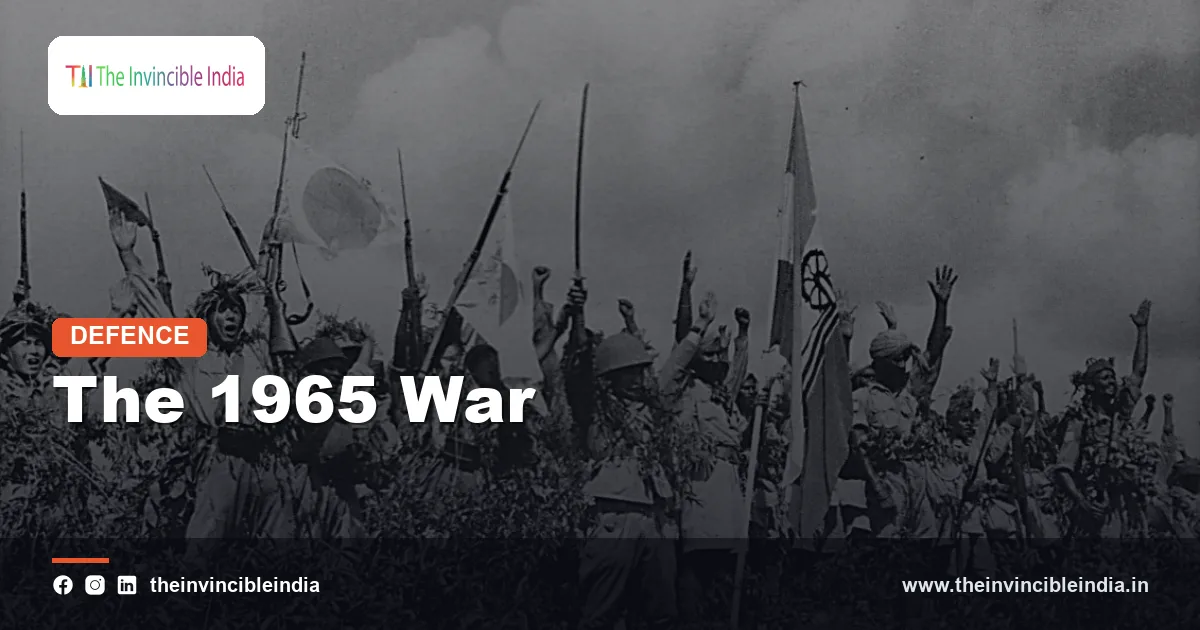
The 1965 war between India and Pakistan was the second major armed conflict between the two neighbours since Independence, and like the first, in 1947-48, it grew out of the unresolved question of Jammu and Kashmir. Lasting a little over two weeks of full-scale fighting in September 1965, it involved infantry assaults, some of the biggest armoured engagements since the Second World War, and sustained air combat across the western border.
Today the 1965 war is remembered in India for the courage of ordinary soldiers, the leadership of Prime Minister Lal Bahadur Shastri and the slogan “Jai Jawan Jai Kisan”. In Pakistan, 6 September is observed as Defence Day. This explainer walks through the background, the major operations, the great tank battles, the ceasefire and the Tashkent Agreement, and what the war left behind.
| Quick Fact | Detail |
|---|---|
| Belligerents | India and Pakistan |
| Main cause | The Kashmir dispute and Pakistan’s attempt to change the situation by force |
| Prelude | Rann of Kutch clashes, April 1965 |
| Pakistani codenames | Operation Gibraltar (August 1965) and Operation Grand Slam (September 1965) |
| Indian counter-move | Capture of Haji Pir Pass (late August) and advance towards Lahore (6 September 1965) |
| Famous battles | Asal Uttar (Khem Karan), Chawinda, Dograi, Phillora |
| Ceasefire | Took effect in the early hours of 23 September 1965 after a UN Security Council call |
| Peace settlement | Tashkent Agreement (Declaration), 10 January 1966, mediated by the Soviet Union |
| Outcome | Militarily inconclusive; both sides returned to pre-war positions |
Background: Why the 1965 War Broke Out
When British rule ended in 1947, the princely state of Jammu and Kashmir acceded to India, and fighting between the two new countries followed. A UN-supervised ceasefire in January 1949 left the state divided along a ceasefire line, with India holding the larger part, including the Kashmir Valley. Pakistan never accepted this arrangement, and through the 1950s and early 1960s the dispute stayed at the centre of bilateral relations.
Pakistan’s reading of India after 1962
India’s defeat in the 1962 war with China shaped Pakistani thinking considerably. Many in Pakistan’s leadership, including President Ayub Khan and some of his advisers, concluded that the Indian armed forces were demoralised and poorly equipped. Jawaharlal Nehru’s death in May 1964 and the elevation of the mild-mannered Lal Bahadur Shastri added to a belief that India would not respond firmly to a sharp, limited challenge.
Pakistan’s own position had also improved. It had received substantial American military assistance, including M47 and M48 Patton tanks and F-86 Sabre jets, and its leadership believed it enjoyed a qualitative edge that might not last. India, for its part, had launched a major expansion of its army after 1962, so some in Rawalpindi felt a window of opportunity was closing.
The Rann of Kutch skirmish
The first sign of trouble came in the Rann of Kutch, a vast seasonal marsh on the Gujarat-Sindh frontier whose boundary was disputed. In early 1965, patrols and then larger formations clashed there, and by April there was fighting involving brigade-sized forces. British Prime Minister Harold Wilson helped broker a ceasefire in June, and the dispute was sent to an international tribunal, which in 1968 awarded Pakistan a small portion of the claimed territory. For Pakistan’s planners, the Kutch episode seemed to confirm that India’s response was hesitant, which encouraged bolder plans in Kashmir.
Operation Gibraltar: Infiltration into Kashmir
In early August 1965, Pakistan launched Operation Gibraltar. The idea was to send thousands of trained irregulars and soldiers, often described as “Gibraltar Force” and divided into several smaller groups, across the ceasefire line into Jammu and Kashmir. They were to blend with the local population, sabotage communications and military installations, and trigger a popular uprising that would give Pakistan an opening to intervene. The name echoed the historical Muslim crossing into Spain at Gibraltar, signalling the ambitious intent.
Why it failed
The plan rested on the assumption that Kashmiris would rise against Indian rule. That did not happen. Local residents in several areas informed the police and the army about unfamiliar armed groups, and Indian security forces began rounding up and neutralising infiltrators. The much-expected uprising never materialised, and the operation lost momentum within days.
- Local villagers, shepherds and officials alerted the authorities to infiltrators.
- Indian forces sealed mountain routes and passes and pursued the groups.
- Pakistan’s wider plan depended on a quick popular revolt, which never came.
- The infiltration gave India a strong justification to act across the ceasefire line.
Though Pakistan denied direct involvement at first, the scale of the operation and the capture of equipment and personnel made its origin clear to observers, including UN military observers on the ground.
India’s Response: Crossing the Ceasefire Line and Haji Pir
As the infiltration persisted, India decided that defensive action alone was not enough. In mid-August 1965, Indian forces crossed the ceasefire line at several points to close down the infiltration routes and take the fight to the other side. One of the most important achievements of this phase was the capture of the Haji Pir Pass in late August 1965.
The significance of Haji Pir
Located on a ridge in Pakistan-administered Kashmir, the Haji Pir Pass sat on a key infiltration route and offered a shorter link between the Poonch and Uri sectors. Capturing it, after hard fighting in difficult mountain terrain, shut off a major corridor used by infiltrators and was widely celebrated in India. Indian troops also pushed forward in other areas, including the Tithwal and Kargil sectors, to straighten their defensive lines.
The pass was later returned to Pakistan under the terms of the Tashkent Agreement, a decision that was criticised by some Indian commentators at the time. It remains a recurring point in discussions of what the war achieved and what was conceded at the peace table.
Operation Grand Slam and the Lahore Front
Pakistan’s response to the Indian pressure came on 1 September 1965, when it launched Operation Grand Slam in the Chhamb-Jaurian sector of Jammu. Using armour and artillery, Pakistan aimed to reach Akhnoor, whose bridge over the Chenab was a vital link for Indian forces in Kashmir. If Akhnoor fell, the road to Jammu and the supply routes to the Valley would be threatened.
The Indian forces in Chhamb were initially outnumbered and under heavy pressure. With the situation precarious, India took a strategic decision that changed the character of the war.
The 6 September crossing
On 6 September 1965, Indian forces crossed the international border into Punjab, Pakistan, and advanced towards Lahore. The idea was to relieve pressure on Akhnoor by forcing Pakistan to defend its own heartland. Indian troops moved along the Amritsar-Lahore axis, encountering fierce resistance near the Ichhogil Canal, which Pakistan had fortified as a defensive barrier. Fighting around Dograi and Barki was intense, and Indian soldiers reached the outskirts of Lahore in places, though the city itself was not captured.
The date is still marked in Pakistan as Defence Day, commemorating what it sees as the successful defence of the country against an Indian offensive. In India, it is remembered as the day the army widened the war to protect Kashmir. Both narratives reflect different vantage points on the same set of events.
The Battle of Asal Uttar: “Patton Nagar”
Pakistan’s counter-offensive in the Khem Karan sector, south of Amritsar, led to the Battle of Asal Uttar, fought in the second week of September 1965. Pakistan’s 1st Armoured Division, equipped with American-supplied Patton tanks, advanced with the aim of capturing the bridges over the Beas river and threatening Amritsar and Delhi’s rear.
The defensive trap
Indian commanders pulled back to a horseshoe-shaped defensive position around the village of Asal Uttar, a name which means “a fitting reply”. The surrounding fields were flooded in places, and Pakistan’s heavy tanks, advancing through sugarcane and waterlogged ground, became bogged down. Indian Centurion tanks and anti-tank units, hidden in carefully prepared positions, engaged the Pattons at short range. By the end of the battle, many dozens of Pakistani tanks had been destroyed or abandoned, with estimates varying by source. The area came to be called “Patton Nagar”, or Patton Town, a graveyard of tanks. It is often described as one of the largest tank battles since the Second World War.
Company Quartermaster Havildar Abdul Hamid
The battle is closely associated with Company Quartermaster Havildar Abdul Hamid of 4 Grenadiers. Armed with a recoilless gun mounted on a jeep, he moved between positions, engaging and destroying several enemy tanks at close range on 8-10 September. He was killed on 10 September 1965 while still fighting, and was awarded the Param Vir Chakra, India’s highest wartime gallantry award, posthumously. His story is taught in schools across India as a symbol of selfless courage.
The Battle of Chawinda and the Sialkot Sector
If Asal Uttar was a defensive triumph, the Sialkot front saw a major Indian offensive. In September 1965, India’s 1st Armoured Division and supporting infantry advanced towards Chawinda, aiming to cut the vital Grand Trunk Road and rail links around Sialkot, and so disrupt Pakistan’s lines of communication. The terrain, with cotton and sugarcane fields cut by drainage channels, did not favour manoeuvre.
- Fighting centred on villages such as Phillora, Chawinda, Butur-Dograndi and Jassoran.
- Pakistan’s 6th Armoured Division and other units mounted determined counter-attacks.
- Lieutenant Colonel Ardeshir Burzorji Tarapore of the Poona Horse fought in the Phillora operations and was posthumously awarded the Param Vir Chakra.
- Both sides suffered heavy tank losses, and the battle, one of the largest armoured contests since 1945, ended without a decisive breakthrough.
India did not capture Chawinda itself, and Pakistan could claim it had held the line. India, however, had gained ground elsewhere in the sector and tied down large Pakistani forces. Historians usually describe the battle as a hard-fought stalemate rather than a clear victory for either side.
The Air and Naval Dimensions
The 1965 war also saw intense air operations. Both air forces attacked airfields and ground targets, and aerial combat took place over Punjab and Kashmir. Pakistan’s Sabres and Starfighters faced the Indian Air Force’s Hunters, Mysteres, Vampires and the small, nimble Gnat, nicknamed “Sabre Slayer” for its performance against the Sabre. Pakistan attacked Indian airbases such as Pathankot, Adampur and Halwara in the evening of 6 September, and the IAF in turn struck airfields including Sargodha and Peshawar. Both sides claimed favourable kill ratios, and independent assessments differ, so figures should be treated with caution.
The naval skirmish
The naval war was brief. On the night of 7-8 September, a Pakistani naval squadron bombarded the coastal town of Dwarka in Gujarat, an action known in Pakistan as Operation Dwarka. The damage was limited, and the Indian Navy did not carry out a comparable operation in return, as its role was constrained by the wider strategy, though the incident prompted later naval modernisation.
Leadership: Shastri and “Jai Jawan Jai Kisan”
Lal Bahadur Shastri had become Prime Minister in June 1964. Seen by many as soft-spoken, he proved decisive in the crisis, authorising the army to cross the international border and rallying the nation. At the time, India was also facing food shortages and was dependent on imports, so the war strained both the battlefield and the farm.
In this context, Shastri popularised the slogan “Jai Jawan Jai Kisan” (Hail the Soldier, Hail the Farmer). It honoured the soldier defending the border and the farmer feeding the country, and linked national security with food security. Shastri even urged citizens to skip a meal once a week to ease pressure on grain supplies. The slogan became a part of India’s civic memory and is still widely quoted.
On the military side, the Indian Army was led by General J.N. Chaudhuri, and the Air Force by Air Marshal Arjan Singh, while Pakistan’s President Ayub Khan headed a government in which military and political strategy were closely tied.
Ceasefire and the Tashkent Agreement
By mid-September, both armies were running short of ammunition and had suffered significant losses. International pressure grew, and the major powers, including the United States and Britain, suspended military supplies to both countries, which hurt Pakistan, as it relied on American equipment. On 20 September, the UN Security Council called for a ceasefire, and both sides accepted it. The ceasefire came into effect in the early hours of 23 September 1965.
Tashkent, January 1966
To negotiate a lasting settlement, Soviet Premier Alexei Kosygin hosted Lal Bahadur Shastri and Ayub Khan in Tashkent (then in the Soviet Union, now in Uzbekistan). The talks concluded with the Tashkent Declaration on 10 January 1966.
- Both countries agreed to withdraw their forces to the positions held before 5 August 1965.
- They agreed to restore diplomatic relations and to resolve disputes by peaceful means.
- Prisoners of war were to be exchanged, and economic and trade ties were to be revisited.
- The declaration did not contain a no-war pact, which India had sought, and it did not settle Kashmir.
Shortly after signing, on 11 January 1966, Lal Bahadur Shastri died in Tashkent of a heart attack. The news stunned the country, and his body was brought home for a state funeral.
A Timeline of the 1965 War
| Date | Event |
|---|---|
| April 1965 | Clashes in the Rann of Kutch |
| Early August 1965 | Pakistan begins Operation Gibraltar in Jammu and Kashmir |
| Late August 1965 | India captures the Haji Pir Pass |
| 1 September 1965 | Pakistan launches Operation Grand Slam in the Chhamb sector |
| 6 September 1965 | India crosses the international border towards Lahore |
| 7-8 September 1965 | Pakistani naval bombardment of Dwarka |
| 8-10 September 1965 | Battle of Asal Uttar near Khem Karan; Abdul Hamid killed on 10 September |
| Mid-September 1965 | Battle of Chawinda and the Sialkot sector |
| 22-23 September 1965 | Ceasefire takes effect |
| 10 January 1966 | Tashkent Declaration signed |
| 11 January 1966 | Death of Lal Bahadur Shastri in Tashkent |
Outcome and Legacy of the 1965 War
Judging the result of the 1965 war depends on the yardstick used. Militarily, the war was largely a stalemate. Neither side achieved its core objective: Pakistan did not wrest Kashmir, and India did not capture Lahore or Sialkot. Both returned to pre-war positions, and each country has historically claimed success. Casualty and equipment-loss figures differ widely between sources, and are best treated as approximate.
Strategic and political effects
- Morale in India: After the setback of 1962, the performance of the army and air force, and the national unity displayed, restored confidence.
- Military reform: India increased defence spending and modernised equipment, while Pakistan faced an arms embargo and turned increasingly to other suppliers.
- Food security: The slogan of Jai Jawan Jai Kisan fed into the push for agricultural self-reliance that culminated in the Green Revolution.
- Diplomacy: The Soviet role at Tashkent increased Moscow’s profile in South Asia.
- Domestic politics in Pakistan: The perception that gains had been lost at the negotiating table fed political discontent and contributed to the pressures that ended Ayub Khan’s rule in 1969.
Many historians also see the 1965 war as a prelude to the 1971 war, which led to the creation of Bangladesh, and the later Simla Agreement of 1972, which converted the ceasefire line in Kashmir into the Line of Control.
Conclusion
The 1965 war was a short but intense conflict that began with a failed bid to force change in Kashmir and ended with both countries back where they started. Its battles, from Haji Pir to Asal Uttar and Chawinda, remain studied in military academies, and its heroes, from Abdul Hamid to Lieutenant Colonel Tarapore, continue to be honoured. For India, it is remembered as a moment when the nation came together, and Shastri’s call to the soldier and the farmer still echoes. Last updated: 1 October 2026.
Frequently Asked Questions
What was the main cause of the 1965 India-Pakistan war?
The immediate cause was Pakistan’s Operation Gibraltar in August 1965, which sent infiltrators into Jammu and Kashmir to provoke an uprising against Indian rule. The deeper cause was the unresolved Kashmir dispute, along with Pakistan’s belief that India was weak after its 1962 war with China.
What happened at the Battle of Asal Uttar?
Fought near Khem Karan in Punjab in September 1965, Asal Uttar saw Pakistan’s armoured division, equipped with US-made Patton tanks, advance into a prepared Indian defensive position. Many Pakistani tanks were destroyed or abandoned, and the area became known as “Patton Nagar”. It is often described as one of the largest tank battles since the Second World War.
Who was Abdul Hamid?
Company Quartermaster Havildar Abdul Hamid of 4 Grenadiers destroyed several Pakistani tanks using a jeep-mounted recoilless gun during the Asal Uttar fighting. He was killed on 10 September 1965 and was awarded the Param Vir Chakra posthumously.
What did the Tashkent Agreement say?
Signed on 10 January 1966 under Soviet mediation, the Tashkent Declaration required India and Pakistan to withdraw to their pre-August 1965 positions, restore diplomatic relations and resolve disputes peacefully. It did not settle the Kashmir question. Prime Minister Lal Bahadur Shastri died in Tashkent the next day.
Who won the 1965 war?
The war ended largely in a stalemate, and both countries have historically claimed success. India held the Haji Pir Pass and reached the outskirts of Lahore, but returned the territory under the Tashkent Agreement, while Pakistan failed to secure Kashmir. It is generally seen as a morale boost for India after 1962.
What does “Jai Jawan Jai Kisan” mean?
The slogan, popularised by Lal Bahadur Shastri during the 1965 war, means “Hail the Soldier, Hail the Farmer”. It honoured both the soldier protecting the borders and the farmer producing food for the nation.
{“@context”:”https://schema.org”,”@graph”:[{“@type”:”FAQPage”,”mainEntity”:[{“@type”:”Question”,”name”:”What was the main cause of the 1965 India-Pakistan war?”,”acceptedAnswer”:{“@type”:”Answer”,”text”:”The immediate cause was Pakistan’s Operation Gibraltar in August 1965, which sent infiltrators into Jammu and Kashmir to provoke an uprising against Indian rule. The deeper cause was the unresolved Kashmir dispute, along with Pakistan’s belief that India was weak after its 1962 war with China.”}},{“@type”:”Question”,”name”:”What happened at the Battle of Asal Uttar?”,”acceptedAnswer”:{“@type”:”Answer”,”text”:”Fought near Khem Karan in Punjab in September 1965, Asal Uttar saw Pakistan’s armoured division, equipped with US-made Patton tanks, advance into a prepared Indian defensive position. Many Pakistani tanks were destroyed or abandoned, and the area became known as “Patton Nagar”. It is often described as one of the largest tank battles since the Second World War.”}},{“@type”:”Question”,”name”:”Who was Abdul Hamid?”,”acceptedAnswer”:{“@type”:”Answer”,”text”:”Company Quartermaster Havildar Abdul Hamid of 4 Grenadiers destroyed several Pakistani tanks using a jeep-mounted recoilless gun during the Asal Uttar fighting. He was killed on 10 September 1965 and was awarded the Param Vir Chakra posthumously.”}},{“@type”:”Question”,”name”:”What did the Tashkent Agreement say?”,”acceptedAnswer”:{“@type”:”Answer”,”text”:”Signed on 10 January 1966 under Soviet mediation, the Tashkent Declaration required India and Pakistan to withdraw to their pre-August 1965 positions, restore diplomatic relations and resolve disputes peacefully. It did not settle the Kashmir question. Prime Minister Lal Bahadur Shastri died in Tashkent the next day.”}},{“@type”:”Question”,”name”:”Who won the 1965 war?”,”acceptedAnswer”:{“@type”:”Answer”,”text”:”The war ended largely in a stalemate, and both countries have historically claimed success. India held the Haji Pir Pass and reached the outskirts of Lahore, but returned the territory under the Tashkent Agreement, while Pakistan failed to secure Kashmir. It is generally seen as a morale boost for India after 1962.”}},{“@type”:”Question”,”name”:”What does “Jai Jawan Jai Kisan” mean?”,”acceptedAnswer”:{“@type”:”Answer”,”text”:”The slogan, popularised by Lal Bahadur Shastri during the 1965 war, means “Hail the Soldier, Hail the Farmer”. It honoured both the soldier protecting the borders and the farmer producing food for the nation.”}}]}]}


