

For most of its independent history, India was known in defence circles for one thing above all: buying weapons from other countries. Today the story is changing. India defence exports have climbed from a trickle to a record level in barely a decade, and New Delhi now talks openly about becoming a dependable supplier of missiles, aircraft, ships, artillery, radars and protective gear to friendly nations.
This explainer traces that turnaround. It looks at why India relied on imports for so long, what the Aatmanirbhar Bharat (self-reliant India) push in defence has changed, which products are selling, who is buying, which companies are driving the effort, and what hurdles still stand in the way. Figures are given as approximate and dated, because export numbers are revised every year.
| Aspect | Details |
|---|---|
| Core shift | From one of the world’s largest arms importers to a growing exporter |
| Policy umbrella | Aatmanirbhar Bharat and Make in India in defence |
| Export scale | Under Rs 1,000 crore a year in the early 2010s; over Rs 20,000 crore (about $2.5 billion) in recent record years |
| Official ambition | Around Rs 50,000 crore of annual defence exports by 2029 |
| Landmark deal | BrahMos missiles for the Philippines, signed in January 2022 |
| Industrial corridors | Two Defence Industrial Corridors, in Uttar Pradesh and Tamil Nadu (announced 2018) |
| FDI rule | Up to 74% under the automatic route (since 2020); higher via government approval |
| Key institutions | Ministry of Defence, DRDO, DPSUs such as HAL, BEL and BDL, and private firms |
| Major markets | Southeast Asia, the Middle East, Africa, Latin America, plus components for US and European firms |
From Importer to Exporter: The Big Picture
India has long figured at or near the top of global rankings of arms importers, as tracked by international research bodies such as SIPRI. A country with long land borders, a vast coastline and tense neighbourhood relations needed large militaries, and for decades it bought much of the equipment abroad. That meant heavy spending of foreign exchange and, more importantly, a degree of dependence on suppliers whose policies could change.
The new approach reverses the logic. Instead of treating defence only as a shopping list, the government now treats it as an industrial sector that can create jobs, build technology and earn revenue. Exports are the proof of concept: a weapon that foreign militaries are willing to buy has, in a sense, passed an independent test. The shift does not mean India has stopped importing. It still buys major platforms abroad. What has changed is the direction of travel, with a larger share of the military’s needs produced at home and a growing surplus sold overseas.
Why India Depended on Imports for So Long
After independence, India’s defence industry was small and mostly state-run. Ordnance factories, a few aircraft and shipbuilding units, and the Defence Research and Development Organisation (DRDO), founded in 1958, formed the base. They could make rifles, ammunition and basic vehicles, but frontline platforms needed outside help.
The main suppliers
- Soviet Union and later Russia: the largest single source for decades, supplying fighter jets, tanks, submarines, helicopters and missiles, often on favourable terms.
- France: aircraft such as the Mirage 2000 and later the Rafale, plus submarine technology.
- Israel: radars, drones, missiles and surveillance systems.
- United States: a smaller but growing share since the 2000s, including transport aircraft, helicopters and artillery.
The cost of dependence
Import dependence created three problems. First, it drained foreign exchange. Second, it made the armed forces vulnerable to delays, sanctions or spare-parts shortages during a crisis. Third, it left domestic industry stuck at the low end, because the big orders and the learning that comes with them went abroad. Policymakers increasingly argued that a country aspiring to be a major power could not remain permanently reliant on others for its core military hardware.
The Turnaround: How Defence Exports Grew
The change in numbers has been striking. In the early 2010s India’s annual defence exports were only a few hundred crore rupees, a rounding error against its imports. Over the following decade they rose many-fold. In recent record years the official figure has crossed Rs 20,000 crore, roughly $2.5 billion, and the government has set a target of about Rs 50,000 crore by 2029.
A few caveats help in reading these figures. Official totals are reported by financial year and often revised. They bundle together very different items, from complete weapon systems to small parts and sub-assemblies. And year-to-year movement can be lumpy, because one large contract can swing the total. Even so, the broad direction is clear and widely accepted.
A timeline of the shift
| Period | Milestone |
|---|---|
| 1998 | BrahMos Aerospace formed as an India-Russia joint venture to build a supersonic cruise missile |
| 2001 | Defence production opened to private Indian companies, with limited FDI allowed |
| 2014 to 2016 | FDI ceiling raised to 49%; focus on Make in India in defence |
| 2018 | Defence Industrial Corridors announced; iDEX start-up scheme launched |
| 2020 | FDI raised to 74% via the automatic route; first positive indigenisation list issued |
| 2021 | Ordnance Factory Board corporatised into seven defence companies |
| 2022 | BrahMos export contract with the Philippines signed |
| 2024 onwards | First BrahMos deliveries to the Philippines; exports touch record levels |
Policy Enablers Behind the Surge
No single decision explains the rise in India defence exports. It is the result of many reforms layered over several years.
Indigenisation in procurement
The Defence Acquisition Procedure (DAP) sets the rules for how the armed forces buy equipment. Successive revisions have given top priority to the category usually called Buy (Indian-IDDM), meaning items that are indigenously designed, developed and manufactured. By favouring Indian-made equipment in domestic orders, the policy gives companies a base order book, which in turn helps them offer competitive prices abroad.
Positive indigenisation lists
Starting in 2020, the Ministry of Defence has issued lists of items that the services and public sector units may no longer import. These “positive indigenisation lists” run to hundreds of items, from sub-systems and components to major weapons, and cover a growing set of categories. The lists send a clear demand signal to Indian manufacturers and encourage investment in capacity.
Easier export clearances
The government has simplified licensing for defence exports, streamlined the procedure for obtaining approvals, and expanded the use of open licences for certain components. Embassies and defence attaches are also encouraged to promote Indian products, and events such as Aero India and DefExpo showcase them to foreign delegations.
Opening Up to the Private Sector and FDI
For decades, defence manufacturing was largely a government monopoly. That began to change in 2001, when private Indian companies were allowed to enter the sector under licence. Foreign investment came later and in steps: a ceiling of 26%, then 49%, and in 2020 up to 74% through the automatic route, with proposals above that permitted through government approval where modern technology is involved.
The effect has been to bring in capital, management practices and technology partners. Foreign firms often prefer a joint venture with an Indian partner, since this gives them access to the large domestic market while Indian partners learn to build to international standards. Private firms now account for a substantial share of India’s export earnings, and in some years about half or more, though the exact split varies by year.
The corporatisation of ordnance factories
In October 2021, the Ordnance Factory Board, a government department with about forty-one factories, was converted into seven separate government-owned companies. The aim was to give them commercial freedom, greater accountability and the ability to compete for export orders. These successors make ammunition, vehicles, weapons, parachutes, optical devices and troop comfort items, several of which now feature in export portfolios.
Defence Industrial Corridors and the Start-up Ecosystem
Manufacturing needs clusters, not isolated factories. In 2018 the government announced two Defence Industrial Corridors, one in Uttar Pradesh and one in Tamil Nadu. They are designed to bring together large firms, small suppliers, testing facilities and research institutions, with state governments offering land, infrastructure and incentives. The idea is that a supplier base built around the corridors will lower costs and shorten delivery times.
iDEX and defence innovation
The Innovations for Defence Excellence (iDEX) scheme, launched in 2018, connects the armed forces with start-ups, small enterprises and academic labs. It offers funding and a path to test and sell products to the military. Areas of activity include drones, artificial intelligence, sensors, communication gear and materials. Though most iDEX products serve the domestic market first, a few have attracted foreign interest, and the programme has helped normalise the idea that defence technology need not come only from large state firms.
The DRDO link
DRDO continues to be the primary designer of Indian missiles, radars and many other systems. Policy now encourages it to transfer technology to private industry, share test facilities and work with firms as development partners, rather than handing over only finished designs. This DRDO, DPSU and private firm ecosystem is central to the export story, as it lets different players handle design, production and integration.
Flagship Exports and Products
The export basket has widened from simple items to complex systems. The table below summarises the main categories.
| Product | What it is | Export significance |
|---|---|---|
| BrahMos | Supersonic cruise missile developed by India and Russia | First big missile export, to the Philippines |
| Dornier Do-228 | Light transport and surveillance aircraft built by HAL | Sold to several friendly countries |
| Akash | Surface-to-air missile system developed by DRDO | Export interest from partner countries, with reports of sales |
| Artillery (ATAGS and others) | Towed and other gun systems, plus rocket launchers | Growing interest, particularly in conflict-prone regions |
| Ammunition and shells | Artillery and small-arms rounds | Rising share of private and DPSU exports |
| Radars and electronics | Surveillance, fire-control and communication systems | Steady sales by BEL and private firms |
| Patrol vessels | Offshore and coastal patrol ships | Supplied to Indian Ocean and Southeast Asian partners |
| Body armour and protective gear | Bulletproof jackets, helmets | Exported to many countries in volume |
The BrahMos Breakthrough
The BrahMos is the most visible symbol of India’s export ambitions. The name combines the Brahmaputra and Moskva rivers, a nod to the Indo-Russian partnership that created it. It is a supersonic cruise missile that can be launched from land, ships, submarines and aircraft, and it is known for its speed and precision against land and sea targets.
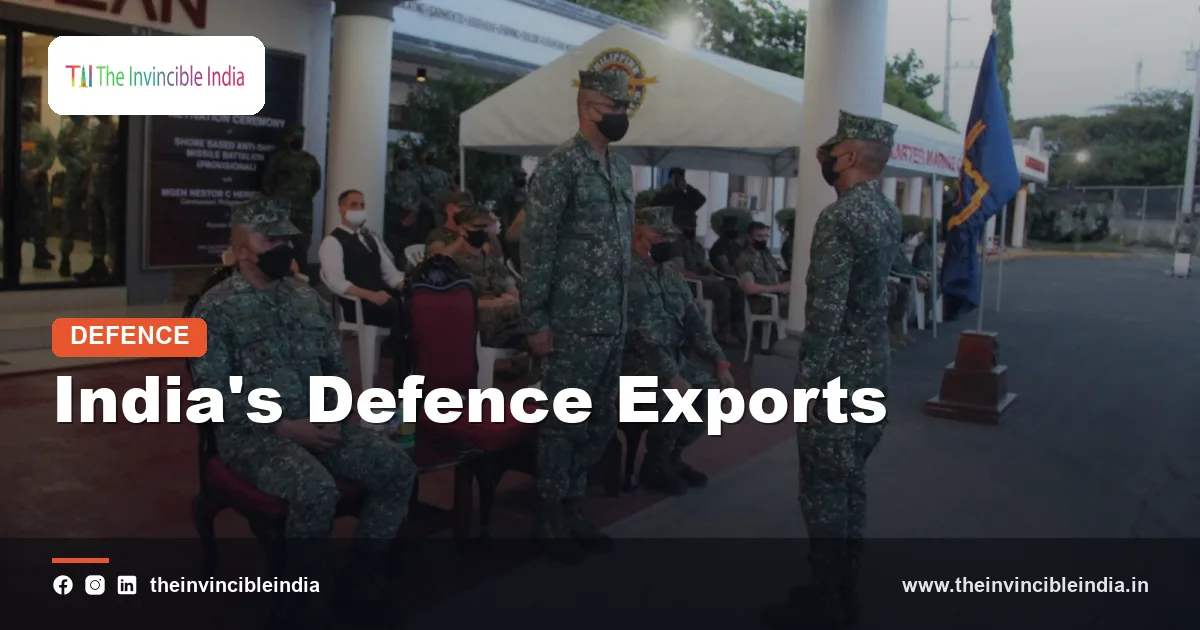
In January 2022, India signed a contract to supply the Philippines with a shore-based anti-ship version of the missile, the first major export of the system. Deliveries followed in 2024. The deal matters well beyond its value. It showed that an Indian-developed weapon could win a competitive foreign order, it strengthened India’s relations with a key Southeast Asian maritime state, and it opened the door for interest from other countries in the region and elsewhere. Production of the missile and its components in India has also created a supply chain involving many domestic firms.
Aircraft
Hindustan Aeronautics Limited (HAL) has exported the Dornier Do-228, a rugged light aircraft used for transport, maritime patrol and utility roles, as well as helicopters such as the Advanced Light Helicopter in small numbers. The Tejas light combat aircraft has drawn interest from several countries looking for an affordable, modern fighter, though converting interest into firm orders takes time and depends on delivery capacity and politics.
Missiles and air defence
Besides BrahMos, the Akash air-defence system and various shorter-range missiles form part of the pitch. Air-defence systems are especially attractive to buyers who face the threat of drones and missiles and want a proven, cost-effective option.
Artillery and ammunition
Indian companies, including Kalyani and Bharat Forge, produce artillery systems and large volumes of shells. Munitions are a steady business because wars and training use up stock quickly, and Indian makers have benefited from demand when global supply was tight.
Ships and sub-systems
Indian shipyards have built offshore patrol vessels and other craft for friendly navies, particularly in the Indian Ocean region. Alongside complete vessels, a wide range of radars, sonars, communication systems and electronic warfare equipment is sold.
Components for Global Manufacturers
Not all exports are finished weapons. A significant portion consists of parts and sub-assemblies made for foreign defence companies as part of global supply chains. Indian firms manufacture aircraft fuselages, structures and components, for example for helicopters and transport aircraft built by large Western makers. These orders matter because they bring advanced manufacturing standards, certification and long-term contracts. They also build trust: a supplier that delivers precise parts on time for a global manufacturer is better placed to win a bigger role later.
The United States and Europe are the main customers in this segment, along with other established defence manufacturing countries. For many Indian firms it is an entry route into the sector, with a lower risk than selling a whole weapon system to a foreign military.
Key Buyers and Markets
- Southeast Asia: countries in this region have rising defence needs and are keen on partners beyond the traditional great powers. The Philippines is the headline customer, and others such as Vietnam and Indonesia have been involved in discussions on missiles, ships and other equipment.
- The Middle East: a large market for protective gear, ammunition, radars and training, helped by strong diplomatic and trade ties.
- Africa: demand for patrol craft, vehicles, light aircraft, small arms and training, often supported by lines of credit and development partnerships.
- Latin America: a smaller but emerging market, with interest in aircraft, radars and patrol vessels.
- Indian Ocean neighbours: Sri Lanka, Mauritius, the Maldives, Seychelles and Bangladesh have taken ships, aircraft or training, tying defence supply to India’s regional security role.
- United States and Europe: principally components, sub-systems and ammunition rather than complete platforms.
Some deals involve countries that have chosen not to disclose details, and reports of specific sales should be treated with caution unless confirmed officially.
The Big Players
Public sector companies
- Hindustan Aeronautics Limited (HAL): aircraft and helicopters, including the Dornier and the Tejas.
- Bharat Electronics Limited (BEL): radars, communication systems, electronic warfare and electro-optics.
- Bharat Dynamics Limited (BDL): guided missiles, including Akash and torpedoes.
- Ordnance factory successors: ammunition, vehicles, small arms and clothing for troops.
- Shipyards: companies such as Mazagon Dock, Garden Reach and Cochin Shipyard build naval and patrol vessels.
Private sector firms
- Larsen & Toubro (L&T): artillery, ships, missile launchers and systems integration.
- Tata Advanced Systems: aerostructures, vehicles, radars and aircraft assembly.
- Adani Defence: drones, small arms and ammunition.
- Mahindra Defence: armoured vehicles, naval systems and aircraft parts.
- Kalyani Group and Bharat Forge: artillery guns, shells and forged components.
Alongside these, hundreds of smaller firms supply parts, castings, electronics and materials, forming the supply chain on which the larger exporters depend.
Why It Matters: Strategic and Economic Gains
- Strategic autonomy: the more of its own weapons India can build, the less it depends on any one foreign supplier.
- Jobs and industry: defence manufacturing supports skilled employment in engineering, electronics and materials, often in smaller towns.
- Foreign exchange: each export order earns hard currency and reduces the net outflow on imports.
- Defence diplomacy: arms sales are rarely just commercial. They create long-term links in training, maintenance and shared operations, and they help India build partnerships in the Indo-Pacific and beyond.
- Scale economies: exports increase production runs, reduce unit costs and fund further research, a virtuous cycle that benefits the Indian armed forces too.
Challenges and the Road Ahead
Competition
The global arms market is dominated by established exporters such as the United States, France, Russia, China and others, who have long track records, extensive financing options and political backing. Newer entrants must offer a clear advantage, whether in price, tailored features, flexible terms or fewer political strings attached.
Quality and delivery record
Buyers want proven products delivered on schedule. Delays in domestic programmes have at times dented the credibility of Indian suppliers, so consistent timelines and after-sales support are essential. Reliable certification and testing are equally important.
Technology gaps
India still depends on foreign sources for some critical items, such as advanced engines and certain electronics. Closing these gaps takes sustained research funding and technology partnerships.
Geopolitics
Arms sales are shaped by international relations, sanctions rules and the sensitivities of regional rivals. India has to balance its relationships with major powers while building partnerships with smaller countries. Policy will likely continue to focus on strengthening financing support, simplifying approvals further, and giving Indian firms enough long-term domestic orders to invest confidently.
Conclusion
The rise of India defence exports reflects a deeper change in how the country thinks about security: as something to be built at home, with industry, technology and diplomacy working together. From the BrahMos deal with the Philippines to components flowing into global supply chains, Indian firms are earning a place in a market once dominated by others. The target of around Rs 50,000 crore by 2029 is ambitious, and the road will test India’s ability to deliver quality, innovate and compete. But the shift from the world’s most prominent importer towards a credible exporter is already one of the notable industrial stories of modern India. (Last updated: 1 October 2026.)
Frequently Asked Questions
How much does India export in defence?
In recent record years, India’s defence exports have crossed Rs 20,000 crore, which is roughly $2.5 billion. That is many times the level of a decade earlier, when annual exports were only a few hundred crore rupees. Official figures are reported by financial year and are periodically revised.
What is India’s defence export target?
The government has set a goal of reaching around Rs 50,000 crore in annual defence exports by 2029. Achieving it depends on winning more large contracts, expanding private sector participation and building a stronger record of timely delivery.
What was India’s first major BrahMos export deal?
In January 2022, India signed a contract with the Philippines to supply a shore-based anti-ship version of the BrahMos supersonic cruise missile. It was the first significant export of the weapon, and deliveries began in 2024. The deal was seen as a milestone for India’s defence industry.
Which countries buy Indian defence equipment?
Buyers include countries in Southeast Asia, the Middle East, Africa, Latin America and the Indian Ocean region. The United States and European countries mainly buy components and sub-systems for their own defence manufacturers rather than complete weapon systems.
What policies have helped India’s defence exports grow?
Key policies include the push for indigenisation in the Defence Acquisition Procedure, positive indigenisation lists that restrict imports of certain items, two Defence Industrial Corridors, easier export approvals, opening of the sector to private firms and up to 74% FDI under the automatic route, and the iDEX scheme for start-ups.
Is India still a major arms importer?
Yes. India continues to import major platforms and systems from countries such as Russia, France, Israel and the United States. The difference is that the share of domestic production is rising, imports are being diversified, and exports are growing alongside them.
{“@context”:”https://schema.org”,”@graph”:[{“@type”:”FAQPage”,”mainEntity”:[{“@type”:”Question”,”name”:”How much does India export in defence?”,”acceptedAnswer”:{“@type”:”Answer”,”text”:”In recent record years, India’s defence exports have crossed Rs 20,000 crore, which is roughly $2.5 billion. That is many times the level of a decade earlier, when annual exports were only a few hundred crore rupees. Official figures are reported by financial year and are periodically revised.”}},{“@type”:”Question”,”name”:”What is India’s defence export target?”,”acceptedAnswer”:{“@type”:”Answer”,”text”:”The government has set a goal of reaching around Rs 50,000 crore in annual defence exports by 2029. Achieving it depends on winning more large contracts, expanding private sector participation and building a stronger record of timely delivery.”}},{“@type”:”Question”,”name”:”What was India’s first major BrahMos export deal?”,”acceptedAnswer”:{“@type”:”Answer”,”text”:”In January 2022, India signed a contract with the Philippines to supply a shore-based anti-ship version of the BrahMos supersonic cruise missile. It was the first significant export of the weapon, and deliveries began in 2024. The deal was seen as a milestone for India’s defence industry.”}},{“@type”:”Question”,”name”:”Which countries buy Indian defence equipment?”,”acceptedAnswer”:{“@type”:”Answer”,”text”:”Buyers include countries in Southeast Asia, the Middle East, Africa, Latin America and the Indian Ocean region. The United States and European countries mainly buy components and sub-systems for their own defence manufacturers rather than complete weapon systems.”}},{“@type”:”Question”,”name”:”What policies have helped India’s defence exports grow?”,”acceptedAnswer”:{“@type”:”Answer”,”text”:”Key policies include the push for indigenisation in the Defence Acquisition Procedure, positive indigenisation lists that restrict imports of certain items, two Defence Industrial Corridors, easier export approvals, opening of the sector to private firms and up to 74% FDI under the automatic route, and the iDEX scheme for start-ups.”}},{“@type”:”Question”,”name”:”Is India still a major arms importer?”,”acceptedAnswer”:{“@type”:”Answer”,”text”:”Yes. India continues to import major platforms and systems from countries such as Russia, France, Israel and the United States. The difference is that the share of domestic production is rising, imports are being diversified, and exports are growing alongside them.”}}]}]}


