

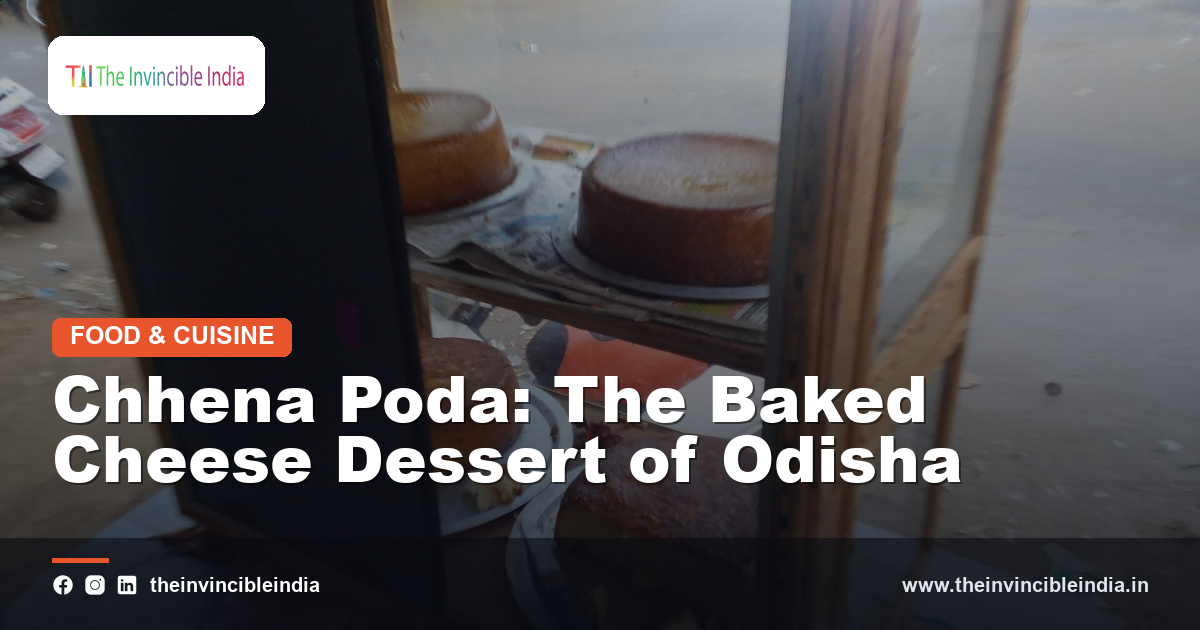
Among the distinctive creations that enrich the famous sweets of India, chhena poda stands out as a dessert that is baked rather than boiled, fried, or steeped in syrup. Made from fresh chhena, the soft curd cheese obtained by curdling milk, together with sugar and a little semolina, it is cooked slowly until the outside turns a deep caramel brown and the inside remains soft, moist, and lightly crumbly. The word poda means burnt or roasted in the Odia language, a reference to the toasted crust that gives the dessert its signature flavour. Closely tied to the culinary identity of Odisha, chhena poda appears in homes, temples, and festivals across the state. This guide explores its meaning, ingredients, traditional method, regional associations, and lasting place in Odia food culture.
Quick Facts
| Detail | Information |
|---|---|
| Type | Baked cheese dessert |
| Main Ingredients | Chhena, sugar, semolina, cardamom |
| Texture | Soft, moist crumb with a caramelised crust |
| Common Additions | Cashews and raisins |
| Regional Origin | Odisha |
| Cooking Method | Slow baking, traditionally in leaves |
What Is Chhena Poda
Chhena poda is a traditional dessert of Odisha prepared by baking a mixture of fresh chhena and sugar until it develops a richly browned crust and a tender, slightly crumbly centre. Chhena is the soft, unpressed curd cheese made by curdling milk and draining away the whey, and it serves as the basis for many sweets across eastern India. In this dessert, the chhena is kneaded with sugar and a modest quantity of semolina, then flavoured with cardamom and often studded with cashews and raisins before being baked slowly. The name combines chhena with poda, meaning burnt or roasted, which describes the caramelised surface that gives the sweet its smoky depth. The overall effect is a dessert that is neither a cake nor a pudding, yet shares qualities with both. Chhena poda is, in essence, the baked cheese sweet of Odisha, valued for its soft texture and deeply caramelised flavour.
Origins in Odisha
Chhena poda is regarded as a native dessert of Odisha, and it is widely associated with the culinary traditions of the state’s rural and temple-centred communities. Popular tradition often links its origin to the town of Nayagarh and to the dairying culture of the region, though the exact beginnings are preserved more through local memory than through documented record. What can be said in general terms is that Odisha has a long and rich tradition of milk-based sweets, and chhena poda is one of the clearest expressions of it. Its method, which relies on slow baking rather than frying, is distinctive among Indian sweets and reflects the ingenuity of cooks who worked with simple fuel, leaves, and earthen vessels. Over generations the dessert became a staple of Odia celebrations and a point of regional pride. Chhena poda therefore represents a home-grown culinary tradition that has remained firmly rooted in the soil and culture of Odisha.
Understanding Chhena
To appreciate chhena poda, it helps to understand chhena itself. Chhena is made by heating milk and adding a souring agent such as lemon juice or whey from a previous batch, causing the milk solids to separate from the liquid. The solids are strained and gathered, forming a soft, fresh cheese with a mild, milky flavour and a slightly grainy, moist texture. Unlike hard aged cheeses, chhena is eaten fresh and is unsalted, which makes it ideal for sweets. In eastern India, chhena is the foundation of famous confections such as rasgulla and sandesh, each shaped by different treatment of the same ingredient. For chhena poda, the cheese is kneaded until smooth enough to bind with sugar and semolina while retaining a pleasant softness. The quality of the finished dessert depends heavily on the freshness and moisture of the chhena, which makes this humble dairy product the true heart of the sweet.
Core Ingredients
The ingredient list for chhena poda is short, and each element has a distinct role. Fresh chhena provides the milky, tender body of the dessert. Sugar sweetens the mixture and, during baking, caramelises at the surface to create the characteristic brown crust and toasty flavour. Semolina, used in small amounts, helps bind the mixture and gives it a gentle, crumbly structure so that it can be sliced neatly once cooled. Ground cardamom lends a warm, floral fragrance that has long accompanied Indian milk sweets. Many cooks add cashews and raisins, which introduce texture and small bursts of sweetness, while a little ghee may be used for greasing the baking vessel and enriching the flavour. Some households include a touch of flour or other binders, depending on custom. Together these few ingredients produce a result greater than their sum, showing how restraint and balance define the best traditional Odia desserts.
The Traditional Baking Method
The classic preparation of chhena poda is a slow, patient process that differs sharply from the quick cooking of many Indian sweets. The chhena, sugar, and semolina are kneaded together into a smooth, soft mass, which is then flavoured and transferred to a prepared vessel or leaf-lined mould. Traditionally, this was baked in a simple setup in which heat came from above and below, using embers or a wood fire, so that the mixture cooked gradually over a long period. As the sugar slowly caramelised, the outer layer darkened to a deep brown while the interior set into a soft, moist crumb. The extended, gentle cooking is what produces the sweet’s signature smoky character. Today, many cooks use ovens, but the underlying principle of slow, even heat remains the same. Chhena poda is therefore defined by its method as much as its ingredients, a dessert shaped by time, heat, and patience.
The Role of Leaves
One of the most characteristic features of the traditional method is the use of leaves in the baking process. Cooks have long used broad leaves, such as those of the sal tree, to line the mould or wrap the mixture before baking. The leaves serve several practical purposes: they prevent the sweet from sticking to the vessel, protect it from direct contact with intense heat, and help retain moisture so that the interior stays tender. They also impart a faint, earthy aroma that blends with the caramelised sugar, contributing to the dessert’s rustic, smoky flavour. Banana leaves are also used in some kitchens, depending on availability and custom. The use of leaves reflects the broader Indian tradition of using natural materials in cooking and serving, a practice that is both resourceful and sustainable. In chhena poda, the leaf is not merely a wrapper but an integral part of its flavour and its identity.
Caramelisation and the Signature Crust
The crust of chhena poda is its most recognizable feature and the source of its name. As the dessert bakes for an extended time, the sugar near the surface melts and darkens through caramelisation, forming a thin, deep brown layer that is slightly firm and carries a pleasant, faintly bitter-sweet note. Beneath this crust, the interior remains pale, soft, and moist, creating a striking contrast of colour and texture within each slice. Skilled cooks judge the degree of browning carefully, because insufficient colour produces a flat, one-dimensional sweetness, while excessive darkening can lead to bitterness. The balance between the burnt edges and the creamy centre is what makes the dessert distinctive. In many households, the browned edges are especially prized for their concentrated flavour. This interplay of crust and crumb shows how heat and sugar can transform a simple mixture of cheese and sweetener into something deeply layered in taste.
Flavour and Texture
The flavour of chhena poda is warm, milky, and gently sweet, underlaid with the toasty, caramel notes of the browned crust. Cardamom adds a fragrant lift, while cashews and raisins contribute soft crunch and occasional pockets of fruity sweetness. The texture falls somewhere between a dense cake and a firm pudding: it is soft and moist, holds its shape when cut, and crumbles lightly under the fork. It is less sticky than syrup-soaked sweets and less rich than those fried in ghee, giving it a distinctly lighter and more rustic character. The sweetness is moderate, allowing the natural taste of the milk to remain present. Because it is baked rather than steeped in syrup, the dessert has a drier, more cake-like finish, which many people find especially satisfying. Taken together, these qualities make chhena poda a comforting sweet with a flavour that is simultaneously simple, earthy, and memorable.
Chhena Poda Among Odisha's Sweets
Odisha has a celebrated tradition of milk-based sweets, and chhena poda holds a prominent place within it. The state is known for a range of chhena preparations, including rasagola, chhena gaja, and chhena jhili, each distinguished by a different treatment of the cheese. Rasagola is soft and syrup-soaked, chhena gaja is firm and sweetened, and chhena jhili is lightly fried and soaked in syrup. Chhena poda differs from all of these in being baked, and its smoky, caramelised profile gives it a character that is quite unlike its relatives. Together, these sweets illustrate the versatility of chhena and the creativity of Odia confectioners. They also show how a single ingredient can yield a broad culinary repertoire when shaped by regional technique. Within this family, chhena poda is often described as the rustic, earthy member, a dessert that is cherished for its homely character and its link to traditional kitchens.
Chhena Poda and Temple Offerings
Food offered in temples holds special significance in Odisha, and chhena poda is among the sweets associated with devotional and festive occasions. Odia temple tradition places great importance on the preparation of offerings, and milk-based sweets are a natural part of that tradition given the region’s long history of dairying. In many communities, chhena poda is prepared for religious observances and shared as a blessed offering among devotees and family members. Its association with sacred and celebratory settings has contributed to its standing as a dessert of cultural, not merely culinary, importance. The act of preparing it at home for festivals is a way of connecting with heritage, and the sharing of it reinforces community ties. While details of specific rituals vary by temple and household, the general role of chhena poda as an offering and festive sweet is widely recognized. It is a dessert closely woven into the devotional life of Odisha.
Festivals and Family Celebrations
Chhena poda features prominently in the festive and family life of Odisha. It is commonly prepared for celebrations, religious observances, and special gatherings, and it is a favourite among those who return home during festival seasons. Many Odia families regard it as a taste of home, and it is often carried as a gift by travellers visiting relatives. Because it is not covered in syrup and holds its shape well, it is easy to slice, serve, and share among large groups. Sweet shops across Odisha prepare it in quantity during peak festive periods, and it is also made at home as a point of pride. The dessert has thus become a symbol of hospitality and belonging, connecting people to their land and traditions. Whether served at a modest family occasion or a large celebration, chhena poda carries associations of warmth, welcome, and the shared enjoyment of regional heritage.
Regional and Home Variations
Like many traditional foods, chhena poda varies from one cook to another. Some versions are firmer and more cake-like, while others are softer and more pudding-like. The degree of browning differs too, with some households preferring a dark, deeply smoky crust and others a lighter, golden finish. Ingredient choices also vary: certain recipes use more semolina for structure, while others rely mainly on the chhena itself, and some add nuts, raisins, or even a hint of saffron. A few cooks include a small amount of flour or use jaggery instead of white sugar for a more rustic sweetness. Modern adaptations include baking in ovens, using moulds of different shapes, and creating individual portions. These variations do not erase the dessert’s identity but demonstrate its adaptability. Whatever the form, chhena poda retains its core character as a baked, caramelised cheese sweet, which is what makes every version recognizably Odia.
Home Preparation and Practical Notes
Preparing chhena poda at home is possible with simple equipment, though it rewards care. Fresh chhena of good quality is essential, and it should be drained well but not dried out, so that the final dessert is moist without being watery. The mixture is kneaded until smooth, and the sugar and semolina are blended in evenly, since lumps can create an uneven texture. Baking at a moderate temperature for a long period allows the interior to set gently while the surface caramelises gradually. Cooks watch the colour of the crust to judge readiness, and the sweet is typically allowed to cool before slicing so that it firms up and holds its shape. Lining the pan with leaves or greased paper helps in removal. These practical points show that good chhena poda depends less on elaborate technique than on fresh ingredients, even mixing, and the patience to let slow heat work.
Serving and Pairing
Chhena poda is typically served in slices or squares, either at room temperature or slightly warm. It may be enjoyed on its own as a dessert or a snack, or as part of a festive meal alongside other sweets. Some people like it with a cup of tea, while others enjoy it as a finish to a traditional Odia meal. Warm slices can be accompanied by a spoonful of fresh cream or rabri for added richness, though the classic presentation is simple and unadorned. Because it keeps reasonably well when stored properly, it can be prepared ahead for gatherings. The sweetness is moderate, which makes it appealing to a broad range of tastes, including those who find syrup-soaked sweets overly sweet. Served plain or with a modest accompaniment, chhena poda remains a satisfying dessert whose appeal lies in its natural flavour, soft texture, and subtle smokiness.
Chhena Poda in the Wider Food Culture of India
Chhena poda also enriches the broader picture of Indian food culture. Much of India’s confectionery is built on fried or syrup-soaked preparations, so a baked cheese dessert offers a notable exception, one that invites comparison with baked cheese traditions elsewhere without being derived from them. It reflects the creativity of Indian cooks in adapting local ingredients and methods to produce something wholly original. The dessert also illustrates the importance of regional identity in Indian cuisine, since it is so closely tied to Odisha that its name immediately evokes the state. It shows how regional cuisines preserve distinct techniques and tastes within a shared national tradition. Studying such sweets helps readers appreciate how food carries history, geography, and community memory. Chhena poda is a clear example of how a single dessert can embody the character of an entire region.
Chhena Poda Today
Today chhena poda continues to flourish as one of Odisha’s most beloved desserts. It is sold in sweet shops across the state, prepared in homes for festivals, and increasingly appreciated by visitors and by Odia communities living elsewhere in India and abroad. Modern bakers and chefs have also taken an interest in it, presenting it in new forms while respecting its essential character. At the same time, traditional makers continue to practise the slow, leaf-lined methods that give the dessert its authentic flavour. This balance between continuity and renewal has helped chhena poda remain relevant to younger generations. It stands as a reminder that regional foods can thrive when they are valued, shared, and celebrated. As a dessert with deep roots, a distinctive flavour, and a strong cultural identity, chhena poda remains a proud emblem of Odia culinary heritage.
Sources & Further Reading
- Ministry of Culture, Government of India (indiaculture.gov.in).
- Government of Odisha, Department of Tourism (odishatourism.gov.in).
Frequently Asked Questions
What is chhena poda?
Chhena poda is a traditional Odia dessert made by baking fresh chhena, sugar, and semolina until it forms a caramelised crust and a soft interior. The word poda means burnt or roasted, referring to its browned surface.
What is chhena?
Chhena is a fresh, unsalted curd cheese made by curdling milk with an acid and draining off the whey. It forms the basis of many sweets in eastern India, including rasgulla and sandesh.
How is chhena poda traditionally baked?
It is baked slowly over gentle heat, often in a leaf-lined vessel, so that the sugar caramelises on the outside while the inside stays soft. Many cooks now use a conventional oven to achieve the same effect.
Why are leaves used in making chhena poda?
Leaves, such as sal or banana leaves, prevent sticking, protect the mixture from harsh heat, and help retain moisture. They also add a subtle earthy aroma to the finished dessert.
How is chhena poda different from rasgulla?
Rasgulla is made from chhena that is shaped into balls and simmered in syrup, giving a soft, spongy, juicy sweet. Chhena poda is baked, resulting in a firmer, cake-like texture with a smoky caramelised crust.


