

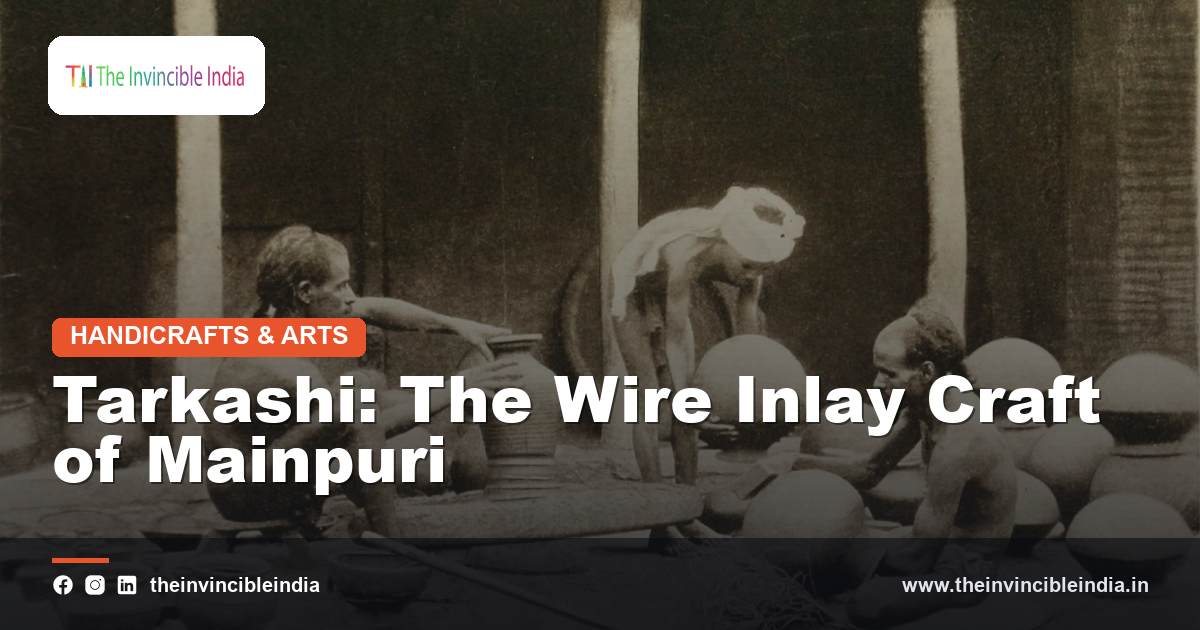
Tarkashi is the traditional Indian craft of setting fine metal wire into carved wooden surfaces to create intricate patterns, and it is most closely associated with the town of Mainpuri in Uttar Pradesh. The word itself is commonly understood to refer to wire work, and the craft depends on precision, patience and a steady hand rather than elaborate machinery. Finished pieces, such as boxes, trays, panels and small furniture, display lines of bright metal that stand out crisply against dark, polished wood. As a form of decorative metalwork on a different base material, Tarkashi invites comparison with Bidriware, though its methods and materials differ. This guide explores the history, tools, process, motifs and continuing revival of Tarkashi.
Quick Facts
| Detail | Information |
|---|---|
| Type | Metal wire inlay on carved wood |
| Home town | Mainpuri |
| State | Uttar Pradesh |
| Typical wood | Dense hardwood such as shisham |
| Typical metal | Brass wire, with other metals in some work |
| Typical products | Boxes, trays, panels, furniture and decor |
What Is Tarkashi
Tarkashi is a decorative craft in which thin strands of metal wire are carefully hammered into fine grooves cut in a wooden surface, forming patterns that stand out in bright contrast against the wood. The name is generally understood to describe the practice of working with wire, which sits at the heart of the technique. Unlike painting or carving alone, Tarkashi combines both skills, since the design must first be cut into the wood and then filled with metal so exactly that the finished surface feels smooth. The craft produces objects that are at once useful and ornamental, and it has long been regarded as one of the distinctive woodworking and metalworking traditions of northern India.
Mainpuri and Its Craft Identity
Mainpuri, a town in the Uttar Pradesh plains, is the place most strongly associated with Tarkashi, and the craft has become part of the town’s identity. Generations of artisan families have worked in the town, passing on both the skills and the specialised tools of the trade. Over time, Mainpuri developed a reputation for producing finely finished wire inlay work, and its craftsmen have supplied customers within India and beyond. The craft has received formal recognition through the Geographical Indication system, which protects the link between the product and its place of origin. This connection between a craft and a town illustrates how deeply local identity can be tied to the long practice of a particular skill.
Origins and Historical Background
The exact origins of Tarkashi are not firmly established, and accounts of how the craft arrived in Mainpuri vary. What is clear is that inlay in wood, metal and stone has a long history across the Indian subcontinent, practised in royal courts and craft centres under many patrons. Artisans skilled in decorative inlay were often supported by rulers and wealthy households who commissioned finely worked furniture and objects. Tarkashi is understood to have grown within this wider culture of decorative inlay, eventually settling into the artisan community of Mainpuri. Without asserting precise dates or specific founders, it is fair to say that the craft is the product of many generations of accumulated skill and refinement.
Choice of Wood
The wood chosen for Tarkashi must be dense, fine-grained and stable enough to hold precisely cut grooves without splitting or warping. Craftsmen have traditionally favoured dense hardwoods, with shisham, also known as Indian rosewood, being among the most widely used because of its strength and rich, dark colour. A well-seasoned piece of wood is essential, since movement caused by moisture would loosen the inlay and spoil the finish. The natural grain and colour of the wood also form part of the final design, providing a dark backdrop against which the metal wire shines. Careful selection and preparation of the timber is therefore the first and most important step in producing a lasting piece of Tarkashi work.
Wire and Other Metals
The metal used for Tarkashi is drawn into very thin wire that can be bent, laid and hammered into narrow channels without breaking. Brass is the metal most commonly associated with the craft, prized for its warm golden colour and its ease of working, though other metals such as copper and white metal are also used in some work to vary the effect. The wire must be of consistent thickness so that it sits evenly within the groove and can be polished flush with the surrounding wood. Combining bright metal with dark wood produces a striking contrast that has become the visual signature of Tarkashi, giving even simple patterns a crisp and luminous quality.
Tools of the Craft
Tarkashi is traditionally carried out with a modest set of hand tools, many of them made or adapted by the craftsmen themselves. Fine chisels and cutting tools are used to engrave the pattern lines into the wood, small hammers drive the wire into place, and pliers or tweezers help shape and position the metal. Files, scrapers and abrasives are then used to level and smooth the surface after inlay. The simplicity of the tools belies the precision they make possible, since results depend on the skill of the hands that guide them. A craftsman’s tool kit, built up and refined over years, is as much a mark of expertise as any finished piece.
Drawing and Preparing the Design
Every Tarkashi piece begins with a design, usually sketched or transferred onto the prepared wooden surface so that the craftsman can follow its lines accurately. Designs may be drawn freehand by experienced artisans or traced from templates handed down within the workshop, and they are planned with the available space and the form of the object in mind. Border arrangements, central motifs and repeating elements are all worked out before cutting begins. Careful planning matters because mistakes in cut wood cannot easily be corrected, and the continuity of the pattern depends on an accurate layout. The drawing stage is therefore the foundation on which the later skilled work of cutting and inlaying rests.
Cutting the Grooves
Once the design is marked, the craftsman uses fine chisels and engraving tools to cut narrow grooves along every line of the pattern. The depth and width of these channels must match the wire to be inlaid, since a groove that is too wide will leave gaps and one that is too narrow will prevent the wire from seating properly. Curves and tight turns require particular care and a steady hand. The work is slow and exacting, and the quality of the groove determines the quality of the finished inlay. This stage demonstrates the close relationship between woodcarving and metalwork in Tarkashi, with each depending on the precision of the other.
Inlaying the Wire
With the grooves ready, the craftsman lays thin metal wire into each channel, bending it to follow curves and cutting it to length where lines end. A small hammer is then used to tap the wire firmly into the groove so that it grips the wood and sits securely. In some workshops the wire is fixed with the help of adhesive as well as by pressure, ensuring that it does not loosen with time. Each strand is placed individually, which makes the process laborious but gives the finished design its fine, linear quality. The patience required at this stage is considerable, and a single piece may take a long time to complete depending on the density of its pattern.
Finishing and Polishing
After the wire has been set, the surface is carefully filed, scraped and sanded until the metal is level with the surrounding wood and the whole piece feels smooth to the touch. Polishing then brings out the shine of the metal and the depth of the wood, often with the application of a protective finish such as a varnish or polish. This stage is as important as the inlay itself, since uneven surfaces or dull metal would detract from the clarity of the design. A well-finished Tarkashi object is crisp, even and lustrous, with the wire lines looking as though they have grown naturally out of the wood. Finishing is where careful technique becomes visible as quality.
Motifs and Patterns
Tarkashi designs draw on a long tradition of Indian ornament, with floral scrolls, creepers, leaves and geometric arrangements among the most common motifs. Many patterns echo the decorative vocabulary seen in architecture, textiles and other crafts of northern India, in which repeating forms and symmetrical borders play an important part. The linear nature of wire inlay lends itself especially well to flowing, vine-like designs and to fine lattice effects reminiscent of jali screens. Contemporary craftsmen also experiment with simpler or more abstract patterns for modern interiors. Across these variations, the defining quality remains the elegant, thread-like line of metal set against dark wood.
Jali Work and Related Techniques
Tarkashi is often associated with other forms of fine decorative woodwork found in northern India, including pierced lattice carving known as jali work, in which delicate patterns are cut through the surface of a panel. In some pieces, wire inlay and carved or latticed areas are combined to give variety of texture and depth. Craftsmen may also work with inlay of other materials, such as bone or contrasting wood, in related traditions. Understanding these neighbouring techniques helps place Tarkashi within a broader family of ornamental woodworking skills, shared and developed by artisans across the region over many generations, each tradition borrowing and responding to the others.
Products and Uses
The range of Tarkashi products is broad, taking in jewellery boxes, trays, nameplates, decorative panels, table tops, small furniture and household accessories. Many items are practical as well as ornamental, such as storage boxes and serving pieces, while others are made purely for display. Larger commissions may include doors, screens and pieces of furniture with extensive inlay. The craft has also adapted to modern tastes with objects such as stationery holders and tabletop decor. This variety shows how the same core technique can be applied to objects of many sizes and purposes, allowing artisans to serve both traditional customers and new markets for handcrafted design.
Challenges Facing the Craft
Like many traditional crafts, Tarkashi faces pressures from competition with machine-made and imitation products, rising material costs and changing consumer preferences. The time-consuming nature of the work makes it difficult to compete on price with cheaper decorative goods, and the supply of good-quality seasoned wood can be a concern. Some younger members of artisan families look toward other careers that promise steadier incomes, raising questions about how skills will be passed on. These difficulties underline the need for fair prices, reliable markets and public appreciation of the labour that goes into each piece. The future of the craft depends on ensuring that making Tarkashi remains a worthwhile livelihood.
Recognition and Revival Efforts
Efforts to support Tarkashi have included craft fairs, exhibitions, training programmes and promotion through government and non-government craft bodies. Geographical Indication recognition for Mainpuri Tarkashi has helped protect the identity of the craft and discourage imitation, while district-level promotion of local specialities has drawn greater attention to its artisans. Designers have also collaborated with craftsmen to develop contemporary products that appeal to new buyers without compromising traditional technique. Such initiatives show that heritage crafts can find fresh relevance when quality, design and marketing are addressed together. Continued support of this kind offers the best prospect of keeping Tarkashi vibrant for future generations of artisans.
Recognising Genuine Tarkashi
Genuine Tarkashi can be recognised by the quality and consistency of its inlay. Wire lines should sit flush with the wood, with no gaps, raised edges or loose strands, and curves should flow smoothly rather than appearing jagged. The wood should feel dense and well finished, and the metal should be crisp and evenly polished. Cheaper imitations sometimes use printed or stamped decoration, or glued metal strips, which lack the fine linear quality of true wire inlay. Buying from established workshops, cooperatives or recognised craft outlets helps ensure authenticity, and it directs payment to the artisans whose patient work gives each piece its character and value.
Tarkashi Today
Today, Tarkashi remains a distinctive emblem of Mainpuri and one of the finer expressions of wood and metal craftsmanship in northern India. Artisan families continue to chisel, inlay and polish by hand, producing boxes, panels and furnishings that combine traditional motifs with contemporary uses. Recognition, design collaboration and growing interest in handmade goods have given the craft renewed visibility. Its enduring appeal lies in the contrast of bright wire against dark wood and in the evident skill behind every line. Tarkashi stands as a reminder that careful, patient handwork can still turn simple materials into objects of lasting beauty and cultural meaning.
Sources & Further Reading
- Ministry of Culture, Government of India (indiaculture.gov.in).
- Office of the Development Commissioner (Handicrafts), Ministry of Textiles, Government of India.
Frequently Asked Questions
What is Tarkashi?
Tarkashi is a traditional craft in which fine metal wire, usually brass, is hammered into carved grooves in wood to form decorative patterns. It is most closely associated with Mainpuri in Uttar Pradesh.
Which wood is used for Tarkashi?
Dense, fine-grained hardwoods are preferred, and shisham, or Indian rosewood, is among the most commonly used. Well-seasoned wood is essential so that the inlay stays firm and the surface does not warp.
How is Tarkashi made?
The design is drawn on the wood and fine grooves are cut along its lines with chisels. Thin wire is then laid and hammered into the grooves, after which the surface is filed, sanded and polished smooth.
What products are made with Tarkashi?
Common products include boxes, trays, nameplates, decorative panels, small furniture and household accessories. Larger commissions can include doors, screens and tables with extensive wire inlay.
How can genuine Tarkashi be recognised?
Genuine work shows wire lines sitting flush with the wood, with smooth curves and no gaps or loose strands. Buying from established workshops or recognised craft outlets helps ensure authenticity.


