

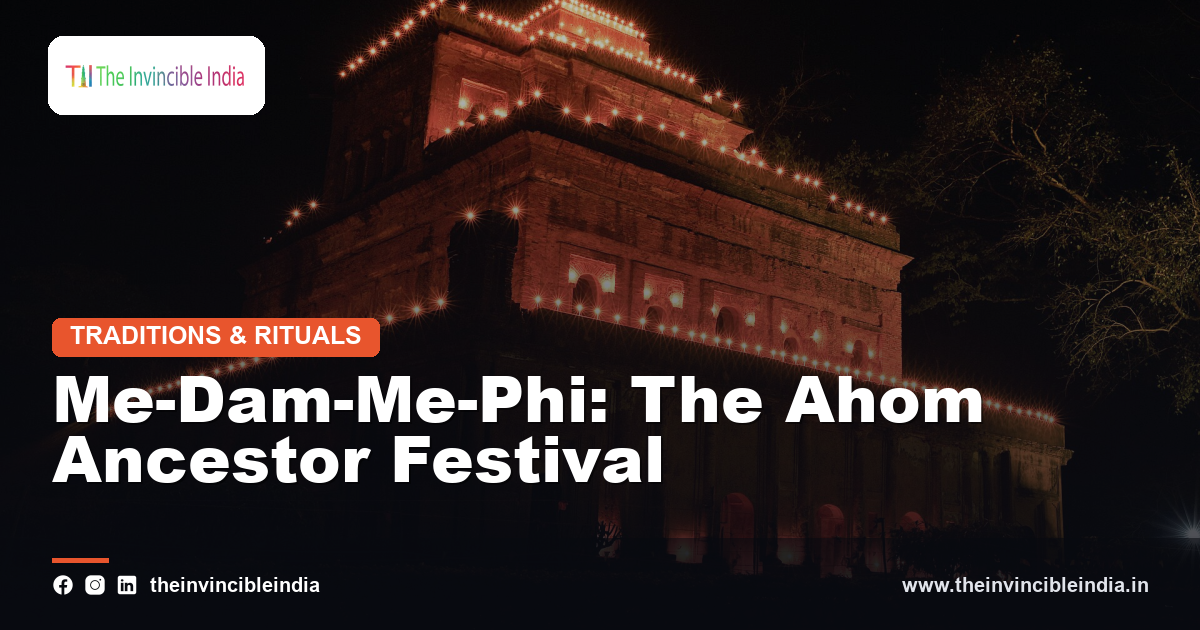
Me-Dam-Me-Phi is the traditional ancestor festival of the Ahom community of Assam, observed each winter to honour departed family members and the deities who protect the household. The Ahoms, who ruled much of the Brahmaputra valley for roughly six centuries, brought with them Tai customs that blended over time with Assamese life, and this festival remains one of the clearest expressions of that inheritance. Families make offerings of food, flowers and incense, elders lead prayers, and communities gather at ancestral sites and at the royal burial mounds known as moidams. It sits alongside the agricultural and seasonal festivals described in the guide to Bihu in Assam, but its focus is remembrance rather than harvest. The festival offers a dignified view of how a community keeps faith with its past.
Quick Facts
| Detail | Information |
|---|---|
| Festival Type | Ancestor remembrance and worship |
| Community | Tai-Ahom people of Assam |
| Timing | Winter, around the end of January |
| Meaning of the Name | Offering to ancestors and to the gods |
| Key Sites | Family homes, Charaideo and Sivasagar |
| Core Practices | Offerings, prayers, and communal remembrance |
The Meaning of the Name
The name Me-Dam-Me-Phi comes from the Tai-Ahom language and is generally understood to combine three ideas. Me refers to an offering, dam refers to the departed ancestors, and phi refers to the gods or higher spirits, so that the festival can be described as the offering to the ancestors and to the divine. The repetition of me in the name points to the two linked acts of worship, one directed to the family dead and the other to the deities of the household and the community. This compact name expresses the structure of the entire festival, in which remembrance of the dead and reverence for the gods are bound together. The festival is therefore best understood not as a mournful occasion but as a respectful and affectionate gathering around the memory of those who came before.
The Ahoms and Their Heritage
The Ahoms are a people of Tai origin who entered the Brahmaputra valley in the thirteenth century and established a kingdom that endured for roughly six hundred years, until the arrival of British rule in the nineteenth century. Over the centuries they integrated with the local population, adopting the Assamese language and many Assamese customs while preserving distinctive elements of their original culture, including historical chronicles called buranjis, systems of administration and their own ancestral traditions. Today the Ahom community is an important part of Assamese society, and many Ahom people work to preserve their language, rituals and history. Me-Dam-Me-Phi is one of the central markers of that heritage. Understanding the Ahom past gives context to the festival, since it is the surviving expression of a long and distinguished cultural continuity in the region.
Ancestor Worship in Tai Tradition
Reverence for ancestors is a feature of many Asian cultures, and it is especially strong among Tai peoples, whose traditional beliefs combine respect for the spirits of the departed with veneration of nature and of higher gods. The Ahoms, as a Tai community, brought these ideas to Assam, where they were maintained through household rites and priestly lineages. The ancestors are regarded as continuing presences who protect the family, and showing them honour is believed to secure their blessings and ensure the wellbeing of the household. This outlook differs in emphasis from some other religious traditions of the region, though it has lived alongside them for centuries without conflict. The ancestor rituals of the Ahoms are thus a distinct heritage, and the festival is a way of keeping this inheritance alive and understood by new generations.
Timing and Annual Observance
Me-Dam-Me-Phi is observed in winter, in recent years on a fixed date around the end of January that has been adopted by the community for collective observance. Traditionally, families performed the rites at times determined by their own priests and customs, and some households continue to follow older schedules. The choice of a common date allows communities across Assam to celebrate together and enables public programmes and official participation to be organised. The winter setting also places the festival after the harvest, when families have time for ritual and gathering. Readers who wish to take part or attend should consult local Ahom organisations for the dates and arrangements in a given year. The practice of fixing a date has helped the festival become more visible, while the underlying rites continue to follow their long established pattern.
The Role of the Deodhai and Bailung Priests
The rituals of Me-Dam-Me-Phi are traditionally led by priests of the Ahom community, known as Deodhai and Bailung, who inherit the knowledge of chants, prayers and procedures from earlier generations. The Deodhai are regarded as the guardians of the ritual tradition, and the Bailung assist in the performance of ceremonies and in preserving ancestral lore. They recite verses in the Tai-Ahom language, a liturgical tongue that is no longer in everyday use, and they conduct offerings in a prescribed order. Their role gives the festival continuity with the royal and religious practices of the Ahom kingdom. Many young people in the community are now being trained in the language and the rites so that the knowledge will not be lost. The priests serve as living links between the present community and its inherited tradition, and their guidance keeps the ceremonies authentic and orderly.
Household Rituals and Offerings
At the family level, Me-Dam-Me-Phi is observed by setting aside a clean place in the home or courtyard where offerings are made to the ancestors. Families prepare traditional food, including rice, fruits and vegetables prepared according to family custom, and place them before a lamp or symbolic altar together with incense, flowers and betel nut. A senior member of the family, usually an elder, leads the prayer, calling upon the ancestors by name and inviting them to share the offering and to bless the descendants. Members of the household stand in respectful silence and then share the food among themselves. The simplicity of the rite is part of its dignity. Household offerings are the core of the festival, since it is within the family that remembrance first takes place.
The Moidams of Charaideo
The most significant physical site connected with the Ahom ancestral tradition is Charaideo, in the Sivasagar region, where the moidams, which are the burial mounds of Ahom kings and members of the royal family, are located. The mounds are earthen hills of varying sizes built over vaults that held the remains of the dead, together with objects intended for their use in the afterlife, in keeping with Tai beliefs. Charaideo was regarded as a sacred place and the earliest capital of the Ahom kingdom. The moidams have been recognised internationally, and they were inscribed on the UNESCO World Heritage list in recent years. During Me-Dam-Me-Phi, many members of the community visit the site to offer prayers and flowers. The moidams give the festival a physical and historical anchor, linking present observance to the royal heritage of the Ahom people.
Community Gatherings and Public Observance
Beyond the household, Me-Dam-Me-Phi is celebrated in community gatherings organised by Ahom associations and cultural bodies in towns and villages across Upper Assam and beyond. These gatherings include collective prayer led by priests, traditional music and dance, cultural presentations, speeches on Ahom history, and the sharing of food among participants. Public events at the Charaideo moidams and in Sivasagar attract large numbers of people, including officials and guests from other communities. Such gatherings give the festival a public dimension and help to build awareness of Ahom history and culture among the wider population. They also provide opportunities for community members who live away from home to return and take part. The communal side of the festival strengthens identity and mutual support, ensuring that remembrance of ancestors is shared as well as private.
Traditional Dress, Music and Performance
Participants in Me-Dam-Me-Phi often wear traditional Ahom clothing, which reflects the textile heritage of Assam. Men may wear a dhoti and a kurta or a traditional jacket with a woven scarf, and women wear the mekhela chador, the two-piece garment of Assam, often in silk with traditional motifs. Musical instruments such as drums and flutes accompany ritual and cultural performances, and the recitation of old chants gives voice to the language of the community. Folk songs and dances of the Ahom tradition may be presented at public gatherings, and young people are encouraged to participate. These cultural expressions enrich the festival and link it with the broader artistic life of Assam. The visual and musical elements of the festival help to convey its meaning to those who may not understand the ritual language, and they make remembrance a living and beautiful experience.
Language and the Revival of Tai-Ahom Studies
The Tai-Ahom language, which was used in the court and religious life of the Ahom kingdom, gradually fell out of everyday use as the community adopted Assamese, though it survives in manuscripts and in the chants of the priests. In recent decades, scholars, teachers and community organisations have worked to revive its study, teaching reading and writing of the script, cataloguing old manuscripts and training young students to recite the traditional verses. Me-Dam-Me-Phi provides a natural setting for this effort, since its prayers are in the old language and its priests are among the keepers of the tradition. The festival is therefore a stage for linguistic as well as religious heritage. This revival reflects a wider interest in preserving the diversity of India’s languages. By keeping the old tongue in use at the festival, the community helps to protect a rare and valuable element of its past.
Relationship with Other Assamese Festivals
Me-Dam-Me-Phi is one of many festivals that shape the cultural calendar of Assam, and it exists alongside observances such as Bihu, which celebrates the agricultural cycle, and the Vaishnava festivals of the Sattra tradition, which reflect the religious reforms of Srimanta Sankardeva. Each has a different character, and many Assamese people take part in several of them. The Ahom ancestor festival is distinctive in its focus on lineage and remembrance, and it expresses the Tai heritage within the composite culture of Assam. The peaceful coexistence of these traditions reflects the region’s long history of cultural exchange and mutual influence. Neighbours from other communities sometimes attend Ahom ceremonies as guests. The festival thus contributes to the richness and plural character of Assamese society, and it is valued by many beyond the Ahom community.
Values of Remembrance and Continuity
The central values of Me-Dam-Me-Phi are gratitude, humility and continuity. By remembering ancestors, the living acknowledge the debts they owe to those who built the family, the community and the land they inhabit. The festival encourages respect for elders, attention to genealogy and a sense of belonging to a long line of people. It also teaches children about their roots through participation in prayers, stories and shared meals. These values are not confined to the Ahom community but are widely shared across Indian cultures, which have long placed emphasis on honouring the departed. The festival presents them in a particular Tai-Ahom form, with its own language and symbols. In a rapidly changing world, such rituals provide a stable point of reference, and they help to maintain the bonds between generations.
Respectful Participation by Visitors
Visitors who wish to witness Me-Dam-Me-Phi should approach it as a respectful guest at a community’s act of remembrance. It is advisable to contact local Ahom cultural organisations in advance, to ask whether visitors are welcome at particular events and to follow their guidance. Modest clothing is appropriate, and shoes are usually removed before entering ritual spaces. Photography should be undertaken only with permission, especially during prayer, and the moidams must be treated with care, since they are both sacred sites and protected monuments. Visitors should avoid climbing on the mounds or disturbing the surroundings. A humble and attentive attitude is appreciated by hosts and allows for a more meaningful exchange. By observing these simple courtesies, guests help to honour the dignity of the occasion and to support the efforts of the community to preserve its tradition.
Preserving Ahom Heritage for the Future
Preserving the heritage associated with Me-Dam-Me-Phi involves protecting historic sites, supporting the training of priests, documenting manuscripts and encouraging young people to take part. Heritage authorities, universities, cultural bodies and the Ahom community itself all contribute to this effort. Conservation of the moidams, which are exposed to weather and development pressure, is an important concern, as is the management of visitor numbers. The recognition of the Charaideo moidams as a World Heritage site has increased awareness of their value and brought additional attention and support. At the same time, community leaders emphasise that heritage is a living practice rather than a museum object. The continued celebration of the festival is itself a form of preservation. Sustained cooperation between institutions and families helps ensure that the traditions will pass intact to future generations.
Me-Dam-Me-Phi Today
Me-Dam-Me-Phi today is a visible and widely respected festival in Assam, observed in homes, community halls and at the moidams of Charaideo each winter. It has grown in public awareness in recent years, drawing participation from Ahom families across the state and attention from other communities and from visitors. While its rituals remain faithful to the Tai-Ahom tradition, they now take place in a modern setting, with organisers using public programmes and media to share the festival’s meaning. For many members of the community, it is a moment of pride, gratitude and reunion with family. The festival also contributes to the wider recognition of the diversity of India’s cultural heritage. Me-Dam-Me-Phi endures as a dignified expression of remembrance, uniting the living with their ancestors and linking the Ahom people with their long and distinguished past.
Sources & Further Reading
- Ministry of Culture, Government of India (indiaculture.gov.in).
- Archaeological Survey of India (asi.nic.in).
Frequently Asked Questions
What is Me-Dam-Me-Phi?
Me-Dam-Me-Phi is the Ahom festival of Assam in which families honour their departed ancestors and the gods through offerings and prayer. The name is understood to mean offering to the ancestors and to the divine.
Who celebrates Me-Dam-Me-Phi?
It is celebrated by the Tai-Ahom community of Assam, who descend from a people that ruled the Brahmaputra valley for around six centuries. Members of other communities sometimes attend as respectful guests.
When is Me-Dam-Me-Phi observed?
It is held in winter, around the end of January, on a date adopted by the community for collective observance. Families and local organisations announce arrangements each year.
What role do the moidams play?
The moidams of Charaideo are the burial mounds of Ahom royalty and a sacred site for the community. Many people visit them during the festival to offer prayers and flowers.
Who leads the rituals of Me-Dam-Me-Phi?
Traditional Ahom priests called Deodhai and Bailung lead the rites, reciting prayers in the Tai-Ahom language. Family elders lead offerings in individual households.


