

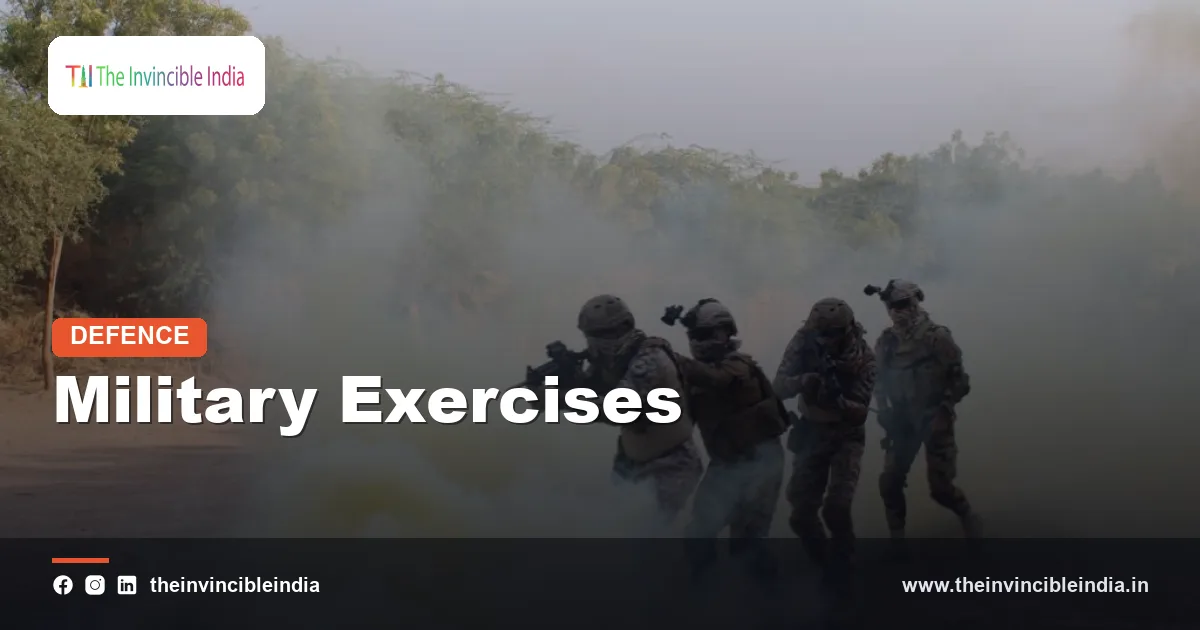
The military exercises of India are a regular part of the country’s defence calendar, ranging from small bilateral drills between army battalions to large multinational naval and air manoeuvres. Held on land, at sea and in the air, they allow the Indian armed forces to train alongside friendly nations, share tactics and test equipment, while also sending a political signal about shared interests and partnerships.
Names such as Malabar, Yudh Abhyas, Varuna, Garuda, Indra and Nomadic Elephant have become familiar to defence watchers because they recur year after year. Together, these exercises form an important instrument of defence diplomacy, helping India build trust with partners, improve interoperability and prepare for operations ranging from counter-terrorism to humanitarian relief.
| Fact | Detail |
|---|---|
| Purpose | Training, interoperability and defence diplomacy |
| Types | Bilateral, trilateral and multilateral; army, navy, air force and tri-service |
| Malabar | Naval exercise, begun in 1992 with the United States; now involves the Quad partners |
| Yudh Abhyas | Army exercise with the United States, held since 2004 |
| Varuna | Naval exercise with France |
| Garuda | Air force exercise with France |
| Indra | Exercise series with Russia, begun in 2003 |
| Nomadic Elephant | Army exercise with Mongolia, begun in the mid-2000s |
| Hand-in-Hand | Army exercise with China, held in earlier years and not currently routine |
What Are Joint Military Exercises?
A joint military exercise is a planned training event in which the armed forces of two or more countries, or two or more services of the same country, operate together under agreed scenarios. Unlike a real operation, an exercise is conducted in controlled conditions, and its scenarios are designed in advance to test particular skills. They can last a few days or several weeks, and may involve a few dozen personnel or thousands of troops with ships, aircraft and armoured vehicles.
Common Formats
- Bilateral exercises: Two nations train together, as in Yudh Abhyas with the United States.
- Trilateral and multilateral exercises: Three or more nations take part, as in Malabar or the Indian Navy’s Milan gathering.
- Passage exercises (PASSEX): Short drills conducted when ships of two navies meet at sea.
- Tri-service exercises: The army, navy and air force of the participating countries train together.
- Staff and table-top exercises: Planning and command drills conducted without full troop deployment.
Domestic Exercises
India also conducts large exercises on its own, such as the major army manoeuvre Brasstacks in the mid-1980s and various annual theatre-level drills by the Army, Navy and Air Force. These test readiness, logistics and joint command, and form the basis for the more complex international exercises India takes part in.
Why India Holds Exercises: Objectives and Benefits
Exercises serve both practical and strategic goals. On the practical side, they raise professional standards, expose personnel to different doctrines and equipment, and sharpen skills that are hard to practise alone, such as coordinating a multinational task force.
Interoperability
Interoperability means the ability of different forces to work together smoothly, using compatible procedures, communications and command systems. Navies that exercise together learn common signals, formations and replenishment procedures, so that they can operate as a combined group if a crisis occurs. Armies share counter-terrorism techniques and logistics practices, while air forces practise complex missions involving mixed fleets of aircraft.
Defence Diplomacy
Military exercises also build relationships and trust. Regular participation signals that two countries are comfortable operating together and have shared interests. For India, a country that follows a policy of strategic autonomy and multi-alignment, exercises with a wide range of partners, from the United States to Russia and from France to Southeast Asian states, show that it is open to cooperation without being tied to any single bloc.
Other Benefits
- Testing indigenous weapons and equipment in realistic conditions.
- Learning from the combat experience of partner forces.
- Preparing for humanitarian assistance and disaster relief missions.
- Promoting regional stability through transparency and confidence-building.
Malabar: The Flagship Naval Exercise
Malabar is the best known of India’s multilateral exercises. It began in 1992 as a bilateral naval exercise between the Indian Navy and the United States Navy, and over time it grew into a larger event involving more countries.
Growth into a Quad Exercise
Japan took part in some editions and became a regular participant from 2015. Australia, which had joined in 2007 in a larger edition, returned in 2020, which meant that all four members of the Quadrilateral Security Dialogue, or Quad, were taking part together. Since then, Malabar has been widely viewed as the naval face of Quad cooperation, even though the Quad itself is a diplomatic grouping rather than a military alliance.
What Malabar Involves
Malabar usually includes surface warfare, anti-submarine warfare, air defence, maritime interdiction, helicopter operations and cross-deck landings. Major warships, submarines, maritime patrol aircraft and sometimes aircraft carriers take part. The exercise is held in different locations, including the Indian Ocean, the Bay of Bengal, the Arabian Sea, and the Pacific, with the host rotating among the partners.
Strategic Significance
Malabar demonstrates a shared interest in open and secure sea lanes and in a free and open Indo-Pacific. It also offers each navy valuable experience in operating with technologically advanced partners.
Yudh Abhyas: Army Cooperation with the United States
Yudh Abhyas is the principal army-level exercise between India and the United States. It has been held since 2004, with the venue alternating between the two countries. The name means “training for war” in Hindi.
Focus Areas
The exercise typically focuses on counter-terrorism, peacekeeping, high-altitude and mountain warfare, and operations under a United Nations mandate. Platoon and company-level units drill in cordon and search, house-clearing, casualty evacuation and command post routines. Over time, the scope has grown to include aviation, drones and cyber elements.
Wider India-US Defence Interactions
Alongside Yudh Abhyas, India and the United States hold other exercises, such as the tri-service exercise Tiger Triumph, which was first conducted in 2019 and concentrates on humanitarian assistance and disaster relief, and Cope India, an air force exercise. Special forces and counter-terrorism drills such as Vajra Prahar add to the portfolio. Together they form one of India’s most extensive exercise relationships.
Exercises With France: Varuna, Garuda and Shakti
France is among India’s closest defence partners, and there is a full set of exercises across the three services.
Varuna
Varuna is a naval exercise between the Indian Navy and the French Navy. Its origins go back to the early 2000s, and in 2001 it was formalised under the name Varuna, after the Vedic god of the seas. It covers anti-submarine warfare, air defence, replenishment at sea and, at times, carrier operations. Both navies operate sophisticated platforms, including carriers, submarines and maritime aircraft, which makes the exercise especially valuable.
Garuda
Garuda is an air force exercise between the Indian Air Force and the French Air Force. It began in 2003 and takes place in both countries on alternate occasions. Fighter aircraft, tankers, transport planes and airborne control platforms take part, and pilots rehearse air combat, strike packages and mixed-fleet operations.
Shakti
Shakti is a bilateral army exercise, with a focus on counter-terrorism and operations in semi-urban and mountain terrain. The three exercises together demonstrate the breadth of Indo-French cooperation across land, sea and air.
Indra and Other Exercises With Russia
Russia has long been a major supplier of Indian defence equipment, and a strong training relationship accompanies the supply link. The Indra series was started in 2003 with a naval exercise, and an army version followed in 2005, with an air element added later.
Nature of the Exercise
Indra covers a variety of themes, such as counter-terrorism, anti-piracy, joint planning and tactical drills. Because much of India’s military hardware is of Russian or Soviet origin, the exercises help personnel understand operational practices and ensure smooth cooperation. The location alternates between the two countries, and the participating forces vary from year to year.
Tri-Service Scope
Exercise Indra has been held in all three domains, giving it a broad character. India has also taken part in multinational drills hosted by Russia in different years, in line with its policy of keeping partnerships diverse.
Hand-in-Hand and Exercises With China
India and China began a series of army-level exercises called Hand-in-Hand in 2007. The drills were focused on counter-terrorism and were designed as confidence-building measures between the two armies. They were held alternately in the two countries over several editions, with the most recent held in 2019 in Meghalaya.
Present Position
Following border tensions and the clash in the Galwan Valley in June 2020, defence engagement between the two countries was sharply reduced, and the exercise has not been a regular feature since then. Whether it resumes depends on the broader state of the bilateral relationship. As a result, Hand-in-Hand is best understood as an example of how exercises can reflect the political mood between countries, rather than as an ongoing series.
Wider Multilateral Settings
Indian and Chinese forces have also taken part in other multilateral settings, such as peace and counter-terrorism drills organised under the Shanghai Cooperation Organisation, in which India is a member.
Nomadic Elephant, Surya Kiran and Neighbourhood Exercises
India holds regular exercises with its neighbours and Asian partners, and many of them are named after local symbols or Sanskrit words.
| Exercise | Partner | Service and Focus |
|---|---|---|
| Nomadic Elephant | Mongolia | Army; counter-insurgency and UN peacekeeping |
| Surya Kiran | Nepal | Army; jungle warfare and disaster relief |
| Sampriti | Bangladesh | Army; counter-terrorism |
| Mitra Shakti | Sri Lanka | Army; counter-insurgency |
| Ekuverin | Maldives | Army; counter-terrorism |
| Maitree | Thailand | Army; counter-terrorism |
| Harimau Shakti | Malaysia | Army; jungle and counter-insurgency |
| SIMBEX | Singapore | Navy; surface, air and anti-submarine warfare |
Nomadic Elephant
Nomadic Elephant is an army exercise between India and Mongolia, begun in the mid-2000s, and conducted alternately in the two countries. It concentrates on counter-insurgency and UN peacekeeping drills, and reflects India’s Buddhist and cultural ties with Mongolia as well as a shared interest in mountain and high-altitude operations.
Exercises With Japan, Australia, the UK and Others
India has widened its exercise partnerships across the Indo-Pacific and beyond.
Japan and Australia
The Indian Navy and the Japan Maritime Self-Defense Force conduct JIMEX, and the armies hold Dharma Guardian, which focuses on counter-terrorism and urban warfare. With Australia, the Navy holds AUSINDEX, and the armies hold exercises of their own, which have grown in recent years as the two countries deepened ties.
The United Kingdom
The Indian and British navies hold Konkan, and the armies hold Ajeya Warrior, while the air forces take part in joint drills from time to time. These exercises draw on a long shared military history.
Gulf, Africa and Central Asia
India has exercises with several West Asian and African partners, including Oman, Egypt, the UAE and Saudi Arabia, covering naval, army and air-force drills. In Central Asia, bilateral army exercises are held with countries such as Kazakhstan, Kyrgyzstan and Uzbekistan, reflecting the growing importance of the region for connectivity and counter-terrorism cooperation.
Multilateral Gatherings: Milan, Tarang Shakti and Beyond
Besides bilateral events, India hosts and joins large multilateral gatherings, which bring together many countries at a time.
Milan
Milan is a biennial gathering of navies hosted by the Indian Navy, first held in 1995 in the Andaman and Nicobar Islands. It began with a few regional navies and has grown to include many countries from Asia, Africa, Europe and elsewhere. It combines professional discussions, city events and sea phases, and has been held at Visakhapatnam in recent editions.
Large Air Exercises
The Indian Air Force has taken part in international exercises such as Red Flag in the United States and has begun hosting larger multinational air exercises, including Tarang Shakti. These allow air arms to practise complex scenarios with a wide mix of aircraft.
Other Gatherings
India has taken part in multinational exercises such as the Rim of the Pacific Exercise, hosted by the United States, and joint drills among the BIMSTEC and ASEAN countries, as well as under the ASEAN Defence Ministers’ Meeting-Plus framework.
Challenges, Critiques and the Future of Exercises
While exercises have clear benefits, they also raise questions about cost, scale and relevance. Critics sometimes ask whether short, scripted drills can truly prepare forces for real conflict, or whether they are mainly symbolic. Defenders respond that exercises create habits of cooperation, expose weaknesses and keep forces ready.
Key Considerations
- Strategic autonomy: India balances partnerships so that it is not seen as aligned with any single bloc.
- Sensitive information: Exercises are designed so that partners do not reveal critical operational secrets.
- Political climate: Exercises can be paused or expanded depending on diplomatic relations, as shown by Hand-in-Hand.
- Cost and logistics: Moving ships, aircraft and troops across long distances requires careful planning.
The Road Ahead
The trend is towards more complex, tri-service and multi-domain exercises that include cyber, space, special forces, and humanitarian operations. India is also increasingly an exercise host as well as a participant, and uses events at home to showcase indigenous equipment. These developments are expected to strengthen the role of exercises as tools both of capability and of diplomacy.
Conclusion
The military exercises of India form a thick web of cooperation across the globe. Malabar links the navies of the Quad partners, Yudh Abhyas and Tiger Triumph deepen ties with the United States, Varuna and Garuda reflect the strength of relations with France, Indra recalls the long partnership with Russia, and Nomadic Elephant reaches into Central and East Asia. Each exercise improves interoperability and also speaks quietly but clearly of India’s friendships and its place in the world. 2 October 2026
Frequently Asked Questions
What is the Malabar exercise?
Malabar is a naval exercise that began in 1992 as a bilateral drill between India and the United States. Japan became a regular participant from 2015 and Australia returned in 2020, so all the Quad partners now take part together.
What is Yudh Abhyas?
Yudh Abhyas is the main army-level exercise between India and the United States, held since 2004 with the venue alternating between the two countries. It focuses on counter-terrorism, peacekeeping and mountain warfare, and the name means training for war.
Which exercises does India hold with France?
India holds Varuna, a naval exercise, Garuda, an air force exercise, and Shakti, an army exercise, with France. Together they cover sea, air and land cooperation and show the depth of the Indo-French defence relationship.
What is the Indra exercise?
Indra is a series of exercises between India and Russia, started in 2003 with a naval edition and followed by army and air elements. It covers areas such as counter-terrorism, anti-piracy and joint planning.
What was Hand-in-Hand?
Hand-in-Hand was an army exercise between India and China, held over several editions between 2007 and 2019 as a confidence-building measure with a focus on counter-terrorism. It has not been a regular feature since the border tensions of 2020.
Why does India conduct joint military exercises?
Joint exercises improve interoperability, let forces learn from each other, test equipment and prepare for operations such as disaster relief and counter-terrorism. They also serve as defence diplomacy by building trust and showing shared interests with partner countries.


