

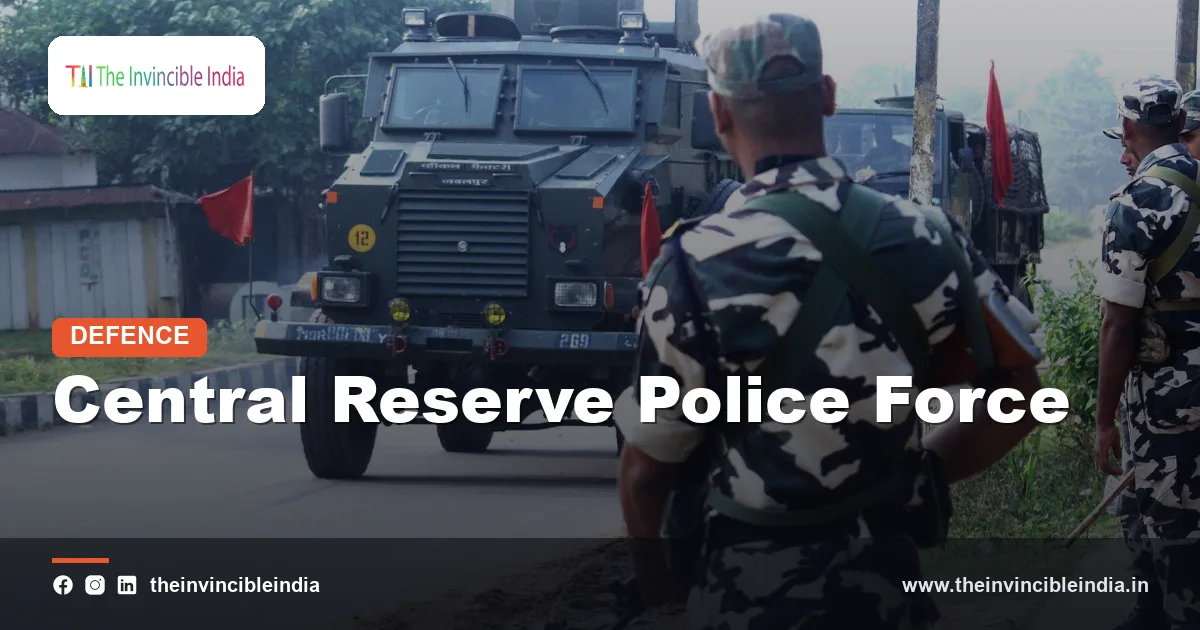
The Central Reserve Police Force (CRPF) is India’s largest Central Armed Police Force and one of the most versatile security organisations in the country. Tracing its roots to 1939, the force has evolved from a small unit created to help police forces in princely states into a large, multi-skilled body that handles internal security, counter-insurgency, election duty, riot control and the protection of key installations.
Operating under the Ministry of Home Affairs, the Central Reserve Police Force is deployed wherever state police need reinforcement, from the forests of central India to the valleys of Jammu and Kashmir and the hills of the North-East. Its specialised arms, such as the Rapid Action Force, the Commando Battalion for Resolute Action (CoBRA) and the Mahila battalions, reflect the wide range of challenges it is asked to meet.
| Fact | Detail |
|---|---|
| Origin | 27 July 1939, as the Crown Representative’s Police |
| Renamed as CRPF | 28 December 1949, under the Central Reserve Police Force Act |
| Parent ministry | Ministry of Home Affairs, Government of India |
| Status | Largest of India’s Central Armed Police Forces |
| Headed by | Director General (an Indian Police Service officer) |
| Motto | Seva aur Nishtha (Service and Loyalty) |
| Specialised units | Rapid Action Force (1992), CoBRA (2008-09), Mahila battalions, Parliament Duty Group |
| Headquarters | New Delhi |
Origins: From the Crown Representative’s Police to the CRPF
The force came into being on 27 July 1939 at Neemuch, in present-day Madhya Pradesh, as the Crown Representative’s Police. In the late 1930s, the British government in India was concerned about unrest in princely states and communal tensions, and wanted a reserve force that could be called upon to assist local police without being tied to any single state. The new unit was intended to be a mobile reserve at the disposal of the Crown Representative, who dealt with the princely states.
Independence and Renaming
After Independence in 1947, the force continued to serve under the new Government of India. The Central Reserve Police Force Act was passed in 1949, and on 28 December 1949 the Crown Representative’s Police was formally renamed the Central Reserve Police Force. Sardar Vallabhbhai Patel, then Home Minister, is closely associated with this transition, as he saw the need for a central reserve that could help states during law and order emergencies and during the integration of princely states.
Early Years After 1949
In the early years, the force grew gradually and was used for escort duty, law and order and assisting state governments during communal disturbances. Over time it took on border duties in the 1950s and 1960s, before the Border Security Force and other forces were created, and it fought alongside the Army in sectors where border posts were attacked.
Legal Basis and Command Structure
The CRPF is governed by the Central Reserve Police Force Act, 1949, and the rules made under it. As a Central Armed Police Force, it is administratively under the Ministry of Home Affairs and is led by a Director General, who is an Indian Police Service officer. Senior officers include Special Directors General, Additional Directors General and Inspectors General in charge of zones and sectors.
Territorial Organisation
- Force Headquarters: Located at New Delhi, handling policy, operations and administration.
- Zones and Sectors: Regional commands that coordinate battalions within particular states or regions.
- Ranges and Groups: Intermediate formations supervising the battalions.
- Battalions: The core operational unit, each commanded by a Commandant, with about a thousand personnel organised into companies.
Types of Battalions
The force has general duty battalions, as well as battalions with special roles, such as the Rapid Action Force, CoBRA, Mahila battalions, signal battalions and specialised groups for duties like the protection of Parliament. This mix allows commanders to match the right unit to each task. Because the force is so large, its exact number of battalions and personnel change over time as new units are raised, and are best described as running into the hundreds of thousands of personnel.
Roles and Responsibilities of the Central Reserve Police Force
The CRPF’s mandate is wide. Its main purpose is to assist state and union territory governments in maintaining law and order and in countering insurgency and subversion. Its personnel can be sent anywhere in the country at short notice, and the force is the preferred choice of the Centre when states ask for reinforcement.
Principal Functions
- Crowd and riot control, and maintenance of public order.
- Counter-insurgency and counter-terrorism operations.
- Anti-Naxal operations in regions affected by left-wing extremism.
- Guarding vital installations, important buildings and sensitive sites.
- Providing security cover during elections.
- Protection of certain high-risk individuals and dignitaries.
- Rescue and relief during natural disasters and accidents.
- Participation in United Nations peacekeeping and international police missions.
Wartime Role
In wartime, the force may be called upon to support the Army, guard vulnerable areas and deal with infiltrators and saboteurs. Though its main tasks are internal, its military-style training enables it to take on supporting roles when required.
Early Operations and Gallantry: Hot Springs and Sardar Post
Two episodes from the force’s early history are especially celebrated, and they show that the CRPF has fought in border engagements as well as in internal security operations.
Hot Springs, 1959
On 21 October 1959, a small CRPF patrol was ambushed by Chinese troops at Hot Springs in Ladakh. Ten CRPF personnel lost their lives in the encounter. The date is now observed across India as Police Commemoration Day, honouring police and paramilitary personnel who have died in the line of duty.
Sardar Post, 1965
In April 1965, during the Rann of Kutch conflict, a CRPF company at Sardar Post in Gujarat held out against a much larger attacking force from across the border, inflicting heavy casualties. The action is celebrated as one of the finest examples of small-unit gallantry by a central police force and is remembered in the force’s history.
Parliament Attack, 2001
On 13 December 2001, CRPF personnel were part of the security cordon during the terrorist attack on Parliament House. Constable Kamlesh Kumari of the force was among the security personnel who lost their lives while thwarting the attackers, and she was posthumously honoured with the Ashoka Chakra.
Counter-Insurgency and Anti-Naxal Operations
A large share of the CRPF’s operational effort is devoted to counter-insurgency. The force has served in Jammu and Kashmir, in various parts of the North-East, and in regions of central and eastern India affected by left-wing extremism, commonly called the Naxal problem.
Role in Jammu and Kashmir
In Jammu and Kashmir, CRPF battalions work alongside the Army and the state police in counter-terrorism operations, area domination, convoy security and the protection of vital places. The force has also been central to security arrangements for the annual Amarnath Yatra, one of the largest pilgrim movements in the region.
Anti-Naxal Operations
In forested and tribal districts of states such as Chhattisgarh, Jharkhand, Odisha and Bihar, the force has been at the forefront of operations against armed left-wing groups. This work involves patrolling dense forests, establishing forward operating bases, escorting road construction teams and engaging with local communities. The security forces have also worked on development and outreach efforts alongside operations, and the CRPF has suffered significant casualties in such terrain.
North-East Deployments
The force has also been deployed in insurgency-affected parts of the North-East at various times, working with state police and the Assam Rifles to restore order and support peace processes.
CoBRA: The Jungle Warfare Specialists
The Commando Battalion for Resolute Action, commonly known as CoBRA, was created in 2008-09 as a specialised wing of the CRPF to take on guerrilla and jungle warfare. It was designed to respond to the tactics of left-wing extremists operating in forested terrain, and is regarded as one of the country’s most capable specialised police units.
Training and Capability
CoBRA personnel are selected from among CRPF members and are put through demanding training in jungle craft, survival, tracking, weapons handling, camouflage, and intelligence-driven operations. Many of them are trained at jungle warfare schools and army institutions. The units work in small, highly mobile teams and operate for extended periods deep in forested areas.
Deployment
CoBRA battalions are stationed in states with forested terrain and are used for targeted, intelligence-led operations. They operate with support from local police, the CRPF’s general duty battalions and, when required, from helicopters and technical surveillance.
Rapid Action Force: Riot Control Specialists
The Rapid Action Force (RAF) is a specialised wing of the CRPF dedicated to dealing with riots and similar situations. It was created in 1992 to give the country a force that could reach communally sensitive areas quickly and handle crowd situations with minimal use of force.
Design and Distinctive Features
RAF battalions are stationed in different parts of the country, including in sensitive and riot-prone areas, so that they can reach a spot within hours of a call. Personnel are trained in crowd psychology, non-lethal weapons, and communal harmony, and are trained to be neutral and professional. They wear a distinctive blue uniform that helps the public identify them.
Use of Non-Lethal Methods
Riot control relies on shields, batons, tear smoke, water cannons and rubber or plastic projectiles in appropriate circumstances. The doctrine emphasises restraint, gradual escalation and de-escalation, with an aim to restore order while limiting injury and loss of life. The RAF has also been used for disaster relief and for security during major events.
Election Duty and VIP Security
Few agencies are as closely associated with Indian elections as the CRPF. In Lok Sabha, Assembly and other polls, the Election Commission asks for Central Armed Police Forces to supplement state police, and the CRPF supplies a large share of the personnel.
Election Duties
- Guarding polling stations and counting centres.
- Escorting electronic voting machines and election material.
- Area domination, flag marches and checking of vehicles before polls.
- Providing a sense of security to voters in sensitive areas.
Protection of Key Individuals and Sites
The CRPF has also been entrusted with the protection of certain high-risk individuals and sites, as the government decides from time to time. Dedicated teams such as the Parliament Duty Group guard the Parliament complex, and other units provide security at sensitive religious and public places. Specialised personnel are trained in close protection, bomb detection and disposal, and dog handling.
Mahila Battalions and Women in the CRPF
The CRPF was the first among the Central Armed Police Forces to raise an all-women battalion, which was established in the mid-1980s. Women personnel now serve in a number of units and take part in the same range of duties as their male colleagues.
Roles of Women Personnel
- Crowd control and riot duty, including in the Rapid Action Force.
- Counter-insurgency operations, including in Jammu and Kashmir and in Naxal-affected areas.
- Election duty, frisking and women-sensitive security tasks.
- Escort and guard duty at important locations.
- International peacekeeping, including all-women contingents sent abroad.
International Recognition
In 2007, a formed police unit made up entirely of women from the force was sent to Liberia as part of the United Nations mission there. It was the first all-women formed police unit of the United Nations, and it drew wide praise for its work and for inspiring local women to join the police.
Deployments Across States and Union Territories
The force is deployed throughout the country, and its battalions are rotated regularly. Deployments broadly fall into the following categories.
| Region | Typical Role |
|---|---|
| Jammu and Kashmir | Counter-terrorism, area domination, pilgrim yatra security, convoy protection |
| Chhattisgarh, Jharkhand, Odisha, Bihar | Anti-Naxal operations, road opening, forward bases |
| North-East | Counter-insurgency support and law and order |
| Delhi and other metros | Parliament and vital installation security, public order |
| Poll-bound states | Election security as requested by the Election Commission |
| Disaster-hit regions | Rescue, relief and law and order support |
Training, Welfare and Institutions
Training for the CRPF is conducted at a network of institutions, with a central academy for officers and a number of training centres and schools for recruits and specialists. Courses include counter-insurgency, jungle warfare, explosive handling, crowd control and community policing.
Recruitment
Constables and other ranks join through all-India recruitment, and officers join through the Union Public Service Commission and departmental promotions. The leadership of the force is drawn largely from the Indian Police Service.
Awards and Sacrifice
CRPF personnel have won numerous gallantry awards, including the Shaurya Chakra and the Police Medals for Gallantry. Remote deployments, difficult terrain and prolonged separation from families make welfare, leave, health care and housing important matters for the force.
Peacekeeping and Humanitarian Work
In addition to the Liberia deployment, CRPF personnel have served in other United Nations missions as police officers and formed units, and have taken part in relief and rescue work after earthquakes, floods and cyclones.
Challenges and the Road Ahead
The CRPF is often the force of last resort, called in when situations are tense. This brings both prestige and pressure. Personnel work in difficult conditions, face the threat of ambushes and improvised explosive devices, and are repeatedly rotated between regions.
Key Challenges
- Stress and fatigue due to long deployments and difficult terrain.
- Improvised explosive devices and ambush tactics used by militants.
- Balancing firm action with community outreach and respect for human rights.
- Modernisation of equipment, communications, protection and mobility.
Modernisation
The force has been steadily adopting technologies such as unmanned aerial vehicles, mine-protected vehicles, better body armour, night-vision devices and advanced communication systems. Greater use of intelligence, forensic and data tools is also helping to make operations more precise and safer for personnel.
Conclusion
From a modest reserve force created in 1939, the Central Reserve Police Force has become the backbone of India’s internal security architecture. Its range of specialised arms, including the Rapid Action Force, CoBRA and the Mahila battalions, allows the Centre to respond to a wide variety of challenges, from riots and elections to jungle warfare and disaster relief. Through the sacrifices of its personnel at places such as Hot Springs and Sardar Post, it has also earned a place in India’s military history. 2 October 2026
Frequently Asked Questions
When was the CRPF established?
The force originated on 27 July 1939 as the Crown Representative’s Police at Neemuch. It was renamed the Central Reserve Police Force on 28 December 1949, following the passage of the Central Reserve Police Force Act.
Why is the CRPF called India’s largest Central Armed Police Force?
The CRPF has more battalions and personnel than any other Central Armed Police Force, such as the BSF, CISF, ITBP, SSB and Assam Rifles. Its size reflects the wide range of internal security duties it performs across the country.
What is CoBRA in the CRPF?
CoBRA stands for Commando Battalion for Resolute Action. It is a specialised wing of the CRPF, created around 2008-09, which is trained in jungle warfare and guerrilla tactics and is used mainly against left-wing extremism in forested areas.
What is the Rapid Action Force?
The Rapid Action Force is a specialised wing of the CRPF, created in 1992, which is trained to deal with riots, communal violence and crowd situations. Its battalions are placed in different parts of the country so that they can move quickly to sensitive areas.
Does the CRPF have women battalions?
Yes. The CRPF was the first Central Armed Police Force to raise an all-women battalion, and women now serve in several units. A formed police unit of CRPF women was sent to Liberia in 2007 as the first all-women formed police unit of the United Nations.
What duties does the CRPF perform during elections?
During elections, the CRPF guards polling stations and counting centres, escorts voting machines, conducts flag marches and area domination, and helps voters feel secure. It does so at the request of the Election Commission, alongside state police.


