

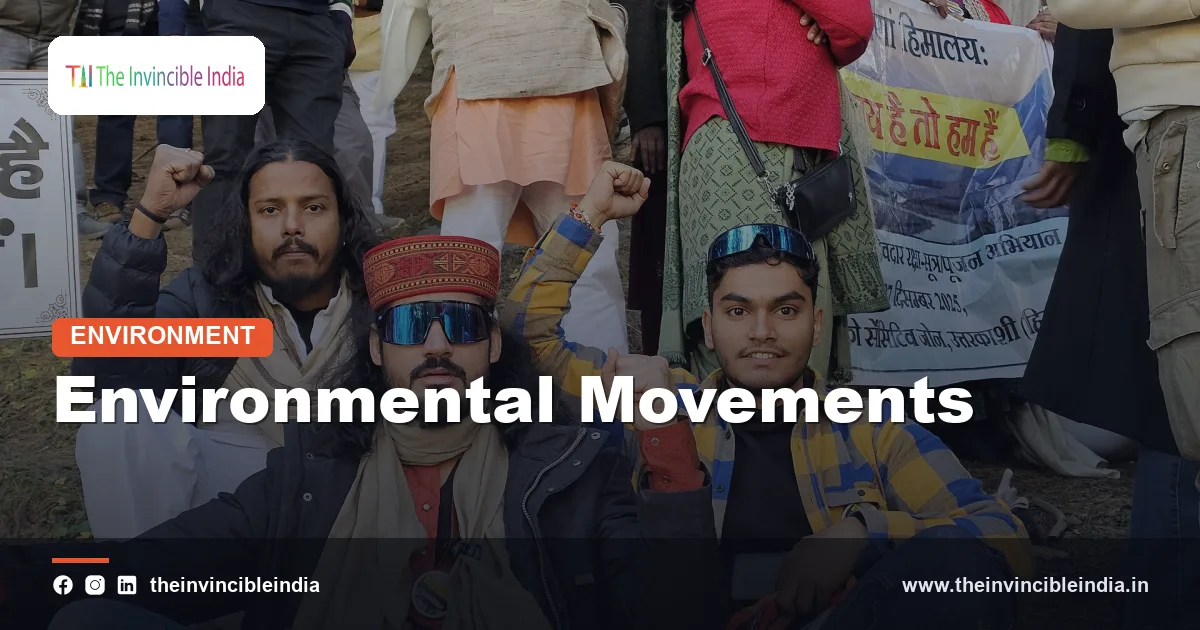
The environmental movements of India are among the most influential grassroots campaigns in the modern history of the country. From villagers hugging trees in the Himalayan foothills to tribal communities standing in rising river water in the Narmada valley, ordinary people have repeatedly challenged the idea that forests, rivers and hills are merely resources to be extracted. Their struggles shaped public opinion, pushed governments to rethink projects and left a lasting mark on environmental law.
This explainer traces the main movements, including Chipko, Appiko, the Silent Valley movement, the Narmada Bachao Andolan and the Jungle Bachao Andolan. It examines their leaders, methods and outcomes, and then looks at how these campaigns influenced India’s legal and institutional response to environmental protection.
Quick Facts
| Movement | Year and place | Core issue | Key figures |
|---|---|---|---|
| Chipko Andolan | 1973, Chamoli district, Uttarakhand (then Uttar Pradesh) | Commercial felling of Himalayan forests | Chandi Prasad Bhatt, Sunderlal Bahuguna, Gaura Devi |
| Jungle Bachao Andolan | 1982, Singhbhum, then Bihar (now Jharkhand) | Replacement of natural sal forest with teak | Tribal communities of Singhbhum |
| Appiko Movement | 1983, Uttara Kannada, Karnataka | Felling of Western Ghats forests | Pandurang Hegde |
| Silent Valley Movement | Late 1970s to 1980s, Palakkad, Kerala | Proposed hydroelectric dam in rainforest | Kerala Sastra Sahitya Parishad, Salim Ali |
| Narmada Bachao Andolan | From 1985, Narmada valley | Displacement and dams on the Narmada | Medha Patkar, Baba Amte |
Roots of Environmental Activism in India
Concern for nature in India is much older than the modern environmental era. In 1730, in the village of Khejarli in Rajasthan, a group of Bishnoi villagers led by Amrita Devi is remembered for sacrificing their lives to protect khejri trees from being felled for the royal palace. Their faith, which treats trees and animals as sacred, is often seen as an early precedent for later movements.
In the twentieth century the Gandhian tradition of non-violent resistance, village self-reliance and simple living provided the method and moral language for many campaigns. When colonial forest policy restricted the rights of forest dwellers, and when post-independence development projects such as large dams and industrial mining caused displacement, local communities had few legal avenues. They turned to protest and satyagraha, and in the 1970s and 1980s a distinct set of ecological movements emerged. Many of them combined environmental concern with questions of livelihood, justice and the right to natural resources, a combination sometimes called the “environmentalism of the poor.”
The Chipko Movement (1973)
The Chipko movement, from the Hindi word meaning “to stick” or “to hug,” began in the Himalayan hill districts of what is now Uttarakhand. It is the most famous environmental movement in India and an inspiration around the world.
Background and origins
The hill economy depended on forests for fuelwood, fodder and small timber, but the government gave contracts for commercial felling to outside companies while denying villagers even small quantities for farm tools. In April 1973, villagers of Mandal near Gopeshwar in Chamoli district, mobilised by the Dasholi Gram Swarajya Sangh, an organisation founded by Chandi Prasad Bhatt in 1964, prevented a sports goods company from cutting ash trees. The same year, protests spread to other areas of the region.
Reni and Gaura Devi
The best-known episode took place in March 1974 at Reni village, when the men had been called away to receive compensation and labourers arrived to cut a forest. A woman named Gaura Devi led the village women into the forest and confronted the workers, declaring they would have to cut through them first. The loggers withdrew. Women were thus central to Chipko, since they bore the burden of collecting fuel, fodder and water and felt deforestation most directly.
Leaders and methods
- Chandi Prasad Bhatt: focused on local, livelihood-based forest management and small forest-based industries.
- Sunderlal Bahuguna: became the movement’s public face, walking thousands of kilometres across the Himalaya to spread the message and popularising the idea that the real products of the forest are soil, water and pure air, and that “ecology is permanent economy.”
- Methods: embracing trees, padayatras, songs and slogans, fasts and community meetings, all strictly non-violent.
Outcomes
In 1980, following discussions with Sunderlal Bahuguna, the then Prime Minister Indira Gandhi announced a 15-year ban on green felling in the Himalayan region of Uttar Pradesh above a specified altitude. Chipko also contributed to the thinking behind the Forest (Conservation) Act of 1980. The movement received international recognition, including the Right Livelihood Award in 1987.
The Appiko Movement (1983)
Appiko is the Kannada word for “hugging,” and the movement is often described as the southern counterpart of Chipko. It began in September 1983 in the Salkani forest in the Sirsi region of Uttara Kannada district in Karnataka, when villagers, men and women, hugged trees to stop contract loggers. The Western Ghats forests there had been steadily depleted by commercial felling, plywood demand and hydroelectric and plantation projects.
The movement was led by Pandurang Hegde, who later became one of its main thinkers. Appiko was notable for going beyond protest. Its activists organised awareness walks through the forest, street plays and slide shows, and promoted the conservation and sustainable use of forest resources, including alternatives to fuelwood and the replanting of degraded land. It also spread to neighbouring districts of Karnataka and to Goa. Its message was that people should use forest produce, such as fruits and fibres, in ways that do not destroy the tree itself, and that local communities have both a right and a responsibility to protect the forest.
The Silent Valley Movement (Kerala)
Silent Valley is a stretch of tropical evergreen forest in Palakkad district, Kerala, through which the Kuntipuzha river flows. In the 1970s the Kerala State Electricity Board proposed a hydroelectric dam across the river, which would have flooded a significant part of the rainforest, a habitat for rare species including the lion-tailed macaque.
The proposal triggered a vigorous public debate. The Kerala Sastra Sahitya Parishad, a science popularisation organisation, took a leading role in questioning the project’s environmental and economic benefits, supported by naturalists such as Salim Ali, poets, journalists, students and scientific institutions. The campaign relied on scientific argument, petitions, public meetings and media coverage rather than mass demonstrations. Following discussions at the national level, including the intervention of the Prime Minister, the project was abandoned. The area was declared a national park in 1984 and formally inaugurated in 1985. Silent Valley became a landmark because it showed that scientific evidence and public opinion could stop a major development project in favour of biodiversity.
The Narmada Bachao Andolan
The Narmada Bachao Andolan (NBA), meaning the “Save the Narmada Movement,” began in the mid-1980s in opposition to large dams planned on the Narmada river, particularly the Sardar Sarovar Project in Gujarat and the Narmada Sagar project in Madhya Pradesh. The movement is most closely associated with Medha Patkar, a social worker, with support from many others, including Baba Amte and writers and artists across the country.
Concerns raised
- Displacement of a large number of people, many of them tribal and farming communities, with inadequate resettlement and rehabilitation.
- Submergence of forests and fertile agricultural land.
- Questions about whether the stated benefits of irrigation and power were realistic.
- The lack of consultation with affected people before approving the project.
Methods
The NBA used a range of non-violent tactics: marches, hunger strikes, public meetings, and the powerful tactic of “jal samarpan,” in which villagers stayed in their homes as monsoon waters rose behind the dam. The movement also used litigation and international campaigning. In the early 1990s an independent review commissioned by the World Bank, known as the Morse Commission, was critical of resettlement planning, and the Bank withdrew from the project in 1993.
Outcomes
The Supreme Court, in a judgment of October 2000, allowed construction to continue in stages with conditions on resettlement, and the dam was eventually completed to its full height in the following years. The movement did not stop the project, but it changed the national conversation about large dams, the rights of displaced people and the need for resettlement and rehabilitation policies. It also helped shape later debates on consent and fair compensation in land acquisition.
Jungle Bachao Andolan and Other Tribal Struggles
The Jungle Bachao Andolan, or “Save the Forest Movement,” began in 1982 in the Singhbhum district of Bihar, now part of Jharkhand. The government proposed to replace the natural sal forest with commercially valuable teak. Tribal communities, who depended on sal for livelihood, culture and ritual, opposed the plan. They saw it as a move to convert a diverse forest into a monoculture and to benefit timber markets at their cost. The protest later spread to Odisha and Madhya Pradesh and drew attention to the rights of forest-dwelling communities.
Other notable movements
- Tehri Dam protests: long campaigning, led largely by Sunderlal Bahuguna, against the dam on the Bhagirathi in Uttarakhand because of seismic risk, displacement and ecological damage.
- Gandhamardan movement: a campaign in Odisha in the 1980s against bauxite mining in the sacred Gandhamardan hills.
- Mitti Bachao Andolan: a protest in Madhya Pradesh against waterlogging and salinity caused by the Tawa dam, linked to farmers’ rights.
- Plachimada protest: villagers in Palakkad, Kerala, from 2002, objected to the heavy groundwater use of a beverage plant.
- Niyamgiri struggle: the Dongria Kondh community in Odisha opposed bauxite mining on a hill they hold sacred, and in 2013 the Supreme Court directed that local gram sabhas be consulted.
- Navdanya: a movement for seed conservation and organic farming associated with Vandana Shiva.
Common Features and Methods
Despite their differences, India’s environmental movements share several characteristics that explain their effectiveness.
- Non-violence: nearly all used Gandhian methods such as satyagraha, fasting, marches and peaceful obstruction.
- Livelihood focus: they connected the environment directly to the daily needs of fuelwood, fodder, water, land and income, which gave them a strong local base.
- Role of women: women were at the forefront in Chipko and Appiko and held important roles in the Narmada struggle, because environmental decline affects them directly.
- Use of knowledge and media: scientific data, local knowledge, folk songs, street theatre and press coverage were used to win public sympathy.
- Alliances: they brought together villagers, scientists, writers, students and national and international organisations.
Impact on Environmental Law and Policy
The movements arrived at a time when India was beginning to build its environmental legal framework, and they both reflected and drove that change.
| Year | Development | Link to the movements |
|---|---|---|
| 1972 | Wildlife (Protection) Act | Part of the growing concern for conservation in the same decade as Chipko |
| 1974 and 1981 | Water Act and Air Act | Pollution-control laws that followed the 1972 Stockholm conference |
| 1976 | 42nd Amendment, adding Article 48A and Article 51A(g) | Made protection of the environment a Directive Principle and a Fundamental Duty |
| 1980 | Forest (Conservation) Act | Restricted diversion of forest land, in the same period as the Chipko ban on felling |
| 1985 | Ministry of Environment and Forests created | Silent Valley and other campaigns had raised the political profile of the issue |
| 1986 | Environment (Protection) Act | Umbrella law passed after the Bhopal gas tragedy |
| 1990 onward | Joint Forest Management | Reflected the demand to involve villagers in forest protection |
| 2006 | Forest Rights Act | Recognised the rights of forest-dwelling communities, a theme of the Jungle Bachao Andolan |
| 2010 | National Green Tribunal | A specialised body for environmental disputes |
The movements also helped build the practice of environmental impact assessment, public hearings and the demand that affected communities should be consulted. Courts began to accept public interest litigation on environmental issues, which opened the courtroom to people who had once relied only on protest.
Legacy and Criticism
The enduring legacy of these movements is a more aware citizenry and a wider acceptance that development and ecology must be balanced. Words such as “Chipko” and “Silent Valley” are familiar even to people who have never visited those places, and later campaigns, whether to save urban forests, protect hills from mining or defend rivers, draw on their imagery and ethics.
Scholars also point out limitations. Some movements delayed projects that supporters considered necessary for irrigation and power. Others were local in scale, and resettlement gaps persisted despite protest. Debates continue over how to weigh the needs of development against those of displaced communities and ecosystems. What is rarely disputed is that these movements ensured that such questions are now asked openly, and that the voices of villagers, tribal communities and women are part of the answer.
Conclusion
From the Himalayan villages of Chipko to the evergreen forests of Silent Valley and the riverbanks of the Narmada, environmental movements have shown that conservation in India is not an elite concern but a matter of survival and dignity for millions. Their methods were peaceful, their arguments rooted in lived experience, and their influence extends into the laws, institutions and public attitudes that shape environmental decisions today.
Frequently Asked Questions
What was the Chipko movement?
Chipko was a non-violent movement that began in 1973 in the Chamoli district of present-day Uttarakhand. Villagers, especially women, hugged trees to stop commercial logging. Leaders such as Chandi Prasad Bhatt, Sunderlal Bahuguna and Gaura Devi are associated with it, and it led to a ban on green felling in the Himalayan region in 1980.
What is the difference between Chipko and Appiko?
Chipko began in the Himalaya in 1973, while Appiko began in the Western Ghats of Karnataka in 1983 and was inspired by Chipko. Both mean “to hug” in their respective languages, and both used tree-hugging, but Appiko placed additional emphasis on afforestation and sustainable use of forest produce.
Why was the Silent Valley project stopped?
A hydroelectric dam proposed on the Kuntipuzha river in Kerala would have flooded a rare tropical rainforest and the habitat of the lion-tailed macaque. After a strong campaign by scientists, naturalists and citizens, led in part by the Kerala Sastra Sahitya Parishad, the project was abandoned and the area was declared a national park in 1984.
Who leads the Narmada Bachao Andolan?
The Narmada Bachao Andolan is closely associated with the social activist Medha Patkar, who has been its best-known leader since the mid-1980s. The movement opposed large dams on the Narmada, particularly the Sardar Sarovar Project, over displacement, inadequate rehabilitation and environmental concerns.
What was the Jungle Bachao Andolan?
It was a movement that began in 1982 in the Singhbhum district of Bihar, now Jharkhand, when tribal communities protested a plan to replace natural sal forest with teak plantations. It highlighted the dependence of forest communities on natural forests and the dangers of monoculture.
How did environmental movements influence Indian law?
They raised public and political awareness that supported laws and institutions such as the Forest (Conservation) Act of 1980, the Environment (Protection) Act of 1986, the Forest Rights Act of 2006 and the National Green Tribunal. They also encouraged public interest litigation and the practice of consulting affected communities before major projects.


