

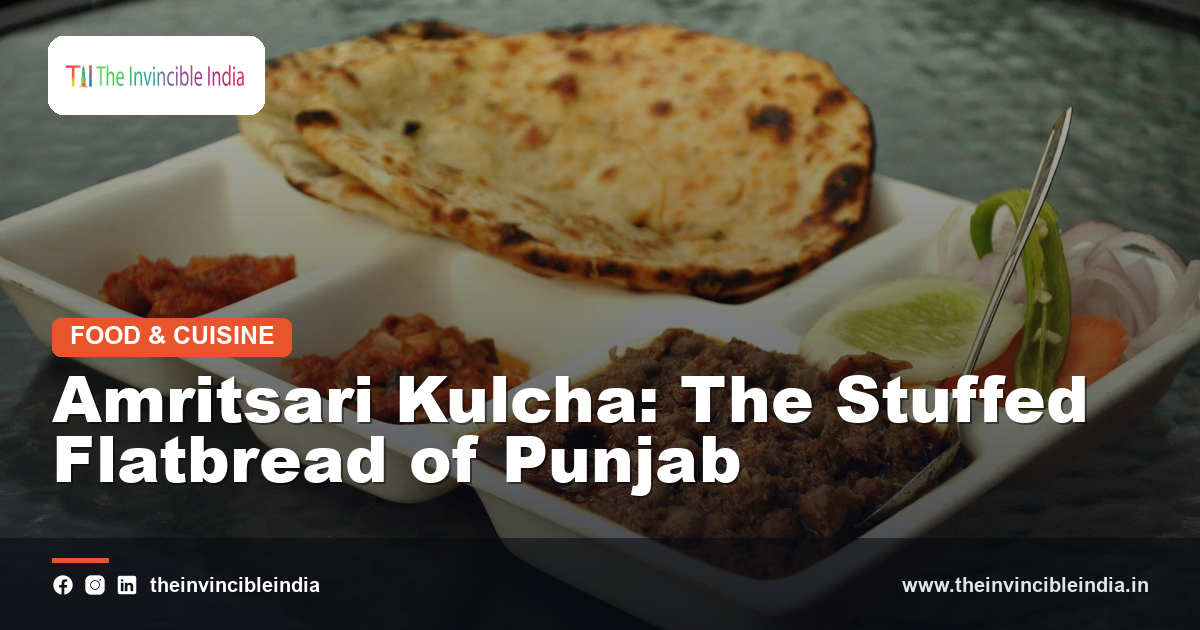
Amritsari kulcha is one of the most recognisable breads of Punjab, a soft, layered flatbread stuffed with a seasoned filling and baked until its surface is blistered and golden. Associated with the city of Amritsar, it is typically served hot with spiced chickpeas, a knob of butter, tangy chutney and sliced onions. The bread reflects the generous, hearty spirit of Punjabi food, where wheat, dairy and bold seasoning come together in simple, satisfying combinations. Like many dishes of the region, it sits comfortably alongside other staples described in the guide to regional cuisines of India. This guide explains what defines an Amritsari kulcha, how it is made, how it is eaten and why it holds such a lasting place in Indian food culture.
Quick Facts
| Detail | Information |
|---|---|
| Dish type | Stuffed leavened flatbread |
| Region | Amritsar, Punjab |
| Main dough | Refined wheat flour (maida) |
| Common fillings | Potato, paneer, onion, cauliflower |
| Cooking method | Baked in a clay tandoor |
| Usual pairing | Chole, butter, chutney, pickled onion |
What Is Amritsari Kulcha?
Amritsari kulcha is a stuffed flatbread associated with the Punjabi city of Amritsar. It is made from a soft, leavened dough that is rolled out, filled with a spiced mixture, sealed, flattened and baked in a hot clay oven. The result is a bread with a crisp, lightly charred exterior and a tender, moist interior flecked with seasoning.
Unlike a plain naan, the kulcha carries its flavour inside, which means each bite delivers the taste of the filling along with the warmth of fresh bread. It is usually enjoyed as a hearty meal rather than a side, often accompanied by chickpea curry. The dish captures the essence of Punjabi cooking, where generous portions and robust flavours are valued, and it remains a defining bread of the region.
Roots in Amritsar and Punjab
Amritsar is a city known across India for its food culture, and kulcha is among its best-loved specialities. Punjab has long been a wheat-growing heartland, and breads baked in the tandoor have been central to its everyday and festive meals. The kulcha belongs to this tradition of oven-baked breads that developed around communal clay ovens and busy local eateries.
Over time the stuffed kulcha became so closely tied to the city that its name is now used to describe the style wherever it is served. Small family-run eateries and bustling market stalls helped carry its reputation outward. The bread thus stands as a living example of how a local speciality can come to represent a whole city and, in a wider sense, the culinary identity of a region.
The Dough Behind the Bread
The base of an Amritsari kulcha is a dough made largely from refined wheat flour, which gives the bread its softness and its characteristic pale, airy crumb. The dough is typically leavened and enriched with ingredients such as yoghurt or milk, which help produce a supple texture that can be stretched around a filling without tearing.
Resting the dough is an important step, because it allows the structure to relax and become easy to roll. A well-prepared dough should feel smooth and slightly elastic, neither stiff nor sticky. Cooks often judge its readiness by touch rather than by measurement. This careful attention to the dough explains why a good kulcha can be both light and satisfying, and why the foundation of the bread matters as much as its filling.
The Classic Potato and Onion Filling
The most familiar filling for Amritsari kulcha is a mixture of mashed potato, chopped onion and fresh herbs, seasoned with a blend of ground spices. Ingredients such as coriander, green chilli, dried pomegranate seed powder and chaat masala are commonly used to give the stuffing a tangy, aromatic and mildly hot character.
The mixture is kept fairly dry so that it does not make the dough soggy or burst through during rolling and baking. Texture is important, with the soft potato balanced by the slight crunch of raw onion. Each cook has a preferred balance of spice and sourness, and these small differences give individual kulchas their personality. The classic filling remains the benchmark against which other variations are usually measured.
Paneer, Gobhi and Other Fillings
While potato is the traditional favourite, many eateries offer kulchas stuffed with other ingredients. Crumbled paneer, the fresh Indian cheese, is a popular choice, lending a mild, creamy richness that contrasts with the tang of the spices. Grated cauliflower, known as gobhi, is another common stuffing, bringing a gentle sweetness and softer texture.
Some versions combine several ingredients, such as paneer with onion, or potato with paneer, for a fuller flavour. Mixed vegetable fillings and radish-based stuffings are also seen in different kitchens. These variations show how adaptable the kulcha is, while the underlying method remains the same. The range of fillings allows diners to choose according to taste and diet, and keeps the bread interesting across repeated visits.
Shaping and Sealing the Kulcha
Making a stuffed kulcha requires a steady hand. A ball of dough is flattened, a portion of filling is placed in the centre, and the edges are gathered up and pinched closed to form a sealed parcel. The parcel is then pressed down and rolled gently into a round or oval disc, taking care that the stuffing remains evenly spread.
The surface is often sprinkled with a few seeds, such as nigella or sesame, and a little dried fenugreek or chopped coriander, which are pressed lightly into the dough. A sprinkle of water on the underside helps the bread adhere to the oven wall. This process, carried out quickly by experienced cooks, turns a simple ball of dough into a neat, filled flatbread ready for the heat.
The Role of the Tandoor
The tandoor is the cylindrical clay oven that gives Amritsari kulcha its distinctive finish. Heated by charcoal or wood and reaching very high temperatures, it bakes the bread rapidly. The dough is slapped against the inner wall, where it puffs, blisters and develops small charred spots while the interior stays soft and cooked through.
This intense, dry heat is difficult to reproduce exactly in a home kitchen, which is one reason kulcha is so often enjoyed at dedicated eateries. The clay absorbs and radiates heat evenly, and the faint smokiness it imparts becomes part of the bread’s character. The tandoor is therefore more than a cooking tool; it is a defining element of the flavour, aroma and texture of this much-loved bread.
Chole: The Essential Companion
Kulcha is rarely served alone. Its most traditional partner is chole, a dish of chickpeas simmered in a dark, tangy and well-spiced gravy. The chickpeas are cooked until tender, and the sauce is flavoured with onion, tomato, ginger and a blend of ground spices, often including a hint of tea or dried mango powder for depth and acidity.
The soft, moist chole complements the crisp edges and fluffy interior of the bread, and the bread in turn soaks up the gravy. Together they form a balanced and filling meal. The pairing is so established that the two are often spoken of in one breath, and a plate of kulcha without chole would seem incomplete to many diners.
Butter, Chutney and Pickled Onions
The accompaniments served with kulcha add contrast and freshness. A generous piece of butter is placed on the hot bread, where it melts into the surface and enriches every bite. A tangy chutney, often made from mint, coriander or tamarind, cuts through the richness and adds brightness.
Slices of raw or lightly pickled onion, sometimes tinged with vinegar and chilli, bring a sharp crunch, while a wedge of lemon or a green chilli may sit on the side. These small elements are not mere garnish. They provide acidity, heat and texture that balance the soft, buttery bread and the deep gravy of the chickpeas, completing a plate that is carefully composed even when it looks casual.
Kulcha as a Breakfast and Street Food
In Amritsar, kulcha is commonly eaten in the morning and through the day, rather than being reserved for dinner. Many eateries open early and serve the bread fresh from the oven to office-goers, travellers and families. It is a filling meal that provides lasting energy, which suits a region with a strong tradition of agriculture and physical work.
The bread also thrives as street food, served on simple plates or leaf bowls in busy lanes. Its portability and generous size make it convenient for casual eating. Whether enjoyed at a crowded counter or a quiet table, kulcha reflects the informal, convivial approach to food that characterises much of northern India, where meals are meant to be shared and savoured.
Kulcha and Its Flatbread Cousins
India has a vast family of flatbreads, and kulcha sits among its leavened, oven-baked members. It is related to naan, which is also made from refined flour and baked in the tandoor, but the stuffed kulcha is usually thicker, more compact and defined by its filling. It differs again from parathas, which are typically wholemeal and cooked on a griddle with fat.
Other regions have their own filled breads, from the sweet-stuffed puran poli of the west to the layered parathas of the north. Comparing them shows how local grains, ovens and tastes shape each tradition. The Amritsari kulcha stands out for combining the softness of leavened dough, the smokiness of the tandoor and the savoury interest of a seasoned stuffing.
Regional Variations and Styles
Although the Amritsari style is the best known, kulcha is prepared in many ways across northern India. Some versions are plain, with only seeds on the surface, while others are cooked on a flat griddle instead of in a tandoor, especially in homes without an oven. Cooks in different cities adjust the thickness, the spicing and the choice of fillings to suit local preferences.
Within Punjab, differences appear in the way the bread is flavoured, the amount of butter used and the style of the chickpea curry served beside it. Such variation is part of the living nature of food traditions, which change gently as they move between kitchens. These adaptations do not diminish the original, but rather show how widely the idea of a stuffed, baked flatbread has been embraced.
Serving Customs and Etiquette
Kulcha is best eaten immediately, while the bread is still hot and the butter is melting. It is usually served on a plate with a generous portion of chole, and diners tear off pieces with their hands, using each piece to scoop up gravy, onion and chutney. Eating with the hands is the customary and preferred way, as it allows the diner to judge texture and temperature.
Meals are often accompanied by a glass of lassi, the cooling yoghurt drink of Punjab, which balances the spice and richness of the food. The sharing of a meal is an important social act in the region, and kulcha is frequently ordered in quantity for groups. These simple customs reflect the warmth and hospitality that Punjabi food culture is widely admired for.
Pairing Kulcha with Lassi and Drinks
The rich, buttery character of kulcha is traditionally balanced by cooling drinks. Lassi, a churned yoghurt beverage that may be served sweet, salted or flavoured, is the most iconic partner. Its tang and creaminess soothe the palate after spicy chickpeas and refresh the diner between bites.
Buttermilk, known as chaas, is a lighter alternative and is often spiced with roasted cumin and mint. Hot tea is also popular, particularly at breakfast, and many diners finish a meal with a small sweet. These beverages are chosen not just for taste but for their cooling effect, which suits the heat of the cuisine and the climate. The thoughtful pairing of bread, curry and drink is a hallmark of a well-composed Punjabi meal.
Making Kulcha at Home
Home cooks who wish to recreate kulcha without a tandoor often use a very hot griddle or an oven. The dough is prepared in advance, rested, and then filled and rolled in the usual way. Cooking on a heavy pan with a little water on one side and a short finish over open flame can approximate the blistered surface of the tandoor bread.
Success depends on a few principles: a well-rested dough, a dry and well-seasoned filling, and a very hot cooking surface. The bread may not be identical to that of a professional oven, but it can be delicious in its own right. Making kulcha at home is also a way of appreciating the skill involved, and of connecting with a tradition that values patience and practice.
Nutrition and Balanced Eating
Amritsari kulcha is a substantial dish, combining refined carbohydrates from the bread with protein and fibre from the chickpeas and, depending on the filling, additional nutrients from vegetables or paneer. Butter and oil contribute richness, making it an energising meal rather than a light snack.
As with many traditional foods, it is best understood within the context of an overall diet. Pairing it with fresh onion, salad and a cooling drink adds freshness and balance. Those who prefer lighter eating may choose a smaller portion, less butter or a wholemeal variation. Seen in this way, kulcha is neither indulgence nor excess but a meal designed for people with active lives, which explains its enduring popularity in its home region.
Amritsari Kulcha Today
Today, Amritsari kulcha is enjoyed far beyond its home city, appearing on restaurant menus across India and in Indian communities around the world. It continues to be prepared in the traditional manner by many eateries, while some cooks experiment with new fillings and presentations. Despite such changes, the essential elements remain the same: a soft dough, a spiced filling, a hot tandoor and a generous plate of chole.
The bread has become a symbol of Punjabi hospitality and a favourite for visitors seeking an authentic taste of the region. Its lasting appeal lies in its honesty, since it relies on good ingredients and careful technique rather than elaborate decoration. Amritsari kulcha thus endures as a vivid, delicious expression of Indian culinary heritage.
Sources & Further Reading
- Ministry of Culture, Government of India (indiaculture.gov.in).
- Ministry of Tourism, Government of India (incredibleindia.org).
Frequently Asked Questions
What is Amritsari kulcha?
Amritsari kulcha is a stuffed, leavened flatbread associated with Amritsar in Punjab. It is filled with a spiced mixture, commonly potato and onion, and baked in a tandoor until golden and blistered.
What is Amritsari kulcha usually served with?
It is traditionally served with chole, a tangy chickpea curry, along with butter, chutney and sliced onions. A glass of lassi is a customary drink to balance the richness and spice.
How is kulcha different from naan?
Both are leavened breads baked in a tandoor, but kulcha is typically thicker and more compact. The Amritsari style is stuffed with a savoury filling, whereas naan is usually plain or lightly topped.
Can kulcha be made without a tandoor?
Yes, home cooks often use a very hot griddle or a conventional oven to approximate the result. The texture and smokiness will differ slightly, but a well-rested dough and a dry filling give good results.
Is Amritsari kulcha vegetarian?
Traditionally it is a vegetarian dish, with fillings such as potato, onion, paneer or cauliflower. Butter and yoghurt are commonly used, so it is vegetarian but not vegan in its classic form.


