

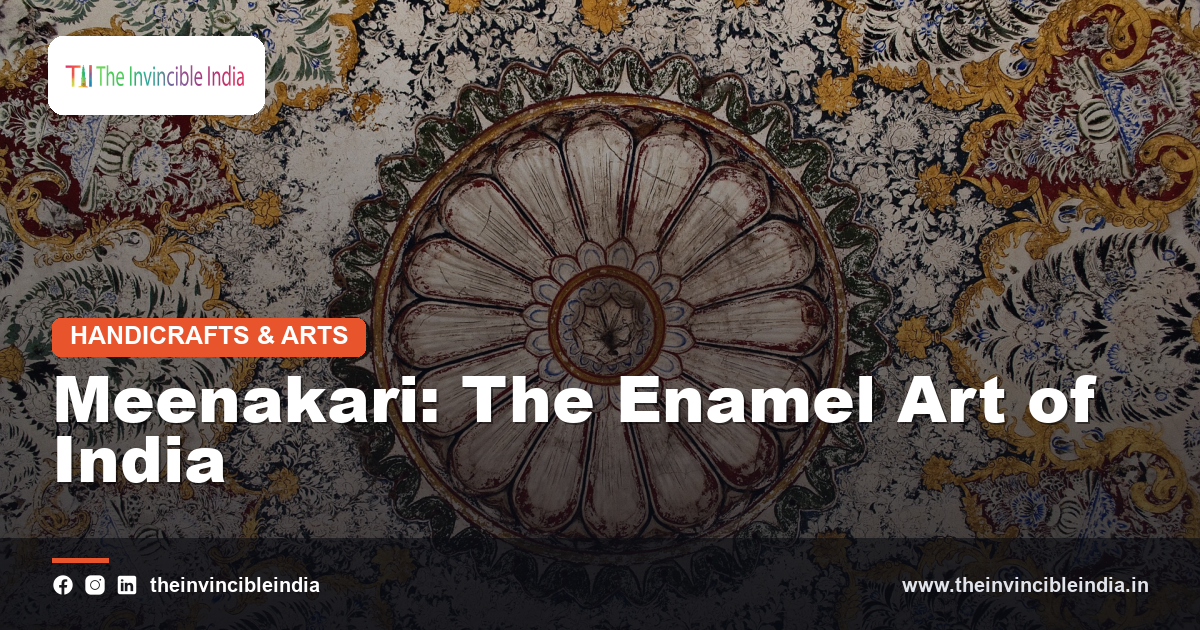
Meenakari is the Indian art of decorating metal with fused enamel colour, turning gold, silver and copper into surfaces that glow like stained glass. Practised for centuries in royal workshops and still alive in the lanes of Jaipur and other craft towns, it joins the skills of the engraver, the enameller and the jeweller in a single object. Every piece passes through fire more than once, and the result is a colour that does not fade or peel. The craft belongs to the same living web of skills as the traditional handicrafts of Rajasthan, and it remains one of the most admired forms of Indian decorative art.
Quick Facts
| Detail | Information |
|---|---|
| Craft type | Enamel decoration on metal |
| Main materials | Gold, silver, copper and mineral colours |
| Key technique | Engraving, colour filling and kiln firing |
| Famous centre | Jaipur, Rajasthan |
| Common products | Jewellery, boxes, vessels and ornaments |
| Cultural role | Royal, bridal and ceremonial adornment |
What Is Meenakari?
Meenakari is the craft of colouring the surface of metal with enamel, a glassy substance made from powdered minerals that is fused to the metal by heat. The artisan first creates a design on the metal, then fills its hollows with colour and fires the piece in a kiln so that the powder melts and bonds permanently. The finished surface is smooth, bright and extremely durable.
Unlike paint, which sits on a surface and can wear away, enamel becomes part of the object itself. This quality explains why antique Meenakari pieces often retain a freshness of colour that astonishes modern viewers. Meenakari is therefore both a decorative art and a feat of material science, in which patience, heat and skilled hands combine to produce lasting beauty.
Historical Journey of the Craft
Enamelling on metal is an ancient technique known in many parts of the world, and its arrival and flowering in India is closely tied to court patronage during the medieval and early modern periods. Skilled enamellers found employment in the workshops of rulers who valued fine jewellery and richly decorated objects, and the craft grew steadily under such support.
Over time Indian artisans developed their own vocabulary of colour, pattern and technique, so that Indian enamelwork became distinct from its foreign relatives. Regional traditions emerged in several centres, each with its own preferences in motif and palette. The history of Meenakari is thus a story of transmission, adaptation and local creativity, in which a borrowed technique became a deeply Indian art.
Royal Patronage in Rajasthan
Rajasthan became the most celebrated home of Meenakari because its Rajput courts valued ornament as a mark of status, ceremony and devotion. Rulers commissioned enamelled jewellery, sword hilts, vessels and ritual objects, and their patronage allowed workshops to refine the craft over generations. Jaipur in particular grew into a famous centre, where goldsmiths and enamellers worked side by side.
Courtly taste favoured intricate design and brilliant colour, and these preferences left a lasting stamp on the art. The tradition of giving enamelled ornaments at weddings and festivals also created steady demand beyond the palace. Royal patronage therefore did more than fund the craft; it set standards of excellence that continue to guide Meenakari artisans in Rajasthan today.
Metals Used in Meenakari
The traditional base for fine Meenakari is gold, which holds enamel beautifully and gives colours a warm, luminous depth. Silver is also widely used, offering a cooler setting and a more accessible price, while copper is common for decorative objects and vessels where cost and size matter. The choice of metal influences both the appearance and the value of the finished piece.
Each metal responds differently to heat, and the enameller must understand these differences to avoid cracking or discolouration. Gold, being soft and stable, is especially favoured for the most refined work. The selection of base metal is therefore a foundational decision in Meenakari, shaping the character, durability and purpose of every object that leaves the workshop.
Mineral Colours and Enamel
Enamel colours are made from powdered glass combined with metallic oxides and other mineral substances, which give each colour its identity when fired. The powders are prepared with great care, because small differences in composition or grinding affect how the colour appears after heating. Artisans traditionally understand the behaviour of each colour through long experience rather than written formulas.
Once mixed with a little liquid, the powder can be applied in a thin paste to the engraved surface. After firing, it becomes a hard, glossy layer that may be transparent or opaque, depending on the type. This mastery of mineral colour lies at the heart of the art, for the enameller must read the fire as a painter reads light.
Engraving the Design
Every Meenakari piece begins with the engraver, who cuts the design into the metal with fine tools. Lines, hollows and small cells are carved to define where the colour will sit, and these engraved boundaries keep the different enamels from running together during firing. The quality of the engraving largely determines the crispness of the final design.
This stage demands steady hands and a trained eye, since the pattern must be cut precisely and with a sense of balance. In some pieces the engraver creates delicate floral scenes; in others, bold geometric borders. The engraving is the skeleton of the object, and a well-cut base allows the enameller to bring the design to life in colour.
Filling the Colours
After engraving, the enameller carefully fills each hollow with the appropriate colour, using a slender tool to place the moist powder exactly where it belongs. The work is slow and exacting, because a stray grain in the wrong cell can spoil a pattern, and neighbouring colours must remain cleanly separated.
Many pieces carry several colours, and these cannot all be fired at once. Artisans plan the sequence so that colours needing more heat go into the kiln first, with gentler colours added in later rounds. The process of filling is therefore not a single step but a patient conversation between design, material and fire, repeated until the entire surface is complete.
The Role of the Kiln
Firing is the decisive moment in Meenakari. The filled piece is placed in a kiln, where heat melts the enamel powder into glass and fuses it to the metal. Timing and temperature matter greatly: too little heat leaves the enamel rough, while too much can ruin the colour or damage the metal beneath.
Because multiple colours are applied in stages, a single object may be fired several times. Each round of firing is a risk as well as a step forward, and experienced artisans judge the moment to withdraw the piece by watching the colour change. The kiln is therefore the final test of the craftsperson, and mastery of firing separates routine work from true excellence.
Polishing and Finishing
After the last firing, the surface is rubbed and polished to remove excess enamel and reveal a clean, even finish. The metal edges are cleaned and burnished so that the lines of the design stand out sharply against the colour. In jewellery, this stage may be followed by stone setting or the attachment of pearls and other decorative elements.
Polishing is more than cosmetic, for it brings out the depth and brilliance of the enamel and completes the contrast between metal and colour. A well-finished piece feels smooth to the touch and shines evenly under light. This careful completion is what gives Meenakari its refined, jewel-like presence.
Motifs and Patterns
Meenakari draws on a rich repertoire of motifs, including flowers, creepers, leaves, birds, peacocks and, in some pieces, figures and scenes. Geometric borders and interlacing patterns frame these images, creating a sense of order and rhythm across the surface. The designs often reflect broader traditions of Indian ornament, found also in textiles, architecture and miniature painting.
Floral and nature-inspired patterns are especially popular because they suit the small, intricate spaces of jewellery. Each motif is adapted to the shape of the object, so that the same flower may appear differently on a pendant and on a box. The language of motifs links Meenakari to the wider visual world of Indian art.
Colour and Symbolism
Colour in Meenakari is chosen with both beauty and meaning in mind. Deep reds, greens, blues, whites and pinks are traditional favourites, and their combinations carry associations with celebration, prosperity, devotion and the seasons. Red, for example, is closely connected in Indian culture with auspiciousness and marriage, and it features strongly in bridal ornaments.
Different regions favour different palettes, and some centres are known for particular colour effects. Rather than following strict rules, artisans balance tradition with their own judgement, seeking harmony between hues. This thoughtful use of colour allows Meenakari objects to express emotion and occasion, making them far more than simple decorations.
Jaipur and Other Centres
Jaipur is the best-known centre of Meenakari, and its workshops have long been associated with the finest work in gold and silver. The city’s goldsmiths and enamellers form a closely connected community, and the craft is part of its identity as a hub of jewellery and gemstones. Visitors to the old city can still see artisans at work in small studios.
Other regions of India also practise enamelling in their own styles, and these local traditions add variety to the national picture. Each centre developed its own tastes in colour, pattern and technique, shaped by local patrons and history. The map of Meenakari is therefore plural, with Jaipur as its most famous but not its only home.
Meenakari Jewellery
Jewellery is the most familiar expression of Meenakari. Necklaces, earrings, bangles, pendants, rings and head ornaments are often enamelled on the reverse or on exposed surfaces, so that colour is concealed or revealed according to the design. Some pieces combine enamel with kundan work or gemstones, creating a richly layered effect.
Enamelled jewellery is a traditional part of weddings and festivals, where its colours suit the vibrant clothing and celebrations of the occasion. Families often treasure such pieces as heirlooms passed between generations. Meenakari jewellery thus connects personal adornment with memory, ceremony and the continuity of family tradition.
The Artisans and Their Work
Meenakari is rarely the work of a single person. A typical piece passes through the hands of a designer, a goldsmith, an engraver, an enameller and a polisher, each of whom contributes a specialised skill. These skills are commonly passed down within families and communities, learned through years of apprenticeship beside experienced elders.
This division of labour builds a strong sense of shared craft and mutual dependence. It also means that the loss of any one skill threatens the whole chain. Respecting and supporting the artisans at every stage is therefore essential to keeping Meenakari alive as a complete, functioning tradition.
Challenges and Revival
Like many traditional crafts, Meenakari faces modern pressures, including rising metal costs, machine-made imitations and the difficulty of persuading younger generations to commit to a demanding trade. Imitation enamel and printed designs can undercut genuine handwork, making it harder for skilled artisans to earn fair rewards.
Yet interest in handmade heritage is also growing. Designers, museums, craft organisations and informed buyers are helping to create new demand, and contemporary jewellers are reinterpreting the art for modern tastes. Revival depends on fair recognition, training and markets, and these efforts offer real hope for the future of the craft.
Meenakari Today
Today Meenakari continues to flourish as both a heritage craft and a living contemporary art. Traditional workshops in Jaipur and elsewhere keep classic techniques alive, while modern designers explore lighter forms, new colour schemes and fresh combinations with other materials. The craft appears in bridal collections, museum displays and everyday gifts alike.
Its enduring appeal lies in the union of colour, metal and fire, shaped by human patience. To admire a piece of Meenakari is to appreciate generations of accumulated skill. The art stands as a bright reminder that India’s craft traditions remain vital, adaptable and deeply rooted in cultural memory.
Sources & Further Reading
- Ministry of Culture, Government of India (indiaculture.gov.in).
- Development Commissioner (Handicrafts), Ministry of Textiles, Government of India.
Frequently Asked Questions
What is Meenakari?
Meenakari is the Indian art of decorating metal with fused enamel colour. Engraved designs are filled with mineral-based powders and fired in a kiln, producing a hard, glossy and long-lasting surface.
Which metals are used in Meenakari?
Gold, silver and copper are the traditional base metals. Gold is preferred for the finest work, while silver and copper are common for more affordable jewellery and decorative objects.
Why is Jaipur famous for Meenakari?
Jaipur’s goldsmiths and enamellers have practised the craft for generations under the patronage of Rajasthan’s courts. The city remains a leading centre for enamelled gold and silver jewellery.
How is Meenakari made?
The metal is engraved with a design, the hollows are filled with coloured enamel powder, and the piece is fired in a kiln. It may be fired several times for different colours and is finally polished.
How can I tell if Meenakari is genuine?
Look for smooth, glassy colour that is well bonded to the metal, with clean engraved lines and neat finishing on the back. Printed or painted imitations lack this depth and durability.


