

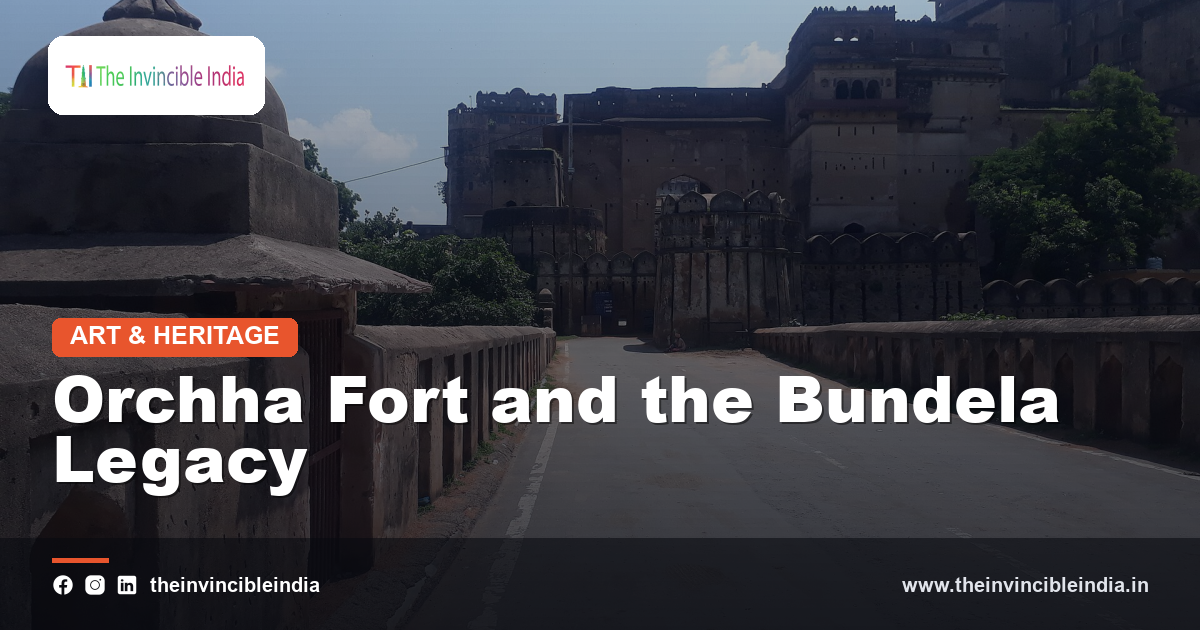
Orchha Fort rises on an island-like site beside the Betwa river in Madhya Pradesh, the centrepiece of a medieval royal town built by the Bundela rulers. Its palaces, temples, gateways and riverside cenotaphs form one of the most atmospheric heritage landscapes of central India, a place where the skyline of domes and spires still looks much as it did in the age of its patrons. Unlike many fortified capitals that grew into modern cities, Orchha preserved its historic character. As with the strongholds described in the guide to the great forts of India, the fort here is both a military work and an expression of royal taste, faith and identity.
Quick Facts
| Detail | Information |
|---|---|
| Location | Orchha, Madhya Pradesh |
| River | Betwa |
| Dynasty | Bundela Rajputs |
| Period | Sixteenth to seventeenth century |
| Main structures | Raj Mahal, Jahangir Mahal, Ram Raja Temple |
| Style | Rajput and Mughal-influenced palace architecture |
A Royal Town on the Betwa
Orchha occupies a bend of the Betwa river in the Bundelkhand region of Madhya Pradesh, and its name is often understood to mean a hidden or concealed place. The fort and the surrounding settlement were laid out on a naturally defended site, where the river and rocky ground provided protection. The town grew around the royal citadel, with temples, gateways, markets and residences spreading outward. Because later political centres shifted elsewhere, Orchha was spared the heavy rebuilding that transformed so many other historic capitals. As a result, the town retains an unusually complete medieval character, with monuments standing close together and the river forming a constant backdrop. This preservation makes Orchha a valuable place for studying how a regional kingdom shaped its capital, balancing defence, worship and royal display within a single landscape.
The Bundela Dynasty and Its Origins
The Bundelas were a Rajput clan who gave their name to the Bundelkhand region of central India, and Orchha became the seat of one of their most important kingdoms. According to tradition, the clan rose to prominence in the late medieval period and established its authority over the hills and forests of the region. Their rulers combined skill in warfare with an energetic interest in building, commissioning forts, palaces, temples and water works. The founding of Orchha as a capital in the sixteenth century is attributed to a Bundela chief named Rudra Pratap Singh, and later rulers expanded and embellished the settlement. The dynasty’s history is bound up with the wider story of northern India, including relations with the Mughal court. Orchha therefore stands as a monument to the ambitions of a regional power that maintained its own distinct identity.
Choosing the Site and Planning the Fort
The builders of Orchha chose a site that could be defended with relative ease, using the river on several sides and a rocky island platform as the foundation of the citadel. A causeway bridge linked the fort to the mainland, and the approach was controlled through gateways and fortified walls. Within the enclosure, the principal palaces were arranged around courtyards, creating zones for public audience, private residence and ceremonial use. This pattern follows the planning logic of Rajput fortress-palaces, where defence and royal life were combined within the same walls. The compact scale of the complex gives it a human quality that contrasts with the vast scale of imperial forts. Planning at Orchha shows how a smaller kingdom could create a refined and self-contained capital, with each building placed to support the daily rhythm of court life.
The Raj Mahal and the Early Palace
The Raj Mahal is one of the oldest and most important palaces in the Orchha complex, and it reflects the traditional Rajput approach to royal architecture. Built around open courtyards, the palace rises in several storeys, with balconies, jharokhas and chhatris adding variety to its silhouette. Interiors contain chambers decorated with painted ceilings and walls, many showing religious and courtly scenes in a lively regional style. The palace was not only a residence but a ceremonial setting where the ruler received guests and conducted the affairs of the kingdom. Its massive walls and restrained exterior give it a fortress-like character, while the interior reveals a more intimate and decorative spirit. The Raj Mahal remains a key to understanding the early architecture of Orchha and the tastes of the rulers who shaped the town.
The Jahangir Mahal and Its Symbolism
The Jahangir Mahal is the best-known palace of Orchha, celebrated for its elegant towers, balconies and domed chhatris that crown the building. Tradition holds that it was built by a Bundela ruler to honour a visit by the Mughal emperor Jahangir, which explains the name. The palace is arranged around a large central courtyard, with tiers of arcaded galleries and corner pavilions that give it a graceful and symmetrical character. Its design blends Rajput forms with decorative features associated with Mughal architecture, creating a hybrid style that reflects the political and cultural exchange of the period. The use of jharokha balconies, brackets and glazed or carved details enlivens the facade. The Jahangir Mahal is therefore both a palace and a statement of alliance, showing how architecture could express relations between a regional kingdom and an imperial court.
Rajput and Mughal Architectural Dialogue
One of the most interesting aspects of Orchha is the way its buildings blend Rajput and Mughal architectural ideas. Rajput tradition contributed massive walls, courtyard planning, chhatris and carved brackets, while Mughal influence appears in the use of arches, domes, symmetrical layouts and certain decorative motifs. Rather than copying one style or the other, the builders combined them into a regional language that suited the needs of the Bundela court. This blending was common across northern India in the early modern period, as local rulers interacted with imperial authority and with each other. At Orchha the result is especially coherent, because the buildings were largely raised within a limited span of generations. Studying the palaces reveals a cultural dialogue in which regional pride and imperial fashion were skilfully reconciled in stone and plaster.
The Ram Raja Temple and the Idea of the King-God
The Ram Raja Temple is unusual among Indian temples because it began its life as a palace building and later became a sanctuary. Tradition recounts that the image of Rama was installed here and could not subsequently be moved, so the palace itself became the temple. Rama is worshipped at Orchha not only as a deity but as the king of the town, a concept that gives the shrine its special character. Devotees come from many regions, and the temple remains a very active centre of worship with daily rituals and festivals. The building retains the appearance of a palace, with courtyards and halls rather than a towering spire. This blend of royal and sacred identity makes the Ram Raja Temple one of the most distinctive religious monuments of central India.
The Chaturbhuj Temple and Its Soaring Plan
Close to the Ram Raja Temple stands the Chaturbhuj Temple, a large and imposing structure on a high platform. It was conceived as the intended home for the image of Rama and rises with a series of spires and a tall, complex plan. The temple is approached by a long flight of steps and contains lofty halls and a sanctum that were designed on a grand scale. Its architecture combines temple forms with the planning of palace buildings, and its upper levels offer fine views across the town and the river. Although the image was ultimately worshipped elsewhere, the Chaturbhuj Temple remains a major landmark of Orchha. Its height and monumental presence show the ambition of Bundela patronage, and it forms an essential part of the skyline that gives the town its unique profile.
The Laxminarayan Temple and Its Painted Interiors
The Laxminarayan Temple, set a short distance from the main fort, is notable for its fortress-like appearance and for the paintings that cover its interior walls and ceilings. The murals depict religious themes and scenes of courtly life, rendered in a regional style with rich colours and lively figures. The combination of devotional and secular subjects gives the paintings a broad documentary value, offering glimpses of costume, ornament and social customs of the period. The exterior of the temple is sturdy and defensive in character, which suggests that sacred and military architecture were not sharply separated in this region. The Laxminarayan Temple therefore preserves an important record of Bundela painting and demonstrates that Orchha’s artistic heritage extended beyond architecture to the decorative arts of wall and ceiling.
Murals and the Decorative Arts of Orchha
The painted decoration found in the palaces and temples of Orchha forms a significant part of the town’s artistic legacy. Walls and ceilings were covered with scenes drawn from religious narrative, royal ceremony and natural imagery, executed with mineral and vegetable colours on prepared plaster. Many of the images follow the conventions of regional Indian painting, with flat, expressive figures, decorative borders and carefully patterned backgrounds. Beyond painting, craftsmen produced carved stone, stucco work and decorative brackets that enriched the surfaces of the buildings. Together these arts show that Orchha was not merely a military capital but a place of cultivated taste. The surviving murals, though weathered in places, provide valuable evidence for the visual culture of the Bundela court and for the continuity of traditional craft practice in central India.
The Chhatris Along the Betwa
One of the most memorable sights of Orchha is the row of royal cenotaphs, known as chhatris, that stand along the bank of the Betwa river. These domed memorial pavilions were built to commemorate rulers and members of the royal family, and they rise from raised platforms in a tight cluster. Their tall shapes, crowned by domes and small spires, are reflected in the river and create a distinctive silhouette, especially at dawn and dusk. The chhatri is a hallmark of Rajput architecture, serving as a memorial that combines grandeur with a sense of calm. At Orchha the group has become an enduring symbol of the town. The cenotaphs show how the Bundela rulers chose to be remembered, using architecture to link royal memory with the natural beauty of the river landscape.
Gateways, Bridges and Defensive Features
Although Orchha is best known for its palaces and temples, its defensive works are also an important part of the story. The fort is reached by a causeway bridge across the river, leading to a fortified gateway that controlled access to the royal enclosure. Walls, bastions and entrance passages were arranged to channel movement and to protect the interior from attack. The river itself acted as a natural moat, and the surrounding hills and forests added further layers of security. These features remind visitors that the Bundela capital existed in an age when safety could not be taken for granted. At the same time, the defensive works are designed with some elegance, their massive forms softened by arches and decorative details. Orchha thus shows how military necessity and architectural beauty were joined in the same structures.
Royal Life, Ceremony and the Court
The buildings of Orchha were designed to support a rich ceremonial life centred on the court of the Bundela ruler. Public audiences were held in open halls and courtyards, while private apartments, women’s quarters and service areas were arranged in separate zones. Festivals, religious observances and state occasions all took place within this architectural framework. The balconies and terraces served as viewing platforms for processions and gatherings, and gardens and water features added to the comfort and prestige of the palaces. The layout of the complex thus mirrors the social order of the court, with its careful distinctions of rank and function. Understanding the architecture in this way allows visitors to imagine the daily rhythm of palace life, and to see the fort as a stage on which royal power was continually performed.
Decline of the Capital and the Survival of Heritage
As political power in the region shifted in later centuries, Orchha gradually lost its role as a major capital, and the royal seat moved elsewhere. The palaces fell quiet, and the town became a smaller settlement among the forests and fields of Bundelkhand. Ironically, this decline helped to preserve the historic fabric, since there was little pressure to demolish or rebuild. The monuments aged but remained largely intact, and the Ram Raja Temple kept the town alive as a pilgrimage centre. In recent times the monuments have been protected and conserved, and attention has grown toward the importance of Orchha as a heritage place. Its survival illustrates how a change in political fortune can sometimes safeguard cultural treasures, leaving future generations with a rare and authentic glimpse of a vanished royal world.
Orchha Fort Today
Today Orchha Fort and its surrounding monuments are protected heritage and a favoured destination for travellers interested in history, architecture and living tradition. The palaces, temples and chhatris are studied as outstanding examples of Bundela and Rajput-Mughal architecture, while the Ram Raja Temple continues to draw devotees throughout the year. The town has also been proposed for wider recognition as a cultural landscape of significance. Visitors can walk through courtyards, climb to balconies and follow the river path to the cenotaphs, experiencing the monuments in a quiet and unhurried setting. The enduring appeal of Orchha lies in this combination of architectural richness and atmosphere. It remains a vivid reminder of the Bundela legacy and of the creative energy of regional kingdoms in the history of India.
Sources & Further Reading
- Archaeological Survey of India (asi.nic.in).
- Ministry of Culture, Government of India (indiaculture.gov.in).
Frequently Asked Questions
Where is Orchha Fort located?
Orchha Fort is located in the town of Orchha in the Bundelkhand region of Madhya Pradesh, beside the Betwa river. The town lies close to the city of Jhansi, which is a common point of access.
Who built Orchha Fort?
The Orchha complex is associated with the Bundela Rajput rulers, who established the town as their capital in the sixteenth century. Later Bundela rulers added palaces, temples and other structures over the following generations.
What is the Jahangir Mahal?
The Jahangir Mahal is the most famous palace in Orchha, known for its domed chhatris, balconies and courtyard plan. Tradition holds that it was built to honour a visit by the Mughal emperor Jahangir.
Why is the Ram Raja Temple special?
The Ram Raja Temple was originally a palace and became a shrine when the image of Rama was installed there. Rama is worshipped as the king of Orchha, which makes the temple unique among Indian places of worship.
What are the chhatris of Orchha?
The chhatris are domed royal cenotaphs built along the bank of the Betwa river to commemorate Bundela rulers and family members. They form a striking skyline and are among the most recognised features of the town.


