

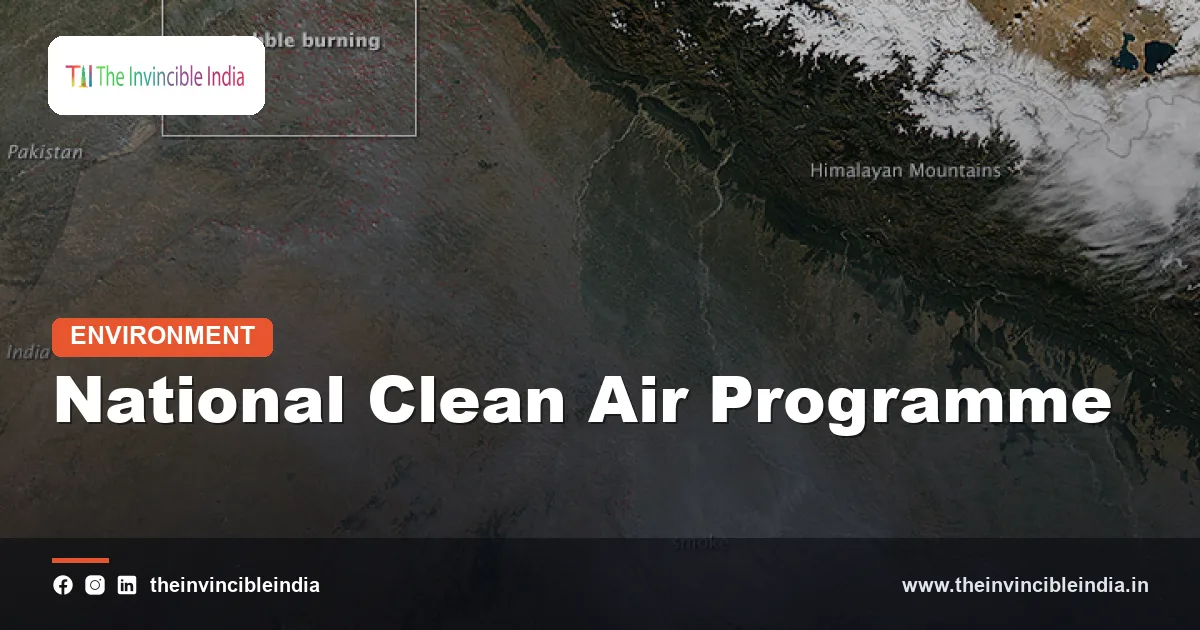
Every winter, large parts of northern India disappear into a grey haze, and in many cities the air quality index climbs into the “poor” or “very poor” range for days at a time. The National Clean Air Programme (NCAP) is India’s first national, time-bound strategy aimed at tackling this problem across the country rather than city by city. Launched in January 2019 by the Ministry of Environment, Forest and Climate Change (MoEFCC), it targets fine particulate pollution, especially PM2.5 and PM10, in cities where the air has repeatedly failed to meet national standards.
The programme does not create a new law. Instead, it works as a framework of targets, funding, monitoring and city-level planning built on the Air (Prevention and Control of Pollution) Act, 1981. This explainer covers what NCAP is, how cities are chosen, what a city clean air action plan contains, how the targets were revised, and how finance, especially through the Fifteenth Finance Commission, is linked to results.
Quick Facts
| Item | Details |
|---|---|
| Launched | 10 January 2019 |
| Launched by | Ministry of Environment, Forest and Climate Change |
| Technical lead | Central Pollution Control Board (CPCB) with State Pollution Control Boards |
| Nature | Time-bound, national-level strategy with a city-specific approach; not a statute |
| Focus pollutants | Particulate matter, PM10 and PM2.5 |
| Original goal | 20 to 30 per cent reduction in PM concentrations by 2024, against 2017 as the base year |
| Revised goal | Up to 40 per cent reduction by 2025-26, or meeting national standards |
| Target cities | Non-attainment cities, initially just over 100 and later expanded to about 130 |
Why Air Quality Became a National Priority
India’s air pollution problem has several overlapping causes. Dense traffic, construction dust, burning of biomass and waste, industrial emissions, coal-based power generation, brick kilns, and household use of solid fuels all contribute, and their relative importance varies across regions. Weather adds a layer: in the Indo-Gangetic Plain, cold, still air during winter traps pollutants near the ground, a phenomenon known as temperature inversion.
The health consequences are well recognised. Fine particles of PM2.5, which are smaller than 2.5 micrometres in diameter, penetrate deep into the lungs and bloodstream, and have been linked with respiratory and cardiovascular disease. Public concern, court proceedings and international rankings of city air quality pushed the government to move from sporadic emergency measures toward a sustained programme. NCAP was designed to provide that continuity.
Earlier measures that paved the way
- The Air (Prevention and Control of Pollution) Act, 1981, which created the legal basis for air quality standards and pollution control boards.
- The National Ambient Air Quality Standards, notified in 2009, which set permissible limits for pollutants.
- The National Air Quality Index, launched in 2014, which expressed air quality in easily understood categories.
- The Graded Response Action Plan for Delhi and its surrounding region, which prescribes emergency steps as pollution worsens.
- Tighter vehicle emission standards, culminating in the move from Bharat Stage IV to Bharat Stage VI fuel and vehicle norms in April 2020.
Objectives and Strategy of NCAP
NCAP’s central objective is to bring down the concentration of particulate matter in polluted cities within a defined period. The programme adopts a multi-pronged strategy that goes beyond a single sector.
- Reduce pollution: prepare and implement city-specific plans that deal with the main sources of PM in each city.
- Strengthen monitoring: increase the number of air quality monitoring stations and improve the quality and accessibility of data.
- Raise awareness: involve citizens, schools and institutions in understanding air quality and what can be done.
- Build capacity: train officials and develop technical expertise within urban local bodies and pollution control boards.
- Coordinate across sectors: link transport, urban development, industry, power, agriculture and public health policies.
The strategy also promotes the use of source apportionment studies, which estimate how much each source contributes to pollution in a given city. These studies, carried out by research and technical institutions, guide which interventions are likely to work best.
Understanding the Pollutants and Standards
NCAP concentrates on particulate matter because it is among the most widespread and harmful air pollutants in Indian cities. PM10 refers to particles of 10 micrometres or smaller, such as road dust and construction debris, while PM2.5 refers to finer particles, which come from combustion in vehicles, industry and burning of biomass and are formed in the atmosphere from gases.
National Ambient Air Quality Standards
The 2009 standards prescribe limits for pollutants including PM10, PM2.5, sulphur dioxide, nitrogen dioxide, ozone, carbon monoxide, lead, ammonia, benzene, benzo(a)pyrene, arsenic and nickel. For particulate matter, both an annual and a 24-hour average limit apply.
| Pollutant | Annual average limit | 24-hour limit |
|---|---|---|
| PM10 | 60 micrograms per cubic metre | 100 micrograms per cubic metre |
| PM2.5 | 40 micrograms per cubic metre | 60 micrograms per cubic metre |
These limits are considerably looser than the guidelines of the World Health Organization, which has tightened its recommended levels in recent years. Many Indian cities exceed even the national limits, which is why they are classified as non-attainment cities.
What Are Non-Attainment Cities?
A non-attainment city is one that has failed to meet the National Ambient Air Quality Standards for PM10 or nitrogen dioxide over a period of five consecutive years. NCAP initially identified just over 100 such cities, based on air quality data from 2011 to 2015. The list was later expanded, and the total rose to about 130 cities and urban areas as more were brought under the programme.
The cities are spread across many states, including large industrial and metropolitan centres as well as mid-sized towns. Not all are in northern India, and several in the east, west and south also appear on the list, showing that particulate pollution is not only a winter phenomenon of the Indo-Gangetic Plain.
Why these cities were chosen
- They had enough long-term monitoring data to show persistent non-compliance.
- They represent a range of climatic and economic conditions.
- Concentrating on named cities allows accountability, since each one gets its own plan and target.
City Clean Air Action Plans
The operational core of NCAP is the City Action Plan. Each non-attainment city is required to prepare a plan, typically through the municipal body working with the state pollution control board, district administration, transport department and other agencies. Plans are scrutinised by a central committee and are expected to be specific, costed and time-bound.
Common elements of city plans
- Road dust control: mechanised sweeping, paving of road shoulders, water sprinkling and the use of anti-smog guns at large construction sites.
- Vehicular emissions: promotion of public transport, electric mobility, parking management, and checks on polluting vehicles.
- Construction and demolition waste: setting up of processing facilities and enforcement of dust mitigation norms.
- Biomass and waste burning: measures to prevent burning of leaves, garbage and agricultural residue, and to provide cleaner cooking fuel.
- Industrial emissions: stricter compliance and cleaner fuels in small industries, brick kilns and other units.
- Green cover: urban plantation and greening of open spaces to reduce dust.
Cities are also expected to set annual targets for reduction and to report progress on indicators such as the number of days with poor air quality. This makes NCAP more measurable than earlier advisories.
Strengthening the Monitoring Network
You cannot manage what you do not measure. When NCAP began, many Indian cities had few or no real-time monitors, and some of the data was manual and delayed. The programme therefore emphasises expansion of the network of air quality monitoring stations, including continuous ambient air quality monitoring stations (CAAQMS) and manual stations under the National Air Monitoring Programme run by the Central Pollution Control Board.
Data and transparency
Air quality data is published through the CPCB’s national air quality index platform, which classifies the air into six categories: Good, Satisfactory, Moderate, Poor, Very Poor and Severe. An online portal known as PRANA was developed to track the implementation of NCAP, showing the status of city plans, funds and activities. Better monitoring serves two purposes: it identifies pollution hotspots, and it provides the baseline against which the progress of cities is judged.
A related focus is the calibration and quality assurance of low-cost sensors and the use of satellite data and modelling, which help fill gaps where ground monitors are not available.
Targets: Original and Revised
The programme’s initial target was a 20 to 30 per cent reduction in the concentration of PM10 and PM2.5 by 2024, with 2017 as the base year. This was a national-level, tentative target, and cities were expected to set their own goals consistent with it.
In 2022, the target was revised. The new goal set a reduction of up to 40 per cent in PM10 concentrations by 2025-26, or the achievement of the national standards, whichever is applicable. The revision also moved the base year to 2019-20 and extended the timeline, recognising that the original window was too short and that the pandemic years had distorted the data. The revised approach relies more on PM10, which is more widely monitored, while PM2.5 is addressed through the broader strategy and plans.
How progress is judged
- Annual average PM10 concentration in each city compared with its base year.
- Utilisation of funds and completion of planned activities.
- Improvement in the number of days with good and satisfactory air.
Funding and the Fifteenth Finance Commission
NCAP does not carry a very large dedicated budget of its own. Instead, it combines central funds for the programme with resources from existing schemes for urban development, transport, clean cooking and waste management, and with money from the Finance Commission.
The Fifteenth Finance Commission recommended special grants for air quality improvement in the urban agglomerations with a population of more than one million. These grants, which are performance-linked, are released in stages based on how well the city improves its annual average concentration of PM10, and on the utilisation of the grant itself. This was a significant step because it linked fiscal transfers to environmental outcomes. The grants are channelled through the Ministry of Housing and Urban Affairs and the environment ministry as part of the broader Finance Commission framework.
Why performance-linked grants matter
Because the money is conditional on results, city administrations have a financial reason to invest in dust control, clean transport and monitoring. Critics note that a focus on annual averages of a single pollutant can leave seasonal peaks or other pollutants, such as nitrogen oxides, relatively unaddressed.
Institutional Structure and Governance
NCAP is governed through a layered structure. At the top, a steering committee and a monitoring committee in the central ministry oversee implementation. At the state level, a state steering committee coordinates the work of departments, while each city has its own implementation committee, usually headed by the municipal commissioner or district magistrate. The Central Pollution Control Board provides technical guidance, and the State Pollution Control Boards support the preparation of plans and enforcement.
Alongside NCAP, a separate statutory body, the Commission for Air Quality Management in the National Capital Region and Adjoining Areas, was set up in 2021 to coordinate action across Delhi, Haryana, Punjab, Rajasthan and Uttar Pradesh, where air pollution crosses state boundaries.
Recognition, Ranking and Citizen Participation
To encourage competition among cities, the Ministry introduced a ranking exercise, known as Swachh Vayu Survekshan, which assesses cities on their clean air measures and performance and rewards the best performers. Cities are grouped by population so that they are compared fairly.
Public involvement is a recurring theme. Awareness campaigns, school programmes, and the availability of real-time air quality data on mobile applications are meant to make air quality a visible public issue. The idea is that informed citizens can demand better enforcement and also change their own behaviour, whether by using public transport, avoiding burning waste, or switching to cleaner cooking fuel.
Challenges and Criticisms
NCAP is widely regarded as a significant step, but it has also faced questions.
- Legal status: the programme is a policy framework without statutory force, so it relies on existing laws and on cooperation among agencies.
- Regional pollution: air pollution does not stop at city limits, yet plans are prepared city by city, so regional sources such as crop residue burning or power plants may be left out.
- Monitoring gaps: many smaller cities still have limited monitoring, which makes it hard to measure improvement.
- Capacity: urban local bodies often have limited staff and technical expertise for implementing complex plans.
- Fund use: a large share of spending has gone to road dust control and similar measures, with less emphasis on transport, industry and household energy.
- Focus on particulates: other harmful pollutants such as ozone and nitrogen dioxide receive less attention.
Conclusion
The National Clean Air Programme marks a shift in how India handles air pollution, from episodic emergency steps to a sustained, target-based approach with city plans, better data and performance-linked finance. Its success will depend on how well cities turn plans into action, how far regional and cross-sector sources are addressed, and whether the monitoring system stays reliable enough to show real change. As the programme matures, its design and targets are likely to continue evolving in line with scientific evidence and public health priorities.
Frequently Asked Questions
When was the National Clean Air Programme launched?
The National Clean Air Programme was launched on 10 January 2019 by the Ministry of Environment, Forest and Climate Change. It is a national, time-bound strategy aimed at reducing particulate matter pollution in cities that do not meet the national air quality standards.
What is a non-attainment city?
A non-attainment city is one that has failed to meet the National Ambient Air Quality Standards for PM10 or nitrogen dioxide over five consecutive years. NCAP began with just over 100 such cities, based on data from 2011 to 2015, and the list later expanded to about 130.
What are the targets of NCAP?
The original target was a 20 to 30 per cent reduction in PM2.5 and PM10 concentrations by 2024, with 2017 as the base year. This was revised to a reduction of up to 40 per cent, or the achievement of national standards, by 2025-26, with a later base year.
What is a City Action Plan under NCAP?
A City Action Plan is a document prepared for each non-attainment city, setting out the sources of pollution and the specific measures to reduce them. It typically covers road dust, vehicles, construction waste, biomass burning, industry and greening, with timelines and funding.
How is the Finance Commission linked to NCAP?
The Fifteenth Finance Commission recommended performance-linked grants for air quality improvement in cities with a population of more than one million. Funds are released depending on the improvement in annual average PM10 levels and on the use of the grants.
Is NCAP a law?
No. NCAP is a policy framework and national strategy, not a statute. It works within the legal powers provided by the Air (Prevention and Control of Pollution) Act, 1981 and the Environment (Protection) Act, 1986, and is implemented by central, state and city agencies.


