

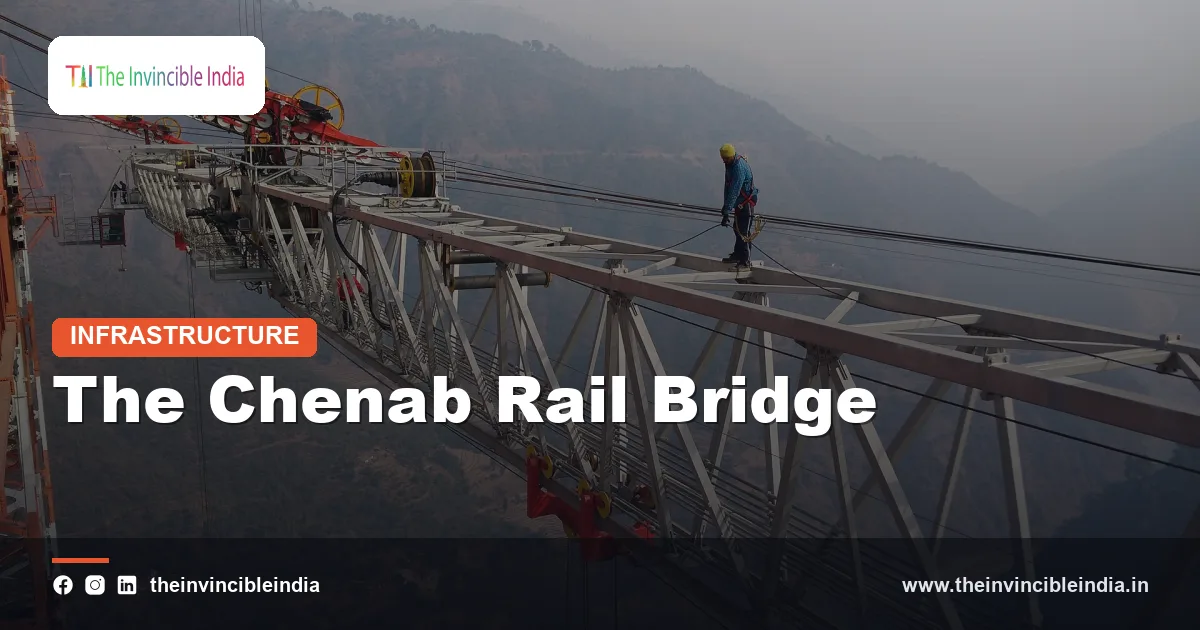
The Chenab Rail Bridge is the world’s highest railway arch bridge, a single steel arch in Reasi district of Jammu and Kashmir that carries a railway line about 359 metres above the bed of the Chenab river. It is a key structure on the Udhampur-Srinagar-Baramulla Rail Link (USBRL), the project that finally connected the Kashmir Valley to India’s national railway network.
The bridge stands higher than the Eiffel Tower in Paris and was built in a steep, seismically active Himalayan gorge by Konkan Railway Corporation Limited (KRCL) with AFCONS as the main contractor. Its design addresses wind, earthquakes and blast loads, and its opening in June 2025 completed a rail connection that engineers had worked on for decades. This explainer covers what the bridge is, how it was designed and built, where it fits in the USBRL, and why it matters for the region.
| Attribute | Detail |
|---|---|
| Location | Between Bakkal and Kauri, Reasi district, Jammu and Kashmir |
| River crossed | Chenab |
| Deck height above riverbed | About 359 metres, the highest for a railway bridge in the world |
| Main arch span | About 467 metres |
| Total length | About 1,315 metres including approach viaducts |
| Type | Single steel arch (concrete-filled steel box sections) with a steel deck |
| Project | Udhampur-Srinagar-Baramulla Rail Link (USBRL), about 272 km |
| Builders | Konkan Railway Corporation Limited (executing agency) and AFCONS (contractor) |
| Opened | June 2025, with passenger services to Srinagar |
Key Takeaways
- The Chenab Rail Bridge in Reasi, Jammu and Kashmir, has a deck about 359 metres above the Chenab riverbed, making it the highest railway bridge in the world and taller than the Eiffel Tower.
- The Chenab Rail Bridge is part of the roughly 272-kilometre Udhampur-Srinagar-Baramulla Rail Link, which connects the Kashmir Valley to the Indian railway network.
- The bridge uses a single main steel arch of about 467 metres span, supported by large foundations cut into the gorge walls.
- Engineers designed the Chenab Rail Bridge to resist very strong winds, high earthquake forces and blast loads, with a design life of about 120 years.
- Konkan Railway Corporation Limited was the executing agency and AFCONS the main contractor for the bridge.
- The Chenab Rail Bridge provides all-weather rail access to the Kashmir Valley, where road links through the Pir Panjal range are often disrupted by snow and landslides in winter.
What is the Chenab Rail Bridge?
The Chenab Rail Bridge is a railway bridge across the Chenab river gorge in Reasi district, Jammu and Kashmir, built as part of the Katra-Banihal section of the USBRL, and it is the world’s highest railway bridge by the height of its deck above the riverbed. It is a steel arch bridge with a main span of around 467 metres and a total length of around 1,315 metres.
The bridge crosses the river between the villages of Bakkal and Kauri, in a deep and narrow section of the gorge not far from the town of Reasi. A single railway track runs along the deck, which is held by steel columns standing on the arch and on the approach piers. The structure is visible from far away because of its large white-and-steel arch spanning the gorge.
The bridge exceeds the height of the earlier record holders. A railway bridge in China’s Guizhou province, the Beipanjiang railway bridge, is about 275 metres high, and a number of other high railway viaducts stand well below 200 metres. At about 359 metres, the Chenab Rail Bridge is well above these, and it is also taller than the Eiffel Tower, which stands about 330 metres including its antenna.
Where is the Chenab Rail Bridge and what is the Chenab river?
The Chenab Rail Bridge is located in Reasi district in the Jammu division of Jammu and Kashmir, on the railway line between Katra, the base town for the Vaishno Devi pilgrimage, and Banihal. The river below it, the Chenab, is one of the major rivers of the Indus system.
The Chenab is formed by the meeting of two rivers, the Chandra and the Bhaga, at Tandi in Himachal Pradesh. It then flows through Jammu and Kashmir, where it passes through narrow valleys and gorges and supports several hydroelectric projects, before entering Pakistan’s Punjab province. Under the Indus Waters Treaty of 1960, the Chenab is one of the western rivers of the Indus system.
The gorge at Reasi is steep and rocky, with rapidly changing weather and strong winds. These conditions made the bridge site difficult to access. Builders had to construct roads, cableways and tunnels to reach the abutments before any work on the bridge itself could start.
What is the Udhampur-Srinagar-Baramulla Rail Link (USBRL)?
The Udhampur-Srinagar-Baramulla Rail Link (USBRL) is a railway project of about 272 kilometres that connects Udhampur in Jammu with Baramulla in the Kashmir Valley through the Pir Panjal and the Himalayan foothills, and it was declared a national project in 2002. The Chenab Rail Bridge is on its most difficult section.
The USBRL was built in stages, and each stage opened as it was completed. The line is notable for its large number of tunnels and bridges, built in mountainous terrain with unstable slopes.
| Section | Approximate length | Milestone |
|---|---|---|
| Qazigund-Baramulla | 118 km | Opened in stages, completed around 2009 (within the Kashmir Valley) |
| Banihal-Qazigund | 18 km | Opened in 2013, including the long Pir Panjal tunnel |
| Udhampur-Katra | 25 km | Opened in 2014 |
| Katra-Banihal | 111 km | Completed in 2025, including the Chenab Rail Bridge and the Anji Khad bridge |
The Katra-Banihal stretch was the hardest. It includes the Chenab Rail Bridge, the Anji Khad bridge, which is the first cable-stayed railway bridge in India, and numerous tunnels, among them the longest transport tunnel in the country. Completing it joined the valley’s local rail network with the main line that reaches Jammu and, through it, the rest of India.
How was the Chenab Rail Bridge designed?
The Chenab Rail Bridge was designed as a single large steel arch, with steel box sections filled with concrete, and with deck trusses and piers resting on foundations excavated in the gorge walls. The arch shape was chosen because it transfers loads into the rock on both sides and it suits a deep, narrow gorge where piers cannot be placed in the river.
The arch and the deck
The main arch spans about 467 metres and rises from large skewback foundations anchored in the rock. On top of the arch stand tall steel columns that support the deck. The remaining length of the bridge is made of approach viaducts supported by piers on each bank, which bring the total length to around 1,315 metres.
Wind, earthquake and blast resistance
Because the bridge is very high and located in the Himalayan seismic belt, the designers had to consider several special loads:
- Wind: The structure was designed and tested to withstand extremely high wind speeds, and wind-tunnel studies were used to confirm the behaviour of the arch and deck.
- Earthquakes: The bridge is designed for the highest seismic zone in the Indian standards, and its foundations and arch were analysed for strong ground motion.
- Blast loads: The structure includes provisions to remain safe under explosive loading, which was added as a security requirement given the region’s sensitivities.
- Temperature: The steel arch has to handle large daily and seasonal temperature swings in the gorge, from freezing in winter to hot summers.
- Design life: The bridge was planned for a service life of about 120 years, with regular inspection and monitoring.
Sensors and monitoring systems are installed to measure structural response, and the bridge has regular maintenance access for inspectors.
Who built the Chenab Rail Bridge?
The Chenab Rail Bridge was built by Konkan Railway Corporation Limited (KRCL), the Indian Railways public sector company that built the Konkan Railway, with AFCONS Infrastructure as the main construction contractor. International design consultants and Indian technical institutions also contributed to design checks and testing.
KRCL has a long record of building railways through difficult terrain, with many tunnels and bridges on the Konkan line completed in 1998. It was given the responsibility for the Katra-Banihal section and the Chenab bridge, and it worked with Northern Railway and the Ministry of Railways. AFCONS, part of the Shapoorji Pallonji group, handled the steelwork, the arch erection and the civil construction.
Indian research institutions and agencies were consulted for slope stability, foundations, wind effects and blast resistance. The Indian Institute of Science advised on geotechnical issues for the gorge slopes, and the Defence Research and Development Organisation was involved in matters relating to blast loading. Such cooperation shows that the project combined railway, defence, academic and private-sector expertise.
How was the Chenab Rail Bridge constructed?
The Chenab Rail Bridge was constructed by first building access roads and cableways to the gorge, then excavating foundations, then erecting the arch in two halves from both banks using cable cranes, and finally joining the halves at the crown and adding the deck. The method avoided the need for any support from the riverbed.
- Access: Builders constructed roads, tunnels and temporary tracks to reach the abutments on the steep slopes. Some access routes were themselves major engineering projects.
- Foundations: Large excavations and slope stabilisation work were completed on both banks, with rock anchors and retaining measures.
- Cable crane system: A system of tall cable cranes was installed across the gorge to lift heavy steel segments into place, as the river below was not usable for support or transport.
- Arch erection: Steel segments were assembled from both sides, with temporary stay cables holding the growing arch halves.
- Closing the arch: The two halves were joined at the crown, an event often described as the closure of the arch, which was completed in 2021.
- Deck and tracks: The deck, columns and approach viaducts were then added, followed by track laying, safety systems and testing.
The project took many years. Work began in the mid-2000s, slowed or paused at times because of design revisions, security and geological challenges, and then resumed with a revised plan. Completing the arch in 2021 was a major milestone, and finishing the full Katra-Banihal section in 2025 allowed the line to open for regular services.
Why does the Chenab Rail Bridge matter for Jammu and Kashmir?
The Chenab Rail Bridge matters because it completed the missing link between the Kashmir Valley and the national railway network, providing a safe, all-weather and faster form of transport for passengers and freight. Before the link, the valley depended mainly on a single highway and air travel.
The National Highway through the Pir Panjal range, which passes the Banihal pass, is frequently disrupted by heavy snowfall, landslides and shooting stones, particularly in winter. During such closures, supplies of essential goods and fruit consignments are delayed. A railway line running largely in tunnels and on bridges is more resistant to such disruptions.
The expected benefits include:
- Passenger travel: Faster and more reliable travel between Katra, Jammu and Srinagar, with travel time between Katra and Srinagar reduced to roughly three hours on modern trains.
- Freight and horticulture: Easier movement of apples, other fruit and handicrafts from the valley to markets across India, and of goods such as cement, food and fuel into the valley.
- Tourism and pilgrimage: Easier access for tourists and for pilgrims travelling to Vaishno Devi and Amarnath.
- Regional integration: Stronger economic and social links between the valley, the Jammu region and the rest of the country.
- Strategic mobility: A reliable corridor for moving people and supplies in a sensitive border region.
Passenger services on the new section, including Vande Bharat trains between Katra and Srinagar, started after the opening in June 2025. Further services have been planned over time.
How does the Chenab Rail Bridge compare with other high bridges?
The Chenab Rail Bridge is higher than other railway bridges and taller than many famous structures, though it is not the longest or the highest bridge of every kind. The comparison needs to distinguish railway bridges from road bridges.
| Structure | Type | Approximate height |
|---|---|---|
| Chenab Rail Bridge, India | Railway steel arch bridge | About 359 m above riverbed |
| Beipanjiang railway bridge, China | Railway bridge | About 275 m |
| Eiffel Tower, France | Tower, for comparison | About 330 m with antenna |
| Anji Khad bridge, India | Cable-stayed railway bridge, USBRL | Pylon of nearly 200 m |
The Chenab bridge’s claim rests on the clearance between the rail deck and the river below. The Millau Viaduct in France and several Chinese road bridges have taller pylons or decks above valleys, but those are road structures. The Chenab bridge holds the record for railway use.
What are the challenges and criticisms of the project?
The main challenges of the Chenab Rail Bridge project were geology, weather, access, security and cost, and the main criticisms concern delays and the environmental impact of large infrastructure in the Himalaya. These topics have been discussed by engineers, officials and commentators.
Engineering and construction difficulties
The geology of the Pir Panjal and the lower Himalaya includes weak rock, fault zones and water ingress, which created problems for tunnels and foundations. The rugged terrain made it difficult to move heavy equipment, and the weather limited working seasons.
Delays and costs
The USBRL was first planned in the 1990s, and it was completed decades after the first surveys. Costs increased with time, with design changes and with the extreme conditions. Supporters argue that the strategic and social value justifies the investment, while critics point to the long delays.
Environment and maintenance
Tunnels, roads and bridges in a fragile mountain zone affect slopes, springs and local ecosystems, and managing these effects is an ongoing task. Regular inspection and maintenance will be necessary for the structure to remain safe for its intended life.
Bottom Line
The Chenab Rail Bridge is a record-setting steel arch bridge, about 359 metres above the river, that made it possible to bring the Kashmir Valley onto the national rail network through the USBRL. Its design for wind, earthquakes and blast loads, together with its role in all-weather connectivity, makes it one of India’s most significant modern engineering projects. Information on this page was last reviewed on 7 October 2026.
Frequently Asked Questions
How high is the Chenab Rail Bridge?
The Chenab Rail Bridge has a deck about 359 metres above the Chenab riverbed, which makes it the highest railway bridge in the world. It is taller than the Eiffel Tower in Paris.
Where is the Chenab Rail Bridge located?
The Chenab Rail Bridge is located in Reasi district of Jammu and Kashmir, between Bakkal and Kauri. It forms part of the Katra-Banihal section of the Udhampur-Srinagar-Baramulla Rail Link.
Who built the Chenab Rail Bridge?
Konkan Railway Corporation Limited was the executing agency, and AFCONS Infrastructure was the main contractor. Indian institutions and international consultants supported the design, testing and slope stabilisation work.
What type of bridge is the Chenab Rail Bridge?
The Chenab Rail Bridge is a single steel arch bridge with a main span of about 467 metres. The arch uses steel box sections filled with concrete, and it supports a steel deck through tall columns.
Why is the Chenab Rail Bridge important?
The Chenab Rail Bridge is important because it completed the rail link between the Kashmir Valley and the rest of India. It provides all-weather connectivity in a region where roads are often blocked by snow and landslides.
Is the Chenab Rail Bridge safe against earthquakes and winds?
Yes, the Chenab Rail Bridge was designed for high wind speeds, strong earthquake forces and blast loads, with a design life of about 120 years. The designers tested the structure through analysis and wind studies, and monitoring systems track its condition.
{“@context”:”https://schema.org”,”@graph”:[{“@type”:”FAQPage”,”mainEntity”:[{“@type”:”Question”,”name”:”How high is the Chenab Rail Bridge?”,”acceptedAnswer”:{“@type”:”Answer”,”text”:”The Chenab Rail Bridge has a deck about 359 metres above the Chenab riverbed, which makes it the highest railway bridge in the world. It is taller than the Eiffel Tower in Paris.”}},{“@type”:”Question”,”name”:”Where is the Chenab Rail Bridge located?”,”acceptedAnswer”:{“@type”:”Answer”,”text”:”The Chenab Rail Bridge is located in Reasi district of Jammu and Kashmir, between Bakkal and Kauri. It forms part of the Katra-Banihal section of the Udhampur-Srinagar-Baramulla Rail Link.”}},{“@type”:”Question”,”name”:”Who built the Chenab Rail Bridge?”,”acceptedAnswer”:{“@type”:”Answer”,”text”:”Konkan Railway Corporation Limited was the executing agency, and AFCONS Infrastructure was the main contractor. Indian institutions and international consultants supported the design, testing and slope stabilisation work.”}},{“@type”:”Question”,”name”:”What type of bridge is the Chenab Rail Bridge?”,”acceptedAnswer”:{“@type”:”Answer”,”text”:”The Chenab Rail Bridge is a single steel arch bridge with a main span of about 467 metres. The arch uses steel box sections filled with concrete, and it supports a steel deck through tall columns.”}},{“@type”:”Question”,”name”:”Why is the Chenab Rail Bridge important?”,”acceptedAnswer”:{“@type”:”Answer”,”text”:”The Chenab Rail Bridge is important because it completed the rail link between the Kashmir Valley and the rest of India. It provides all-weather connectivity in a region where roads are often blocked by snow and landslides.”}},{“@type”:”Question”,”name”:”Is the Chenab Rail Bridge safe against earthquakes and winds?”,”acceptedAnswer”:{“@type”:”Answer”,”text”:”Yes, the Chenab Rail Bridge was designed for high wind speeds, strong earthquake forces and blast loads, with a design life of about 120 years. The designers tested the structure through analysis and wind studies, and monitoring systems track its condition.”}}]}]}


