

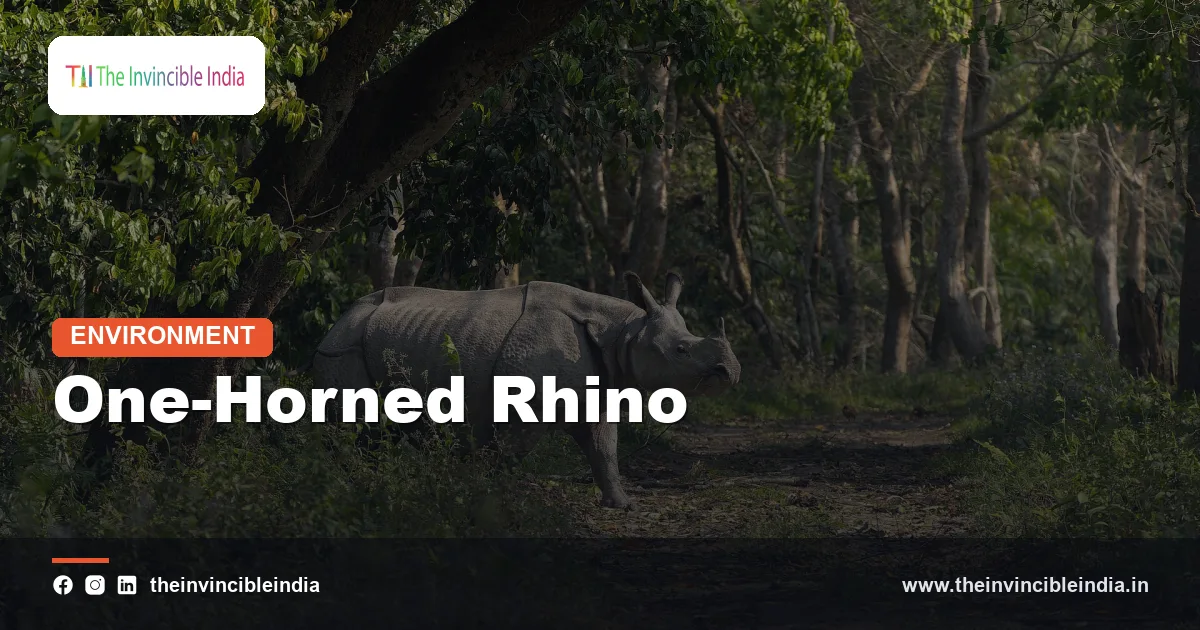
The greater one-horned rhino, also called the Indian rhinoceros (Rhinoceros unicornis), is among the great conservation stories of the Indian subcontinent. A century ago, hunting and the conversion of grasslands into farmland had reduced the species to a few hundred animals, mostly clinging on in a handful of floodplain pockets of the Brahmaputra valley and the foothills of Nepal. Today, thanks to protection that began in the early twentieth century and intensified after Independence, the species is no longer listed as endangered, and India holds the large majority of the world’s population.
This explainer describes the animal and its habitat, traces the recovery from near-extinction, looks at the key protected areas from Kaziranga to Dudhwa, and examines the continuing threats of poaching, floods and habitat loss. It also outlines the programmes, such as Indian Rhino Vision 2020, that aim to secure the species across a wider range.
Quick Facts
| Item | Details |
|---|---|
| Scientific name | Rhinoceros unicornis |
| Stronghold | Kaziranga National Park, Assam, which holds the majority of India’s rhinos |
| Other key sites | Pobitora, Orang and Manas in Assam; Jaldapara and Gorumara in West Bengal; Dudhwa in Uttar Pradesh |
| Legal protection in India | Schedule I of the Wildlife (Protection) Act, 1972 |
| International status | CITES Appendix I; IUCN Red List category Vulnerable |
| Low point | Early 1900s, when only a few hundred survived |
| Major programme | Indian Rhino Vision 2020, launched in 2005 |
| Main threats | Poaching for horn, floods, habitat loss, invasive plants |
The Animal: Features and Biology
The Indian rhino is the largest of Asia’s rhinoceros species and one of the largest land mammals in the region. Adult males can weigh well over two tonnes, and females are somewhat smaller. Its most distinctive features are its single black horn, which is made of keratin, the same protein found in hair and fingernails, and its thick grey-brown skin that falls into folds around the neck, shoulders and hindquarters, giving the impression of plates of armour.
The skin is thick but sensitive, and rhinos spend much of the day wallowing in water and mud, which keeps them cool and protects them from insects. Despite their size, they are fast over short distances and are good swimmers.
Behaviour and diet
- Rhinos are largely solitary, apart from mothers with calves and temporary groups at wallows or feeding areas.
- They are grazers that feed mainly on grasses, along with aquatic plants, fruits, leaves and crops.
- Males mark territories with dung piles, called middens, which are used repeatedly.
- Gestation lasts around 16 months, and a female usually gives birth to a single calf, which stays with her for a couple of years. This slow breeding rate means that populations recover only gradually.
Habitat: Grasslands and Floodplains
The species lives in the tall alluvial grasslands, swamps and riverine forests of the Terai and the Brahmaputra floodplain. The tall elephant grass, which can grow several metres high, provides cover and food, while wetlands and beels, which are shallow lakes, give water and wallowing sites. Annual floods renew the soil and the grasslands, so the ecosystem is shaped by water.
These habitats are rich in other wildlife. In the same landscape live tigers, Asian elephants, wild water buffalo, swamp deer, hog deer, the Gangetic dolphin in the rivers, and a large number of birds. Protecting the rhino therefore protects an entire floodplain community, which is why the species is often called an umbrella species.
A History of Decline and Recovery
The Indian rhino once ranged across the northern part of the subcontinent, from the Indus valley in the west to Assam and Myanmar in the east. Historical accounts, including those of the Mughal emperor Babur in the early sixteenth century, record rhinos in the plains of what is now Pakistan and north India. Over the following centuries, expanding agriculture, drainage of swamps and hunting steadily pushed the species back.
By the early twentieth century, the rhino was near extinction, with only a few hundred left, mostly in Assam and in parts of Nepal. Hunting was widespread, including as a trophy and for the supposed medicinal value of the horn.
Milestones in conservation
| Year | Event |
|---|---|
| 1905 | Kaziranga is proposed and notified as a reserve forest, after Lady Curzon’s visit in 1904 drew attention to the dwindling rhinos |
| 1916 | Kaziranga is declared a game reserve |
| 1950 | Kaziranga becomes a wildlife sanctuary |
| 1972 | The Wildlife (Protection) Act places the rhino in Schedule I |
| 1974 | Kaziranga is declared a national park |
| 1984-85 | Rhinos are reintroduced to Dudhwa in Uttar Pradesh |
| 1985 | Kaziranga is inscribed as a UNESCO World Heritage Site |
| 2005 | Indian Rhino Vision 2020 is launched |
Kaziranga National Park: The Stronghold
Kaziranga, on the southern bank of the Brahmaputra in Assam, is the heart of rhino conservation. It was set up as a reserve forest following the efforts of Mary Curzon, wife of the then Viceroy, Lord Curzon, who visited the area and could not see a single rhino. She urged her husband to take steps to protect the animal, and a forest reserve was created soon afterwards. Over the decades, the status of the area was gradually upgraded.
The park is a mix of tall grasslands, open forests, marshes and water bodies. It holds the majority of the world’s greater one-horned rhinos, together with one of the highest densities of tigers in any protected area, as well as elephants, wild buffalo and eastern swamp deer. It has been a UNESCO World Heritage Site since 1985 and is also recognised as a tiger reserve and an important bird area.
Why Kaziranga succeeded
- Sustained legal protection since the early twentieth century.
- A dedicated force of forest guards using anti-poaching camps spread across the park.
- Community support from villages around the park.
- Regular monitoring through censuses and surveys of the population.
Other Strongholds in Assam
Several other protected areas in Assam contribute to the future of the species. Pobitora Wildlife Sanctuary, close to Guwahati, is small but has one of the highest densities of rhinos in the world, so much so that the habitat is nearly saturated. Orang National Park, sometimes called the mini Kaziranga, supports a smaller but growing population along the north bank of the Brahmaputra. Manas National Park, a UNESCO World Heritage Site in the Bodoland region, lost its rhinos to poaching during a period of unrest in the late twentieth century, but has been repopulated by translocation.
The spread of rhinos across several parks matters because a species concentrated in one location is vulnerable to a single disaster, such as a disease outbreak or a severe flood. Having multiple populations spreads the risk.
North Bengal and Uttar Pradesh
West Bengal has rhinos in the northern part of the state, in Jaldapara National Park and Gorumara National Park, both located in the Dooars region at the foothills of the Himalaya. These parks are smaller than Kaziranga, but their grasslands support steadily growing populations, and Jaldapara in particular is known for sightings of rhinos from elephant-back safaris.
Dudhwa National Park, in Lakhimpur Kheri district of Uttar Pradesh, is part of the Dudhwa Tiger Reserve in the Terai. The rhino had disappeared from this area long ago, and in the mid-1980s a reintroduction programme brought animals from Assam and Nepal. The success of this effort showed that translocation could re-establish the species in places where it had once lived, and later work in nearby areas has attempted to build on it.
Across the border
The species also lives in Nepal, mainly in Chitwan National Park and Bardia National Park, with small numbers in Bhutan. Cross-border cooperation matters, since habitats and threats cross national boundaries.
The Poaching Threat
The main threat to the rhino is poaching for its horn. The horn is valued in illegal markets in parts of East and Southeast Asia, where it is wrongly believed to have medicinal powers or is bought as a status symbol. Scientific analysis shows that it contains keratin and has no proven medicinal value. Despite this, the black-market price of rhino horn is high, which makes poaching attractive to organised criminal networks.
Poaching in Assam has fluctuated over the years, with spikes during periods of political instability and relative decline after stronger protection. Poachers have used firearms, pits and electrocution in various forms, and the illegal trade connects local hunters, middlemen and international smugglers.
Responses to poaching
- Armed anti-poaching patrols, watchtowers and camps throughout the park, including night patrols.
- Special rhino protection forces in Assam and intelligence networks that track wildlife crime.
- Strict punishment under the Wildlife (Protection) Act, 1972.
- Use of technology, such as drones, camera traps, radio communication and tracking of suspects.
- Community engagement, including information networks and alternative livelihoods for people near the parks.
- International cooperation under CITES, which prohibits commercial trade in rhino horn.
In 2021, the Assam government publicly burned thousands of pieces of stockpiled rhino horn, a symbolic act intended to send a message against the illegal trade and to counter the belief that horn has commercial value.
Floods, Habitat and Other Challenges
Kaziranga lies in the floodplain of the Brahmaputra, and floods are a normal part of its ecology. Moderate floods are beneficial, replenishing wetlands and soil, but severe floods can drown animals or push them out of the park. During a major flood, animals seek higher ground, including the Karbi Anglong hills to the south, and must cross the national highway that runs along the park’s southern boundary. This increases the risk of accidents with vehicles and of poaching during their movement.
To reduce the risk, authorities have built artificial highlands inside the park, and set up speed limits and checkpoints on the highway, along with corridors used by animals. Rescue and rehabilitation centres treat injured and orphaned animals.
Longer-term pressures
- Habitat shrinkage: encroachment, agriculture and development near park boundaries reduce available grassland.
- Invasive plants: species like water hyacinth and invasive weeds replace native grasses and choke wetlands.
- Siltation and river changes: shifting river courses and erosion of the Brahmaputra’s banks can eat into park land.
- Human-wildlife conflict: rhinos may stray into crops and villages.
- Disease and overcrowding: concentrated populations are vulnerable to infection, and saturated habitats limit growth.
Indian Rhino Vision 2020
Indian Rhino Vision 2020 (IRV 2020) was launched in 2005 as a partnership between the Assam Forest Department, the Bodoland Territorial Council, the International Rhino Foundation, the World Wide Fund for Nature (WWF) and the US Fish and Wildlife Service. Its goal was to raise the rhino population in Assam to 3,000 by 2020 and to distribute it across seven protected areas, rather than concentrating it in one or two. The programme involved translocating rhinos from Kaziranga and Pobitora to other areas, notably Manas National Park, along with strengthening protection and community involvement.
The translocations helped re-establish a breeding population at Manas, and a number of rhinos were successfully moved over the years, proving that the method could work. While the full numerical target was not reached by the planned date, the programme is widely seen as a successful model for species recovery through translocation, and it influenced later national and regional efforts.
National conservation strategy
India has since also adopted a national conservation strategy for the rhino, which stresses range-wide protection, genetic management, habitat improvement, and cooperation with Nepal and other range countries. It builds on earlier lessons from IRV 2020 and aims to establish additional populations.
Community and Cultural Dimensions
The rhino is the state animal of Assam and a symbol of the state’s identity. It features in local folklore and is a flagship of the state’s tourism. Many villages near Kaziranga depend on the park for jobs, including as guides, drivers, forest staff and hospitality workers. Maintaining the support of local people is therefore important to the long-term success of conservation.
World Rhino Day, observed on 22 September each year, is marked in Assam with awareness events. Conservation organisations also run programmes for schools, and local communities participate in monitoring and reporting suspicious activity. This community role is often cited as one of the reasons for Kaziranga’s success.
Conclusion
The recovery of the one-horned rhino from a few hundred animals to a species that is no longer classed as endangered shows what sustained legal protection, dedicated field staff and community support can do. The work is not finished: poaching remains a risk, annual floods test the animals, habitats are under pressure, and the population is still concentrated in a small number of places. Spreading the species across more parks, protecting grasslands, and maintaining vigilance remain the key priorities for the years ahead.
Frequently Asked Questions
Where is the one-horned rhino found in India?
The greater one-horned rhino is found mainly in Assam, in Kaziranga, Pobitora, Orang and Manas, as well as in Jaldapara and Gorumara in West Bengal and in Dudhwa in Uttar Pradesh. Kaziranga National Park holds the majority of India’s rhinos.
Why was the Indian rhino nearly extinct in the early 1900s?
Hunting, the conversion of grasslands and swamps into farmland, and demand for the horn reduced the species to only a few hundred animals by the early twentieth century. Legal protection and the creation of reserves, beginning at Kaziranga, helped the population to recover.
What is Indian Rhino Vision 2020?
It was a programme launched in 2005 by the Assam Forest Department and conservation partners to raise the rhino population in Assam and to spread it across seven protected areas through translocation. It helped re-establish rhinos at Manas National Park.
Why are rhinos poached?
Rhinos are poached for their horn, which is sold in illegal markets in parts of Asia where it is wrongly believed to have medicinal value. The horn is made of keratin, like human hair and nails, and has no proven medicinal benefit.
How do floods affect rhinos in Kaziranga?
Seasonal floods of the Brahmaputra renew the grasslands, but severe floods can drown animals and force them to cross the highway to higher ground, exposing them to accidents and poaching. Artificial highlands, speed limits and rescue centres are used to reduce the risk.
What is the conservation status of the one-horned rhino?
The species is listed in Schedule I of India’s Wildlife (Protection) Act, 1972 and in CITES Appendix I. On the IUCN Red List it is classified as Vulnerable, an improvement from its earlier endangered status.


