

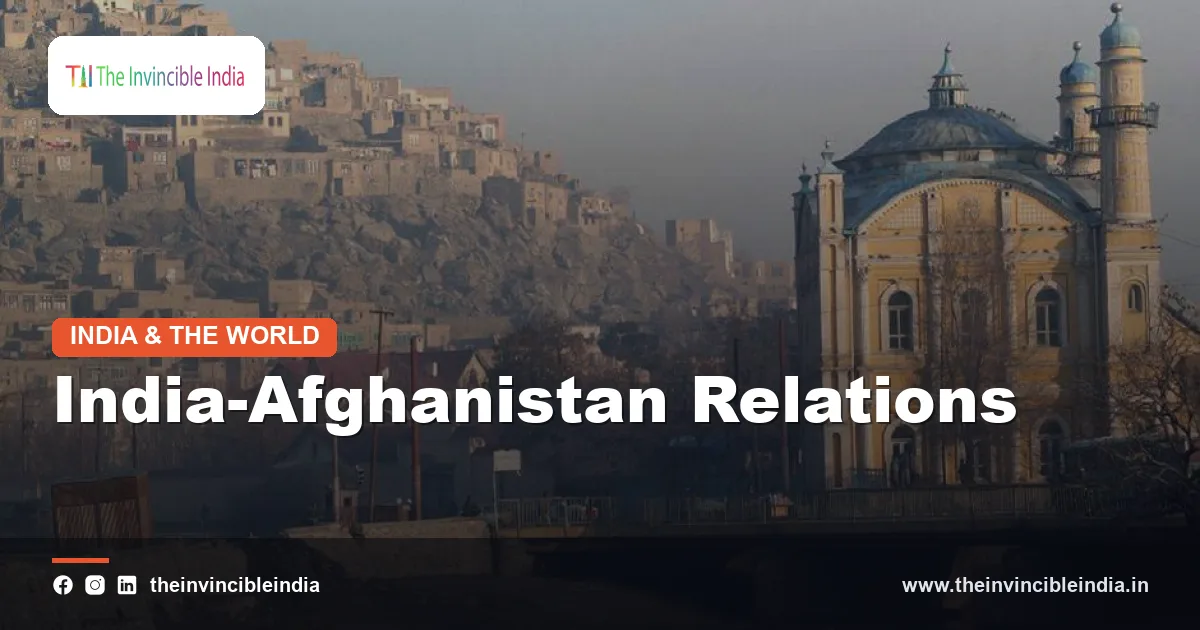
India-Afghanistan relations stretch across more than two thousand years, from the Buddhist monasteries of Bamiyan and the ancient kingdom of Gandhara to modern highways, dams and a Parliament building built with Indian assistance. The two countries are separated by a mountainous stretch of territory that is today under Pakistani administration, yet trade routes, pilgrims, soldiers, scholars and musicians have connected the Indian subcontinent and the Afghan plateau for centuries.
In the modern era the relationship has moved through several distinct phases: friendly diplomacy in the decades after independence, difficult years during the Soviet intervention and civil war, a long period of reconstruction partnership after 2001, and a cautious, humanitarian-led engagement since the change of power in Kabul in August 2021. This explainer sets out the history, the development projects, the Chabahar connectivity route and the more recent shifts in a factual and even-handed way.
| Quick Facts: India-Afghanistan Relations | |
|---|---|
| Formal bilateral treaty | Treaty of Friendship signed in 1950, soon after Indian independence |
| Strategic framework | Strategic Partnership Agreement signed in October 2011 |
| Flagship road project | Zaranj-Delaram highway in south-western Afghanistan, completed in 2009 |
| Flagship dam project | Salma Dam on the Hari Rud river in Herat, inaugurated in 2016 as the Afghan-India Friendship Dam |
| Flagship building | Afghan Parliament building in Kabul, inaugurated in December 2015 |
| Connectivity route | Chabahar Port in Iran, a sea-and-land gateway that avoids Pakistani territory |
| Cultural links | Gandhara art, Buddhism, Sufism, Hindustani classical music, Bollywood and cricket |
| Change of power in Kabul | 15 August 2021, followed by evacuation of Indian diplomatic staff |
Ancient, Medieval and Colonial Roots
The earliest links between the two regions lie in the Indus-Hindu Kush world. Archaeological finds suggest that the Harappan civilisation maintained a trading outpost at Shortugai in northern Afghanistan, which was prized for lapis lazuli. Later, the region formed part of the Achaemenid world and then of the Mauryan empire, with Emperor Ashoka leaving rock edicts at Kandahar written in Greek and Aramaic.
Gandhara and Buddhism
Gandhara, covering parts of present-day eastern Afghanistan and north-western Pakistan, became a great centre of Buddhist learning and a school of sculpture that blended Indian and Hellenistic styles. The colossal Buddha statues of Bamiyan, carved into cliffs in the fifth and sixth centuries CE, were a wonder of the Buddhist world until their destruction in 2001. Pilgrims such as Xuanzang passed through the region on their way to India.
Turkic, Afghan and Mughal Eras
From the tenth century onward, dynasties based in Ghazni and later Ghor pushed into the Indian plains, and the Delhi Sultanate absorbed many Afghan nobles and soldiers. Babur, the founder of the Mughal dynasty, came from Kabul and is buried there in a garden that still bears his name. Kabul and Kandahar remained key frontier cities for the Mughals, while the Afghan Lodi and Suri dynasties ruled Delhi in their own right. This long traffic of rulers, merchants and horses created deep and lasting social and linguistic exchange.
The Colonial Frontier and the Durand Line
In the nineteenth century, British India and Afghanistan became neighbours across a contested frontier. The Anglo-Afghan wars of 1839-42 and 1878-80 shaped Afghan politics, and in 1893 the Durand Line was agreed as the boundary between Afghanistan and British India. The line cut across Pashtun lands and remains a sensitive issue in Afghan-Pakistani relations to this day, which in turn shapes the strategic setting in which India deals with Kabul.
Culturally, the period also produced enduring images. Rabindranath Tagore’s short story Kabuliwala, written in the 1890s, portrayed an Afghan dry-fruit seller in Calcutta and became a lasting symbol of the affection between the peoples. Afghan traders had long been a familiar sight in Indian cities, and Indian traders, many of them Sikh and Hindu, lived in Afghan towns for generations.
Independent India, Soviet Intervention and the Taliban Era
Independent India and Afghanistan, 1947-1979
After Indian independence in 1947, the Treaty of Friendship of 1950 established a framework of peaceful relations. Afghanistan was among the countries that welcomed India’s non-aligned stance, and ties were warm under King Zahir Shah. Leaders including Jawaharlal Nehru and later Indira Gandhi maintained regular exchanges, and Afghan students began to study in Indian institutions in significant numbers.
A notable feature of this period was that Afghanistan, as a landlocked state, depended heavily on transit through Pakistan, and its relations with Pakistan were frequently strained over the Durand Line and the Pashtunistan question. India, with its own difficult relationship with Pakistan, found a natural partner in Kabul on many diplomatic matters, though both countries were careful to describe the relationship as one of friendship rather than alliance. Indian engineers, teachers and doctors worked in Afghanistan throughout these decades, and cultural institutions such as the Indian Council for Cultural Relations were already active.
Soviet Intervention and Civil War
The Soviet military intervention of December 1979 transformed Afghanistan. India, which had a close relationship with the Soviet Union, did not endorse the Western and Pakistani-backed resistance, and it continued to maintain relations with the Kabul government through the 1980s, including during the presidency of Najibullah. After the Soviet withdrawal in 1989 and the collapse of the Najibullah government in 1992, Afghanistan fell into a prolonged civil war.
The Taliban Government of the 1990s
When the Taliban took control of Kabul in 1996, India did not recognise their government and closed its embassy. It supported the opposition grouping known as the United Front, or Northern Alliance, with humanitarian and limited logistical assistance, and it worked with Iran and Russia to coordinate on the situation. A major episode came in December 1999, when Indian Airlines flight IC-814 was hijacked and flown to Kandahar, a crisis that deeply influenced Indian security thinking about Afghan territory.
Humanitarian Work Continues
Even in those years, India continued small-scale humanitarian work, including support for children’s hospitals and artificial-limb camps, a theme that would recur later. The events of September 2001 and the subsequent international intervention led to the fall of the Taliban government and opened a new chapter.
Reconstruction Partnership After 2001
After the Bonn Agreement of December 2001, India reopened its embassy in Kabul and re-established consulates in Kandahar, Herat, Jalalabad and Mazar-i-Sharif. It became one of the largest regional donors to Afghan reconstruction, with a development portfolio covering hundreds of projects across all the provinces. India’s declared approach was to support Afghan-led and Afghan-owned development rather than to send troops, and it emphasised projects that directly improved daily life.
In October 2011 the two governments signed a Strategic Partnership Agreement, the first such agreement Afghanistan concluded with any country. It covered political and security cooperation, trade and economic ties, capacity building and education, and social and cultural exchanges. Among other elements, India agreed to help train Afghan police and army personnel and to invite Afghan officers to its military academies.
India’s Development Footprint
India’s assistance spans infrastructure, health, education, agriculture and capacity building. The most visible projects are described below, followed by a summary table.
The Afghan Parliament Building
The new Parliament complex in Kabul was built with Indian funding and designed to include domes and arches in a contemporary style, with a block named after Atal Bihari Vajpayee. It was inaugurated by Prime Minister Narendra Modi in December 2015 and was widely presented as a symbol of India’s support for Afghan democratic institutions of that time.
The Salma Dam, or Afghan-India Friendship Dam
The Salma Dam, in Herat province on the Hari Rud river, is a hydroelectric and irrigation project. Construction was delayed repeatedly because of security difficulties, and it was formally inaugurated in 2016 by the Indian Prime Minister and the then Afghan President. The dam provides electricity generation and irrigation water for farmland in western Afghanistan.
The Zaranj-Delaram Highway
The road, roughly 200 kilometres long, connects Zaranj, near the Iranian border, with Delaram on the main ring road. It was built by India’s Border Roads Organisation, with the loss of several Indian and Afghan lives to attacks during construction, and completed in 2009. Its strategic value is that it gives Afghanistan a route towards Iranian ports.
Other Notable Projects
- Restoration of the historic Stor Palace in Kabul, which now serves as a ministry building
- A power transmission line from Pul-e-Khumri to Kabul, bringing electricity from Central Asian sources
- Support for the Indira Gandhi Institute of Child Health, a major paediatric hospital in Kabul
- Mobile health clinics, ambulances, buses and vehicles for city transport
- Support for the Habibia High School and other educational institutions
- Small development projects at the community level in many provinces, covering schools, water supply and clinics
| Project | Sector | Location |
|---|---|---|
| Parliament building | Governance | Kabul |
| Salma Dam | Power and irrigation | Herat province |
| Zaranj-Delaram highway | Roads and connectivity | Nimroz and Farah provinces |
| Pul-e-Khumri transmission line | Power | Baghlan to Kabul |
| Stor Palace restoration | Heritage | Kabul |
Scholarships, Training and Humanitarian Aid
People-to-people links have been a central pillar of the partnership. Under programmes run by the Indian Council for Cultural Relations and the Ministry of External Affairs, thousands of Afghan students have received scholarships to study at Indian universities, and a large number of Afghan civil servants, teachers and professionals have attended training courses under the Indian Technical and Economic Cooperation programme. Afghan students form one of the longer-standing foreign student communities in Indian universities.
Humanitarian Assistance
India has repeatedly sent food, medicines and vaccines. Wheat shipments, supplies of pulses, and high-protein biscuits for school children have featured in different periods, and during the COVID-19 pandemic India dispatched medicines and vaccines. India also supported the Jaipur Foot programme, which has provided artificial limbs to large numbers of amputees.
Culture and Sport
Bollywood films and songs enjoy a devoted following in Afghanistan, and many Afghan musicians trained in Indian classical traditions, with a historic link to the Patiala gharana. Cricket grew in popularity among Afghans, and India offered facilities for the national team, including a home ground at one time in Greater Noida and a training base in Dehradun.
The Chabahar Connectivity Route and Trade
Afghanistan is landlocked, and the most direct route from India to Afghanistan passes through Pakistan. Since Pakistan has restricted transit for Indian goods, India looked to Iran for an alternative. The answer was the port of Chabahar, on the Gulf of Oman in south-eastern Iran, which lies outside the Strait of Hormuz and is relatively accessible from India’s west coast.
Why Chabahar Matters
- It gives India sea access to Afghanistan and Central Asia without crossing Pakistani territory
- It links up with the Zaranj-Delaram highway, which carries goods deeper into Afghanistan
- It can connect with the International North-South Transport Corridor, a multi-modal route linking India, Iran, the Caucasus and Russia
- It offers Afghanistan an additional outlet to world markets
Milestones
India, Iran and Afghanistan signed a trilateral transit agreement in May 2016 during a visit by the Indian Prime Minister to Tehran. An Indian company later began operating a terminal at the Shahid Beheshti port, and the first shipments of wheat for Afghanistan passed through it in 2017. The project also envisages a rail line from Chabahar towards Zahedan. Progress has been affected over the years by international sanctions on Iran, financing questions and regional conditions, but the port remains a central element of India’s connectivity thinking, and both countries have used it for aid deliveries.
Trade and the Air Freight Corridor
Bilateral trade historically consisted of Indian exports of pharmaceuticals, sugar, textiles, tea and machinery, and Afghan exports of dry fruits, fresh fruit, saffron and spices. Afghan dried fruits, especially almonds, raisins, figs and apricots, have a large Indian market. The transit limits imposed by Pakistan meant that overland trade was constrained, and so alternatives were developed.
In 2017, India and Afghanistan opened a dedicated air freight corridor between Kabul, Kandahar and Delhi, which allowed Afghan farmers to send perishable produce quickly to Indian markets. The corridor was a response to the transit difficulties and was meant to double as a symbol of connectivity beyond the land route. Trade continued in different forms in later years, but its volume has shifted with the changing political and banking circumstances.
Strategic and Security Dimensions
From the Indian perspective, a stable and independent Afghanistan matters because of concerns about terrorism, regional security and the stability of Central Asia. India has said it supports an Afghan-led peace and reconciliation process, and it has participated in regional forums, including the Heart of Asia process and the Moscow and Tehran formats on Afghanistan, as well as dialogues hosted by India itself with regional security advisers.
For Afghanistan, India has offered a counterbalance in its regional diplomacy, access to training and education, and a large non-military partnership. At the same time, the relationship has been complicated by the troubled bilateral relationship between India and Pakistan, by Afghan-Pakistani disputes over the border and by the actions of armed groups. Indian personnel and projects were targeted in several attacks, including a bombing at the Indian embassy in Kabul in 2008.
Developments Since 2021
In August 2021 the Afghan government collapsed as international forces completed their withdrawal, and the Taliban assumed control of Kabul. India temporarily closed its embassy and evacuated its diplomats and many nationals, together with some Afghan citizens, in a series of flights. India made clear that it was prioritising the safety of its nationals and of Afghans who sought to travel, and it adopted an emergency visa system for Afghans.
A Humanitarian-Led Approach
Since then India’s policy has been described by officials as one that is guided by the interests of the Afghan people. India has sent wheat, medicines, vaccines, winter clothing and relief supplies, sometimes by road through Pakistan under a special arrangement and sometimes through Chabahar. It has also sent aid after earthquakes. In 2022 India sent a technical team to its embassy premises in Kabul to coordinate assistance and to monitor aid distribution, and it participated in multilateral meetings concerning Afghanistan.
Continuing Contacts
India has not, as a matter of long-standing practice, taken positions on the internal politics of Afghanistan beyond calling for inclusive governance and for Afghan territory not to be used for terrorism. Contacts with the authorities in Kabul have continued at various levels, and the situation remains fluid, with the diplomatic status of missions and the question of formal recognition varying across countries. Readers should consult current official sources for the latest position.
Challenges and the Road Ahead
Several structural factors will shape the relationship in future. Afghanistan remains landlocked and dependent on its neighbours for trade. India has no direct land border with Afghanistan accessible for trade, so the Chabahar route and air links remain essential. Security conditions, sanctions regimes, banking restrictions and the humanitarian situation all influence what is possible.
- Connectivity: the pace of Chabahar and the rail link to Zahedan will affect trade options
- Humanitarian needs: food security, health and education continue to be priority areas
- Human capital: the fate of Afghan students and professionals trained in India
- Regional diplomacy: the interplay among Iran, Russia, Central Asia, China and Pakistan
- Protection of heritage: the preservation of shared Buddhist and Mughal-era sites
Conclusion
The history of India-Afghanistan relations is one of deep civilisational contact, repeated political upheaval and a lasting people-to-people bond. India’s development projects, from the Parliament building and the Friendship Dam to the Zaranj-Delaram road, remain among the most visible symbols of that bond, while Chabahar represents its connectivity aspiration. Whatever the changes in Kabul, the geography, history and shared interests of the two peoples ensure the relationship will remain a significant subject of regional affairs.
Frequently Asked Questions
What is the historical connection between India and Afghanistan?
The two regions have been linked since antiquity through trade, Buddhism, the Gandhara cultural sphere and later Turkic, Afghan and Mughal rule. Babur, the founder of the Mughal dynasty, came from Kabul. Literature such as Tagore’s Kabuliwala reflects these ties.
What major projects has India built in Afghanistan?
The best known are the Afghan Parliament building in Kabul, the Salma Dam, also called the Afghan-India Friendship Dam, in Herat, and the Zaranj-Delaram highway. India also built a power transmission line to Kabul, restored the Stor Palace and supported hospitals, schools and community projects.
Why is the Chabahar port important for India and Afghanistan?
Chabahar, in Iran, gives India a sea route to Afghanistan and Central Asia that avoids Pakistan. It connects with the Zaranj-Delaram road and with the proposed International North-South Transport Corridor. It has been used for shipments of wheat and other humanitarian supplies.
What was the 2011 Strategic Partnership Agreement?
Signed in October 2011, it was the first such agreement Afghanistan concluded with any country. It covered political and security cooperation, trade and economic ties, capacity building and education, and cultural exchange, and it formalised India’s role in Afghan reconstruction.
How did India-Afghanistan relations change after 2021?
After the change of power in Kabul in August 2021, India evacuated its diplomats and nationals and paused its previous development-led partnership. It has since focused on humanitarian assistance, such as food, medicines and vaccines, and has maintained contacts through a technical presence and multilateral meetings.
Does India have scholarships for Afghan students?
Yes. For many years India has offered scholarships through the Indian Council for Cultural Relations and other schemes, and thousands of Afghan students have studied at Indian universities. Afghan professionals have also attended training courses in India.


