

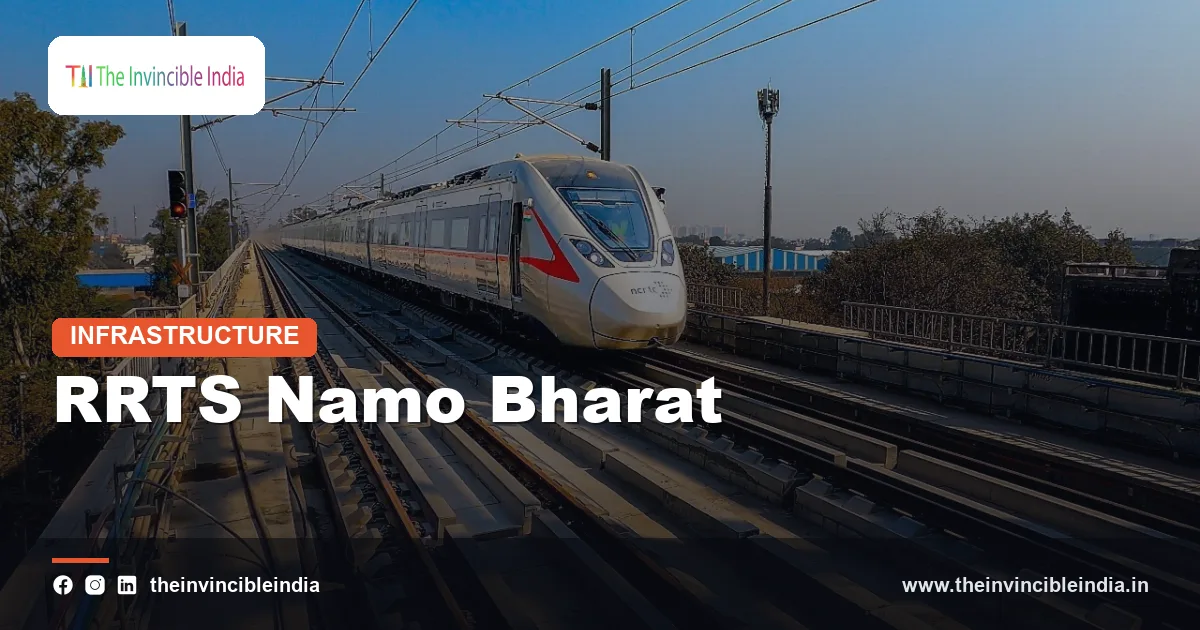
The RRTS, or Regional Rapid Transit System, is India’s first dedicated high-speed regional commuter rail network, designed to link the cities of the National Capital Region with fast, frequent, air-conditioned trains. It sits between a city metro and a long-distance train: it is faster and stops less often than a metro, but it is built for daily commuters rather than for overnight travellers. The first corridor connects Delhi, Ghaziabad and Meerut, and the trains that run on it are branded Namo Bharat.
The idea behind RRTS is simple: if people can reach the capital’s job centres, colleges, hospitals and markets in an hour or less from a town 60 or 80 kilometres away, they do not need to crowd into Delhi itself. That in turn can reduce road congestion, ease pressure on housing, and spread economic opportunity across a wider region. This article explains how the system is organised, how it differs from a metro, what the Delhi-Ghaziabad-Meerut corridor looks like and how the project fits into the larger vision of regional mobility.
| Quick Facts: RRTS and Namo Bharat | |
|---|---|
| Full name | Regional Rapid Transit System (RRTS) |
| Implementing agency | National Capital Region Transport Corporation (NCRTC), set up in 2013 |
| First corridor | Delhi-Ghaziabad-Meerut, roughly 82 kilometres |
| Foundation stone of first corridor | 8 March 2019, at Ghaziabad |
| Train brand | Namo Bharat (earlier known as RapidX) |
| Design speed | 180 km/h, with a typical operating speed of about 160 km/h |
| First operational stretch | Sahibabad to Duhai, opened in October 2023 |
| Track gauge | Standard gauge, 1435 mm |
| Power supply | 25 kV AC overhead electrification |
What Is the Regional Rapid Transit System?
The Regional Rapid Transit System is a concept for fast, high-capacity rail travel across a city region. Many large metropolitan areas around the world run such services, which are often known as regional express or suburban express rail. They are intended for trips of 30 to 150 kilometres, using trains that accelerate rapidly, run at high speeds between widely spaced stations, and run at high frequency throughout the day.
In India, the RRTS is the first purpose-built system of this kind. The key features can be summarised as follows.
- Dedicated, fully separated tracks, so that trains are not delayed by other rail traffic
- High acceleration and a high maximum speed, with stations typically several kilometres apart
- Frequent services, with short gaps between trains at peak hours
- Modern signalling for safe operation at close intervals
- Integration with local metro, bus and railway services at major interchange stations
RRTS Compared with a Metro and Conventional Trains
It helps to understand where RRTS sits among urban and regional rail modes. A metro serves a dense urban area with stations around a kilometre apart and a top speed of about 80 to 90 km/h. Ordinary suburban trains share tracks with long-distance and freight trains, which limits their frequency and reliability. RRTS combines the dedicated corridor of a metro with the speed of an express train.
| Feature | Metro | RRTS | Conventional suburban or passenger trains |
|---|---|---|---|
| Typical station spacing | Around 1 km | Several km | Varies, often frequent stops |
| Top speed | About 80 to 90 km/h | Up to 180 km/h design speed | Typically lower, shared tracks |
| Track | Dedicated | Dedicated | Shared with other trains |
| Typical trip length | Within a city | Between cities in a region | Mixed |
| Frequency | High | High | Limited by traffic |
The National Capital Region Transport Corporation
The National Capital Region Transport Corporation, or NCRTC, was incorporated in 2013 as a joint venture of the Government of India and the governments of Delhi, Haryana, Rajasthan and Uttar Pradesh, with the Centre and the states holding equity in equal measure. Its task is to plan, design, finance, construct, operate and maintain RRTS corridors across the National Capital Region.
Why NCR Needs a Regional Transit Network
The National Capital Region covers Delhi and large parts of neighbouring states. Its towns such as Ghaziabad, Noida, Gurugram, Faridabad and Meerut have grown rapidly, and millions of people commute between them and the capital. Highways in the region are among the busiest in the country, and the dependence on cars and two-wheelers has contributed to congestion and air pollution. A fast rail alternative is expected to offer a cleaner, more predictable commute.
Funding
The corridors are financed through equity from the Centre and the states, together with loans from multilateral lenders and domestic sources, and, in some cases, land-based revenue. Several international development banks have extended loans for the first corridor. Because the project involves multiple governments, the joint-venture model was chosen to coordinate decisions and funding across state boundaries.
The Eight Planned RRTS Corridors
The idea of a regional rapid transit network for the capital emerged from the Regional Plan 2021 of the National Capital Region Planning Board, and was further developed in its Functional Plan on Transport for the National Capital Region. That plan identified eight corridors radiating out from Delhi, among them:
- Delhi-Gurugram-Shahjahanpur-Neemrana-Behror-Alwar (the Rajasthan axis)
- Delhi-Ghaziabad-Meerut
- Delhi-Sonipat-Panipat (extended towards Karnal)
- Delhi-Faridabad-Ballabhgarh-Palwal
- Delhi-Bahadurgarh-Rohtak
- Delhi-Shahdara-Baraut
- Further corridors proposed in the same plan, including links to Khurja and other regional towns
Out of these, three corridors, Delhi-Gurugram-Alwar, Delhi-Ghaziabad-Meerut and Delhi-Sonipat-Panipat, were given priority in the first phase. Of these the Delhi-Meerut corridor was the first to receive sanction and to go into construction. The others are at different stages of planning and approval, and readers should consult official sources for their current status.
The Delhi-Ghaziabad-Meerut Corridor
The Delhi-Ghaziabad-Meerut corridor is the pioneer RRTS line. It runs for roughly 82 kilometres, starting at Sarai Kale Khan in Delhi, passing through New Ashok Nagar, Anand Vihar, Sahibabad and Ghaziabad, and continuing along the Delhi-Meerut axis to Modinagar, Meerut and Modipuram at the Meerut end. The Union Cabinet approved the project in early March 2019, and the foundation stone was laid on 8 March 2019 at Ghaziabad.
Alignment and Structure
Most of the line is elevated, and it runs along existing transport corridors such as the national highway and the Delhi-Meerut Expressway, which reduces the need for fresh land acquisition. Within Meerut, a portion of the line is underground, and it includes a deep underground station in the heart of the city, because the dense old town left no room for an elevated structure. The Delhi end connects with the metro and mainline railway at Sarai Kale Khan, and the line also connects to other transport networks at Anand Vihar and other interchange points.
Number of Stations
The corridor has about 25 stations. The average distance between stations is far greater than on a metro, which is what permits the high operating speed. Depots and maintenance facilities are located along the route, with a main depot near Duhai.
Travel Time
Once the full line is operational, the journey time between Delhi and Meerut is expected to be around an hour, compared with several hours at times on congested roads. That is the main promise of the system.
Namo Bharat Trains
The trains were originally introduced under the name RapidX. In October 2023, ahead of the opening of the first section, they were rebranded as Namo Bharat. They are built by Alstom at its Savli plant in Gujarat, in line with the policy of local manufacturing, and they are made of stainless steel with an aerodynamic design.
Design Speed and Performance
The trains have a design speed of 180 km/h and an operating speed of about 160 km/h. They accelerate and brake quickly, which is important for a service that must reach high speeds between relatively close stations. Trains are electric multiple units, powered through 25 kV AC overhead lines, and they use regenerative braking to return energy to the grid.
Passenger Features
- Fully air-conditioned coaches with wide gangways between coaches
- A premium coach with more spacious seating, in addition to standard coaches
- A coach reserved for women in each train
- Space for wheelchairs and priority seating for senior citizens and passengers with disabilities
- Luggage racks, mobile charging points and information displays
- Automatic doors, with platform screen doors at stations
- Ticketing through smart cards, mobile apps and the National Common Mobility Card
Signalling
The system uses a modern communication-based train control system, which allows the trains to run closely spaced yet safely and supports a high degree of automation. This is one of the main technological differences from conventional railway signalling.
Milestones and Opening
The first section to open was the 17-kilometre priority section between Sahibabad and Duhai, which was inaugurated in October 2023 and began carrying passengers a few days later. The service was then extended in stages, with a longer stretch opening in March 2024, and further sections have been progressively commissioned toward Meerut. Since the dates of subsequent extensions depend on construction progress, it is best to check official announcements for the current length in operation.
| Year | Milestone |
|---|---|
| 2013 | NCRTC incorporated to implement RRTS corridors |
| 2019 | Delhi-Ghaziabad-Meerut corridor approved and foundation stone laid |
| 2023 | First priority section from Sahibabad to Duhai opened; trains named Namo Bharat |
| 2024 | Service extended further beyond Duhai |
| Later | Progressive opening of the remaining stretches towards Meerut and Modipuram |
Integration with Other Transport
A regional railway is only effective if passengers can easily reach it and continue their journey. The plan therefore treats RRTS as a part of a wider network.
- At Sarai Kale Khan, passengers can transfer to the Delhi Metro, to mainline railway services at Hazrat Nizamuddin and to bus services at the interstate bus terminal
- At Anand Vihar and other stations, passengers can access the metro, the railway and the bus terminals
- In Meerut, a local metro-style service is meant to feed passengers to the Namo Bharat stations
- Last-mile services, including feeder buses, e-rickshaws and cycle facilities, are planned around stations
The principle of one ticket and one card for multiple modes, through the National Common Mobility Card, is meant to make transfers convenient.
Benefits and Regional Vision
The expected benefits of RRTS are wide-ranging. Faster commutes save time for daily travellers, and shifting people from private vehicles to rail is expected to reduce traffic, fuel use and emissions. Better connectivity may spread development to smaller towns, making it possible for people to live in a more affordable city and work in another.
Transit-Oriented Development
The planners aim to encourage compact, mixed-use development around stations, with housing, offices and services located within walking distance. This approach, called transit-oriented development, is meant to use land efficiently and to make stations into active neighbourhoods rather than isolated structures.
Environmental Considerations
Because the trains are electric and can be powered by increasing shares of renewable energy, the system is promoted as an environmentally friendlier alternative. NCRTC has also pursued measures such as solar panels at stations and depots, and the use of green building practices.
Challenges and the Road Ahead
Building a new type of rail system across multiple states involves practical difficulties. Land acquisition, utility shifting, work in dense urban areas, coordination between state agencies and the need for large capital investment are among the challenges. Passenger numbers and fares will also determine how well the system pays for its operations.
Looking ahead, other RRTS corridors are expected to follow, and the experience of the first line will inform them. Several other Indian metropolitan regions have also expressed interest in regional rapid rail, drawing on the experience of the National Capital Region. The success of the Delhi-Meerut line is therefore likely to influence how India plans its regional mobility for decades to come.
Conclusion
The RRTS represents a new category of public transport in India: a high-speed, high-frequency commuter rail that links cities within a region. With NCRTC as the implementing agency, the Delhi-Ghaziabad-Meerut corridor and the Namo Bharat trains show how dedicated tracks, modern signalling and regional planning can come together. As more sections open and more corridors are developed, the system is likely to change the way people live, work and travel across the National Capital Region.
Frequently Asked Questions
What does RRTS stand for?
RRTS stands for Regional Rapid Transit System. It is a high-speed commuter rail network designed to connect cities in the National Capital Region with fast, frequent trains running on dedicated tracks.
What is the NCRTC?
The National Capital Region Transport Corporation is the joint venture of the Government of India and several state governments that plans, builds and operates RRTS corridors. It was set up in 2013, with the Centre and the states sharing equity.
What are Namo Bharat trains?
Namo Bharat is the brand name of the electric trains that run on the RRTS network. They were earlier called RapidX. They are air-conditioned, have a design speed of 180 km/h and operate at around 160 km/h.
Which is the first RRTS corridor?
The first corridor connects Delhi, Ghaziabad and Meerut, over roughly 82 kilometres with about 25 stations. The foundation stone was laid in March 2019, and the first section between Sahibabad and Duhai opened in October 2023.
How is RRTS different from the metro?
The RRTS serves longer regional trips, with stations spaced several kilometres apart and a much higher top speed. A metro serves dense urban areas with closely spaced stations and a lower speed. Both run on dedicated tracks and the two networks are designed to connect.
How long will it take to travel from Delhi to Meerut?
When the entire corridor is operational, the journey is expected to take about an hour. The actual time depends on the services run and on the stations at which a train stops.


