

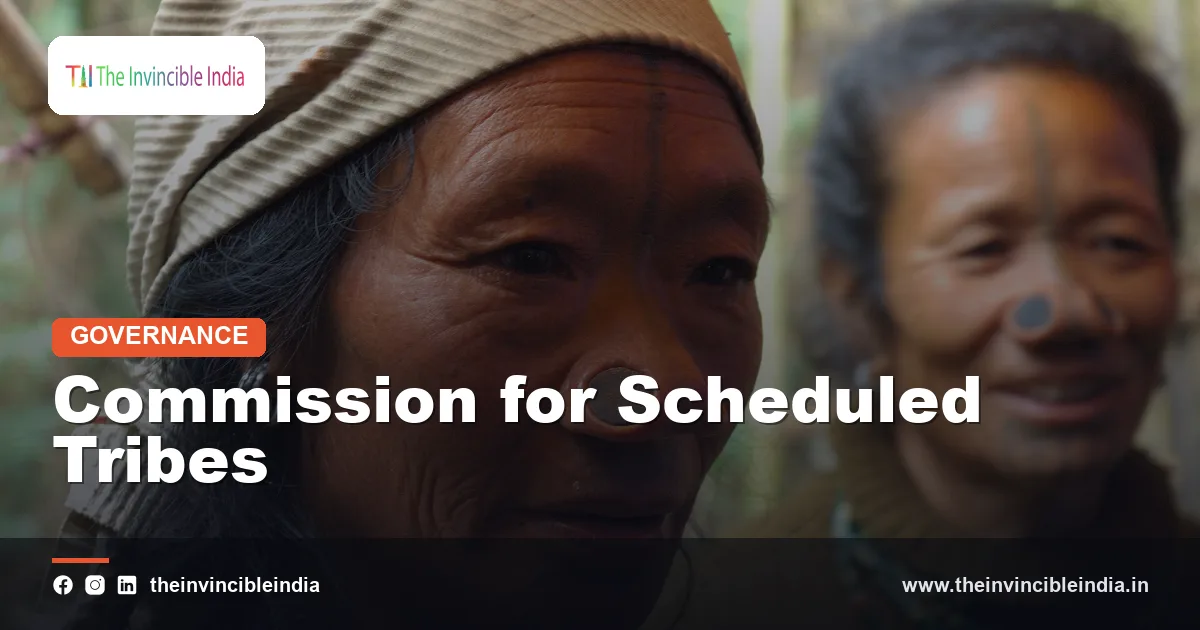
The National Commission for Scheduled Tribes (NCST) is a constitutional body set up to safeguard the rights, interests and welfare of the Scheduled Tribes of India. Created under Article 338A of the Constitution, it investigates complaints, monitors the working of protective provisions and advises the Union and the States on tribal development. Because it draws its authority directly from the Constitution rather than from an ordinary statute, its standing is considerably higher than that of a departmental advisory panel.
For more than five decades after Independence, the concerns of Scheduled Castes and Scheduled Tribes were watched over by a single mechanism. Growing recognition that the two communities faced very different problems, from land alienation and displacement in tribal regions to untouchability in caste society, led Parliament to split the arrangement. The result was a separate commission for tribes, whose structure, powers and functions are explained in this article.
Quick Facts
| Feature | Details |
|---|---|
| Legal basis | Article 338A of the Constitution of India |
| Created by | Constitution (Eighty-ninth Amendment) Act, 2003 |
| Came into being | 2004, after the National Commission for Scheduled Castes and Scheduled Tribes was bifurcated |
| Nature | Constitutional body |
| Composition | Chairperson, Vice-Chairperson and three other Members |
| Appointing authority | The President of India, by warrant under hand and seal |
| Powers in inquiries | Those of a civil court trying a suit |
| Reports to | The President, who lays them before Parliament |
| Administrative ministry | Ministry of Tribal Affairs (formed in 1999) |
Constitutional Background of Tribal Protection
The Constitution of India does not define a “tribe” in general terms. Instead, Article 366(25) describes Scheduled Tribes as those communities, or parts of communities, that are deemed to be Scheduled Tribes under Article 342. That article empowers the President, after consulting the Governor of the State concerned, to specify tribes by public notification for each State or Union Territory. Once a list is notified, only Parliament can modify it by law.
Several other provisions form the wider safety net around the Commission’s work:
- Article 15(4) permits special provisions for the advancement of socially and educationally backward classes, including Scheduled Tribes.
- Article 16(4) and 16(4A) allow reservation in public employment and, in certain cases, in promotions.
- Article 46, a Directive Principle, directs the State to promote the educational and economic interests of weaker sections and protect them from social injustice and exploitation.
- Articles 330 and 332 reserve seats in the Lok Sabha and State Legislative Assemblies.
- Article 335 requires that claims of these communities be considered consistently with the maintenance of administrative efficiency.
- Article 244 with the Fifth and Sixth Schedules provides for special administration of tribal areas.
The NCST sits on top of this framework as an oversight institution that checks whether these promises are actually being honoured on the ground.
From a Special Officer to Two Separate Commissions
The history of the Commission is the history of how India has chosen to monitor the welfare of its most historically disadvantaged groups. In the original Constitution, Article 338 provided for a Special Officer, designated the Commissioner for Scheduled Castes and Scheduled Tribes, who reported to the President. The Commissioner’s reports were laid before Parliament, but the office had no commission-like authority.
The 1990 Change
The Constitution (Sixty-fifth Amendment) Act, 1990 replaced the single Special Officer with a multi-member National Commission for Scheduled Castes and Scheduled Tribes. The new body began functioning in the early 1990s and was given wider monitoring and inquiry duties.
The 2003 Bifurcation
The Constitution (Eighty-ninth Amendment) Act, 2003 went a step further. It amended Article 338, so that it applied only to Scheduled Castes, and inserted a fresh Article 338A dealing solely with Scheduled Tribes. The separation took practical effect in 2004, when two independent commissions were constituted. The reasoning was straightforward: the problems of forest-dwelling and hill communities, such as loss of land, displacement by projects, shifting cultivation and access to forest produce, differed sharply from the problems tackled by the Scheduled Castes Commission, and each deserved focused attention.
Composition and Appointment
Under Article 338A(1) and (2), the Commission consists of a Chairperson, a Vice-Chairperson and three other Members. All of them are appointed by the President by warrant under hand and seal. The conditions of service and tenure of office are determined by the President through rules. In practice, the rules fix a fixed term of office, and the terms of appointment have been designed to give members a measure of independence from the day-to-day executive.
Rank and Status
By long-standing administrative arrangement, the Chairperson enjoys a status comparable to that of a Union Cabinet Minister, the Vice-Chairperson that of a Minister of State, and each Member that of a Secretary to the Government of India. This gives the Commission the protocol standing needed to call senior officials to account.
Support Staff and Offices
The Commission is headquartered in New Delhi and operates through a secretariat headed by a Secretary. It has been supported by regional offices so that tribal citizens living far from the capital can approach it with their grievances. The secretariat handles complaints, prepares investigation papers, coordinates field visits and drafts reports.
Functions Under Article 338A(5)
The core duties of the Commission are listed in clause (5) of Article 338A. They fall into several clear categories:
- To investigate and monitor all matters relating to the safeguards provided for Scheduled Tribes under the Constitution or any other law, or under any government order, and to evaluate how those safeguards are working.
- To inquire into specific complaints about the deprivation of rights and safeguards of Scheduled Tribes.
- To participate and advise in the planning process of socio-economic development of Scheduled Tribes and to evaluate the progress of their development under the Union and any State.
- To present to the President, annually and at other times as it considers appropriate, reports on the working of those safeguards.
- To make recommendations in such reports about measures that should be taken by the Union or any State for the effective implementation of safeguards and for the protection, welfare and socio-economic development of Scheduled Tribes.
- To discharge such other functions in relation to the protection, welfare, development and advancement of Scheduled Tribes as the President may specify, subject to any law made by Parliament.
Together, these tasks make the NCST both a watchdog and an adviser. It does not run welfare schemes itself; it examines whether those run by the government reach the people for whom they are meant.
Additional Functions Assigned by the President
Using the residual power in Article 338A(5)(f), the President issued a specification in 2005 that expanded the Commission’s remit to subjects of particular importance in tribal life. These included measures to ensure the following:
- Tribal rights over minor forest produce, as owners of such produce.
- Rights over mineral resources, water resources and similar assets, as provided by law.
- Measures for the development of tribals and for more viable livelihood strategies.
- Steps to improve the efficacy of relief and rehabilitation for tribal groups displaced by development projects.
- Prevention of alienation of tribal people from land and effective rehabilitation of those already alienated.
- Elimination of the practice of shifting cultivation, which causes loss of forest, and ensuring the well-being of those who practise it.
- Full implementation of provisions relating to the Panchayats (Extension to the Scheduled Areas) Act, 1996.
- Measures to secure full participation of tribal communities in the management of forest, protection and regeneration.
This list shows how closely the Commission’s agenda is tied to land, forests and livelihoods, the three issues that matter most in tribal regions.
Oversight of the Fifth and Sixth Schedules
The Constitution recognises that tribal areas need a different kind of administration from the rest of the country. The Fifth Schedule, operating through Article 244(1), applies to Scheduled Areas and Scheduled Tribes in States other than Assam, Meghalaya, Tripura and Mizoram. It gives the Governor special powers to regulate the transfer of tribal land and to direct that central or State laws shall not apply, or shall apply with modifications, in such areas. Tribes Advisory Councils advise the Governor on tribal welfare.
The Sixth Schedule, linked with Articles 244(2) and 275(1), covers tribal areas in Assam, Meghalaya, Tripura and Mizoram. It creates Autonomous District Councils and Regional Councils with legislative, judicial and executive powers over matters such as land use, forest management other than reserved forests, village administration and inheritance.
The Commission’s Role
The NCST examines whether the Governor’s reports, Tribes Advisory Councils and district councils are functioning as intended. It can study complaints about the illegal transfer of land in Scheduled Areas, examine the allocation and use of funds for tribal sub-plans, and recommend corrective action to the Union and the States.
Forest Rights and the Law on Tribal Welfare
A major part of the Commission’s practical work involves the Scheduled Tribes and Other Traditional Forest Dwellers (Recognition of Forest Rights) Act, 2006. The Act sought to correct what Parliament described as a historical injustice by recognising the rights of forest-dwelling communities over land and forest resources they had used for generations. It recognises individual rights, community rights and the right to protect, regenerate and manage community forest resources, with the Gram Sabha playing the first role in the process.
The Commission also takes up matters under related laws:
- The Panchayats (Extension to the Scheduled Areas) Act, 1996, which strengthens the Gram Sabha in Fifth Schedule areas.
- The Scheduled Castes and the Scheduled Tribes (Prevention of Atrocities) Act, 1989, which protects members of these communities from specified offences and provides for special courts.
- Laws on land transfer and tribal land restoration enacted by individual States.
When it receives complaints about delays in recognising forest rights, wrongful eviction or denial of claims, the NCST can seek reports from district and State authorities, and make recommendations for review of rejected claims.
Civil-Court Powers and Inquiry Procedure
The NCST’s strength comes in large part from Article 338A(8). When the Commission investigates a matter or inquires into a complaint, it holds all the powers of a civil court trying a suit. In particular, it may:
- Summon and enforce the attendance of any person from any part of India and examine him on oath.
- Require the discovery and production of any document.
- Receive evidence on affidavits.
- Requisition any public record or copy of it from any court or office.
- Issue commissions for the examination of witnesses and documents.
- Deal with any other matter that the President may by rule determine.
How a Complaint Moves
A complaint, whether from an individual, a community organisation or taken up by the Commission on its own, is typically registered and examined by the secretariat. Where it appears to disclose a violation of tribal safeguards, the Commission may call for a report from the officials concerned, hold a hearing, visit the site and then recommend action. These recommendations are not binding judgments; the Commission cannot punish an officer. Its power lies in documentation, public scrutiny and the obligation on governments to respond.
Reports, Consultation and Accountability
Article 338A(5)(d) obliges the Commission to present reports to the President. Under Article 338A(6), the President must cause every such report to be laid before each House of Parliament, together with a memorandum explaining the action taken, or proposed to be taken, on the recommendations relating to the Union, and the reasons for non-acceptance, if any.
Where a report relates to a matter concerning a State government, a copy is forwarded to the State Governor, who causes it to be laid before the State Legislature with a similar memorandum, as provided in Article 338A(7). This two-level process ensures that both the Parliament and the State legislatures become aware of the findings.
Mandatory Consultation
Article 338A(9) requires the Union and every State government to consult the Commission on all major policy matters affecting Scheduled Tribes. This gives the Commission a seat at the table while decisions are being made, rather than only an opportunity to criticise them later.
Related Bodies
The Ministry of Tribal Affairs, formed as a separate ministry in 1999, is the nodal ministry for tribal development. The Commission is distinct from the ministry: the ministry designs and funds programmes, while the Commission evaluates them from outside the executive chain. A parallel arrangement exists for the Scheduled Castes under Article 338, and for socially and educationally backward classes under Article 338B, which was added by the Constitution (One Hundred and Second Amendment) Act, 2018.
Strengths, Limits and the Road Ahead
The NCST has several structural strengths. Its constitutional status protects it from being abolished by an ordinary law, its members have fixed terms, its civil-court powers help in gathering evidence, and its reports are placed before Parliament, which makes them public documents. The requirement of mandatory consultation on policy adds weight to its advice.
It also faces recognised limits. Its recommendations are advisory, so effectiveness depends on the willingness of governments to act. Tribal regions are geographically remote and diverse, with a large number of communities speaking different languages, which makes field monitoring demanding. Questions about land, forests and development projects often involve overlapping jurisdictions between Union ministries, State governments and local bodies. Observers and parliamentary committees have often stressed the need for adequate staff, field presence and timely action on the Commission’s reports.
Even so, the Commission remains the principal constitutional forum where tribal grievances can be heard, documented and carried to the highest levels of government.
Conclusion
The National Commission for Scheduled Tribes embodies a long-standing constitutional commitment: that communities historically living at the edges of mainstream development should have a dedicated institution watching over their rights. Born from the Eighty-ninth Amendment and Article 338A, it combines investigation, advice and reporting. Its civil-court powers, its mandate over land and forest issues, and its direct line to the President and Parliament make it a central pillar of India’s framework for tribal welfare, even though its power to persuade matters more than any power to compel.
Frequently Asked Questions
Which article of the Constitution establishes the National Commission for Scheduled Tribes?
Article 338A, inserted by the Constitution (Eighty-ninth Amendment) Act, 2003, establishes the National Commission for Scheduled Tribes. It lays down the composition, functions, powers and reporting obligations of the Commission. Article 338, in its amended form, now deals only with the Scheduled Castes.
Who are the members of the NCST and who appoints them?
The Commission consists of a Chairperson, a Vice-Chairperson and three other Members. All are appointed by the President of India by warrant under hand and seal. Their conditions of service and tenure are determined by rules made by the President.
What powers does the NCST have while inquiring into a complaint?
While investigating a matter or inquiring into a complaint, the Commission has all the powers of a civil court trying a suit. It can summon witnesses and examine them on oath, require production of documents, receive evidence on affidavit, requisition public records and issue commissions for examination of witnesses. Its findings are recommendations rather than binding orders.
How is the NCST different from the National Commission for Scheduled Castes?
Both were created when the combined commission was split in 2004, but they derive from different articles. The Scheduled Castes Commission functions under Article 338, while the Scheduled Tribes Commission functions under Article 338A. The tribes commission pays special attention to forest rights, land alienation, displacement and the Fifth and Sixth Schedule areas.
To whom does the NCST submit its reports?
The Commission presents its reports to the President, who must have them laid before both Houses of Parliament along with a memorandum on the action taken or proposed on its recommendations. Reports on matters concerning a State are sent to the Governor, who lays them before the State Legislature.
Does the NCST deal with forest rights?
Yes. Under the functions specified by the President in 2005 and under its general mandate, the Commission monitors the protection of tribal rights over forest produce and land, and the implementation of laws such as the Forest Rights Act, 2006. It can examine complaints about the rejection of claims, eviction and denial of community rights.
{“@context”:”https://schema.org”,”@graph”:[{“@type”:”FAQPage”,”mainEntity”:[{“@type”:”Question”,”name”:”Which article of the Constitution establishes the National Commission for Scheduled Tribes?”,”acceptedAnswer”:{“@type”:”Answer”,”text”:”Article 338A, inserted by the Constitution (Eighty-ninth Amendment) Act, 2003, establishes the National Commission for Scheduled Tribes. It lays down the composition, functions, powers and reporting obligations of the Commission. Article 338, in its amended form, now deals only with the Scheduled Castes.”}},{“@type”:”Question”,”name”:”Who are the members of the NCST and who appoints them?”,”acceptedAnswer”:{“@type”:”Answer”,”text”:”The Commission consists of a Chairperson, a Vice-Chairperson and three other Members. All are appointed by the President of India by warrant under hand and seal. Their conditions of service and tenure are determined by rules made by the President.”}},{“@type”:”Question”,”name”:”What powers does the NCST have while inquiring into a complaint?”,”acceptedAnswer”:{“@type”:”Answer”,”text”:”While investigating a matter or inquiring into a complaint, the Commission has all the powers of a civil court trying a suit. It can summon witnesses and examine them on oath, require production of documents, receive evidence on affidavit, requisition public records and issue commissions for examination of witnesses. Its findings are recommendations rather than binding orders.”}},{“@type”:”Question”,”name”:”How is the NCST different from the National Commission for Scheduled Castes?”,”acceptedAnswer”:{“@type”:”Answer”,”text”:”Both were created when the combined commission was split in 2004, but they derive from different articles. The Scheduled Castes Commission functions under Article 338, while the Scheduled Tribes Commission functions under Article 338A. The tribes commission pays special attention to forest rights, land alienation, displacement and the Fifth and Sixth Schedule areas.”}},{“@type”:”Question”,”name”:”To whom does the NCST submit its reports?”,”acceptedAnswer”:{“@type”:”Answer”,”text”:”The Commission presents its reports to the President, who must have them laid before both Houses of Parliament along with a memorandum on the action taken or proposed on its recommendations. Reports on matters concerning a State are sent to the Governor, who lays them before the State Legislature.”}},{“@type”:”Question”,”name”:”Does the NCST deal with forest rights?”,”acceptedAnswer”:{“@type”:”Answer”,”text”:”Yes. Under the functions specified by the President in 2005 and under its general mandate, the Commission monitors the protection of tribal rights over forest produce and land, and the implementation of laws such as the Forest Rights Act, 2006. It can examine complaints about the rejection of claims, eviction and denial of community rights.”}}]}]}


