

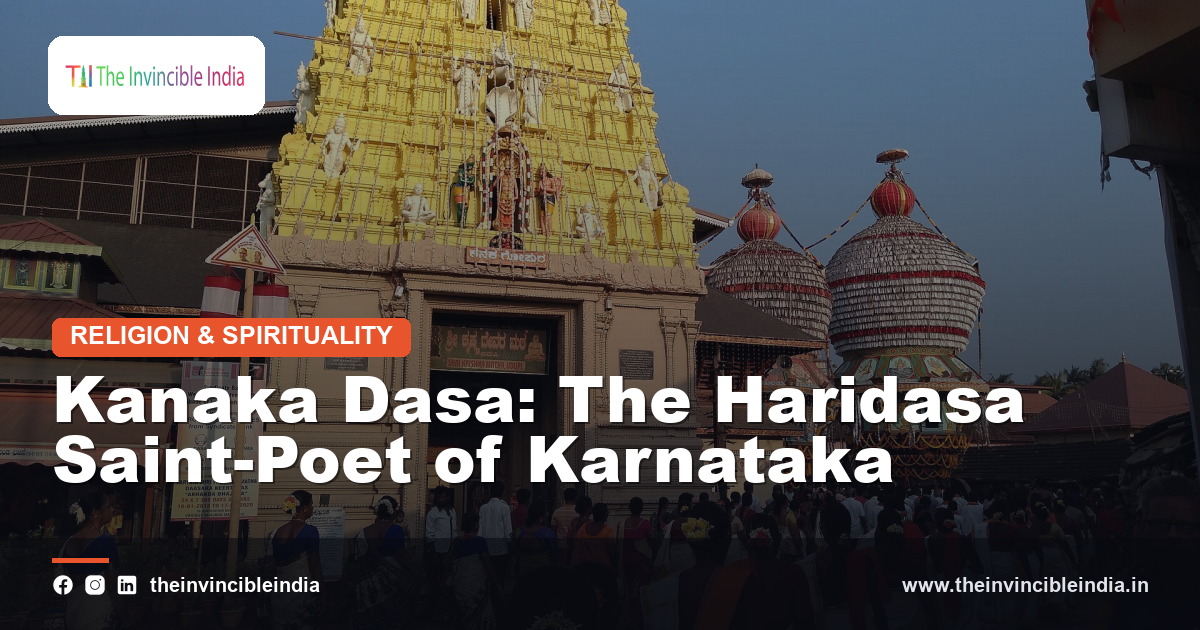
Kanaka Dasa is one of the most beloved saint-poets of Karnataka, a devotee of Krishna whose Kannada songs, stories and reflections have been sung and cherished for centuries. Belonging to the Haridasa tradition of wandering devotional poets, he is remembered for his humility, his sharp insight into human nature and his refusal to accept pride of birth as a measure of worth. Tradition links him with the Vijayanagara period, with the great teacher Vyasaraja and with the famed Krishna temple at Udupi, where a small window still bears his name. His work forms a cornerstone of Kannada devotional literature and a vital part of the wider Bhakti movement, and this guide examines his life, compositions, philosophy and the enduring affection in which he is held.
Quick Facts
| Detail | Information |
|---|---|
| Tradition | Haridasa (Vaishnava devotional poets of Karnataka) |
| Language | Kannada |
| Pen-name (Ankita) | Kaginele Adikeshava |
| Birthplace (traditional) | Bada village, near Bankapura, Haveri district |
| Guru (traditional) | Vyasaraja (Vyasatirtha) |
| Famous Works | Mohanatarangini, Nalacharitre, Haribhaktasara, Ramadhanyacharite |
A Saint-Poet of the Kannada Land
Kanaka Dasa occupies a special place in the cultural memory of Karnataka as a poet whose devotion and wisdom were expressed in the language of the people. His songs, known as kirtanas, are recited in homes and temples, taught in schools and performed on concert stages, and many of his sayings have entered everyday speech. He is celebrated as one of the foremost figures of the Haridasa movement, which used simple Kannada verse to teach devotion to Vishnu and Krishna. Details of his life come largely from tradition and from references within the later Haridasa literature, so some accounts are legendary in character. Even so, his personality emerges clearly from his own writings, which show a thoughtful, humorous and deeply sincere voice. The affection felt for him across Karnataka shows how a poet from humble origins can become a lasting spiritual and literary presence.
Origins and Early Life
According to tradition, Kanaka Dasa was born in the village of Bada, near Bankapura in the present-day Haveri district of Karnataka, into a family of the Kuruba community, which is traditionally linked with shepherding and the keeping of livestock. Early accounts say his name was Thimmappa Nayaka and that he rose to a position of local leadership, with responsibility for a region during the period of the Vijayanagara Empire. Such details are preserved in the oral and devotional tradition and are not documented in detail by contemporary records, so they should be read as traditional narrative. What remains consistent is the picture of a man of practical ability and standing who later turned his life toward devotion. His background among the working communities of the countryside gave his later poetry a grounded and compassionate perspective that continues to resonate.
The Turning Point
Devotional tradition tells that Kanaka Dasa experienced a profound change of heart that led him away from worldly power and toward a life of devotion and humility. A familiar story describes a moment of danger or loss that awakened his awareness of the transience of wealth and status, after which he is said to have sought refuge in the Lord. The account, like many in the lives of saints, is told in different ways and belongs to the realm of legend rather than documented history. Its meaning is nonetheless clear, for it expresses a movement from ambition to surrender that is a common theme in Indian devotional biography. After this change he took up the life of a wandering singer and devotee, adopting the name Kanaka, meaning gold, with the suffix Dasa, meaning servant of God. The new name signalled his dedication to humble service.
The Haridasa Tradition
The Haridasa movement of Karnataka consisted of devotional poets and singers who were servants of Hari, a name of Vishnu, and who carried the message of devotion in Kannada songs. Rooted in the dualist Madhva tradition, it nevertheless reached across all sections of society, and its poets came from many backgrounds. Earlier figures such as Narahari Tirtha and Sripadaraja helped lay its foundations, while Vyasaraja gave the movement important patronage and guidance at the Vijayanagara court. Among the leading names are Purandara Dasa, often called the father of Carnatic music, along with Kanaka Dasa, Vijaya Dasa, Gopala Dasa and Jagannatha Dasa. Their compositions combine devotion, ethical teaching and social observation in a direct, melodious form. Kanaka Dasa stands as one of the principal pillars of this tradition, and his work shows how it brought philosophy to the people in song.
Vyasaraja and the Vijayanagara Context
Tradition names Vyasaraja, also known as Vyasatirtha, the great Madhva scholar and spiritual adviser at the court of the Vijayanagara Empire, as the guru of Kanaka Dasa. Vyasaraja is remembered for his philosophical writings and for welcoming devotional poets from varied backgrounds into the fold of the movement. The Vijayanagara period was one of notable cultural flowering in the Deccan, supporting temples, music, literature and learning in several languages. Within this environment, a poet from a pastoral community could gain recognition and influence through devotion and talent. Accounts also describe the guru as appreciating the sincerity and depth of his disciple, though the stories of their interactions are part of tradition. The connection with Vyasaraja places Kanaka Dasa within a distinguished intellectual lineage while also illustrating the inclusive spirit of the Haridasa movement.
The Udupi Krishna Temple
Udupi, on the coast of Karnataka, is home to a famous Krishna temple associated with the Madhva tradition, and it has a central place in the story of Kanaka Dasa. The temple’s image of Krishna is served by a rotation of monastic institutions founded in the Madhva lineage, and the town is among the best-known pilgrimage destinations of the region. Tradition holds that Kanaka Dasa came to Udupi as a devotee and spent time in prayer and song near the sanctum. The temple’s rituals, including daily worship and festivals, form the background of many of his devotional compositions. For visitors today, the temple remains a living centre of devotion, with a culture of hospitality and music. The relationship between the poet and the sacred place has become one of the most cherished themes in the Haridasa heritage.
The Story of the Kanakana Kindi
A famous tradition relates that Kanaka Dasa was not permitted to enter the inner sanctum of the Udupi temple, and that he therefore stood outside singing to the deity with great devotion. The account says that the image of Krishna turned to face him, or that a gap appeared in the wall, so that he could see the Lord through a small opening. Today a small window in the temple wall, known as Kanakana Kindi, meaning Kanaka’s window, is shown to pilgrims, who look through it to see the image of Krishna. The story belongs to devotional tradition and is told as a lesson about sincere devotion overcoming barriers of social convention. Whatever its historical status, the narrative expresses a powerful moral about the equal worth of all devotees. The window itself has become a beloved symbol of the saint and a point of pilgrimage.
Kirtanas and the Ankita Kaginele Adikeshava
Kanaka Dasa composed a large number of kirtanas, which are devotional songs in Kannada, and he signed them with the pen-name Kaginele Adikeshava, referring to the form of Vishnu worshipped at the village of Kaginele. The use of an ankita, a signature in the closing verse, is a common feature of Haridasa composition and allows the songs to be identified with their author. His kirtanas range in subject from praise of the Lord to reflection on the nature of the world, the folly of pride and the need for humility. They are written in plain, flowing language that conveys deep ideas without elaborate ornament. Many have been set to music and are performed by singers across Karnataka and in the wider Carnatic tradition, where a number are widely sung. The ankita thus links each song with a particular place and a particular poet’s voice.
Mohanatarangini and Nalacharitre
Among the longer narrative poems attributed to Kanaka Dasa are the Mohanatarangini and the Nalacharitre, which show his skill in extended storytelling. The Mohanatarangini is a poem that deals with the story of Krishna and the city of Dvaraka in a manner that combines devotion with literary charm. The Nalacharitre retells the story of King Nala and Damayanti, familiar from the epic tradition, and it is admired for its narrative interest and moral reflection. These works demonstrate that the poet was not only a composer of devotional songs but also an accomplished literary artist capable of working in longer forms. Their language and style helped to enrich Kannada narrative poetry in the sixteenth century. Together they extend the poet’s reach beyond the temple into the broader sphere of Kannada literature, where they continue to be read and studied.
Haribhaktasara and Devotional Instruction
The Haribhaktasara is a didactic poem attributed to Kanaka Dasa that sets out the essence of devotion to Hari and offers guidance on the life of a true devotee. It is composed in a meter suited to recitation and teaches that devotion, humility and surrender are the real measures of spiritual worth rather than birth or learning. The work addresses themes such as the character of a devotee, the dangers of ego and the importance of remembering God in all circumstances. Because it is written in clear Kannada, it has been widely used for instruction in homes and communities. Its message echoes that of other Haridasa writings while bearing the distinctive stamp of Kanaka Dasa’s plain-spoken wisdom. The poem remains a valued text of the tradition, offering readers a concise and sincere account of the devotional ideal.
Ramadhanyacharite and the Question of Worth
The Ramadhanyacharite is among the most celebrated works attributed to Kanaka Dasa and is known for its imaginative allegory. It tells of a dispute between rice and ragi, two staple grains, each claiming to be the superior, and the story ends with divine judgment that honours the humble grain. The tale is generally understood as a parable that questions assumptions of superiority based on status, appearance or wealth, and it carries a social message about the dignity of ordinary people. Ragi is the staple of the poorer farming communities of the region, which gives the story added meaning. The poem is celebrated for its wit, its warmth and its insight into human attitudes. It has remained popular for generations and is frequently cited as an example of the poet’s gift for combining literary skill with moral purpose.
Critique of Caste and Pride
A recurring theme in the writings of Kanaka Dasa is the criticism of social pride, especially pride founded on caste and birth, which he treats as foolish in the face of the shared humanity and common dependence on God. His songs ask pointed questions about the value of status, challenging listeners to consider the qualities of the heart rather than the accidents of lineage. This message was particularly striking given his own background, and it resonated strongly with communities that experienced social exclusion. At the same time, his tone is not bitter but gently ironic, inviting reflection rather than resentment. The theme links him with other Bhakti poets across India who made similar appeals. Through his poetry, Kanaka Dasa contributed to a long conversation about equality and dignity that continues to have relevance in modern society.
Philosophy and Spiritual Message
The spiritual outlook of Kanaka Dasa is grounded in the devotional theology of the Madhva tradition, which holds Vishnu to be the supreme reality and teaches that grace and surrender lead the soul to liberation. Yet his songs are not technical treatises, and they present these ideas through images from daily life, stories and direct address to the Lord. He emphasizes humility, honesty, detachment from pride and wealth, and the sincere remembrance of God as the heart of religious life. His voice often combines tenderness with a keen wit, making profound ideas approachable. The message that devotion is open to everyone, whatever their station, is central to his teaching. In this way the poet translated philosophy into lived practice and offered his listeners a path that was both spiritually serious and warmly human.
Kaginele and the Kanaka Gurupeetha
Kaginele, in the Haveri district of Karnataka, is a village associated with the form of Vishnu named in the poet’s pen-name, Adikeshava, and it is closely linked with his memory. A temple of Adikeshava stands there, and the village has become a place of pilgrimage for admirers of the saint and for members of the community that honours him. An institution called the Kanaka Gurupeetha has been established at the place to carry forward his teaching and to serve the community through education and cultural activity. Devotees visit the site to pay respects, to participate in observances and to reflect on the poet’s message. Such sites show how the memory of a saint can create new religious and cultural institutions over time. Kaginele thus provides a physical home for the legacy of Kanaka Dasa, complementing his association with Udupi.
Kanaka Jayanti and Public Remembrance
The birth anniversary of Kanaka Dasa, known as Kanaka Jayanti, is observed in Karnataka as an occasion to honour the saint and to recall his teachings, and it is marked as a public observance in the state. Celebrations include processions, devotional music, lectures and cultural programmes, organized by communities, institutions and government bodies. Schools and colleges often hold events in which students learn about the poet’s life and recite his songs. The observance reflects the wide respect for the saint across communities and regions of Karnataka. It also serves as an opportunity to reflect on the values he stood for, such as equality, humility and devotion. Through such public remembrance, the saint’s message is brought to each new generation, and his place in the shared culture of the state is renewed year after year.
Influence on Music and Literature
The compositions of Kanaka Dasa have influenced both Kannada literature and the wider world of Indian music, particularly the Carnatic tradition, where Haridasa songs, known as devaranamas, form a respected repertoire. Singers regularly include his kirtanas in concerts, and some of his songs are widely known beyond the circle of specialists. In literature, his narrative poems and didactic works have been studied as important examples of sixteenth-century Kannada writing, and they have inspired later poets and scholars. His combination of simple language with depth of feeling has become a model for devotional verse. Folk performers, theatre artists and storytellers have also drawn on his tales and themes. The breadth of his influence shows that his work belongs not only to religious life but to the creative heritage of the entire region.
Kanaka Dasa and His Legacy Today
Today Kanaka Dasa is remembered across Karnataka as a saint-poet who spoke for devotion, dignity and wisdom in the language of ordinary people. His kirtanas continue to be sung in temples and concert halls, his narrative poems are studied by students of Kannada literature, and his window at Udupi draws pilgrims who come to honour his memory. Institutions at Kaginele and elsewhere maintain his teaching, while the annual Kanaka Jayanti renews public appreciation of his message. Scholars continue to examine the sources of his life and the texts attributed to him, while the tradition preserves the stories that give his memory warmth and meaning. The poet’s call for humility and equality retains great relevance in the modern world. Kanaka Dasa endures as a luminous voice of the Haridasa tradition and of Karnataka’s devotional heritage.
Sources & Further Reading
- Ministry of Culture, Government of India (indiaculture.gov.in).
- Sahitya Akademi, national academy of letters (sahitya-akademi.gov.in).
Frequently Asked Questions
Who was Kanaka Dasa?
Kanaka Dasa was a sixteenth-century saint-poet of Karnataka and a leading figure in the Haridasa tradition of devotional singers. He composed songs and poems in Kannada in praise of Krishna and Vishnu.
What is the Kanakana Kindi?
The Kanakana Kindi is a small window in the wall of the Udupi Krishna temple through which devotees view the deity. Tradition links it with the saint, who is said to have sung to the Lord from outside the sanctum.
What is Kanaka Dasa's pen-name?
His signature in the closing verse of his songs is Kaginele Adikeshava, referring to the form of Vishnu worshipped at the village of Kaginele. Such signatures are known as ankitas in the Haridasa tradition.
What are his best-known works?
Works attributed to him include the Mohanatarangini, the Nalacharitre, the Haribhaktasara and the Ramadhanyacharite, along with many kirtanas. The Ramadhanyacharite is especially famous for its parable of rice and ragi.
Who was his guru according to tradition?
Tradition names Vyasaraja, the Madhva scholar and spiritual adviser of the Vijayanagara court, as his guru. The details of their relationship are preserved in devotional accounts.


