

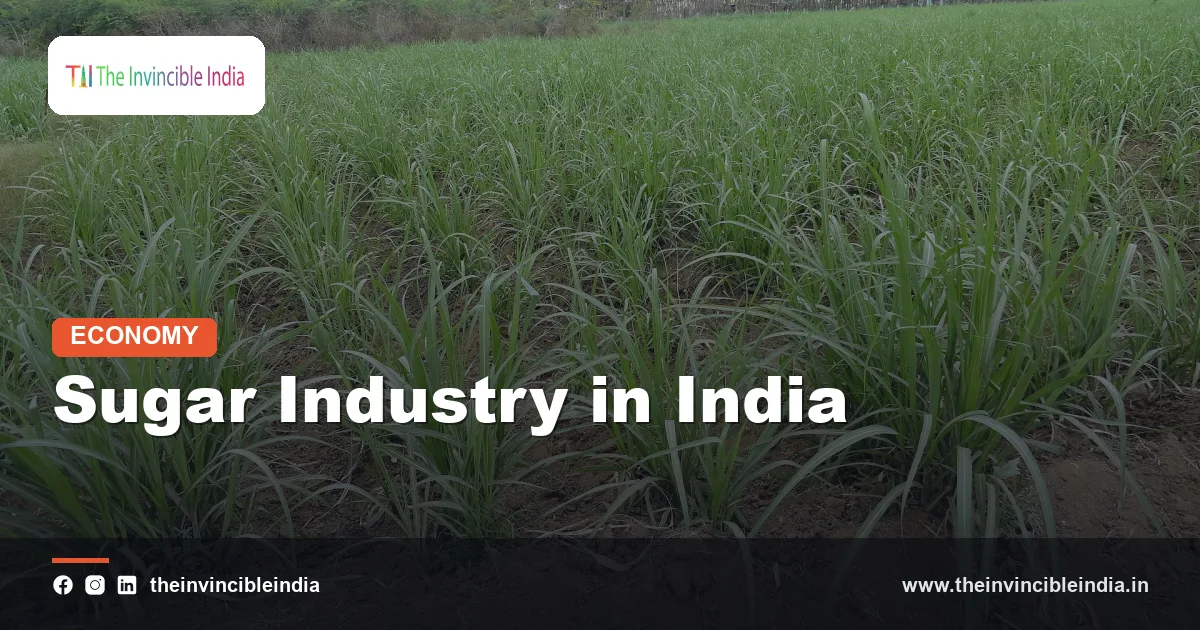
The sugar industry in India is one of the country’s oldest and most economically significant agro-based industries. India is among the two largest sugar producers in the world, alongside Brazil, and is also the largest single consumer of sugar, which makes the sector central to rural livelihoods, food security and, increasingly, energy policy. Millions of farming families grow sugarcane, and hundreds of mills crush it every year in a tightly regulated cycle.
This explainer walks through how the industry works: where sugarcane is grown, how the cooperative mill model evolved, how cane prices are fixed through the Fair and Remunerative Price (FRP) and State Advised Price (SAP), why payment arrears keep recurring, what by-products such as molasses, bagasse and ethanol add to the picture, and how the sugar-ethanol link is reshaping the sector.
Quick Facts
| Aspect | Detail |
|---|---|
| Global standing | Among the top two sugar producers in the world, and the largest consumer |
| Main cane-growing states | Uttar Pradesh, Maharashtra and Karnataka, followed by Tamil Nadu, Gujarat, Bihar, Andhra Pradesh and others |
| Sugar season | October to September (the “sugar year”), with crushing mostly from October-November to March-April |
| Cane price mechanism | Centrally fixed FRP; some states announce a higher State Advised Price |
| Key legal instruments | Essential Commodities Act, 1955; Sugarcane (Control) Order, 1966 |
| Ownership model | Cooperative, private and public-sector mills |
| Main by-products | Molasses, bagasse and press mud |
| Energy link | Ethanol from cane juice and molasses for blending in petrol; bagasse-based power |
A Brief History of Sugar in India
India has a very old relationship with sugarcane. The Sanskrit word sharkara, meaning grit or gravel and later crystallised sugar, is widely regarded as the root of the English word “sugar”. Ancient Indian texts refer to cane juice, jaggery (gur) and crystallised sugar, and techniques for refining cane juice into crystals are traditionally associated with the early centuries of the Common Era. From India, knowledge of sugar-making travelled to Persia, the Arab world and eventually Europe.
For most of history, sugar in India meant jaggery and khandsari, produced in small village units. Modern vacuum-pan factories arrived during the colonial period, and the protective tariff policy introduced in the early 1930s led to a rapid rise in the number of mills, particularly in eastern Uttar Pradesh and Bihar. After Independence, sugar was treated as a sector for planned development: licensing, controls on prices and distribution, and later the encouragement of cooperative mills in western India shaped the structure that exists today.
Milestones in the sector
- Early 1930s: tariff protection and the first major wave of modern sugar factories.
- 1950s: the first cooperative sugar mill in Asia was established at Pravaranagar (Loni) in Maharashtra, inspiring the cooperative movement in cane.
- 1955 and 1966: the Essential Commodities Act and the Sugarcane (Control) Order created the legal base for regulating cane and sugar.
- 1990s: partial delicensing of the industry.
- 2009-10: the Statutory Minimum Price of cane was replaced by the Fair and Remunerative Price.
- 2010s: partial decontrol of sugar, removal of the levy sugar obligation and a push towards ethanol.
Where Sugarcane Is Grown: The Main Cane Belts
Sugarcane is a long-duration, water-demanding crop that grows best in tropical and subtropical conditions with abundant sunlight, deep fertile soil and assured irrigation. India’s cane area is concentrated in two broad belts: the subtropical belt of the northern plains and the tropical belt of the peninsula.
Uttar Pradesh
Uttar Pradesh has the largest area under sugarcane in the country and is usually the top producer of cane and one of the top producers of sugar. Its mills are clustered in the western districts and in the Terai and eastern regions. The Ganga-Yamuna plains offer fertile alluvial soil and canal and tube-well irrigation, but winters are cooler and the sucrose content and recovery rate tend to be lower than in the south.
Maharashtra
Maharashtra is the heartland of the cooperative sugar movement. Mills in western Maharashtra and the Marathwada region draw on irrigation from major river systems. The state’s tropical climate gives relatively higher sugar recovery, and its output swings noticeably with monsoon performance, since drought years reduce cane availability sharply.
Karnataka and other states
Karnataka is a consistently large producer, especially in the northern districts around the Krishna basin and the Mandya region of the south. Tamil Nadu, Gujarat, Andhra Pradesh, Telangana, Bihar, Haryana, Punjab and Uttarakhand also grow cane and host mills, each with its own pricing and cane-purchase practices. Tropical states typically report higher recovery rates than northern states, which is one reason the peninsular belt is considered more efficient per tonne of cane crushed.
How a Sugar Mill Works
A sugar factory is essentially a seasonal processing plant that converts a perishable raw material into a storable product. Cane begins to lose sucrose soon after harvesting, so mills must crush it quickly, ideally within a day or two. This creates a strong link between farm and factory.
The production steps
- Cane preparation and milling: cane is shredded and passed through heavy rollers to extract juice, leaving fibrous residue called bagasse.
- Clarification: lime and heat remove impurities from the juice.
- Evaporation and crystallisation: the clear juice is concentrated into syrup and boiled in vacuum pans until sugar crystals form.
- Centrifuging and drying: crystals are separated from the thick liquid, which becomes molasses, then dried, graded and bagged.
The sugar recovery rate, meaning the quantity of sugar obtained from a given weight of cane, is a key efficiency measure. As a rough benchmark, a tonne of cane yields on the order of one-tenth of its weight as sugar, though this varies by region, variety, ripeness and season.
The Cooperative Mill Model
One of the most distinctive features of Indian sugar is the cooperative sector. In a cooperative mill, the cane growers are the members and shareholders. They supply cane to the mill, elect its board and share in its fortunes. The model took root in Maharashtra and Gujarat, spread to Karnataka and Tamil Nadu in some form, and is much less prominent in Uttar Pradesh and Bihar, where private mills dominate.
Why cooperatives mattered
Cooperative mills offered farmers an assured buyer, a processing facility they partly owned and a channel for credit, inputs and extension services. In western Maharashtra, they became engines of rural development, funding schools, hospitals, dairies and banks, and they had a lasting influence on regional economy and politics.
Challenges for cooperatives
- Ageing plant and machinery and lower crushing efficiency in some mills.
- Governance issues and uneven management quality.
- Heavy debt, which limits modernisation and delays cane payments.
- Competition from private mills that can invest in integrated distilleries and cogeneration plants.
The cooperative, private and public sectors together make up the three ownership categories. Over time, private mills have grown in share, particularly in Uttar Pradesh, while many cooperative mills have been restructured, leased or sold.
Cane Pricing: FRP and State Advised Price
Because the farmer cannot easily sell cane anywhere but the nearby mill, the price at which cane is purchased is regulated by the government. The framework has two layers.
Fair and Remunerative Price (FRP)
The FRP is the minimum price that mills must pay for cane. It is announced by the Union Government for each sugar season on the recommendation of the Commission for Agricultural Costs and Prices (CACP), after consulting state governments and other stakeholders. The FRP replaced the earlier Statutory Minimum Price (SMP) from the 2009-10 season. It is linked to a basic recovery rate, with a premium for higher recovery, and takes into account the cost of production, returns from alternative crops, the price of sugar and the reasonable margin for growers.
State Advised Price (SAP)
Some states, notably Uttar Pradesh, Punjab, Haryana, Uttarakhand and Tamil Nadu, announce their own State Advised Price, which is typically higher than the FRP. Mills are expected to pay the SAP in those states. The difference between FRP and SAP has long been a subject of dispute, since mills argue that a higher SAP is not matched by sugar realisations, while farmers press for better returns.
| Feature | FRP | SAP |
|---|---|---|
| Announced by | Union Government | State governments |
| Basis | CACP recommendation, cost of production, recovery rate | State-level considerations, often above FRP |
| Applies to | All mills across the country (as a floor) | Mills in the states that announce it |
| Legal anchor | Sugarcane (Control) Order, 1966 | State cane regulations |
The Cane Arrears Cycle
Under the Sugarcane (Control) Order, mills are required to pay farmers within 14 days of cane delivery, failing which interest becomes payable. In practice, delays are common, and the build-up of unpaid dues, known as cane arrears, is one of the most persistent problems in the sector.
How arrears build up
- Cane prices (FRP or SAP) are fixed at the start of the season, but sugar prices are market-driven and may fall during the season.
- When sugar output exceeds demand, prices fall below the cost of production and mills lose cash flow.
- Mills with heavy debt and little working capital pay farmers late.
- Unsold stock must be financed through bank loans, adding to the interest burden.
The boom-and-bust pattern
Sugarcane farming itself follows a cycle. High sugar prices encourage farmers to plant more cane, leading to a surplus a year or two later, lower prices, mill losses and arrears. Poor monsoons then cut the crop and prices recover, and the cycle begins again. Governments have responded with measures such as soft loans, buffer stocks, export incentives, a minimum selling price for sugar and, more recently, diversion of surplus cane to ethanol, which provides an alternative outlet and more predictable payments.
Regulation and Policy Tools
The sector has historically been among the most regulated in Indian agriculture. Since sugar is an essential commodity, the Centre and the states have used a mix of instruments to balance the interests of farmers, mills and consumers.
- Cane reservation and zoning: mills were assigned specific cane areas, and farmers were expected to supply to the mill of their zone. Rules on the minimum distance between mills were intended to protect cane supply but have been relaxed over time.
- Levy and release mechanism: earlier, mills had to sell a fixed share of sugar to the government at a lower price for the public distribution system, and the rest was sold in the open market under monthly release quotas. The levy obligation was removed in the early 2010s.
- Stock limits and export-import policy: the government may impose stock limits, restrict exports when domestic supply is tight, or allow exports with or without support when stocks are high.
- Minimum selling price (MSP) of sugar: introduced in 2018 as a floor on the price at which mills sell sugar, to help them meet cane dues.
- Buffer stock and financial support: interest subvention, soft loans and support for modernisation, including through the Sugar Development Fund.
Policy debates continue over whether the sector should be gradually deregulated, whether cane prices should be linked more closely to sugar and by-product revenues (a revenue-sharing approach was examined by an expert committee in 2012), and how to reduce the dependence on frequent administrative intervention.
By-Products: Molasses, Bagasse and Press Mud
A modern sugar mill is better described as a multi-product processing complex. Besides sugar, it produces valuable by-products that improve its finances and reduce waste.
Molasses
Molasses is the dark, viscous liquid left after sugar crystals are removed. It is the raw material for distilleries, producing industrial alcohol, potable alcohol and ethanol. Molasses also finds use in animal feed and in some chemical and yeast industries.
Bagasse
Bagasse is the fibrous residue left after juice extraction. Mills burn it as fuel to run their own boilers and turbines, and many sell surplus electricity to the grid under cogeneration arrangements. Bagasse is also used for making paper and board and, increasingly, for biodegradable tableware and other products.
Press mud and other residues
Press mud, the filter cake from juice clarification, is rich in organic matter and is used as a soil enrichment and in the preparation of compost and biogas. Distillery effluent, called spent wash, is a pollution concern and is increasingly treated or converted into biogas and potash-rich manure.
| By-product | Source | Main uses |
|---|---|---|
| Molasses | Liquid left after crystallisation | Ethanol, alcohol, animal feed |
| Bagasse | Fibre left after crushing | Boiler fuel, cogeneration power, paper |
| Press mud | Filter cake from clarification | Compost, soil conditioner, biogas |
| Spent wash | Distillery effluent | Biogas, treated manure |
The Sugar-Ethanol Link
Ethanol has become the most important new element in the economics of sugar. Because cane juice and molasses can both be fermented into ethanol, mills can choose how much cane to convert into sugar and how much to divert into fuel. This gives the sector a pressure valve that did not exist earlier.
Why the link matters
Under the national Ethanol Blended Petrol programme, oil marketing companies buy ethanol from producers at administered prices for blending with petrol. In 2018, the government allowed ethanol to be produced directly from cane juice and from B-heavy molasses, and introduced differential ethanol prices based on feedstock. Interest subvention schemes encouraged mills to set up or expand distilleries.
Benefits and concerns
- Surplus cane and sugar can be diverted, stabilising sugar prices and supporting mill cash flow.
- Faster payment of cane dues, since ethanol supply to oil companies brings assured and timely revenue.
- Reduced crude oil import dependence and lower tailpipe emissions.
- Concerns include the large water footprint of cane, regional concentration of cane in water-stressed areas and the competition between sugar, fuel and food crops.
The long-term direction of the sector is therefore towards integrated sugar-ethanol-power complexes, where the mill’s profitability depends on all three products.
Trade, Exports and Sugar Consumption
India’s sugar trade policy shifts with domestic production. In surplus years, the government has encouraged exports through export quotas and financial assistance, while in tight years it has restricted exports to protect domestic prices. Because India is both a major producer and a major consumer, even small changes in its policy can influence world prices.
Who consumes sugar
A major share of sugar is consumed not by households directly but by industry, including confectionery, sweets, beverages, bakery and pharmaceuticals. Household consumption remains significant, and India also has a large parallel market for jaggery and khandsari, which compete with white sugar in rural areas.
Global context
Brazil is the largest exporter of sugar and leans heavily on a flexible system in which mills can switch between sugar and ethanol according to relative prices. India, with its domestic demand and administered price structure, has historically been a swing player, exporting in some years and importing little. Trade-related disputes at the World Trade Organization over Indian support measures have been a recurring feature of the sector.
Economic and Social Importance
The sugar industry supports a vast rural economy. Millions of cane growers, harvest labourers, transport operators, mill workers and ancillary businesses depend on it. Mills are often located in rural areas and are among the largest employers and consumers of local goods and services there.
Rural development and politics
Cane belts enjoy relatively higher farm incomes than many dryland regions because the crop is assured of a buyer and a notified price. In several states, the governance of cooperative mills and the setting of cane prices are politically important issues, and cane growers’ associations play a strong role in policy debates.
Environmental and structural challenges
- Water stress: cane needs far more water than many competing crops, raising concerns in drought-prone areas.
- Productivity gaps: yields and recovery rates vary widely between states, leaving room for better varieties, drip irrigation and improved agronomy.
- Dependence on policy: farmers and mills are sensitive to changes in prices, export rules and support schemes.
- Labour conditions: seasonal migration of cane-cutting labourers raises welfare and education concerns for families.
The road ahead
The future of the sugar industry in India will probably be shaped by three trends. First, ethanol and cogeneration will keep reducing the sector’s dependence on sugar alone. Second, technology, including better cane varieties, drip and micro-irrigation, mechanised harvesting and digital cane management, can improve yields and reduce water use. Third, ongoing reforms in pricing and regulation may move the sector gradually towards a more market-linked and transparent system, while retaining protections for farmers.
Climate variability is another factor. Erratic monsoons, heat stress and changing rainfall patterns can swing cane output from year to year, which is why a more diversified product basket, good water management and predictable policy are widely seen as crucial for stability.
Conclusion
The sugar industry in India is a classic example of how agriculture, industry, policy and politics intersect. From the cane belts of Uttar Pradesh, Maharashtra and Karnataka to the cooperative mills that built rural institutions, and from the FRP and SAP debates to the cycle of arrears, the sector’s story is one of both resilience and recurring strain. With ethanol, cogeneration and by-product industries gaining ground, the mill of the future is likely to be an integrated energy and food processing hub rather than a sugar factory alone.
Frequently Asked Questions
Which states are the largest sugarcane producers in India?
Uttar Pradesh, Maharashtra and Karnataka are the three largest cane-growing and sugar-producing states. Tamil Nadu, Gujarat, Bihar, Andhra Pradesh, Telangana, Haryana and Punjab also have significant cane areas and mills. The ranking can change slightly from year to year depending on rainfall and cane availability.
What is the Fair and Remunerative Price (FRP) of sugarcane?
The FRP is the minimum price that sugar mills must pay to farmers for sugarcane. It is announced by the Union Government for each sugar season on the recommendation of the Commission for Agricultural Costs and Prices, and it replaced the earlier Statutory Minimum Price from 2009-10. It is linked to a basic sugar recovery rate, with a premium for higher recovery.
What is the State Advised Price (SAP)?
The State Advised Price is a cane price announced by some state governments, such as Uttar Pradesh, Punjab, Haryana, Uttarakhand and Tamil Nadu, which is usually higher than the FRP. Mills in those states are expected to pay the SAP, which has often been a source of disagreement between mills and governments.
Why do cane arrears keep building up?
Mills must pay for cane at government-fixed prices, but sugar sells at market prices that can fall below the cost of production in surplus years. When mills lack cash flow or carry heavy debt, they delay payment to farmers beyond the 14 days allowed under the Sugarcane (Control) Order. Boom-and-bust cycles in cane planting add to the problem.
What are the main by-products of the sugar industry?
The principal by-products are molasses, bagasse and press mud. Molasses is used to make ethanol, alcohol and animal feed. Bagasse is burned to generate electricity and steam, and is also used in paper-making, while press mud is used as compost and soil conditioner.
How is the sugar industry linked to ethanol blending?
Ethanol can be made from cane juice and molasses, so mills can divert part of their cane to fuel instead of sugar. Oil marketing companies buy this ethanol for blending with petrol under the Ethanol Blended Petrol programme. This reduces surplus sugar, helps mills pay farmers faster and lowers India’s dependence on imported crude oil.
{“@context”:”https://schema.org”,”@graph”:[{“@type”:”FAQPage”,”mainEntity”:[{“@type”:”Question”,”name”:”Which states are the largest sugarcane producers in India?”,”acceptedAnswer”:{“@type”:”Answer”,”text”:”Uttar Pradesh, Maharashtra and Karnataka are the three largest cane-growing and sugar-producing states. Tamil Nadu, Gujarat, Bihar, Andhra Pradesh, Telangana, Haryana and Punjab also have significant cane areas and mills. The ranking can change slightly from year to year depending on rainfall and cane availability.”}},{“@type”:”Question”,”name”:”What is the Fair and Remunerative Price (FRP) of sugarcane?”,”acceptedAnswer”:{“@type”:”Answer”,”text”:”The FRP is the minimum price that sugar mills must pay to farmers for sugarcane. It is announced by the Union Government for each sugar season on the recommendation of the Commission for Agricultural Costs and Prices, and it replaced the earlier Statutory Minimum Price from 2009-10. It is linked to a basic sugar recovery rate, with a premium for higher recovery.”}},{“@type”:”Question”,”name”:”What is the State Advised Price (SAP)?”,”acceptedAnswer”:{“@type”:”Answer”,”text”:”The State Advised Price is a cane price announced by some state governments, such as Uttar Pradesh, Punjab, Haryana, Uttarakhand and Tamil Nadu, which is usually higher than the FRP. Mills in those states are expected to pay the SAP, which has often been a source of disagreement between mills and governments.”}},{“@type”:”Question”,”name”:”Why do cane arrears keep building up?”,”acceptedAnswer”:{“@type”:”Answer”,”text”:”Mills must pay for cane at government-fixed prices, but sugar sells at market prices that can fall below the cost of production in surplus years. When mills lack cash flow or carry heavy debt, they delay payment to farmers beyond the 14 days allowed under the Sugarcane (Control) Order. Boom-and-bust cycles in cane planting add to the problem.”}},{“@type”:”Question”,”name”:”What are the main by-products of the sugar industry?”,”acceptedAnswer”:{“@type”:”Answer”,”text”:”The principal by-products are molasses, bagasse and press mud. Molasses is used to make ethanol, alcohol and animal feed. Bagasse is burned to generate electricity and steam, and is also used in paper-making, while press mud is used as compost and soil conditioner.”}},{“@type”:”Question”,”name”:”How is the sugar industry linked to ethanol blending?”,”acceptedAnswer”:{“@type”:”Answer”,”text”:”Ethanol can be made from cane juice and molasses, so mills can divert part of their cane to fuel instead of sugar. Oil marketing companies buy this ethanol for blending with petrol under the Ethanol Blended Petrol programme. This reduces surplus sugar, helps mills pay farmers faster and lowers India’s dependence on imported crude oil.”}}]}]}


