

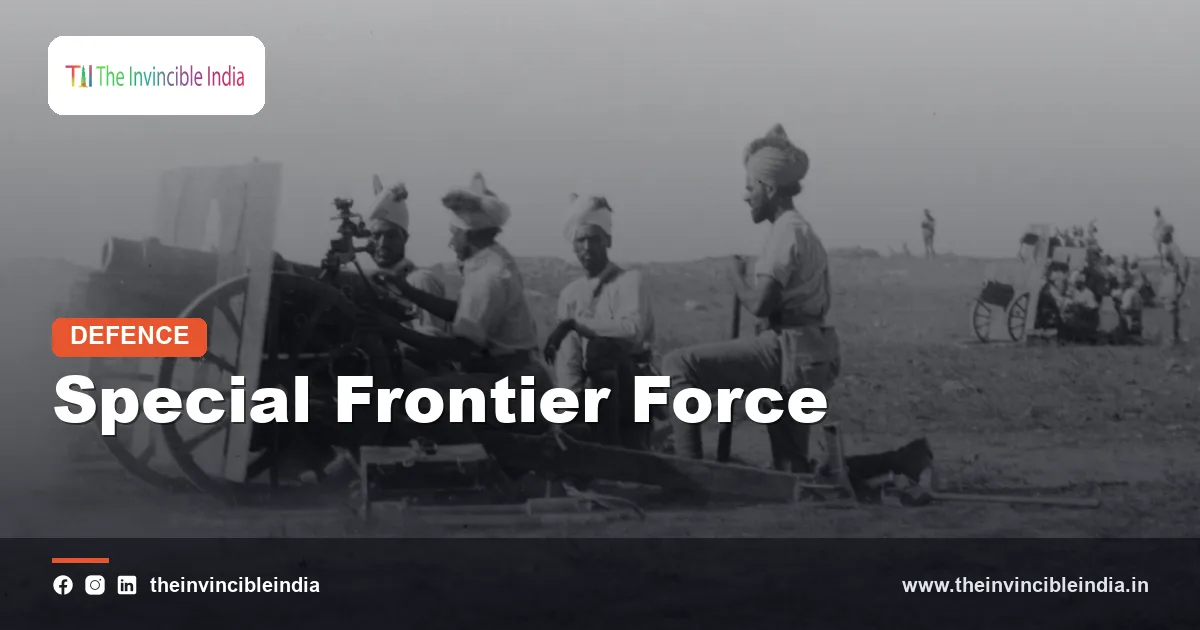
The Special Frontier Force (SFF) is one of India’s most unusual and least publicly discussed military formations. Raised in November 1962, in the immediate aftermath of the India-China war, it is a covert paramilitary special unit that was originally manned by Tibetan refugees living in India. Officially known as Establishment 22, and also called the Vikas Regiment or Vikas Battalion, the force sits outside the regular chain of the Indian Army and reports through the Cabinet Secretariat.
Because it is a secret organisation, very little about it appears in official documents. This explainer therefore confines itself to well-established public information: why the force was created, how it is organised and where it sits in India’s security architecture, how it is trained, who leads it, and what has become known over the decades through public records, memoirs and press reports. It deliberately avoids operational detail.
Quick Facts
| Aspect | Detail |
|---|---|
| Full name | Special Frontier Force (SFF) |
| Other names | Establishment 22; Vikas Regiment or Vikas Battalion |
| Raised | November 1962, after the India-China war |
| Original manpower | Tibetan refugees, widely referred to as Khampa and other Tibetan recruits |
| Administrative placement | Cabinet Secretariat, with a link to the Research and Analysis Wing (R&AW) |
| Head | Inspector General, a serving Army officer of Major General rank |
| Headquarters | Chakrata, in the Dehradun district of Uttarakhand |
| Character | Covert paramilitary special force; not part of the regular Army order of battle |
The Background: Tibet and the 1962 War
To understand the Special Frontier Force, one has to start with Tibet. In 1950, China moved troops into Tibet, and in 1959, following an uprising in Lhasa, the Dalai Lama crossed into India and was granted asylum. Tens of thousands of Tibetans followed him over the next years, settling in camps and later in organised settlements across India.
In October-November 1962, India and China fought a short but consequential war along their disputed Himalayan frontier, in Ladakh in the west and the then North-East Frontier Agency in the east. India suffered setbacks, and the conflict exposed gaps in intelligence, mountain warfare capability and preparedness. The war ended with a unilateral ceasefire declared by China in the latter part of November 1962. It was in this climate of rethinking that the idea of a specialised force drawing on Tibetan refugees took shape.
Why Tibetans?
Many refugees, particularly those from the eastern Tibetan regions of Kham and Amdo, were hardy, used to high-altitude terrain, and strongly motivated by loss of their homeland. They had experience of resistance against Chinese rule. Indian planners saw in them a manpower pool with natural skills for operating in mountain and frontier areas, and with a clear stake in the Himalayan contest.
Raising the Force in November 1962
The unit was created in November 1962 on the initiative of senior officials of the government, notably the then Director of the Intelligence Bureau, B. N. Mullik, with support from political leadership and the military. Biju Patnaik, a prominent political figure of the time who was known for his aviation experience, is widely reported to have played a part in the early thinking, and the first commander, Major General Sujan Singh Uban of the Army, became closely identified with the unit.
Why “Establishment 22”?
The name Establishment 22 is commonly explained by Uban’s earlier association with the 22 Mountain Regiment of the Army, an artillery unit from his career. The cover name signalled an administrative office rather than a fighting force. The term “Vikas”, meaning development, was used as a name for the unit’s battalions, again an understated label.
Original purpose
The force was originally conceived as a guerrilla and covert action capability that could operate behind Chinese lines in the event of a renewed conflict in the Himalayan region. In the early years, the plan involved training Tibetan volunteers in guerrilla warfare, intelligence gathering and mountain operations. Over time, as the strategic situation changed and a repeat of the 1962 conflict did not occur in the same form, the role of the force evolved.
Where the SFF Sits: Command and Control
The organisational placement of the SFF is one of its defining features. It is neither part of the Indian Army nor a Central Armed Police Force in the usual sense.
Early arrangement
In the early years, the force functioned under the Intelligence Bureau, which was then India’s main intelligence agency, with support from the Army for training and administration and with outside assistance in the Cold War context, which has been widely discussed in published accounts.
The Cabinet Secretariat and R&AW
After the creation of the Research and Analysis Wing in 1968 as India’s external intelligence agency, the SFF was placed under the Cabinet Secretariat, which houses R&AW. It operates under the Director General of Security, an appointment within the Cabinet Secretariat, and answers to the Prime Minister through the cabinet structure. This means it is not under the Ministry of Defence, even though its Inspector General is drawn from the Army.
- Not part of the regular Army chain of command.
- Administered by the Cabinet Secretariat.
- Linked with R&AW for intelligence and tasking.
- Headed by an Army Major General serving as Inspector General.
Leadership: The Inspector General
The SFF is headed by an Inspector General, a post held by a serving Army officer of Major General rank who is deputed to the force. The arrangement combines the discipline and professional military expertise of the Army with the secrecy and independence of an intelligence-linked organisation.
Command structure
Below the Inspector General, the force has been described in public sources as organised into battalion-sized units known as Vikas battalions, with officers from the Army and other services on deputation in the senior positions and Tibetan and other recruits forming the rank and file. Tibetan personnel have traditionally served in non-commissioned and junior positions in ranks with titles similar to those used in the Army.
Why a Major General?
Having a Major General in charge reflects the scale of the force, which is substantial enough to require a senior officer, and the need to coordinate closely with the Army, from which equipment, specialists and officers come. It also gives the organisation an easy interface with military planning.
Training and Capabilities
The SFF’s training base at Chakrata, a hill station in Uttarakhand, is the best-known fact about its institutional life. Chakrata’s altitude and terrain make it a natural location for mountain and high-altitude training.
What is publicly known
- Training reportedly includes parachuting and airborne skills, since the force was traditionally associated with paratrooper capabilities.
- Mountain warfare and high-altitude survival, reflecting its Himalayan origins.
- Small-unit tactics, guerrilla warfare, and special operations skills.
- Intelligence-related skills and reconnaissance.
International assistance
Publicly available histories suggest that during the early Cold War years, India received support for training and equipment from friendly nations, with the United States intelligence community widely reported to have been involved at the start, given shared concern over China. Details are contested and rarely confirmed officially, and this article does not go beyond that general picture.
The Composition: From Tibetan Exiles to a Broader Force
At its founding, the force drew its recruits almost entirely from Tibetan refugees. Over the decades, as the original generation aged and the Tibetan community in exile changed, reports indicate that the recruitment pool broadened. Public accounts mention that Gorkhas and others have also served in the unit, though the force has long retained a strong Tibetan identity and heritage.
Cultural dimension
The SFF has a special place in the story of the Tibetan exile community in India. For many Tibetans, service in the force represented a way to contribute to India, which had given them refuge, and to preserve a connection to the cause of Tibet. The unit’s ties to the Tibetan community have been noted in memorials and funerals attended by community leaders.
Secrecy and legal status
The personnel serve under Indian law and rules appropriate to their service, and the force has no public recruitment advertisements. Its secrecy means that terms of service, pay, welfare and veteran benefits have received limited public discussion, and questions on these have occasionally been raised in the media.
Known Public History
For decades, the SFF existed without any public acknowledgement. Over time, a handful of episodes have entered the public record through press reports, memoirs of officers and statements. The following is a high-level summary only.
| Period | Publicly reported involvement |
|---|---|
| 1962 | Establishment raised in November after the India-China war |
| 1968 | Placed under the Cabinet Secretariat after the creation of R&AW |
| 1971 | Widely reported to have been deployed in the Bangladesh liberation war in the Chittagong Hill Tracts area |
| 2020 | Public attention after the death of an SFF member during border tensions in eastern Ladakh |
The 1971 war
The best-known publicly reported episode is the force’s deployment during the 1971 war that led to the creation of Bangladesh. Accounts say that SFF units were used in the eastern theatre, and some members were reported to have been recognised later. Specific details remain officially unconfirmed, and this article does not describe operations.
Later years and public acknowledgement
In later decades, the unit has seldom been mentioned in public. In 2020, the funeral of an SFF soldier who died during tensions in eastern Ladakh drew public attention because senior political figures attended, which was seen as an unusual public acknowledgement of the force’s existence. The soldier’s Tibetan identity and the show of respect received considerable media attention.
The SFF in India’s Security Architecture
India’s security system includes a wide variety of forces, from the three armed services to the Central Armed Police Forces. Each has its own legal basis and role. Within this architecture, the SFF is a very specialised element at the intersection of intelligence and military capability.
How it differs from other forces
- Army Special Forces and Para (Special Forces) units: under the Army and the Ministry of Defence, with openly acknowledged commando roles.
- Marine Commandos (MARCOS) and Garud: special forces of the Navy and Air Force, respectively.
- Central Armed Police Forces: under the Ministry of Home Affairs, with border guarding and internal security roles.
- SFF: under the Cabinet Secretariat, covert in nature and linked with external intelligence.
Strategic logic
The existence of a force of this kind reflects the logic that India’s northern borders require specialised capabilities that combine intelligence, mountain skills and rapid action. Such a force can offer options that conventional units are not designed for, while remaining under political control through the Cabinet Secretariat.
Challenges and Public Questions
Because the SFF is a covert organisation, scrutiny is limited, and public debate has centred on a few themes. These are questions raised in commentary, not conclusions about the force’s performance.
- Transparency and oversight: how a covert unit can be held accountable to Parliament and the public while protecting security.
- Welfare of personnel: pay, medical care, pensions and recognition for those who serve, especially for Tibetan veterans.
- Legal clarity: the status of members, their rights and the framework under which they serve.
- Evolving mission: how the force adapts as the geopolitical and technological environment changes.
Over the years, commentators and former officers have suggested that more formal recognition and welfare support would be consistent with the sacrifices made by members of the unit, while acknowledging the need for secrecy.
Legacy and Significance
The SFF is significant for several reasons. It reflects a period in Indian security thinking when the shock of 1962 prompted institutional innovation. It is an example of how a refugee community became part of the host nation’s defence story. And it shows how India has used a layered system of formal and informal security institutions to secure a difficult frontier.
For students of Indian security, it is also an example of the importance of the Cabinet Secretariat, which supervises not only R&AW and the Aviation Research Centre, but also the SFF, as part of the machinery that supports the Prime Minister’s office on external intelligence and special security tasks.
Conclusion
The Special Frontier Force began as Establishment 22, a covert unit raised in November 1962 from Tibetan refugees in the shadow of the India-China war. Over six decades it has remained a secretive but enduring part of India’s security structure, administered by the Cabinet Secretariat, linked with R&AW, led by an Army Major General as Inspector General, and trained in the hills of Chakrata. What is publicly known is limited, and rightly so for a unit of this kind, but its origins and its place in the Himalayan story make it a distinctive chapter in India’s defence history.
Frequently Asked Questions
What is the Special Frontier Force?
The Special Frontier Force is a covert paramilitary special unit of India, raised in November 1962 after the India-China war. It was originally manned by Tibetan refugees and is also known as Establishment 22 or the Vikas Regiment. It sits under the Cabinet Secretariat rather than the regular Army.
Why is it called Establishment 22?
The name is generally explained by the association of its first commander, Major General Sujan Singh Uban, with the 22 Mountain Regiment of the Army. It was meant as an unrevealing cover name for what was in fact a special force. The units are also referred to as Vikas battalions.
Who commands the Special Frontier Force?
The force is headed by an Inspector General, who is a serving Army officer of Major General rank deputed to the organisation. The force itself is administered through the Cabinet Secretariat under the Director General of Security, not through the Ministry of Defence.
Is the SFF part of the Indian Army or R&AW?
It is not part of the regular Indian Army. It functions under the Cabinet Secretariat, which also houses the Research and Analysis Wing, and it has a close link with R&AW. Army officers serve in it on deputation, particularly in senior posts.
Where is the SFF trained and based?
The force’s headquarters and training establishment are at Chakrata in the Dehradun district of Uttarakhand. The hilly terrain and altitude suit mountain, airborne and special operations training. Beyond this, details of training are not officially disclosed.
Are only Tibetans recruited into the force?
The unit was originally formed from Tibetan refugees, and it retains a strong Tibetan heritage. Public reports suggest that other communities, such as Gorkhas, have also served in later years. Since the force is covert, its recruitment policies are not formally publicised.
{“@context”:”https://schema.org”,”@graph”:[{“@type”:”FAQPage”,”mainEntity”:[{“@type”:”Question”,”name”:”What is the Special Frontier Force?”,”acceptedAnswer”:{“@type”:”Answer”,”text”:”The Special Frontier Force is a covert paramilitary special unit of India, raised in November 1962 after the India-China war. It was originally manned by Tibetan refugees and is also known as Establishment 22 or the Vikas Regiment. It sits under the Cabinet Secretariat rather than the regular Army.”}},{“@type”:”Question”,”name”:”Why is it called Establishment 22?”,”acceptedAnswer”:{“@type”:”Answer”,”text”:”The name is generally explained by the association of its first commander, Major General Sujan Singh Uban, with the 22 Mountain Regiment of the Army. It was meant as an unrevealing cover name for what was in fact a special force. The units are also referred to as Vikas battalions.”}},{“@type”:”Question”,”name”:”Who commands the Special Frontier Force?”,”acceptedAnswer”:{“@type”:”Answer”,”text”:”The force is headed by an Inspector General, who is a serving Army officer of Major General rank deputed to the organisation. The force itself is administered through the Cabinet Secretariat under the Director General of Security, not through the Ministry of Defence.”}},{“@type”:”Question”,”name”:”Is the SFF part of the Indian Army or R&AW?”,”acceptedAnswer”:{“@type”:”Answer”,”text”:”It is not part of the regular Indian Army. It functions under the Cabinet Secretariat, which also houses the Research and Analysis Wing, and it has a close link with R&AW. Army officers serve in it on deputation, particularly in senior posts.”}},{“@type”:”Question”,”name”:”Where is the SFF trained and based?”,”acceptedAnswer”:{“@type”:”Answer”,”text”:”The force’s headquarters and training establishment are at Chakrata in the Dehradun district of Uttarakhand. The hilly terrain and altitude suit mountain, airborne and special operations training. Beyond this, details of training are not officially disclosed.”}},{“@type”:”Question”,”name”:”Are only Tibetans recruited into the force?”,”acceptedAnswer”:{“@type”:”Answer”,”text”:”The unit was originally formed from Tibetan refugees, and it retains a strong Tibetan heritage. Public reports suggest that other communities, such as Gorkhas, have also served in later years. Since the force is covert, its recruitment policies are not formally publicised.”}}]}]}


