

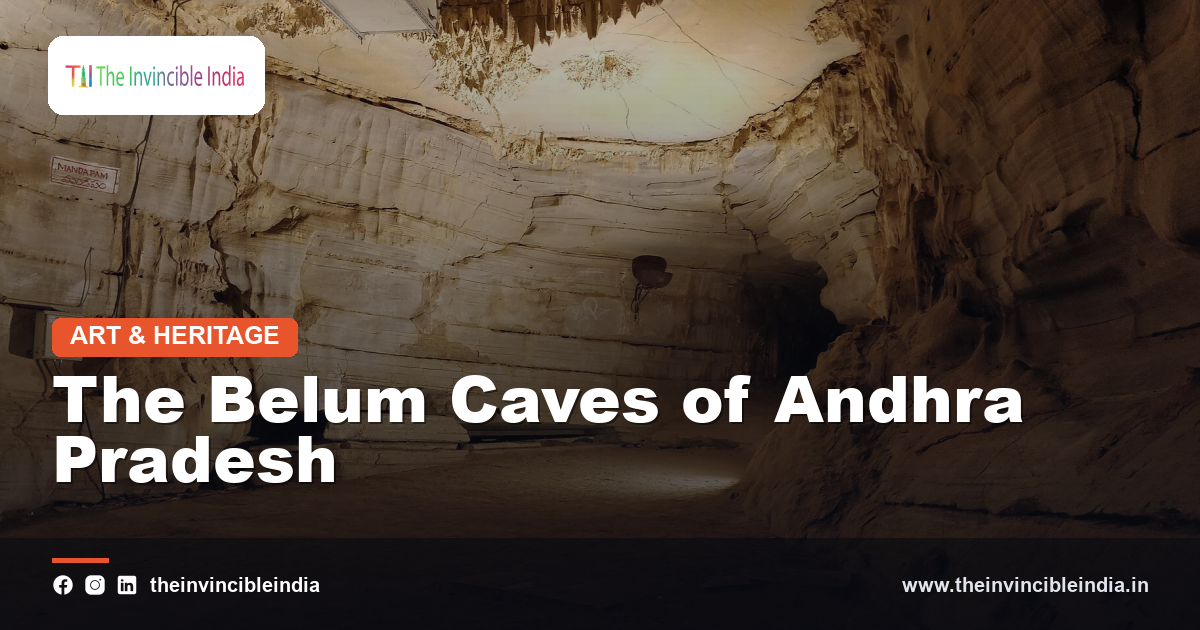
The Belum Caves, also called Belum Guhalu in Telugu, are a vast underground limestone cave system near the village of Belum in the Kurnool district of Andhra Pradesh. Formed over a very long time by the action of water on rock, they wind for several kilometres beneath the plateau and contain dramatic stalactites, stalagmites, chambers and passages. They are widely described as one of the longest cave systems on the Indian subcontinent, and part of the system is open to visitors. Alongside the carved stone monuments covered in the guide to India’s UNESCO World Heritage Sites, they remind us that India’s heritage also includes natural wonders shaped by time. This guide explains the formation, features and cultural history of the caves.
Quick answer: The Belum Caves are a natural limestone cave system near Belum village in Kurnool district, Andhra Pradesh, among the longest on the Indian subcontinent. They were formed over a very long time by the action of underground water on limestone and contain stalactites, stalagmites, silent chambers and passages. Evidence of early occupation by Buddhist and Jain monks adds a cultural dimension, and part of the system is open to the public today.
Key Takeaways
- The Belum Caves are a natural limestone cave system in Kurnool district, Andhra Pradesh.
- They are widely described as one of the longest cave systems on the Indian subcontinent, and only a portion is open to visitors.
- The caves were formed by underground water slowly dissolving limestone, and they contain stalactites and stalagmites.
- Named chambers include the Pataalganga, the Thousand Hoods formation and the Dhyana Buddha Mandapam.
- Remains found in the caves suggest that Buddhist and Jain monks used them in ancient times.
- The caves were described in the nineteenth century by a British geologist and surveyed again in the twentieth century by German speleologists.
The sections below follow the caves from their geology and discovery to their chambers, history and care.
Quick Facts
| Detail | Information |
|---|---|
| Location | Near Belum village, Kurnool district, Andhra Pradesh |
| Also known as | Belum Guhalu |
| Type | Natural limestone cave system |
| Rank | Among the longest cave systems on the Indian subcontinent |
| Notable features | Stalactites, stalagmites, Pataalganga, Dhyana Buddha Mandapam |
| Cultural link | Used in ancient times by Buddhist and Jain monks |
What Are the Belum Caves?
The Belum Caves are a natural underground cave system in the Kurnool district of Andhra Pradesh, formed within a belt of limestone rock. Unlike the carved cave monuments of Ajanta or Ellora, they were not excavated by human hands but were shaped over a very long period by flowing water. They are celebrated for their length, the beauty of their mineral formations and the sense of mystery that surrounds a world hidden beneath the plateau. In recent decades the caves have been developed as a visitor attraction, with lighting, walkways and access arranged so that the public can see a portion of the system safely. The caves also carry a human story, because they were visited and used in ancient times. Belum therefore combines natural wonder with cultural memory, and it holds a special place among the heritage sites of southern India.
Where Are the Belum Caves Located?
The Belum Caves are located near the village of Belum in the Kurnool district of Andhra Pradesh, in the southern part of the Deccan plateau. The nearest towns include Tadipatri, Betamcherla and Koilkuntla, and the caves can be reached by road from Kurnool, Anantapur and further afield. The region is one of low hills, dry plains and limestone outcrops, a landscape that conceals the large cavities beneath. The entrance is a surprising feature, since it is a large sinkhole that opens in the ground, with steps leading down into the darkness. Nearby attractions include the temple town of Ahobilam, the Yaganti shrine and the hill sites of the Nallamala range. The location in the interior of Andhra Pradesh puts the caves within reach of travellers exploring the heritage of Rayalaseema. Their quiet rural setting adds to the sense of discovery.
How Were the Belum Caves Formed?
The Belum Caves were formed by the slow action of water on limestone, a process that geologists describe as karst development. Rainwater absorbs carbon dioxide from the air and soil and becomes weakly acidic, and it gradually dissolves the limestone along cracks and joints. Over very long spans of time these small channels widen into passages and chambers. It is believed that an ancient underground stream, associated with the Chitravathi river system, helped to carve the principal passages. Once the water table dropped, the passages were left dry, and mineral-rich water dripping from the ceiling began to build the cave decorations. The process is extremely slow and continues in places even now. The caves are therefore not static monuments but the product of continuing natural forces. Their formation illustrates the patient creativity of water in shaping the landscape of the Deccan.
Why Are the Belum Caves Important?
The Belum Caves are important because they combine geological, ecological and cultural significance in a single site. Their length makes them one of the most extensive cave systems of the Indian subcontinent, and the variety of their formations makes them a natural laboratory for the study of limestone caves. They shelter specialised life forms adapted to darkness, and they preserve evidence of human use that extends back many centuries. For the public they are a rare opportunity to walk through a subterranean landscape without technical equipment. The caves have also become a symbol of the heritage of Andhra Pradesh and a draw for tourism in the Rayalaseema region. Protecting the site therefore serves science, culture and local livelihoods at the same time. The importance of Belum lies in its rare union of natural beauty and human story.
Discovery and Exploration
The caves have long been known to local people, who knew them as a mysterious opening in the ground, but they came to wider scientific attention in the late nineteenth century when a British geologist, Robert Bruce Foote, surveyed them in the year 1884. Subsequently, the caves were largely forgotten by the wider world until a team of German speleologists led by H. Daniel Gebauer carried out systematic exploration in the early 1980s. Their work revealed the true extent of the system and its passages, and led to greater recognition. After these explorations, the state government of Andhra Pradesh took steps to protect and develop the site as a tourist destination. The sequence of exploration shows how local knowledge and scientific investigation together bring a natural wonder into public view. The story of discovery adds an adventurous chapter to the history of the caves.
The Entrance and the Descent
The entrance to the Belum Caves is dramatic, a large circular sinkhole in the earth with a flight of steps spiralling down to the cave floor. As visitors descend, the temperature drops and the daylight fades, and the atmosphere changes from the dry heat of the plateau to the cool stillness of the underground. The descent is a memorable moment, since it signals the transition from the familiar to the unknown. Lighting installed along the route allows visitors to see the walls and formations clearly while keeping the cave safe to walk. The passage floor in the public section is mostly level and well prepared, though it can be damp in places. The experience of descending into the earth is often compared to entering another world. The entrance gives the caves a ceremonial quality that few other Indian heritage sites can match.
Stalactites, Stalagmites and Cave Formations
The most striking features inside the Belum Caves are the speleothems, the mineral formations that decorate walls, ceilings and floors. Stalactites hang from the roof like stone icicles, while stalagmites rise from the floor beneath them, and where the two meet they form columns. The formations are created by dripping water that carries dissolved calcium carbonate, which is deposited drop by drop over thousands of years. Curtains, flowstones and other shapes add to the variety, and their colours range from creamy white to warm brown depending on the minerals. Many formations have been given popular names by guides and visitors, inspired by the shapes that the imagination finds in the stone. The delicate nature of these growths makes them extremely vulnerable to touch and damage. They are the main artistic achievement of nature in the caves. Looking at them is like reading a slow record of geological time.
The Pataalganga and Underground Water
One of the best known features of the caves is the Pataalganga, a chamber in which a perennial stream of water is seen at the lower level, taking its name from the idea of a hidden river of the underworld. Water has always been central to the creation of the cave, and its presence in this area reminds visitors of the force that made it. In the public narrative the Pataalganga is often described as the point at which the cave is deepest and its atmosphere most mysterious. The name draws on the Indian tradition of associating subterranean waters with the holy Ganga flowing beneath the earth. Details of the water flow vary with the seasons and with the conditions of the cave. The Pataalganga makes a fitting climax to the visit and links the natural story of Belum to the imagination of the Indian tradition. It is a place where geology and legend meet.
The Thousand Hoods Formation
Among the most photographed formations of the caves is the one often called the Thousand Hoods, a ceiling cluster of stalactites that resembles the raised hoods of many cobras. The popular name draws on the Hindu image of the serpent Shesha, whose many hoods shelter the god Vishnu. The formation is a good example of the way in which Indian visitors read religious and mythic meanings into natural shapes. Nearby formations have been given other names by local guides, including shapes compared to a lion, a banyan tree and a temple. These names are informal, and they vary from guide to guide, but they add charm and help visitors to remember what they have seen. The Thousand Hoods is a remarkable example of how nature and culture meet underground. It shows the human instinct to find familiar forms in the unfamiliar.
The Dhyana Buddha Mandapam and Buddhist Links
A chamber known as the Dhyana Buddha Mandapam preserves a link between the caves and the Buddhist tradition. Archaeological evidence suggests that Buddhist monks used the caves for meditation in ancient times, and a statue of the Buddha in the seated meditation posture has been placed in the chamber to commemorate this. The cool, silent darkness of the cave is well suited to contemplation, and monks across the world have often sought out caves for retreat. Some accounts speak of ancient relics such as pottery and remains found within the system, which are taken as signs of long human presence, although specific dates are best treated as approximate. The chamber gives the caves a quiet spiritual dimension that sits alongside their natural splendour. It also ties them to the broader story of Buddhism in Andhra Pradesh, a region rich in ancient stupas and monasteries.
Jain and Other Traditions of Use
In addition to the Buddhist connection, the caves are associated with the Jain tradition, whose monks also sought out caves for ascetic practice. Remains discovered within the caves are interpreted by researchers as evidence that both Buddhist and Jain communities may have used the site at different times. Local lore adds other stories, linking the caves to sages, hermits and the legends of the region. These traditions should be understood as a mixture of archaeological interpretation and folk memory rather than as precise historical statements. They do show, however, that the caves were part of the religious landscape of the area for a very long time. The coexistence of several traditions of use is typical of southern India, where communities often shared sacred places. Belum thus stands as a place of shared spiritual memory.
Life Inside the Cave: Ecology and Darkness
The Belum Caves are home to specialised forms of life that have adapted to constant darkness and stable temperature. Insects, spiders and bats are among the creatures that may be found in caves of this kind, and researchers study such fauna because it is often found nowhere else. Because light is absent, there is no plant growth beyond the entrance zone, and the food chain depends on materials washed in from outside or brought by bats. The delicate balance of a cave ecosystem is easily disturbed by noise, light, litter and human traffic. Responsible management therefore limits the number of visitors and controls lighting. Awareness of this hidden ecology adds a new layer of respect to the visit. The cave is not just a stage for formations but a living habitat. Protecting that habitat is part of protecting the heritage of Belum.
How Do You Visit the Belum Caves?
Visitors reach the Belum Caves by road, and the site is managed for tourism by the Andhra Pradesh authorities, with a ticket office, lighting and guided access in the public portion. Only a part of the full system is open, and visitors walk a prepared route that passes the main chambers before returning along the same way. The walk takes some time and involves steps and uneven ground, so comfortable footwear is advisable. Because the cave is humid, it can be slippery, and visitors with breathing or mobility difficulties should consider their comfort carefully. Photography rules and timings vary, and it is best to check current arrangements before travelling. The cooler months are generally the most pleasant for the surrounding countryside. A visit to Belum is a rewarding half-day excursion in the Rayalaseema region.
Nearby Heritage Sites in Rayalaseema
The Belum Caves can be combined with visits to other important heritage sites in the Rayalaseema region and the nearby Nallamala hills. Among them are the Ahobilam temples, dedicated to Narasimha, the ancient shrine of Yaganti with its natural cave temples, the temple town of Lepakshi with its famous Vijayanagara-era carvings and the great Vijayanagara capital at Hampi across the border in Karnataka. Each of these places adds a different dimension to the cultural geography of the area. The Borra Caves of Visakhapatnam are another well known cave system in Andhra Pradesh, though they lie far to the east, in a different region. Planning a circuit that includes several sites makes the long journey more rewarding. Belum is a natural beginning or endpoint for such a tour. It brings the natural heritage of Andhra Pradesh into the same story as its temples and monuments.
Conservation and Responsible Tourism
Conserving the Belum Caves requires careful management of both the natural environment and the flow of visitors. Touching formations can leave oils that stop their growth, and breaking them can destroy features that took thousands of years to form. Lighting that is too bright or too long may encourage the growth of algae on the walls, while litter and noise harm the cave habitat. The authorities that manage the site have set rules to limit damage, including controlled access and staff supervision. Visitors help by following instructions, staying on paths and refraining from collecting stones or marking the walls. Local communities also have a stake in protecting the caves, since tourism provides income. Balanced management allows the caves to be enjoyed without being spoiled. Conservation here is a matter of respect for a heritage that can never be replaced once it is lost.
Belum Caves Today
The Belum Caves today are a well known natural and cultural attraction of Andhra Pradesh, visited by families, students, geologists and travellers from many parts of India. They stand as one of the longest cave systems of the Indian subcontinent and as a rare example of a natural site with a long record of human association. The formations, the Pataalganga, the Thousand Hoods and the meditation chamber together offer a varied and unforgettable underground journey. The caves also teach lessons about geology, ecology and the shared religious history of the region. Their management shows the challenge of balancing public access with the protection of fragile wonders. For anyone interested in the many ways in which India’s heritage has been shaped, from carved temples to natural caverns, Belum is an essential destination. It reveals that the story of India’s heritage extends far beneath the surface of the land.
Sources & Further Reading
- Ministry of Culture, Government of India (indiaculture.gov.in).
- Andhra Pradesh Tourism Development Corporation.
Frequently Asked Questions
What are the Belum Caves?
The Belum Caves are a natural limestone cave system near Belum village in the Kurnool district of Andhra Pradesh. They are widely described as one of the longest cave systems on the Indian subcontinent. Part of the system is open to visitors.
Where are the Belum Caves located?
The Belum Caves are located near Belum village in the Kurnool district of Andhra Pradesh, close to towns such as Tadipatri, Betamcherla and Koilkuntla. The entrance is a large sinkhole with steps leading down. The caves can be reached by road from Kurnool and Anantapur.
How were the Belum Caves formed?
The Belum Caves were formed by water slowly dissolving limestone over a very long time, a process called karst development. An ancient underground stream is thought to have carved the main passages. The stalactites and stalagmites grew later from dripping mineral-rich water.
Who explored the Belum Caves?
The caves were surveyed by the British geologist Robert Bruce Foote in the late nineteenth century. German speleologists led by H. Daniel Gebauer explored them systematically in the early 1980s. Their work led to the caves being developed for tourism.
What is the Pataalganga in the Belum Caves?
The Pataalganga is a chamber in the Belum Caves where underground water is seen at a lower level, named after the idea of a hidden river of the underworld. It is often considered the deepest and most atmospheric part of the visitor route. The name draws on Indian tradition about subterranean waters.
Did monks live in the Belum Caves?
Yes, archaeological evidence suggests that Buddhist and Jain monks used the Belum Caves in ancient times for meditation. A seated Buddha statue in the Dhyana Buddha Mandapam commemorates this link. Exact dates of use are best treated as approximate.


