

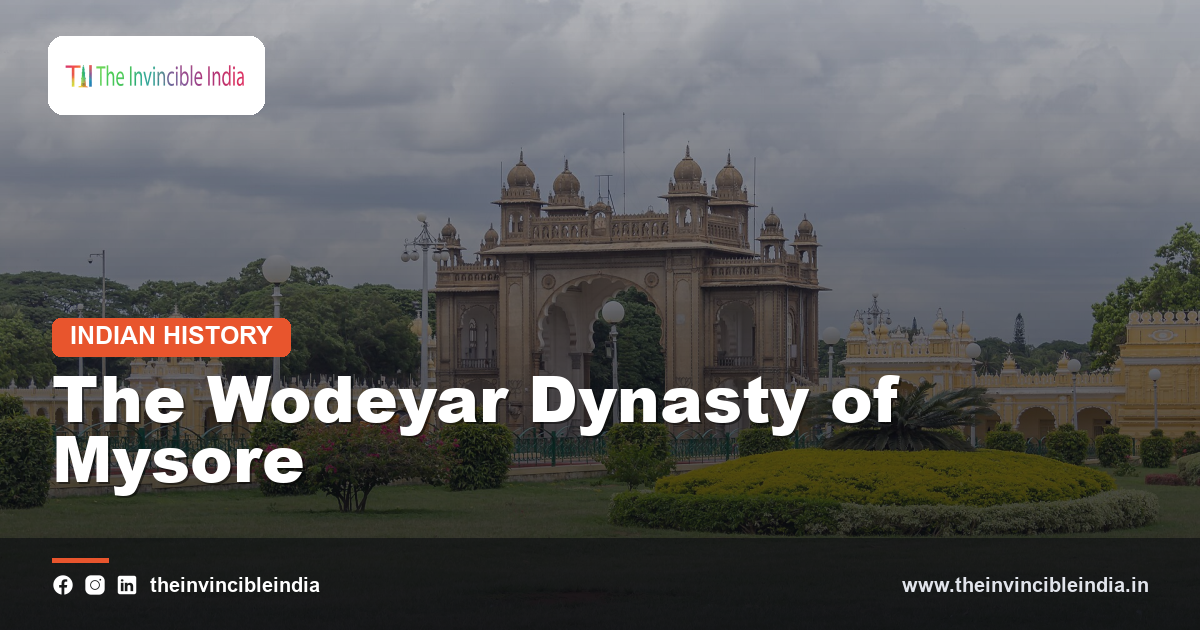
The Wodeyar dynasty of Mysore, also spelled Wadiyar, Odeyar or Udayar, was the ruling family of the Kingdom of Mysore in southern Karnataka for several centuries, first as vassals of the Vijayanagara empire and later as an independent kingdom and a princely state of British India. Their capital moved from Mysore to Srirangapatna and back, and their court became a major centre of music, art and festival life. The Dasara tradition they adopted from the older empire, described in our guide to the Vijayanagara empire, remains one of the best-known celebrations in India. Early dates are debated, so this guide keeps to broad and widely accepted outlines.
Quick answer: The Wodeyar dynasty of Mysore was the royal family that ruled the Kingdom of Mysore in southern Karnataka from the Vijayanagara period until Indian independence, with a break during the de facto rule of Hyder Ali and Tipu Sultan. It is known for the Mysore Dasara festival, the Mysore Palace, patronage of the arts and modernising reforms in the early twentieth century. The last ruling Maharaja acceded to the Indian Union in 1947.
Key Takeaways
- The Wodeyar dynasty, also spelled Wadiyar, ruled the Kingdom of Mysore in southern Karnataka for several centuries.
- The family began as feudatories of the Vijayanagara empire and became fully independent after that empire declined.
- Hyder Ali and Tipu Sultan held real power in Mysore for a period, with the Wodeyars as nominal rulers.
- After the fall of Tipu Sultan in 1799, the British restored the Wodeyar family to the throne.
- Krishnaraja Wodeyar IV is remembered for modernising Mysore with the help of capable ministers such as M. Visvesvaraya.
- The Mysore Dasara festival and the Mysore Palace remain the dynasty’s most visible cultural legacies.
Read on for the history, culture, and legacy in detail.
Quick Facts
| Detail | Information |
|---|---|
| Dynasty | Wodeyar (Wadiyar, Odeyar) dynasty of Mysore |
| Region | Southern Karnataka, with Mysore and Srirangapatna as capitals |
| Began As | Feudatories of the Vijayanagara empire |
| Restored | By the British after the fall of Tipu Sultan in 1799 |
| Famous Festival | Mysore Dasara, centred on Navaratri and Vijayadashami |
| Last Ruler | Jayachamaraja Wodeyar, who joined the Indian Union in 1947 |
Who Were the Wodeyars of Mysore?
The Wodeyars were a Kannada-speaking ruling family who governed Mysore, a region in the south of present-day Karnataka. Their name, spelled in several ways, is derived from a Kannada word meaning lord or master. Over many generations they grew from a small chiefdom into a significant regional power that survived the end of the Vijayanagara empire, the rise of Hyder Ali and the colonial era. The family tradition claims descent from the Yadava line, although such claims are traditional rather than proven. The Wodeyars are remembered as long-lived rulers who combined political adaptability with cultural patronage.
Origins: From Chiefs to Rulers
The Wodeyars began as local chiefs in the Mysore area who served the Vijayanagara empire as feudatories. Tradition places the founding of the line in the late medieval period and links it to a pair of brothers who came from the north, but the early generations are poorly documented and scholars disagree on specifics. What is clear is that the family gradually extended its territory and prestige during the sixteenth century, as the Vijayanagara state became less able to control its distant provinces. The early Wodeyars managed this transition carefully, remaining loyal to the empire while preparing for greater independence. This careful approach laid the foundation for the later kingdom.
Raja Wodeyar and Srirangapatna
Raja Wodeyar is remembered as the ruler who raised the family from regional lords to the head of a kingdom. In the early seventeenth century he took control of Srirangapatna, the strong island fortress on the Kaveri river, from the weakening Vijayanagara governor and made it the capital. He is also credited with continuing the Dasara festival there, in the style of the older empire. The move to Srirangapatna gave the Wodeyars a defensible centre and a symbolic link to the former imperial order. Raja Wodeyar’s reign is therefore seen as the real beginning of Mysore as an independent state.
What Is the Mysore Dasara?
Mysore Dasara is a ten-day royal festival centred on Navaratri and Vijayadashami that celebrates the victory of good over evil and honours the goddess Chamundeshwari. The Wodeyars adopted and developed the festival from the Vijayanagara tradition, and it became the signature celebration of the court. Its highlights include a grand procession in which the image of the goddess is carried through the city, special durbars, cultural performances and illuminated palaces. The festival continues each year as a state celebration and draws large numbers of visitors. Dasara is the clearest living link between the Wodeyars and the imperial culture they inherited.
Expansion Under Chikkadevaraja Wodeyar
Chikkadevaraja Wodeyar, who ruled in the later seventeenth century, is often regarded as the greatest of the early Wodeyars. He expanded the kingdom’s territory, reorganised its administration and strengthened its finances through systematic revenue arrangements. He is also remembered for patronising scholars and writers in Kannada and Sanskrit, and for building irrigation and public works. His reign gave Mysore a more centralised government than before and raised it to the status of a significant southern power. Because of these achievements, Chikkadevaraja is often presented as the ruler who set the administrative pattern for later Mysore.
How Did Hyder Ali and Tipu Sultan Affect the Wodeyars?
Hyder Ali and Tipu Sultan held real authority in Mysore during the later eighteenth century, while the Wodeyar kings remained as nominal rulers. Hyder Ali rose as a military commander in the Mysore army and gradually took control of the state, and his son Tipu Sultan continued the arrangement and fought the British in several wars. The Wodeyar family was kept in a limited position during this period, retaining its status but not its power. Their eventual restoration followed the defeat of Tipu Sultan in 1799 at Srirangapatna. This phase is a distinctive chapter in which the royal house survived under the shadow of a powerful military regime.
The Restoration and the Princely State
After the fall of Tipu Sultan, the British restored the Wodeyar family and placed a young prince, Krishnaraja III, on the throne under a subsidiary arrangement. Mysore thus became a princely state under British paramountcy, with its own ruler, army and administration subject to colonial oversight. The capital returned to Mysore city, which grew in importance as a royal and cultural centre. Later in the nineteenth century the British administered the state directly for a period before returning rule to the Wodeyars. The princely state arrangement lasted until independence, and it allowed the dynasty to remain a visible institution through the colonial era.
Krishnaraja Wodeyar IV and the Model State
Krishnaraja Wodeyar IV, who ruled in the early twentieth century, is remembered as one of the most progressive princely rulers of India. Under his guidance, Mysore became widely regarded as a model state, with investment in education, industry, irrigation and public health. Mahatma Gandhi is often quoted as describing him as a rajarshi, or sage-king, a reflection of his reputation for dutiful and benevolent rule. His reign is considered the high point of the dynasty’s modern history. Krishnaraja IV’s legacy lies in the institutions and infrastructure that shaped Mysore long after his death.
Visvesvaraya and the Modernisation of Mysore
Sir M. Visvesvaraya, the celebrated engineer, served as Diwan of Mysore under Krishnaraja IV and drove many of the state’s modernising projects. The construction of the Krishnarajasagara dam on the Kaveri, the establishment of the University of Mysore, the growth of industries such as soap and silk and the early use of hydroelectric power at Shivanasamudra are all associated with this period. These projects improved agriculture, education and employment, and gave Mysore a reputation for efficient administration. The partnership between ruler and minister is often cited as a successful example of princely governance. Their combined efforts left a durable infrastructure that is still visible in Karnataka today.
Mysore Palace and Royal Architecture
The Mysore Palace, also known as Amba Vilas, is the grand residence of the Wodeyars and one of the most visited monuments in India. The present palace was built after an earlier wooden structure was damaged by fire and was completed in the early twentieth century in the Indo-Saracenic style, which blends Hindu, Islamic and Gothic elements. Its richly decorated halls, domes and arches are lit by thousands of lamps during festival evenings. Other royal buildings, such as Jaganmohan Palace, preserve art collections and heirlooms. The architecture of the palaces reflects the dynasty’s taste, wealth and openness to different traditions.
Chamundi Hill and the Family Deity
Chamundi Hill, overlooking Mysore, is the site of the Chamundeshwari temple, dedicated to the goddess who is regarded as the family deity of the Wodeyars. The temple has long been the centre of royal devotion, and the Dasara festival begins with worship there. Royal patronage of the shrine included grants, buildings and festival arrangements, and the hill itself is part of the city’s identity. A famous large Nandi statue on the hillside is a well-known landmark. The goddess’s association with the royal house gave the dynasty a sacred legitimacy that complemented its political power.
Music, Art and Patronage
The Wodeyar court was a leading centre of Carnatic music, painting, crafts and literature. Musicians, scholars and artists found support in Mysore, and the court nurtured a distinct style of painting and a tradition of fine silk weaving and sandalwood carving. Rulers like Krishnaraja III were themselves writers and patrons of learning, and later generations continued the tradition. The city became known as a cultural capital of the south. The dynasty’s patronage ensured that many traditional arts survived and flourished, and it remains one of the reasons Mysore is still associated with refinement and heritage.
Why Is Mysore Called a Model State?
Mysore is called a model state because its government in the early twentieth century combined economic development, education and cultural preservation more effectively than many other Indian states of the period. The state invested in dams, power, banks and universities and encouraged industry and scientific institutions. It also maintained its traditional institutions, including the court and its festivals. This blend of modern development and cultural continuity impressed contemporary observers and still influences how the period is remembered. The label reflects both the achievements of the rulers and the work of the administrators who served them.
The Talakadu Legend
The Talakadu legend is a popular folk story that explains an alleged curse on the Mysore royal family. According to the tale, a queen named Alamelamma cursed the rulers before drowning herself in the Kaveri, saying that the kings would lack heirs in direct succession. The story is widely told in Karnataka, but historians regard it as folklore rather than documented history. It nevertheless shows how the royal house occupied a place in the popular imagination. The legend remains a part of local culture, even as the historical record of the dynasty rests on other, firmer evidence.
Accession to India and the End of Princely Rule
The last ruling Maharaja, Jayachamaraja Wodeyar, acceded to the Indian Union in 1947, after which Mysore became part of independent India. He later served as governor of the state and was a noted patron of learning and music. The privy purses and special status of former rulers were later ended through constitutional change. The change ended the dynasty’s formal rule but not its cultural role. Members of the family continue to take part in ceremonial duties, particularly in connection with Dasara, preserving a continuous link with the past.
The Wodeyar Dynasty Today
The Wodeyar dynasty lives on in the architecture, festivals and institutions of Mysore. The palace, the Dasara procession and the Chamundi temple remain among the best-known sites in Karnataka, and the city continues to be a centre of music, crafts and education. Historians study the dynasty as an example of a regional power that survived empire, conquest and colonial rule through adaptability. Its story also illustrates how princely states contributed to the cultural and economic development of modern India. The Wodeyars remain an enduring symbol of Mysore’s identity and heritage.
Sources & Further Reading
- Archaeological Survey of India (asi.nic.in).
- Ministry of Culture, Government of India (indiaculture.gov.in).
Frequently Asked Questions
Who were the Wodeyars of Mysore?
The Wodeyars, also spelled Wadiyar, were the royal family that ruled the Kingdom of Mysore in southern Karnataka for several centuries. They began as Vijayanagara feudatories and later ruled an independent kingdom and a princely state.
What is Mysore Dasara?
Mysore Dasara is a ten-day royal festival centred on Navaratri and Vijayadashami, honouring the goddess Chamundeshwari. It features a grand procession, palace illuminations and cultural events.
When was the Mysore Palace built?
The present Mysore Palace was built in the early twentieth century, after an earlier palace on the site was damaged by fire. It is designed in the Indo-Saracenic style.
Who restored the Wodeyars after Tipu Sultan?
The British restored the Wodeyar family to the throne after Tipu Sultan’s defeat at Srirangapatna in 1799. They installed a young prince, Krishnaraja III, under a subsidiary arrangement.
Who was Krishnaraja Wodeyar IV?
Krishnaraja Wodeyar IV was the Maharaja of Mysore in the early twentieth century, known for modernising the state. He is often called a rajarshi because of his reputation for dutiful rule.
Who was the last Wodeyar Maharaja?
The last ruling Maharaja of Mysore was Jayachamaraja Wodeyar, who acceded to the Indian Union in 1947. He later served as governor of the state.


