

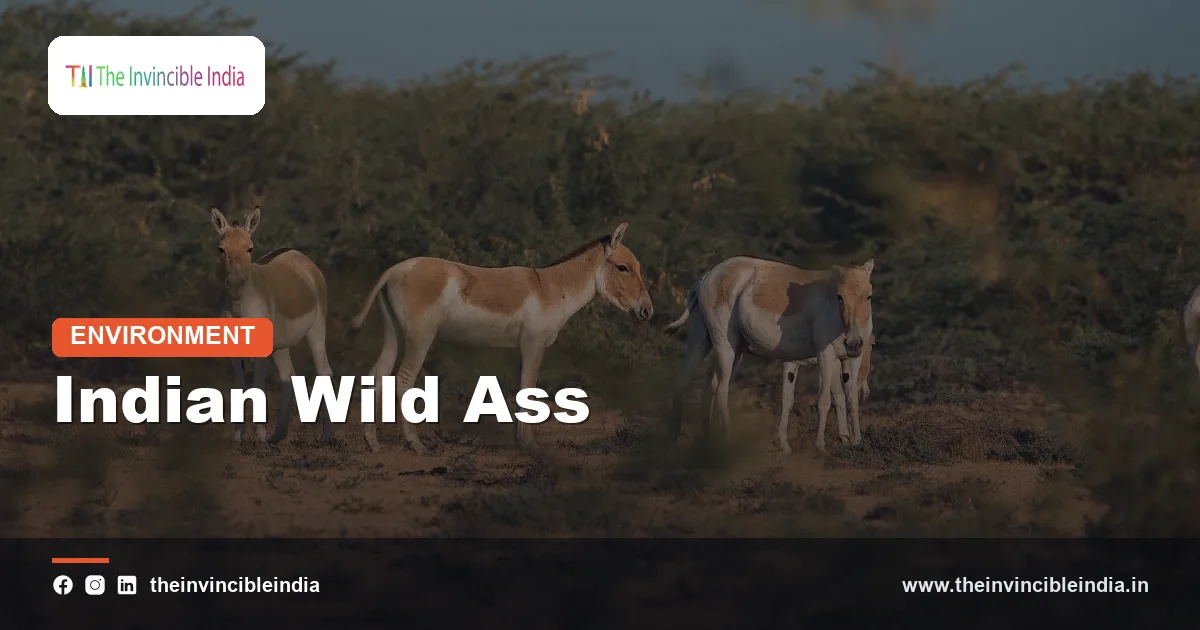
The Indian wild ass, known locally as the khur (Equus hemionus khur), is a subspecies of the Asiatic wild ass that survives in the wild only in the Little Rann of Kutch and adjoining arid parts of Gujarat in western India. The animal is protected within the Indian Wild Ass Sanctuary, the only wildlife sanctuary in the country created specifically for a wild equid, and it is listed in Schedule I of the Wildlife (Protection) Act, 1972.
Few Indian conservation stories show such a sharp swing as this one. The khur fell to a few hundred animals in the early 1960s after disease and drought, yet protection and the creation of the sanctuary in the early 1970s allowed the population to climb to several thousand. Today the species faces a different set of problems, mostly linked to shrinking habitat, invasive trees and competing land uses at the edge of the Rann.
| Attribute | Detail |
|---|---|
| Common names | Indian wild ass, khur, ghudkhur (local Gujarati usage) |
| Scientific name | Equus hemionus khur, a subspecies of the Asiatic wild ass |
| Core range | Little Rann of Kutch, Gujarat, with spillover into nearby districts |
| Protected area | Indian Wild Ass Sanctuary (Wild Ass Sanctuary), established in the early 1970s; roughly 4,950 sq km |
| Sanctuary headquarters | Dhrangadhra, Surendranagar district, Gujarat |
| Legal status in India | Schedule I, Wildlife (Protection) Act, 1972 |
| Global conservation status | Assessed as Near Threatened by the IUCN in recent reviews |
| Population trend | Recovered from a few hundred in the early 1960s to more than 6,000 in the 2020 count |
| Typical top speed | Reported at around 50 to 70 km per hour over short distances |
Key Takeaways
- The Indian wild ass (khur) is a subspecies of the Asiatic wild ass and is now found in the wild only in and around the Little Rann of Kutch in Gujarat.
- The Indian Wild Ass Sanctuary in Gujarat is the only sanctuary in India set aside mainly for a wild equid, and it covers roughly 4,950 square kilometres of saline desert and scrub.
- The khur population collapsed to a few hundred animals in the early 1960s because of disease outbreaks and drought, then recovered to over 6,000 animals by the 2020 count.
- The Indian wild ass uses raised, vegetated patches called bets as refuges when the monsoon floods the Little Rann of Kutch.
- Invasive mesquite (Prosopis juliflora), salt-pan expansion, canal-fed land conversion and crop conflict at the sanctuary edge are the main modern threats to the khur.
- The Wildlife (Protection) Act, 1972 gives the Indian wild ass the highest level of legal protection in India under Schedule I.
What is the Indian wild ass?
The Indian wild ass is a sandy-coloured wild equid, a close relative of horses and donkeys, that belongs to the Asiatic wild ass group (Equus hemionus). The Indian form, Equus hemionus khur, stands about 110 to 120 centimetres at the shoulder and has a pale chestnut to sandy coat, a white belly, and a dark brown stripe running along the spine from mane to tail.
Unlike the domestic donkey, the khur has a longer, more slender build, a straighter back and an upright, short mane. Adults are built for open country and for covering great distances in search of grass and water. Males and females look similar, with males being somewhat larger, and a single foal is born after a gestation of roughly eleven months.
The Asiatic wild ass group has several recognised subspecies spread from the deserts of Iran and Turkmenistan to Mongolia. The khur is the south-eastern representative of the group. In the past it ranged across the arid zones of Rajasthan, Gujarat and what is now Pakistan, but over time its range shrank to the Rann of Kutch region.
Where does the Indian wild ass live?
The Indian wild ass lives in the Little Rann of Kutch, a vast seasonally flooded saline desert in the Kutch, Surendranagar, Patan, Banaskantha and Morbi districts of Gujarat. The core of its range is the Wild Ass Sanctuary, and the animals also move into surrounding scrub, grazing land and farmland, so the total range is larger than the protected area itself.
The Rann is a flat, salt-encrusted plain. During the monsoon it floods and becomes a shallow wetland or marsh. After the water recedes, it dries into a hard, white, saline surface that stretches to the horizon. In this setting, small raised islands of higher ground called bets (also spelt beyts) become the main refuges and feeding areas.
What is a bet in the Little Rann of Kutch?
A bet is a slightly elevated patch of land inside the Rann that stays above the water level in the monsoon and supports grass and scrub. These islands carry grasses, shrubs and trees such as salvadora, and they provide forage, shade and safe ground for the khur when the surrounding plain is inundated. Wild ass herds spend the monsoon concentrated on the bets, and they spread out across the open Rann when the flood subsides.
What else lives in the same habitat?
The sanctuary supports a wider community of arid-zone wildlife. Typical species include the blue bull (nilgai), chinkara, Indian wolf, desert fox, jungle cat, and the Indian fox. Large numbers of migratory waterbirds, including flamingos, pelicans and cranes, use the wetlands in the cooler months, which makes the area significant for birdlife as well as for the khur.
Why did the Indian wild ass population crash in the 1960s?
The Indian wild ass population crashed in the late 1950s and early 1960s mainly because of disease outbreaks and drought, working on top of shrinking and disturbed habitat. Equine diseases, including surra (a trypanosome infection spread by biting flies) and African horse sickness, are commonly cited as major causes of mortality in that period, and drought reduced available forage and water.
Survey estimates put the number of animals in the early 1960s at only a few hundred, making the khur critically low at that time. Earlier in the twentieth century the species had been far more widespread across western India and neighbouring Pakistan. Hunting, loss of grazing land and competition with livestock had already trimmed its range before the disease events pushed it to the edge.
The crash drew attention to the need for formal protection. Because the Rann is a harsh environment with few permanent residents, enforcing protection was practical in a way it would not have been in densely settled areas. That helped the later recovery.
How did the Indian wild ass recover?
The Indian wild ass recovered through legal protection, creation of a dedicated sanctuary, control of hunting and consistent monitoring, supported by favourable natural conditions in the Rann. The Gujarat government notified the Wild Ass Sanctuary in the early 1970s, and the Wildlife (Protection) Act, 1972 placed the khur in the strictest protected category.
After protection began, the population rose steadily across the following decades. Counts reached the low thousands by the 1980s and 1990s, passed several thousand in the 2000s and 2010s, and exceeded 6,000 in the 2020 population estimation. Counts are made at intervals by the Gujarat Forest Department, and the figures are presented as estimates rather than exact headcounts.
Timeline of the khur's decline and recovery
| Period | Development |
|---|---|
| Early twentieth century | Khur still ranges widely across arid western India and neighbouring Pakistan |
| Late 1950s to early 1960s | Disease outbreaks and drought drive the population down to a few hundred animals |
| 1972 | Wildlife (Protection) Act enacted; khur placed in Schedule I |
| Early 1970s | Wild Ass Sanctuary created in the Little Rann of Kutch |
| 1980s to 1990s | Population rises into the low thousands under protection |
| 2000s to 2010s | Population continues to grow and spreads into neighbouring districts |
| 2020 | Population estimate exceeds 6,000 animals |
What is the Indian Wild Ass Sanctuary?
The Indian Wild Ass Sanctuary, also called the Wild Ass Sanctuary or Little Rann of Kutch Wildlife Sanctuary, is a protected area in Gujarat that covers roughly 4,950 square kilometres of the Little Rann. It is the only sanctuary in India established primarily to protect a wild equid, and it is among the larger wildlife sanctuaries in the country by area.
The sanctuary is administered by the Gujarat Forest Department, with its headquarters at Dhrangadhra. Because the area includes saline desert, wetland, bets and surrounding scrub, the forest department manages it as a landscape rather than a single habitat. Access for visitors is regulated, with safaris offered in the cooler months from the post-monsoon season to the early summer.
Inside the sanctuary live communities who depend on the Rann, most notably the Agariyas, traditional salt-makers who extract salt from brine by hand through the dry season. Their presence is a long-standing part of the Rann economy and a major factor in conservation planning.
What are the biggest threats to the Indian wild ass?
The biggest threats to the Indian wild ass today are shrinking and fragmenting habitat, invasion by the mesquite tree Prosopis juliflora, industrial salt-pan expansion, and conflict with farmers around the sanctuary edge. Disease also remains a background risk, because a population concentrated in one landscape can be hit hard by a single outbreak.
Invasive Prosopis juliflora
Prosopis juliflora, known locally as gando bawal, is a fast-spreading thorny tree introduced to arid India for greening and fuel. It spreads across bets and grasslands, replacing native grasses and shrubs that the khur depends on for forage. It also reduces open grazing ground and can hinder the free movement of herds.
Salt pans and industry
Commercial salt production and the infrastructure linked to it, such as roads, embankments and evaporation pans, can alter water flow and take over areas used by the animals. Expansion of such activity around the sanctuary boundary can reduce the land available outside the protected core.
Agriculture, canals and crop conflict
Canal irrigation that reaches the Rann fringe has converted some scrubland into cropland. As the khur population has grown, herds have increasingly moved onto nearby fields in search of food, where they trample or eat standing crops, especially in the winter season. This leads to friction with local farmers, who bear the cost of the damage.
Other pressures
- Grazing pressure from livestock that share forage and water with the wild herds.
- Climate-driven variation in monsoon rainfall and Rann flooding, which affects forage and water.
- Risk of disease transmission from domestic equids and livestock.
- Uncontrolled tourism and vehicle disturbance in sensitive areas.
What is the legal and conservation status of the Indian wild ass?
The Indian wild ass is legally protected in India as a Schedule I species under the Wildlife (Protection) Act, 1972, which prohibits hunting and prescribes strict penalties for harming the animal. Internationally, the Asiatic wild ass is assessed by the International Union for Conservation of Nature (IUCN) in a threatened category, with the Indian subspecies rated as Near Threatened in recent assessments, an improvement over earlier, higher-risk listings.
The sanctuary status itself is a legal layer of protection. Within a sanctuary, activities such as hunting, felling and disturbance are regulated under the Act, and the state forest department has enforcement responsibilities. The surrounding landscape, however, is a mix of revenue land, private farmland and community land, which makes the legal protection less complete outside the sanctuary boundary.
How do local communities and the khur coexist?
Local communities and the khur coexist through a mix of shared land use, traditional livelihoods and compensation arrangements, although the relationship is under strain in some places. The Agariya salt-makers, pastoralists and farmers all use parts of the same landscape, so conservation here depends on balancing livelihoods with the needs of the wildlife.
Tourism has become a supplementary livelihood, with local guides, drivers and homestay operators earning income from safaris. When visitors come specifically to see the khur and the Rann landscape, the animal gains local economic value. Compensation for crop loss, awareness work and community participation are among the tools that forest authorities use to reduce friction.
What does the future hold for the Indian wild ass?
The future of the Indian wild ass depends on securing enough habitat outside the sanctuary, controlling invasive plants and keeping disease risk low. Because the entire wild population lives in one region of Gujarat, conservation planners stress the value of spreading the risk, for example by safeguarding connections between populations and considering suitable additional sites.
Researchers often point to three priorities. First, maintain the hydrology and open character of the Rann and its bets. Second, clear or limit Prosopis in key grazing areas. Third, manage conflict with farmers so that local communities continue to support the animal. A healthy khur population is also a sign of a functioning desert ecosystem, so its conservation benefits other species sharing the Rann.
Quick comparison with other Indian wild equids and relatives
| Animal | Region | Key note |
|---|---|---|
| Indian wild ass (khur) | Little Rann of Kutch, Gujarat | Lowland saline desert; only wild equid with a dedicated Indian sanctuary |
| Kiang (Equus kiang) | Ladakh and Sikkim plateau | High-altitude cold desert species, larger than the khur |
| Domestic donkey | Across India | Domesticated descendant of the African wild ass, a different species |
Bottom Line
The Indian wild ass is a rare conservation success that is still geographically fragile, because almost the entire wild population lives in one corner of Gujarat. Continued protection of the Wild Ass Sanctuary, along with control of invasive trees and careful management of land use around the Rann, will decide whether the khur remains secure.
Frequently Asked Questions
Where is the Indian wild ass found?
The Indian wild ass is found in the Little Rann of Kutch in Gujarat and in neighbouring districts such as Surendranagar, Patan, Banaskantha, Kutch and Morbi. Its stronghold is the Wild Ass Sanctuary, and some animals also range onto nearby scrubland and farmland. It is no longer found in other Indian states in the wild.
Is the Indian wild ass endangered?
The Indian wild ass is no longer classed as Endangered by the IUCN, but it is still treated as a threatened species and is rated Near Threatened in recent assessments. In India it remains in Schedule I of the Wildlife (Protection) Act, 1972, the highest protection level. The population grew from a few hundred in the early 1960s to over 6,000 in the 2020 count.
Why is the Indian wild ass called the khur?
The animal is called the khur because that is its traditional name in the languages of the region where it lives. The scientific name Equus hemionus khur reflects this local name, and in Gujarat the animal is also called ghudkhur. The name distinguishes it from the domestic donkey and from other Asiatic wild ass subspecies.
How many Indian wild asses are there?
There are more than 6,000 Indian wild asses according to the 2020 population estimation in Gujarat. The number is an estimate drawn from periodic counts by the Gujarat Forest Department, and it has risen steadily since the early 1960s, when only a few hundred animals survived. Exact figures change with each count.
What is the Wild Ass Sanctuary?
The Wild Ass Sanctuary is a protected area of roughly 4,950 square kilometres in the Little Rann of Kutch, Gujarat, set up in the early 1970s for the khur. It is the only sanctuary in India dedicated mainly to a wild equid. It also supports species such as the nilgai, chinkara, Indian wolf, desert fox and many migratory waterbirds.
What threatens the Indian wild ass today?
The main threats to the Indian wild ass are habitat shrinkage, invasion by the tree Prosopis juliflora, salt-pan and infrastructure expansion, and conflict with farmers over crop damage. Disease remains a risk because the population is concentrated in one region. Conservation efforts focus on protecting the Rann, controlling invasive plants and reducing human-wildlife conflict.
{“@context”:”https://schema.org”,”@graph”:[{“@type”:”FAQPage”,”mainEntity”:[{“@type”:”Question”,”name”:”Where is the Indian wild ass found?”,”acceptedAnswer”:{“@type”:”Answer”,”text”:”The Indian wild ass is found in the Little Rann of Kutch in Gujarat and in neighbouring districts such as Surendranagar, Patan, Banaskantha, Kutch and Morbi. Its stronghold is the Wild Ass Sanctuary, and some animals also range onto nearby scrubland and farmland. It is no longer found in other Indian states in the wild.”}},{“@type”:”Question”,”name”:”Is the Indian wild ass endangered?”,”acceptedAnswer”:{“@type”:”Answer”,”text”:”The Indian wild ass is no longer classed as Endangered by the IUCN, but it is still treated as a threatened species and is rated Near Threatened in recent assessments. In India it remains in Schedule I of the Wildlife (Protection) Act, 1972, the highest protection level. The population grew from a few hundred in the early 1960s to over 6,000 in the 2020 count.”}},{“@type”:”Question”,”name”:”Why is the Indian wild ass called the khur?”,”acceptedAnswer”:{“@type”:”Answer”,”text”:”The animal is called the khur because that is its traditional name in the languages of the region where it lives. The scientific name Equus hemionus khur reflects this local name, and in Gujarat the animal is also called ghudkhur. The name distinguishes it from the domestic donkey and from other Asiatic wild ass subspecies.”}},{“@type”:”Question”,”name”:”How many Indian wild asses are there?”,”acceptedAnswer”:{“@type”:”Answer”,”text”:”There are more than 6,000 Indian wild asses according to the 2020 population estimation in Gujarat. The number is an estimate drawn from periodic counts by the Gujarat Forest Department, and it has risen steadily since the early 1960s, when only a few hundred animals survived. Exact figures change with each count.”}},{“@type”:”Question”,”name”:”What is the Wild Ass Sanctuary?”,”acceptedAnswer”:{“@type”:”Answer”,”text”:”The Wild Ass Sanctuary is a protected area of roughly 4,950 square kilometres in the Little Rann of Kutch, Gujarat, set up in the early 1970s for the khur. It is the only sanctuary in India dedicated mainly to a wild equid. It also supports species such as the nilgai, chinkara, Indian wolf, desert fox and many migratory waterbirds.”}},{“@type”:”Question”,”name”:”What threatens the Indian wild ass today?”,”acceptedAnswer”:{“@type”:”Answer”,”text”:”The main threats to the Indian wild ass are habitat shrinkage, invasion by the tree Prosopis juliflora, salt-pan and infrastructure expansion, and conflict with farmers over crop damage. Disease remains a risk because the population is concentrated in one region. Conservation efforts focus on protecting the Rann, controlling invasive plants and reducing human-wildlife conflict.”}}]}]}


