

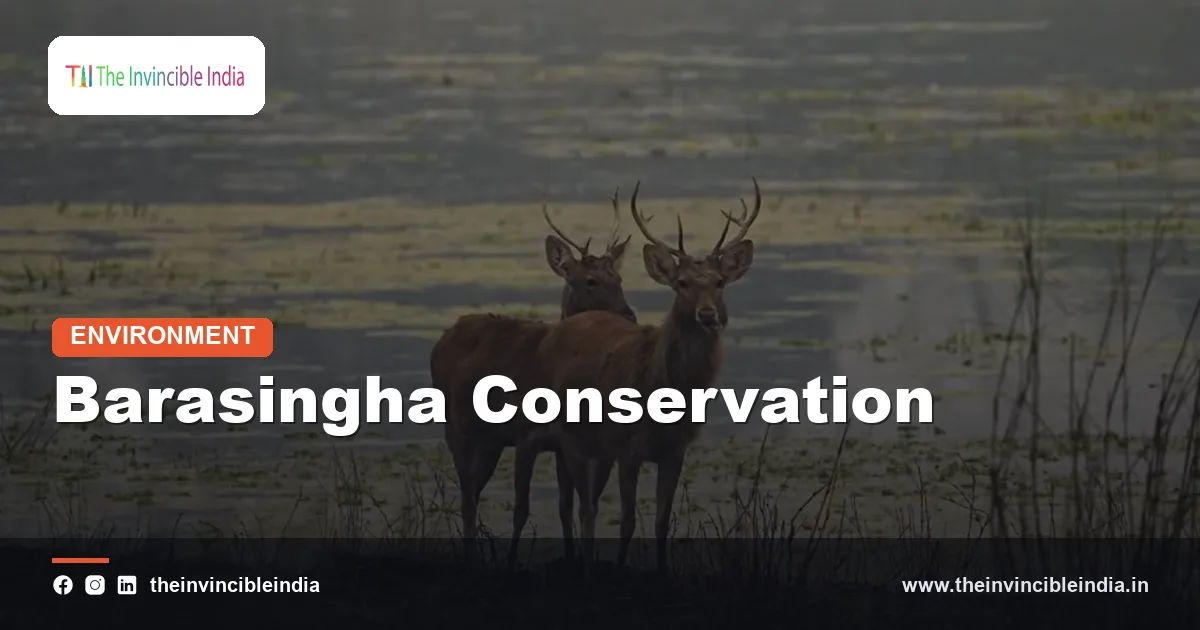
The barasingha, or swamp deer (Rucervus duvaucelii), is a large, gregarious deer of the Indian subcontinent that lives in grasslands and marshes and is named for the many tines on a stag's antlers. It is the state animal of Madhya Pradesh, where it is called the “jewel of Kanha”, and it is listed in Schedule I of the Wildlife (Protection) Act, 1972 and as Vulnerable by the IUCN.
India holds three distinct kinds of barasingha, each tied to a different habitat. The hard-ground barasingha of Kanha almost vanished in the 1960s and 1970s, and its recovery through protection, habitat management and a later translocation to Satpura is among the better-known deer conservation stories in the country.
| Attribute | Detail |
|---|---|
| Common names | Barasingha, swamp deer, “twelve-tined” deer |
| Scientific name | Rucervus duvaucelii (earlier placed in the genus Cervus) |
| Subspecies in India | Northern swamp deer, hard-ground barasingha, eastern swamp deer |
| Hard-ground form | Rucervus duvaucelii branderi, found in Kanha Tiger Reserve, Madhya Pradesh |
| Other key sites | Dudhwa and Kishanpur (Uttar Pradesh), Kaziranga and Manas (Assam) |
| State animal of | Madhya Pradesh and Uttar Pradesh |
| Legal status in India | Schedule I, Wildlife (Protection) Act, 1972 |
| IUCN status | Vulnerable |
| Kanha low point | Around 66 hard-ground animals reported at the end of the 1960s |
Key Takeaways
- The barasingha (swamp deer, Rucervus duvaucelii) is a large grassland and marsh deer whose name means “twelve-tined”, referring to the many points on a stag's antlers.
- India has three barasingha subspecies: the northern swamp deer of the terai, the hard-ground barasingha of Kanha, and the eastern swamp deer of Assam.
- The hard-ground barasingha (Rucervus duvaucelii branderi) survives naturally only in Kanha Tiger Reserve in Madhya Pradesh, which is why the deer is called the jewel of Kanha.
- The Kanha barasingha population fell to roughly 66 animals around 1970 before protection and habitat management allowed it to grow into the hundreds.
- A founding group of barasingha from Kanha was later translocated to Satpura Tiger Reserve to create a second wild population and reduce the risk of a single-site loss.
- The barasingha is listed in Schedule I of the Wildlife (Protection) Act, 1972, and assessed as Vulnerable by the IUCN, with habitat loss, poaching, floods and disease among the continuing threats.
What is a barasingha?
A barasingha is a medium-to-large deer, also called swamp deer, found in the grasslands, floodplains and moist meadows of northern and central India and in southern Nepal. The name comes from Hindi, where “bara” means twelve and “singha” means horns or antlers, because stags typically carry antlers with ten to fourteen tines, and some carry more.
An adult stag stands about 120 centimetres at the shoulder and can weigh over 170 kilograms, while hinds are smaller. The coat is yellowish-brown, turning darker in males during the breeding season, and calves are spotted. The barasingha is a grazer, feeding mostly on grasses and aquatic vegetation, and herds can number from a few animals to many dozens, depending on the habitat and the season.
Because it is a grassland and wetland specialist, the barasingha depends on open meadows that are periodically flooded or burnt. That is why its distribution has always been patchy and why it has been so sensitive to drainage, cultivation and the loss of floodplain grassland.
What are the three subspecies of barasingha in India?
The three subspecies of barasingha in India are the northern swamp deer (Rucervus duvaucelii duvaucelii), the hard-ground barasingha (Rucervus duvaucelii branderi) and the eastern swamp deer (Rucervus duvaucelii ranjitsinhi). Each lives in a different habitat and region, and the hard-ground form is the rarest and the most geographically restricted.
| Subspecies | Habitat | Main Indian sites |
|---|---|---|
| Northern swamp deer (R. d. duvaucelii) | Wetland and tall grassland of the terai and upper Gangetic plains | Dudhwa National Park, Kishanpur Wildlife Sanctuary, Jhilmil Jheel (Uttarakhand) |
| Hard-ground barasingha (R. d. branderi) | Dry, firm meadows and sal forest edges of central India | Kanha Tiger Reserve, Madhya Pradesh; reintroduced population in Satpura |
| Eastern swamp deer (R. d. ranjitsinhi) | Flooded grassland and swamp of the Brahmaputra floodplain | Kaziranga National Park and Manas National Park, Assam |
How is the hard-ground barasingha different?
The hard-ground barasingha differs from its relatives by living on firm, relatively dry ground rather than in standing water. Its hooves are adapted to hard ground, and its diet and habitat in Kanha are based on grass meadows (called maidans) within sal and mixed forest. The scientific name branderi honours the forest officer and naturalist A. A. Dunbar Brander, and the Kanha form is regarded as genetically and ecologically distinct.
What is special about the eastern swamp deer?
The eastern swamp deer is the form that lives in the Brahmaputra floodplain of Assam, where it shares grassland with rhinoceros, wild buffalo and elephants. It has smaller antlers and a somewhat darker coat compared with the northern form. Kaziranga and Manas are the main strongholds, and the population in Assam is exposed to seasonal flooding and poaching pressure.
Why is the barasingha called the jewel of Kanha?
The barasingha is called the jewel of Kanha because Kanha Tiger Reserve in Madhya Pradesh is the only place where the hard-ground subspecies survived naturally, and the deer became a symbol of the reserve. Its sweeping antlers, the open meadow setting and its rescue from near-extinction made it a flagship of the park alongside the tiger.
Kanha was declared a national park in 1955 and brought under Project Tiger as a tiger reserve in 1973. The reserve's meadows were historically home to large barasingha herds, and visitors still seek out the herds on the grassland clearings, particularly in the cooler months when the rut takes place. Madhya Pradesh adopted the barasingha as its state animal, a reflection of how closely the deer is linked to the state's identity.
How close did the barasingha come to extinction in Kanha?
The hard-ground barasingha came very close to extinction in Kanha, with only about 66 animals reported around 1970, down from a population that had once been in the thousands across central India. The decline was driven by hunting, loss of grassland to farming and disturbance, and disease affecting herds.
In the decades before Independence, the barasingha was widespread in the grasslands of central India, and sport hunting contributed to its fall. After Independence, growing cultivation, grazing by village cattle and disease outbreaks, such as those spread from livestock, further shrank the population. By the late 1960s the deer was confined to a small area in and around Kanha.
That low count is usually described as a numerical bottleneck. A bottleneck matters because it reduces genetic diversity and makes a population more vulnerable to disease, a single bad season or inbreeding, even after the number of animals has risen.
How did the Kanha barasingha recover?
The Kanha barasingha recovered through strict protection, relocation of villages from the core area, management of meadows and monitoring over several decades. As a result, the herd grew from fewer than a hundred animals in 1970 to several hundred animals in subsequent decades.
Key steps in the recovery
- Legal protection under the Wildlife (Protection) Act, 1972, which placed the species in Schedule I and banned hunting.
- Strengthening of Kanha as a protected area, including its designation as a tiger reserve in 1973 and stricter control of grazing and disturbance.
- Relocation of villages from the core meadows so that grasslands could recover and the herd had undisturbed ground.
- Meadow management, including controlled burning and the maintenance of grassland clearings in the face of woody encroachment.
- Veterinary and disease vigilance, along with regular census work by the forest department.
The recovery shows what protection can do when a population still has enough breeding animals and suitable habitat. Managers, however, have long stressed that a species concentrated at a single site is not truly safe, which led to the idea of establishing a second population elsewhere.
What is the barasingha translocation to Satpura?
The barasingha translocation to Satpura is a conservation programme that moved hard-ground barasingha from Kanha Tiger Reserve to Satpura Tiger Reserve in Madhya Pradesh to start a second wild population. The aim is to reduce the risk of losing the subspecies to a single disease outbreak, flood, fire or other disaster at Kanha.
The idea of a second population is a standard approach in endangered-species recovery, sometimes described as “not keeping all eggs in one basket”. Satpura was chosen because it has suitable grassland and forest habitat in the same central Indian landscape and because the earlier distribution of the deer likely included areas in this region. The animals were first held in a soft-release enclosure so that they could acclimatise before being freed, a method that improves survival after release.
Earlier, captive breeding efforts, including at Van Vihar in Bhopal, also supported the programme by maintaining animals outside Kanha. The long-term test of the Satpura population is whether it breeds, expands and becomes self-sustaining over successive years.
What is the status of the barasingha in northern and north-eastern India?
The northern swamp deer survives in a handful of terai protected areas, with Dudhwa and Kishanpur in Uttar Pradesh holding the largest populations in India, while the eastern swamp deer survives mainly in Assam. Both forms depend on wetland grassland that is under pressure from drainage, farming and river-flow changes.
In the terai, the deer share habitat with tigers, elephants and rhinoceroses that were reintroduced to Dudhwa, and conservationists have moved small groups to other sites, such as Jhilmil Jheel in Uttarakhand, to broaden the range. In Assam, the barasingha of Kaziranga and Manas are monitored along with other grassland wildlife. Outside India, southern Nepal, notably Shuklaphanta, holds an important population, while the species has disappeared from Bangladesh, Pakistan and most of its former range.
What are the continuing threats to the barasingha?
The continuing threats to the barasingha include loss and degradation of grassland and wetland, poaching, disease from domestic livestock, flooding, and the small size and limited number of its populations. Because the species is a grassland specialist, any process that changes meadows into scrub, forest or farmland directly reduces the habitat available.
- Habitat loss: Conversion of floodplain grassland to agriculture, drainage of wetlands and embankments that alter flooding patterns.
- Woody encroachment: Invasion of meadows by shrubs and trees, which reduces grazing area unless managed by fire or cutting.
- Disease: Diseases such as foot-and-mouth disease and others that can pass between cattle and deer, especially in areas near villages.
- Poaching: Hunting for meat and antlers remains a risk in poorly guarded areas.
- Flood and fire events: Extreme floods can kill calves and hinds, and uncontrolled fires can remove cover.
- Genetic limits: The Kanha population came through a very narrow bottleneck, so low genetic variation is a long-term concern.
- Predation and competition: Tigers and leopards prey on the deer, which is natural, but high pressure on a small herd can matter, as can grazing competition with other herbivores.
How is the barasingha legally protected?
The barasingha is legally protected in India under Schedule I of the Wildlife (Protection) Act, 1972, which gives it the highest level of protection and prohibits hunting and trade. Internationally, the species is listed in Appendix I of CITES, which restricts international commercial trade, and it is assessed as Vulnerable on the IUCN Red List.
Most of the barasingha's remaining habitat lies inside national parks, tiger reserves and sanctuaries, where management is the responsibility of state forest departments. This overlap with tiger reserves means that tiger conservation funding and staff, such as those at Kanha under Project Tiger, indirectly support the deer by protecting the meadows and enforcing rules.
Why does the barasingha matter for ecosystems and conservation?
The barasingha matters because it is a key grazer that helps maintain open meadow ecosystems and a major prey species for tigers, leopards and dholes in the areas where it lives. Protecting the deer also means protecting scarce grasslands and wetlands that support many other species.
Grasslands are often overlooked in conservation, which tends to focus on forests. The barasingha's story shows that grassland species need dedicated management, such as fire and grazing control, rather than just being left alone. It also illustrates a recurring conservation principle: a species recovered from a bottleneck should be spread across multiple sites, and its genetic health should be monitored.
Bottom Line
The barasingha is a landmark example of recovery in Indian wildlife conservation, with the hard-ground form rescued from a few dozen animals to several hundred through protection and habitat care. Its security still depends on safeguarding wet and dry grasslands, controlling disease and establishing viable populations beyond Kanha.
Frequently Asked Questions
Why is the barasingha called the swamp deer?
The barasingha is called the swamp deer because the northern and eastern forms live in marshes, floodplains and wet grasslands. The hard-ground form in Kanha lives on firmer, drier meadows, so the common English name does not describe every subspecies. The Hindi name barasingha means twelve-tined, referring to the antlers.
How many subspecies of barasingha are there in India?
There are three subspecies of barasingha in India: the northern swamp deer, the hard-ground barasingha and the eastern swamp deer. The northern form lives in the terai of Uttar Pradesh and Uttarakhand, the hard-ground form in Kanha in Madhya Pradesh, and the eastern form in Assam. Each is adapted to its own habitat.
Why is the barasingha called the jewel of Kanha?
The barasingha is called the jewel of Kanha because Kanha Tiger Reserve is the only place where the hard-ground subspecies survived naturally. The deer was nearly lost in the 1960s and 1970s, and its recovery became a symbol of the reserve. It is also the state animal of Madhya Pradesh.
How many barasingha were left in Kanha at the lowest point?
Around 66 hard-ground barasingha were reported in Kanha at the end of the 1960s, which is the figure usually cited as the low point. The number has since grown to several hundred animals under protection. Exact counts change from year to year with each census.
Where was the barasingha translocated from Kanha?
Hard-ground barasingha were translocated from Kanha Tiger Reserve to Satpura Tiger Reserve, also in Madhya Pradesh. The purpose was to build a second wild population so that a single disease outbreak or disaster at Kanha could not wipe out the subspecies. The animals were first kept in an enclosure to settle before release.
Is the barasingha endangered?
The barasingha is classed as Vulnerable by the IUCN, which is a threatened category, rather than Endangered. In India it is in Schedule I of the Wildlife (Protection) Act, 1972, the strictest category. Its populations are small and scattered, so it remains a conservation priority.
{“@context”:”https://schema.org”,”@graph”:[{“@type”:”FAQPage”,”mainEntity”:[{“@type”:”Question”,”name”:”Why is the barasingha called the swamp deer?”,”acceptedAnswer”:{“@type”:”Answer”,”text”:”The barasingha is called the swamp deer because the northern and eastern forms live in marshes, floodplains and wet grasslands. The hard-ground form in Kanha lives on firmer, drier meadows, so the common English name does not describe every subspecies. The Hindi name barasingha means twelve-tined, referring to the antlers.”}},{“@type”:”Question”,”name”:”How many subspecies of barasingha are there in India?”,”acceptedAnswer”:{“@type”:”Answer”,”text”:”There are three subspecies of barasingha in India: the northern swamp deer, the hard-ground barasingha and the eastern swamp deer. The northern form lives in the terai of Uttar Pradesh and Uttarakhand, the hard-ground form in Kanha in Madhya Pradesh, and the eastern form in Assam. Each is adapted to its own habitat.”}},{“@type”:”Question”,”name”:”Why is the barasingha called the jewel of Kanha?”,”acceptedAnswer”:{“@type”:”Answer”,”text”:”The barasingha is called the jewel of Kanha because Kanha Tiger Reserve is the only place where the hard-ground subspecies survived naturally. The deer was nearly lost in the 1960s and 1970s, and its recovery became a symbol of the reserve. It is also the state animal of Madhya Pradesh.”}},{“@type”:”Question”,”name”:”How many barasingha were left in Kanha at the lowest point?”,”acceptedAnswer”:{“@type”:”Answer”,”text”:”Around 66 hard-ground barasingha were reported in Kanha at the end of the 1960s, which is the figure usually cited as the low point. The number has since grown to several hundred animals under protection. Exact counts change from year to year with each census.”}},{“@type”:”Question”,”name”:”Where was the barasingha translocated from Kanha?”,”acceptedAnswer”:{“@type”:”Answer”,”text”:”Hard-ground barasingha were translocated from Kanha Tiger Reserve to Satpura Tiger Reserve, also in Madhya Pradesh. The purpose was to build a second wild population so that a single disease outbreak or disaster at Kanha could not wipe out the subspecies. The animals were first kept in an enclosure to settle before release.”}},{“@type”:”Question”,”name”:”Is the barasingha endangered?”,”acceptedAnswer”:{“@type”:”Answer”,”text”:”The barasingha is classed as Vulnerable by the IUCN, which is a threatened category, rather than Endangered. In India it is in Schedule I of the Wildlife (Protection) Act, 1972, the strictest category. Its populations are small and scattered, so it remains a conservation priority.”}}]}]}


