

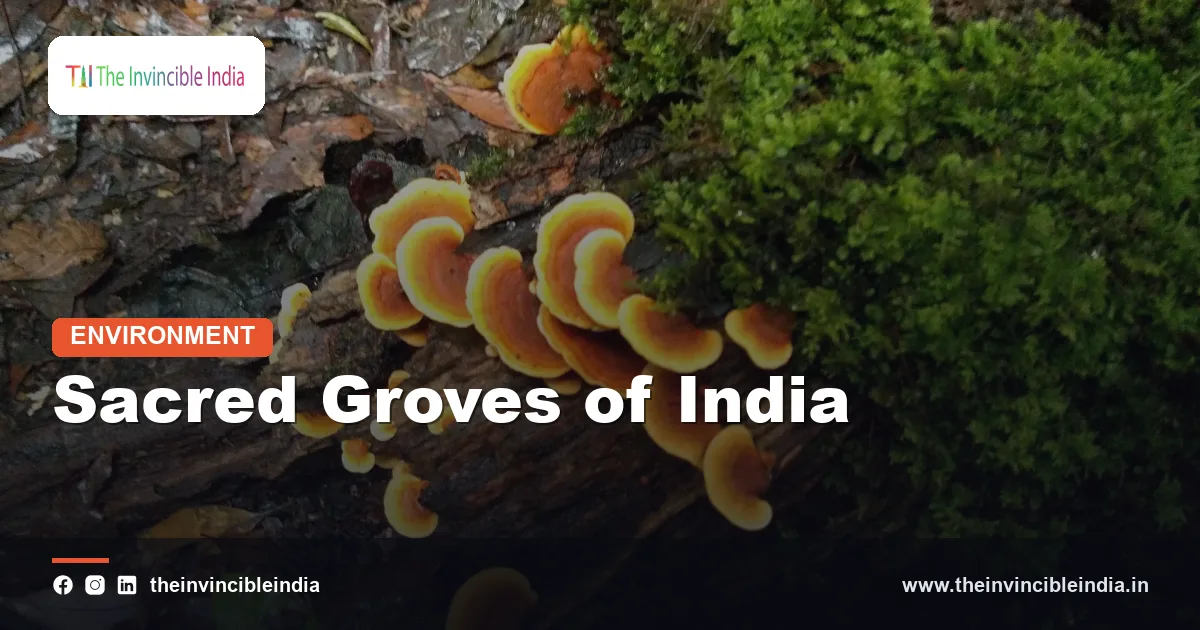
Sacred groves in India are patches of forest, ranging from a fraction of a hectare to several hundred hectares, that local communities have protected for generations because of religious belief, usually by dedicating the grove to a deity or ancestral spirit and forbidding felling or hunting. They are among the oldest community conservation systems in the world and are found across India, from Kerala and Karnataka to Meghalaya, Rajasthan and Jharkhand.
Because the rules are enforced through faith, custom and social pressure rather than by law, many groves have preserved patches of near-natural forest within otherwise cleared landscapes. Since the 2002 amendment to the Wildlife (Protection) Act, 1972, some of these groves can also be formally recognised as Community Reserves.
| Attribute | Detail |
|---|---|
| What they are | Forest patches protected by communities on religious or cultural grounds |
| Typical size | Less than one hectare to several hundred hectares |
| Regional names | Kavu (Kerala), Devrai or Deorai (Maharashtra), Sarna (Jharkhand), Oran (Rajasthan), Law Kyntang (Meghalaya), Kovilkadu (Tamil Nadu) |
| Number | Estimates vary widely; figures above 100,000 are sometimes cited for the country |
| Regions of high density | Western Ghats, North-East India, Chota Nagpur plateau, parts of Rajasthan |
| Management | Traditional community or temple institutions |
| Formal legal route | Community Reserves under Chapter IV of the Wildlife (Protection) Act, 1972 (added in 2002) |
| Pioneering survey | Madhav Gadgil and V. D. Vartak, mid-1970s |
| Main values | Biodiversity refuge, water-source protection, gene bank, cultural heritage |
Key Takeaways
- Sacred groves are forest patches that Indian communities protect through religious belief, with taboos against cutting trees, hunting animals or collecting wood.
- Sacred groves carry different names across India, including Kavu in Kerala, Devrai in Maharashtra, Sarna in Jharkhand, Oran in Rajasthan, Law Kyntang in Meghalaya and Kovilkadu in Tamil Nadu.
- Many sacred groves act as the last remaining patches of native forest in a region, sheltering rare, endemic and medicinal plants that have disappeared from surrounding land.
- Sacred groves often protect streams, springs and ponds, so they function as water-source refuges for nearby villages.
- The Wildlife (Protection) Amendment Act, 2002 created Community Reserves, allowing sacred groves on community land to be formally recognised without transferring ownership from the community.
- Mining, encroachment, infrastructure, invasive plants and weakening traditional beliefs are the main pressures on sacred groves today.
What are sacred groves?
Sacred groves are naturally vegetated areas dedicated to a deity, spirit or ancestor, in which community custom restricts the cutting of trees and the killing of animals. Researchers describe them as a form of traditional in-situ conservation, because species are protected where they naturally grow.
A grove usually contains a shrine, an altar, a stone or a simple symbol of the presiding spirit rather than a built temple. In some places the grove is believed to be the dwelling of a forest deity, and the trees themselves are regarded as sacred. The rules of protection are typically upheld by a local priest, a clan, a village council or a temple committee.
The scientific interest in sacred groves in India grew in the 1970s, when ecologists such as Madhav Gadgil and V. D. Vartak documented them in the Western Ghats and argued that they deserved attention as conservation sites. Since then, surveys in many states have recorded thousands of groves and described their plant communities.
What are sacred groves called in different parts of India?
Sacred groves are called by many different local names across India, reflecting the country's linguistic and cultural diversity. The best-known names include Kavu in Kerala, Devrai or Deorai in Maharashtra, Sarna in Jharkhand, Oran in Rajasthan, Law Kyntang in Meghalaya and Kovilkadu in Tamil Nadu.
| Name | Region | Notes |
|---|---|---|
| Kavu | Kerala | Often associated with snake deities (sarpa kavu) and Bhagavathy shrines |
| Devarakadu | Karnataka, notably Kodagu | Literally “forest of the gods”; many groves in the Western Ghats |
| Devrai or Deorai | Maharashtra | Documented widely in the Western Ghats and the Konkan |
| Sarna | Jharkhand, Chhattisgarh, Odisha, West Bengal | Sacred grove of tribal communities, often with Sal trees; also called Jaher in some groups |
| Oran | Rajasthan | Grazing commons and sacred woodland in dry areas such as Jaisalmer |
| Law Kyntang, Law Lyngdoh, Law Niam | Meghalaya | Khasi and Jaintia sacred forests; Mawphlang is a well-known example |
| Kovilkadu | Tamil Nadu | Temple forests, often associated with Ayyanar and village deities |
| Devbhumi or Devban | Himalayan states | Forests dedicated to local deities in places such as Himachal Pradesh and Uttarakhand |
Though the names differ, the underlying principle is similar: a piece of nature is set apart through faith and social norms. The size, the type of forest and the way rules are enforced vary from one region and community to another.
How do sacred groves protect biodiversity?
Sacred groves protect biodiversity by keeping patches of native forest intact in landscapes that have otherwise been cleared, so they act as refuges for plants and animals that need undisturbed habitat. Many groves hold species that are rare or absent in surrounding fields and plantations, including old, large trees that are seed sources for the wider area.
In the Western Ghats, a global biodiversity hotspot, sacred groves have been found to hold endemic and threatened plants, orchids, ferns, amphibians and invertebrates. In the north-east, groves such as those of the Khasi hills preserve primary forest with high species richness. In arid Rajasthan, orans keep stretches of native trees such as khejri and other drought-adapted species in a landscape of scrub and grazing land.
Why are sacred groves called in-situ gene banks?
Sacred groves are called in-situ gene banks because they conserve the genetic diversity of wild species, including relatives of crops and medicinal plants, in their natural setting. Wild relatives of cultivated plants such as pepper, cardamom, mango, jackfruit and citrus have been recorded in groves in some regions. The genetic variety held in these trees can be valuable for future breeding and for restoring degraded forest.
Which animals benefit from sacred groves?
Many animals benefit, from insects, frogs and reptiles to birds and mammals. Groves can serve as stepping stones for birds and bats that move between forest fragments, and some large groves shelter monkeys, squirrels, civets and even larger species. Taboos on hunting inside the grove mean that animals can live there without the same level of disturbance.
How do sacred groves protect water sources?
Sacred groves protect water sources because many are located around springs, streams, ponds and wetlands, and the forest cover keeps the soil in place and helps sustain the flow of water. In many villages, the grove is the catchment area from which a perennial stream emerges.
The tree cover slows runoff, encourages water to soak into the ground and reduces soil erosion. Studies in parts of the Western Ghats, Meghalaya and the Himalaya have linked groves with the continued flow of springs that supply drinking water and irrigation. Several groves contain a sacred pond or tank that is believed to be the property of the deity and is therefore kept clean and undisturbed. In dry regions such as Rajasthan, orans also serve as grazing and water commons during droughts, which adds a practical value to the belief system.
What is the link between sacred groves and Community Reserves?
The link between sacred groves and Community Reserves is that the Wildlife (Protection) Amendment Act, 2002 added a category of Community Reserve, which allows the State Government to declare community or private land, including a sacred grove, a protected area with the consent of the people who own or use it. This gave sacred groves a route to formal recognition.
Chapter IV of the Wildlife (Protection) Act, 1972 deals with Conservation Reserves and Community Reserves, and these were inserted by the 2002 amendment. A Community Reserve is meant for land that is not owned by the government, so it suits village forests and sacred groves. The community remains involved in managing the area through a committee, and the land ownership is not transferred to the state. Some groves, particularly in the north-east, have been recognised in this way.
Other legal and policy provisions
- The Biological Diversity Act, 2002 allows State Governments to notify Biodiversity Heritage Sites, which can include sacred groves of high ecological value.
- The Forest Rights Act, 2006 recognises community forest resource rights of forest-dwelling communities, which can strengthen community control over groves on forest land.
- Courts in India have also considered the protection of traditional community forests and sacred groves, urging authorities to identify and record them.
Even so, many sacred groves have no formal legal status and remain protected only by custom, which makes them vulnerable when customary authority declines or land use changes.
Who protects sacred groves and how do the rules work?
Sacred groves are protected by local communities, clans, temple committees or village councils through customary rules, taboos and the belief that harming the grove brings misfortune. The rules are typically unwritten and enforced through social pressure, rather than through police or courts.
Typical rules include a ban on cutting live trees, a ban on collecting wood or leaves, a ban on hunting and, in some groves, a ban on entering without permission or in certain seasons. In some places, people can remove only fallen deadwood for a ritual purpose, or take medicinal plants only with the approval of the priest. Violations are believed to anger the deity and are thought to cause illness or crop failure, and communities may impose a fine or ritual penance on those who break the rules.
In the Khasi hills, for example, the traditional institution that manages a grove forms part of a larger system of clan and village governance. In Kerala, family-owned kavus are managed by the family, and temple groves are managed by the temple trust. The diversity of institutions is one reason why generalising about sacred groves can be misleading.
What threatens sacred groves in India today?
The main threats to sacred groves in India are encroachment, mining and quarrying, infrastructure, land-use change, invasive species and the decline of the traditional beliefs that once protected them. Many groves have shrunk in size or become degraded within a few generations.
- Encroachment and land conversion: Groves have been cleared for agriculture, plantations, housing and roads, particularly where land values have risen.
- Mining and quarrying: In parts of the north-east and central India, extractive activity near or inside groves threatens their forests and streams.
- Weakening of belief: Migration, changes in religion and loss of traditional authority reduce the force of taboos.
- Temple renovation: Building larger concrete shrines and clearing trees around them can change the nature of a grove.
- Invasive species: Plants such as Lantana and Chromolaena can spread into groves and alter their composition.
- Fragmentation and grazing: Small, isolated groves can lose species over time, and heavy grazing can stop trees from regenerating.
- Lack of legal status: Groves without formal records can be treated as revenue or wasteland and diverted for other uses.
Why do sacred groves matter today?
Sacred groves matter today because they conserve biodiversity, water sources and cultural heritage at very low cost, and they demonstrate that communities can be effective custodians of forests. They also serve as reference sites that show what the natural vegetation of an area once looked like.
For conservation policy, groves highlight the value of recognising community rights and community knowledge, rather than relying only on state-run protected areas. For science, they are living laboratories for studying forest regeneration, species richness and the effect of fragmentation. For communities, they are places of identity, ritual and memory, and they often hold festivals and ceremonies that keep customary values alive.
Effective protection usually combines mapping and documentation, community participation, legal recognition where the community wishes it, and support for restoration. Recognising the cultural and spiritual basis of a grove, rather than treating it merely as a patch of trees, is widely regarded as essential to keeping it protected.
Bottom Line
Sacred groves are a distinctive Indian blend of faith, ecology and community governance that has kept patches of forest standing across the country for generations. Their survival now depends on documentation, legal recognition where communities want it, and support for the traditional institutions that look after them.
Frequently Asked Questions
What is a sacred grove in simple terms?
A sacred grove is a patch of forest that a community protects because of religious belief, usually by dedicating it to a deity or ancestral spirit. Cutting trees, hunting and collecting wood are typically forbidden. Such groves are found across India and often hold older and more diverse forest than the land around them.
What are sacred groves called in Kerala, Maharashtra and Meghalaya?
Sacred groves are called Kavu in Kerala, Devrai or Deorai in Maharashtra and Law Kyntang in Meghalaya. Other names include Sarna in Jharkhand, Oran in Rajasthan and Kovilkadu in Tamil Nadu. The names differ, but the idea of protection through belief is shared.
How many sacred groves are there in India?
There is no single agreed count of sacred groves in India, and estimates vary widely depending on how a grove is defined and surveyed. Some estimates exceed 100,000 groves across the country. Many are very small, and many are not formally recorded.
How do sacred groves help conserve biodiversity?
Sacred groves help conserve biodiversity by keeping patches of native forest intact when surrounding land has been cleared. They shelter rare, endemic and medicinal plants and provide refuge for many animals. They also act as natural gene banks, conserving species in the place where they grow.
What is a Community Reserve under the Wildlife Protection Act?
A Community Reserve is a category of protected area created by the Wildlife (Protection) Amendment Act, 2002, which a State Government can declare on community or private land with the consent of the people involved. It suits village forests and sacred groves because ownership stays with the community. Management is carried out through a community committee.
Are sacred groves legally protected in India?
Many sacred groves are protected only by custom, although some have legal recognition. A grove can be declared a Community Reserve under the Wildlife (Protection) Act, 1972, or a Biodiversity Heritage Site under the Biological Diversity Act, 2002. Groves without such recognition remain vulnerable to land-use change.
{“@context”:”https://schema.org”,”@graph”:[{“@type”:”FAQPage”,”mainEntity”:[{“@type”:”Question”,”name”:”What is a sacred grove in simple terms?”,”acceptedAnswer”:{“@type”:”Answer”,”text”:”A sacred grove is a patch of forest that a community protects because of religious belief, usually by dedicating it to a deity or ancestral spirit. Cutting trees, hunting and collecting wood are typically forbidden. Such groves are found across India and often hold older and more diverse forest than the land around them.”}},{“@type”:”Question”,”name”:”What are sacred groves called in Kerala, Maharashtra and Meghalaya?”,”acceptedAnswer”:{“@type”:”Answer”,”text”:”Sacred groves are called Kavu in Kerala, Devrai or Deorai in Maharashtra and Law Kyntang in Meghalaya. Other names include Sarna in Jharkhand, Oran in Rajasthan and Kovilkadu in Tamil Nadu. The names differ, but the idea of protection through belief is shared.”}},{“@type”:”Question”,”name”:”How many sacred groves are there in India?”,”acceptedAnswer”:{“@type”:”Answer”,”text”:”There is no single agreed count of sacred groves in India, and estimates vary widely depending on how a grove is defined and surveyed. Some estimates exceed 100,000 groves across the country. Many are very small, and many are not formally recorded.”}},{“@type”:”Question”,”name”:”How do sacred groves help conserve biodiversity?”,”acceptedAnswer”:{“@type”:”Answer”,”text”:”Sacred groves help conserve biodiversity by keeping patches of native forest intact when surrounding land has been cleared. They shelter rare, endemic and medicinal plants and provide refuge for many animals. They also act as natural gene banks, conserving species in the place where they grow.”}},{“@type”:”Question”,”name”:”What is a Community Reserve under the Wildlife Protection Act?”,”acceptedAnswer”:{“@type”:”Answer”,”text”:”A Community Reserve is a category of protected area created by the Wildlife (Protection) Amendment Act, 2002, which a State Government can declare on community or private land with the consent of the people involved. It suits village forests and sacred groves because ownership stays with the community. Management is carried out through a community committee.”}},{“@type”:”Question”,”name”:”Are sacred groves legally protected in India?”,”acceptedAnswer”:{“@type”:”Answer”,”text”:”Many sacred groves are protected only by custom, although some have legal recognition. A grove can be declared a Community Reserve under the Wildlife (Protection) Act, 1972, or a Biodiversity Heritage Site under the Biological Diversity Act, 2002. Groves without such recognition remain vulnerable to land-use change.”}}]}]}


