

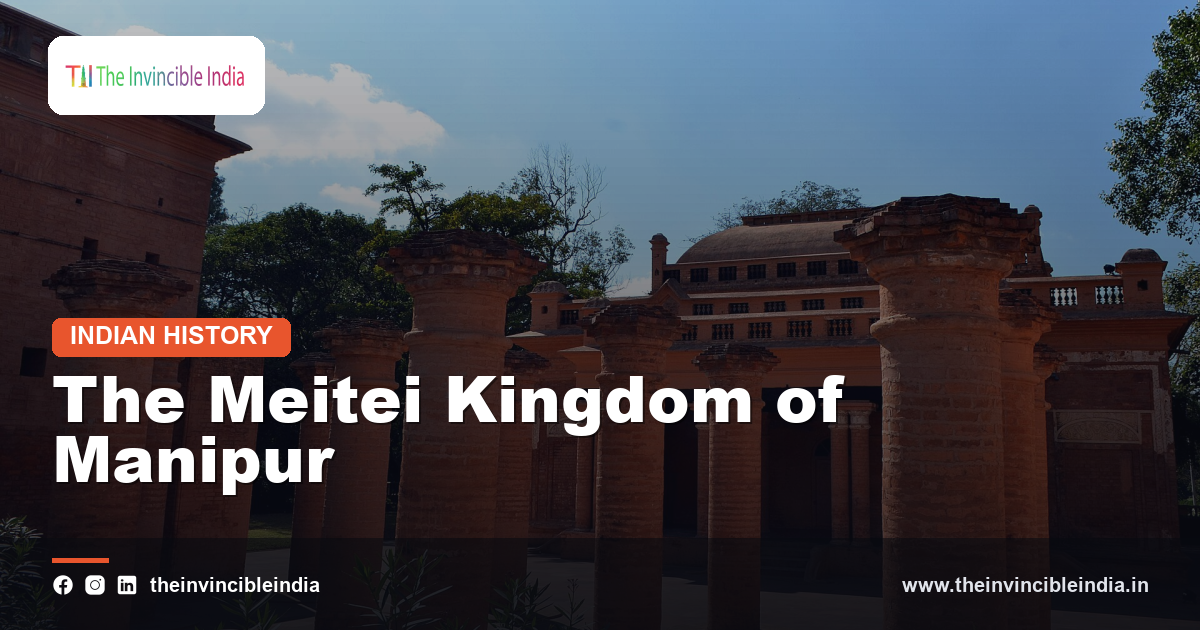
The Meitei kingdom of Manipur, also known as the Kingdom of Manipur, Kangleipak in older Meitei usage, or the Ningthouja realm after its ruling clan, was a long-lived state in the Imphal valley of north-eastern India. Its kings ruled from Kangla, a fortified royal seat on the Imphal river, and their court history is preserved in the chronicle Cheitharol Kumbaba. Unlike the great peninsular houses recalled in our guide to the Chola dynasty, the Meitei state grew in a frontier valley ringed by hills, where Indic and local traditions mingled. Early dates are debated, so this guide stays with general terms.
Quick answer: The Meitei kingdom of Manipur was the historical state of the Meitei people in the Imphal valley of north-eastern India, ruled by the Ningthouja dynasty from the royal seat at Kangla. Its history is recorded in the court chronicle Cheitharol Kumbaba, and it is known for the Meitei script, the Lai Haraoba festival, the adoption of Vaishnavism, and the classical Manipuri dance. The kingdom became a princely state under the British and joined independent India in 1949.
Key Takeaways
- The Meitei kingdom was the historical state of the Meitei people in the Imphal valley of Manipur.
- Its royal seat was Kangla, a fortified complex on the Imphal river that was the centre of kingship, ritual and administration.
- The chronicle Cheitharol Kumbaba records the reigns, wars and events of the Manipur court.
- Vaishnavism became a major royal faith in the eighteenth century, shaping Manipuri dance, music and temple life.
- The Seven Years Devastation, a period of Burmese occupation in the early nineteenth century, deeply scarred the kingdom.
- Manipur joined the Indian Union in 1949 and became a full state in 1972.
Read on for the history, culture, and legacy in detail.
Quick Facts
| Detail | Information |
|---|---|
| Kingdom | Meitei kingdom of Manipur (Kangleipak in older usage) |
| Ruling Clan | Ningthouja |
| Royal Seat | Kangla Fort, Imphal |
| Court Chronicle | Cheitharol Kumbaba |
| Script and Language | Meiteilon (Manipuri) with the Meitei Mayek script |
| Joined India | 1949, with statehood in 1972 |
What Was the Meitei Kingdom of Manipur?
The Meitei kingdom of Manipur was a regional state that grew in the Imphal valley and gradually brought the surrounding hill communities into its political and ritual orbit. Its rulers belonged to the Ningthouja clan and held the title of king, ruling through a court with ritual, military and revenue duties. The kingdom lay between the Brahmaputra and Barak plains on one side and the hills of Burma on the other, which made it both a crossroads and a frontier. Its political identity was bound up with Meitei language, clan tradition and a distinctive royal religion. The state therefore forms one of the oldest continuous political traditions of the Northeast.
Where Is Manipur and Why Did Geography Matter?
Manipur lies in the far north-east of India, with a central oval valley surrounded by wooded hills that form the border with Myanmar. The valley holds the Imphal river system and the great Loktak lake, and its fertile land supported dense rice cultivation. The hills sheltered a range of peoples, including the Naga and Kuki-Zo groups, who traded and sometimes contended with the valley kingdom. This setting gave the Meitei kings natural defence but also exposed them to invasion from Burma through the passes. Geography thus shaped both the prosperity and the vulnerability of the kingdom.
Who Are the Meitei People?
The Meitei are the principal people of the Manipur valley, speaking Meiteilon, a Tibeto-Burman language also called Manipuri. Their society is organised into clans known as salai, of which the Ningthouja became the royal line, and their traditions record the gathering of several early clans into one political community. The Meitei traditionally followed an indigenous faith centred on the deity Sanamahi and later adopted Vaishnavism in large numbers, creating a layered religious life. They are known for a strong tradition of arts, sport and ritual theatre. Understanding the Meitei is therefore central to understanding the kingdom.
The Ningthouja Dynasty and the Early Kings
The Ningthouja dynasty is the ruling line of Manipur, and tradition names Nongda Lairen Pakhangba as its legendary first king. Pakhangba is associated with the serpent-dragon symbol that appears in Meitei art and ritual, and he is revered as an ancestral deity as well as a ruler. The chronicle assigns early reigns to the first millennium, but modern scholars treat the earliest dates as uncertain and rely more on later records. What is clear is that over several centuries the Ningthouja clan absorbed rival clans through alliance and conquest. The early story thus blends tradition with a real process of state formation.
What Is the Cheitharol Kumbaba?
The Cheitharol Kumbaba is the royal chronicle of Manipur, a year-by-year court record kept by scribes of the kingdom. It lists reigns, battles, rituals, appointments, floods and other events, and it is among the most continuous court chronicles of the Northeast. The text was written in the Meitei language and is valued by historians for its detail on diplomacy with neighbouring states, including Burma and the Ahom kingdom. Its earliest sections are treated cautiously, as they were compiled and revised later, while the entries for subsequent centuries are more firmly anchored. The chronicle is therefore a primary source for Manipur’s long political and social history.
Kangla: The Royal Seat of Manipur
Kangla is the historic fort and palace complex at Imphal that served as the seat of Meitei kings for many centuries. The name is often interpreted as dry land, and the site lies on the bank of the Imphal river, enclosed by a moat and walls. Within the complex stand temples, ponds, coronation grounds and shrines linked to the Pakhangba tradition. The great sculpture of the Kangla Sa, a mythical dragon-lion figure, marks the entrance and has become a symbol of Manipur. Kangla was later used by the British and then by Indian forces before being returned to the state, and it is now developed as a heritage site.
Why Is the Meitei Script Important?
The Meitei script, called Meitei Mayek, is important because it is the traditional writing system of the Meitei language and a marker of cultural identity. Old manuscripts known as puya were written in the script and preserve myths, genealogies, rituals and medical lore. During the period of Hindu court patronage, the Bengali script came to be widely used for Meiteilon, and the older script declined for a time. In recent decades the Meitei Mayek has been revived in education and public signage, and it is now taught in schools. Its story reflects the way a community can reclaim a literary inheritance.
Sanamahi, Pakhangba and the Indigenous Faith
The indigenous religion of the Meitei centres on Sanamahi and Pakhangba and on a wide pantheon of forest and household deities called lai. Sanamahi is revered as the household god, honoured in the south-west corner of homes, while Pakhangba is the ancestral serpent king. Rituals are led by priestly specialists known as maibas and maibis, and the sacred groves, or umang lai, form the ritual landscape. This faith survived the spread of Hinduism and continues to be practised by many Meitei today. Its endurance shows how the kingdom’s religion was layered rather than replaced.
Lai Haraoba: The Festival of the Gods
Lai Haraoba is the great ritual festival of the Meitei, in which the community re-enacts the creation of the world and the birth of the deities. It is held in honour of local guardian gods and combines dance, music, song and ritual storytelling over several days. Many scholars see in its choreography the roots of later Manipuri dance, with movements that depict the building of houses and the weaving of cloth. The festival is celebrated in villages across the valley and remains a living link to the pre-Vaishnava past. Lai Haraoba thus preserves the oldest layer of Meitei artistic and religious life.
How Did Vaishnavism Come to Manipur?
Vaishnavism entered Manipur through contacts with Bengal and Assam and became the royal faith in the eighteenth century under King Garib Niwaz, also known as Pamheiba. Tradition describes the arrival of Vaishnava teachers and a large-scale adoption of Hindu names and rites at court. The king’s successors, notably Bhagyachandra, are remembered for devotional works and temple building. The new faith did not erase the older worship but combined with it, producing a distinct Manipuri Vaishnava culture. This transformation reshaped the arts, festivals and social life of the kingdom.
Govindajee Temple and Manipuri Dance
The Shri Govindajee temple beside the royal palace at Imphal is the central shrine of Manipuri Vaishnavism, dedicated to Krishna and Radha. Tradition links the Ras Lila of Manipur to King Bhagyachandra, who is said to have conceived the dance from a vision, and the form is now recognised as one of the classical dances of India. The dance is known for flowing gestures, soft costumes and accompaniment by the pung drum and the devotional sankirtana. The temple and the dance together express the way royal patronage turned faith into art. Both remain central to the cultural identity of Manipur.
Sagol Kangjei and the Origins of Polo
Sagol Kangjei is the traditional Meitei form of polo, played on ponies and linked in popular tradition with the origins of the modern game. British officers stationed in the region took up the sport in the nineteenth century and carried it to clubs elsewhere, a history that is widely told though the details are debated. In Manipur the game has ritual associations and is connected with the deity Marjing, the divine horse rider. Players use the small and sturdy Manipuri pony, an indigenous breed. The sport illustrates how the kingdom’s culture left a mark far beyond its borders.
The Seven Years Devastation
The Seven Years Devastation is the traditional name for the period in the early nineteenth century when Burmese forces occupied Manipur and caused widespread destruction. Villages were emptied, many people were taken away or fled, and the royal line was driven into exile in neighbouring Cachar. The memory of the period remains strong in Manipuri tradition and in the Cheitharol Kumbaba. The war eventually drew in the British, whose campaign against Burma opened the way for the restoration of a Manipuri prince. The event thus marks a deep rupture and also the start of closer ties with British India.
The Anglo-Manipur War and Khongjom
The Anglo-Manipur War arose from a palace crisis in the late nineteenth century, when a British political agent and his party were killed at the capital and the British sent a punitive expedition. The Manipuri forces made a stand at Khongjom, where the general Paona Brajabashi is remembered as a hero who fell in defence of the kingdom. The British took Kangla, and the state was placed under a political agent with a minor ruler on the throne. The episode is remembered each year in Manipur through memorial observances. It ended the full independence of the kingdom in practice.
From Princely State to the Indian Union
Manipur remained a princely state under British paramountcy until the end of colonial rule, and in 1947 it adopted a written constitution for the state. After independence the kingdom briefly had an elected legislature, and the ruler then signed a merger agreement with India in 1949. Manipur became a Union Territory and later a full state in the early 1970s. The merger remains a topic of historical and political discussion, and this article does not attempt to settle it. The transition nonetheless brought the royal era to a close and set the course of modern Manipur.
The Meitei Kingdom Today
The Meitei kingdom lives on today in the monuments, arts and festivals of Manipur. Kangla, the Govindajee temple, the old palace area and the Loktak lake draw visitors, while Manipuri dance, martial arts such as thang-ta, and the Lai Haraoba continue to be performed. The Cheitharol Kumbaba remains a vital source for historians, and revival of the Meitei script has strengthened cultural pride. The history of the kingdom is also part of ongoing public conversation in the state. The Meitei kingdom therefore remains a living reference point for the culture of the Northeast.
Sources & Further Reading
- Archaeological Survey of India (asi.nic.in).
- Sangeet Natak Akademi (sangeetnatak.gov.in).
Frequently Asked Questions
Who ruled the Meitei kingdom of Manipur?
The Meitei kingdom was ruled by kings of the Ningthouja clan, who held court at Kangla in Imphal. Tradition names Nongda Lairen Pakhangba as the first king, though early dates are uncertain.
What is the Cheitharol Kumbaba?
The Cheitharol Kumbaba is the royal chronicle of Manipur, a year-by-year court record written in the Meitei language. It documents reigns, wars, rituals and diplomatic contacts across many centuries.
What is Kangla Fort?
Kangla Fort is the historic palace and ritual complex at Imphal that served as the seat of Manipur kings. It holds temples, ponds and the Kangla Sa sculpture, and it is now a heritage site.
When did Vaishnavism become the royal faith of Manipur?
Vaishnavism became the royal faith in the eighteenth century under King Garib Niwaz. Later kings such as Bhagyachandra helped to develop temples and devotional arts.
Is polo linked to Manipur?
Yes, the modern game of polo is widely traced to the Manipuri game of Sagol Kangjei, which British officers adopted in the nineteenth century. Historians debate some details, but the connection is commonly accepted.
When did Manipur join India?
Manipur joined the Indian Union in 1949 through a merger agreement. It became a Union Territory and later a full state in 1972.


