

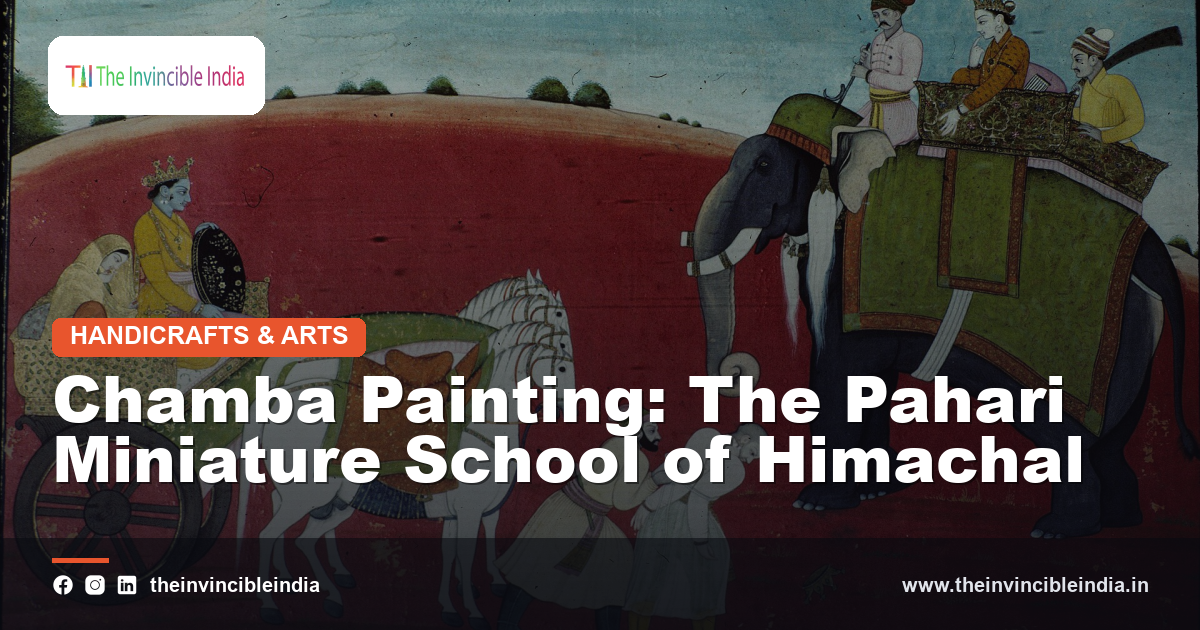
Chamba painting is the Pahari miniature tradition of the former princely hill state of Chamba, set in the Ravi river valley of present-day Himachal Pradesh. The style, also called the Chamba school, Chamba Kalam or Chamba miniature painting, grew from the refined manner of neighbouring Guler and Kangra but acquired a bolder palette and a distinct local flavour. It produced court portraits, devotional scenes and poetic illustrations, and it shaped related crafts such as the embroidered Chamba rumal. Like the courtly pictures that connect the hill kingdoms with the miniature heritage of traditional handicrafts of Rajasthan, it is an art of small, precise and richly coloured works.
Quick answer: Chamba painting is a school of Pahari miniature art that developed in the former hill state of Chamba, in present-day Himachal Pradesh. It is known for flat, saturated colour, firm outline and a lively local character, and it illustrated Hindu epics, devotional poetry, Ragamala themes and court portraits. Influenced by the Guler and Kangra styles, the Chamba school also left a legacy in temple murals and in the embroidered Chamba rumal.
Key Takeaways
- Chamba painting is a regional school of Pahari miniature painting from the former hill state of Chamba in Himachal Pradesh.
- The style grew under the influence of the Guler and Kangra schools while developing bolder colour and a local character.
- Typical subjects include the Bhagavata Purana, the Ramayana, the Gita Govinda, Ragamala themes and court portraits.
- Artists use mineral and vegetable pigments, handmade paper and very fine brushes, and may add gold or silver for ornament.
- The Chamba rumal, an embroidered cloth, draws its designs from the Pahari painting tradition and holds a Geographical Indication.
- The Bhuri Singh Museum in Chamba is an important institution for the study and display of local painting.
The sections below explain the history, style, themes, materials and continuing life of this hill tradition.
Quick Facts
| Detail | Information |
|---|---|
| Type | Pahari miniature painting |
| Region | Chamba, Himachal Pradesh |
| Also called | Chamba school, Chamba Kalam |
| Related schools | Guler, Kangra and Basohli styles |
| Medium | Opaque watercolour on handmade paper |
| Related craft | Chamba rumal embroidery |
What Is Chamba Painting?
Chamba painting is a regional style of Pahari miniature painting made in and around the old hill state of Chamba. The pictures are small, painted in opaque watercolour on paper, and were produced in royal workshops for rulers, nobles and temples. They are admired for clear outline, flat zones of rich colour and a lively sense of character in faces and dress. While related to the softer naturalism of Guler and Kangra, the Chamba manner often appears more vivid and direct. Artists worked in a courtly tradition yet also absorbed local costume, architecture and landscape. This blend of refinement and regional identity is what makes the Chamba school easy to recognise and worth study.
Where Is Chamba and Why Did Painting Flourish There?
Chamba is a town and former princely state in the Ravi valley of Himachal Pradesh, in the western Himalayan foothills. Its position among mountain ridges and river valleys kept it culturally distinct while still connected to neighbouring hill courts through marriage, trade and travelling artists. Painting flourished there because the ruling family maintained a court that valued art, poetry and temple building, and because skilled painters moved between the hill kingdoms in search of patronage. The scenic setting, with its forests, rivers and temples, also inspired the backgrounds that appear in many pictures. Geography and patronage together created the conditions for a steady local school.
How Did Chamba Painting Develop?
Chamba painting developed over the eighteenth and nineteenth centuries as part of the wider Pahari movement that spread through the hill states. Early hill painting centred on bold centres such as Basohli, and later the graceful Guler and Kangra manner became the dominant influence across the region. Painters at the Chamba court adopted this refined style but kept a preference for strong colour and clear design. Artists and families often moved between courts, carrying techniques and compositions with them, so schools influenced each other constantly. The Chamba school therefore grew as a regional branch of a shared tradition rather than as an isolated invention, and its development reflects the lively exchange among the hill kingdoms.
Who Patronised Chamba Painting?
Chamba painting was patronised mainly by the ruling family and court of Chamba, with rulers such as Raja Umed Singh remembered as supporters of the arts. Patrons commissioned portraits of themselves and their families, illustrations of sacred texts, and decorative panels for palaces and temples. Court painters were often hereditary specialists whose families served several generations of rulers. Patronage also supported related crafts, since the same designs could guide embroiderers, woodcarvers and temple artisans. The strength of the Chamba school therefore rested on the steady commissions of a court that treated painting as a mark of culture and devotion, and on skilled families who passed their craft from one generation to the next.
What Makes the Chamba Style Distinctive?
The Chamba style is distinctive for its bold colour fields, firm outline and decorative sense of pattern. Backgrounds are often painted in strong reds, yellows, greens or blues, which makes the figures stand out clearly. Faces follow the Pahari convention of a straight profile with large, elongated eyes, while garments and jewellery are drawn with fine, careful detail. Architecture appears in flat, tidy planes, and trees and flowers are arranged as rhythmic accents rather than as deep landscape. The overall effect is more graphic and vivid than the soft, misty manner of the Kangra valley. These qualities give Chamba pictures a confident presence even at a very small size.
What Themes Do Chamba Paintings Depict?
Chamba paintings depict episodes from the Bhagavata Purana, the Ramayana, the Gita Govinda and other devotional texts, together with court portraits and scenes of royal life. The loves and adventures of Krishna were especially popular, as were stories of Rama and the divine feminine in the form of the goddess. Artists also painted rulers in audience, at worship or at leisure, giving later viewers a record of dress, ornament and ceremony. Each picture usually concentrates on one clear moment, arranged so that the main figures are visible at once. Devotion and courtly life together provide the two great streams of subject matter in the Chamba school.
Ragamala and Poetic Illustration
Ragamala and poetic illustration form an important part of Pahari art, and the Chamba school shares in this tradition. A Ragamala painting visualises a musical mode, or raga, as a scene involving a hero, a heroine, a season or a mood, so that melody and emotion are expressed through colour and figure. Pictures drawn from romantic poetry present lovers, waiting heroines and meetings in gardens, using gesture and setting to suggest feeling. These works demonstrate how painting, music and literature were linked in court culture. For modern viewers they offer a way to understand how Indian artists translated sound and verse into image, and why such pictures remain so attractive.
Murals of the Rang Mahal and Temples
Chamba is also known for wall painting, especially the murals of the Rang Mahal, a palace building whose painted panels are now preserved in museum collections. These murals show figures and scenes in the same family of styles as the miniatures, enlarged to suit a wall and painted with confident, rhythmic colour. Temples of the region, with their carved stone and wooden elements, also formed part of a wider decorative culture that included painting. Mural work reveals that Chamba artists were not limited to small pictures but could plan large compositions. Wall painting and miniature painting together present a fuller image of the artistic life of the court.
Materials and Pigments
Chamba artists traditionally use handmade paper, mineral and vegetable pigments and brushes made from fine animal hair. Colours come from sources such as earths, ground stones, plants and lamp black, mixed with a natural gum so that they bind to the surface. Pure white and deep black are used for outline and emphasis, while gold or silver may be added to jewellery, crowns and borders to give a rich shine. Paper is often prepared in layers and smoothed so that the colour sits evenly. Natural materials give the paintings their glowing, matte depth and also connect modern artists with the methods of earlier generations. Careful preparation is therefore central to the finished work.
How Is a Chamba Miniature Painted?
A Chamba miniature is painted in stages, beginning with a light drawing and ending with the finest details. The artist first sketches the composition in outline, then lays in the broad areas of colour, building the layers patiently so that the surface is smooth and deep. Faces, hands and ornaments are painted last, using a very fine brush with only a few hairs. Borders are added to frame the scene, and burnishing with a smooth stone may be used to give the paper a gentle sheen. Because each stage depends on the one before it, the work demands steady concentration and control. The process can take days or weeks for a single small picture.
Chamba Rumal and Painting
The Chamba rumal is an embroidered cloth whose designs were traditionally drawn from the Pahari painting tradition, linking needlework with miniature art. A painter or outline artist would sketch a scene on fine cloth, and embroiderers, often women, would fill it in with silk thread using a double satin stitch that looks the same on both sides. Common subjects include Krishna and the gopis, scenes from epics, and festive or marriage themes. The craft has been recognised with a Geographical Indication, which helps protect its identity. The Chamba rumal shows how painted compositions travelled beyond paper and into textile art, giving the region a second celebrated heritage craft.
The Role of the Bhuri Singh Museum
The Bhuri Singh Museum in Chamba is an important institution for the study and display of local art, named after a former ruler of the state. It holds miniature paintings, murals, embroidered pieces, copper plates, manuscripts and other objects that document the cultural history of the region. Visitors and researchers can study the development of the Chamba school there and compare it with neighbouring styles. A museum of this kind helps keep fragile paintings safe and gives the public direct access to local heritage. By presenting art alongside the history of the state, it explains the context in which Chamba painting first arose and continues to inspire.
Chamba Painting and Other Pahari Schools
Chamba painting belongs to the wider family of Pahari schools, which includes Basohli, Guler, Kangra and several others. Basohli is noted for its intense colour and bold features, while Guler and Kangra are celebrated for lyrical naturalism and soft grace. Chamba sits within this range, borrowing the refinement of Kangra yet keeping a vivid, decorative strength. Painters and patrons moved across the hill states, so similarities are common and boundaries between schools are not always sharp. Understanding Chamba therefore means seeing it as part of a shared hill tradition, with local features that distinguish it. Comparing the schools helps viewers appreciate the variety within Pahari art.
Who Are the Chamba Artists Today?
Chamba artists today include painters, embroiderers and craftspeople who continue the regional tradition while adapting it to modern buyers. Some work in the miniature style, creating portraits, devotional scenes and decorative panels, while others focus on the Chamba rumal and related textile art. Training often happens within families or through workshops and cultural institutions, where younger artists learn drawing, colour preparation and fine brushwork. Many use traditional materials, although some adopt modern aids for convenience. Their work appears in craft fairs, exhibitions and private collections. Through such practice, the Chamba school remains a living craft that connects present-day Himachal with the court art of its past.
How Is Chamba Painting Being Preserved?
Chamba painting is being preserved through museums, training programmes, craft fairs, documentation and recognition of related crafts such as the Chamba rumal. Cultural agencies and institutions organise workshops that teach young people the skills of drawing, pigment preparation and fine brushwork. Exhibitions bring the art before wider audiences, and museum collections protect older works from damage and loss. Scholars record the history of the school so that its place within Pahari art is understood. Support for artists, including fair marketing and access to buyers, helps make the craft a viable livelihood. These combined efforts give the tradition a stable foundation for future generations of painters.
Chamba Painting Today
Chamba painting today is a living reminder of the artistic richness of the Himalayan foothills. Collectors, students and travellers can find miniature pictures, embroidered rumals and museum displays that show how the school evolved from a courtly practice into a regional craft. The tradition continues to inspire contemporary artists who value its clear line, bold colour and devotional warmth. Visitors to Chamba can combine the study of painting with temples, festivals and mountain scenery, which gives the art a vivid setting. As interest in handmade heritage grows, the Chamba school remains an enduring symbol of the creativity of Himachal Pradesh.
Sources & Further Reading
- Ministry of Culture, Government of India (indiaculture.gov.in).
- Archaeological Survey of India (asi.nic.in).
Frequently Asked Questions
What is Chamba painting?
Chamba painting is a school of Pahari miniature art from the former hill state of Chamba in Himachal Pradesh. It is known for bold colour, firm outline and subjects drawn from epics, devotional poetry and court life.
Where is Chamba painting from?
Chamba painting comes from Chamba, a town and former princely state in the Ravi valley of Himachal Pradesh. The style developed at the local court under the influence of the Guler and Kangra schools.
How is Chamba painting different from Kangra painting?
Chamba painting is usually bolder and more decorative in colour, while Kangra painting is known for soft, lyrical naturalism. Both belong to the Pahari tradition and share many conventions, so the difference is one of emphasis rather than kind.
What is the Chamba rumal?
The Chamba rumal is an embroidered cloth of Chamba whose designs come from the Pahari painting tradition. It is worked in a double satin stitch so that both sides look alike, and it holds a Geographical Indication.
What subjects do Chamba paintings show?
Chamba paintings show scenes from the Bhagavata Purana, the Ramayana and the Gita Govinda, along with Ragamala themes and court portraits. Stories of Krishna are especially popular.
Where can I see Chamba paintings?
Chamba paintings can be seen at the Bhuri Singh Museum in Chamba, which is devoted to local art and history. Larger museums and exhibitions of Indian miniature art also display examples of Pahari painting.


