

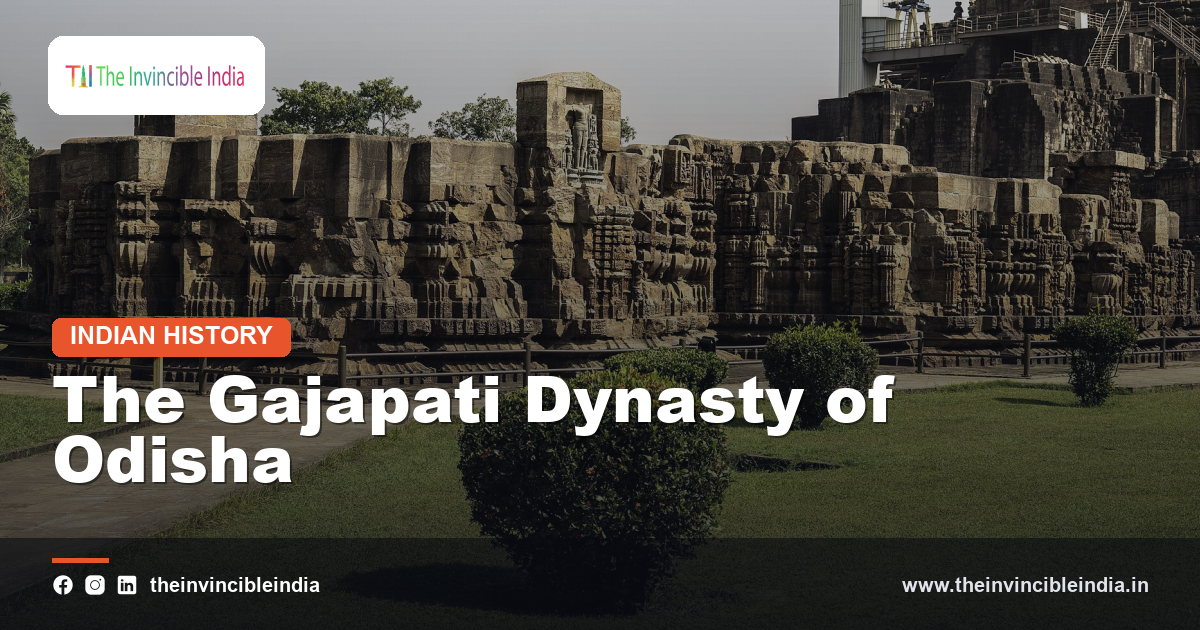
The Gajapati dynasty, also known as the Suryavamsi Gajapatis or the Gajapati kings of Odisha, was the medieval royal line that ruled Odisha and parts of the eastern coast after the Eastern Ganga rulers. The title Gajapati means lord of elephants, and the kings combined it with a devout service to Lord Jagannath at Puri. Their realm competed with the Vijayanagara empire and the Bahmani sultans, as recalled in our guide to the Vijayanagara Empire. Exact reign dates are debated, so this guide uses general terms.
Quick answer: The Gajapati dynasty was the medieval royal house of Odisha, founded by Kapilendra Deva in the fifteenth century after the Eastern Ganga period, whose kings took the title Gajapati and ruled as servants of Lord Jagannath. Their kingdom stretched across the eastern coast and fought repeated wars with Vijayanagara and the Bahmani sultanates before declining in the sixteenth century. The Gajapati title survives today as a ceremonial honour of the royal house of Puri.
Key Takeaways
- The Gajapati dynasty was the medieval royal line of Odisha that followed the Eastern Ganga rulers.
- Its founder, Kapilendra Deva, rose in the fifteenth century and extended the realm well beyond the Odisha coast.
- The title Gajapati means lord of elephants and became linked with a king who served Lord Jagannath.
- Purushottama Deva and Prataparudra Deva are remembered for wars with Vijayanagara and for patronage of Jagannath worship.
- The famous Sun Temple at Konark was built earlier, under the Eastern Gangas, and is part of the heritage the Gajapatis inherited.
- The dynasty fell in the sixteenth century, but the Gajapati title continues in the Puri royal house as a ritual office.
Read on for the history, culture, and legacy in detail.
Quick Facts
| Detail | Information |
|---|---|
| Dynasty | Gajapati (Suryavamsi Gajapati) dynasty of Odisha |
| Founder | Kapilendra Deva, in the fifteenth century |
| Region | Odisha and parts of the eastern coast of India |
| Title Meaning | Gajapati, lord of elephants |
| Presiding Deity | Lord Jagannath of Puri |
| Decline | Sixteenth century, with the end of independent Odishan rule |
Who Were the Gajapati Kings of Odisha?
The Gajapati kings were the rulers of Odisha from the fifteenth to the sixteenth century, and they governed one of the last major Hindu kingdoms of the eastern coast before the arrival of larger Islamic powers. They called themselves Suryavamsi, or of the solar line, and used the title Gajapati. Their kingdom grew from the heartland of Odisha into a wide empire reaching toward the Godavari and Krishna rivers. The kings were also patrons of art, literature and the cult of Jagannath. They are remembered as the last great dynasty of independent medieval Odisha.
What Does the Title Gajapati Mean?
The title Gajapati means lord of elephants, a style used by Odishan kings to emphasise military power and royal dignity. In the south and east of India, rulers adopted such titles to signal the strength of their forces, and the Gajapati name paired with Ashvapati and Narapati in the royal vocabulary of the age. In Odisha the title took on a unique religious dimension, since the Gajapati was regarded as the first servant of Jagannath. This duality made the king both a warrior and a ritual figure. The title continues to be used for the head of the royal house of Puri.
Where Did the Gajapatis Rule?
The Gajapatis ruled Odisha and, at their height, a long stretch of the eastern coast from the Ganga delta toward the Krishna river. Their heartland lay in the old Kalinga country around Cuttack, Puri and Bhubaneswar, with the Mahanadi river forming the core of the kingdom. In the south they pushed into the Telugu country, where they came into conflict with the Reddis and Vijayanagara. The coast offered trade and a stretch of ports, while the interior hills provided military manpower. The reach of the realm made it a leading power of the eastern seaboard.
The Eastern Gangas and the Background to Gajapati Rule
The Gajapatis took power in a land already shaped by the Eastern Ganga dynasty, whose rulers had built much of the great temple tradition of Odisha. The Eastern Gangas had sponsored the Jagannath temple at Puri and the Sun Temple at Konark, and they governed for several centuries. In the fifteenth century their line weakened, and a minister of the court, Kapilendra, rose to take the throne. The transition passed through a period of turmoil and was remembered in later chronicles. The Gajapatis therefore inherited a mature cultural landscape rather than creating one.
Kapilendra Deva: Founder of the Dynasty
Kapilendra Deva was the founder of the Gajapati dynasty, who rose from a position at the Ganga court to become king in the fifteenth century. He was a skilled general who extended his kingdom far to the south and west, challenging the Bahmani sultans and the Reddi chiefs of the Telugu country. He is also remembered for his support for Odia literature, and the poet Sarala Das, author of the Odia Mahabharata, is traditionally placed in his age. His descendants called themselves Suryavamsi to strengthen their claim to legitimacy. The reign of Kapilendra established the dynasty at the height of its power.
Purushottama Deva and the Kanchi Expedition
Purushottama Deva was the son and successor of Kapilendra, who held the throne in the late fifteenth century and fought to maintain the southern conquests. A famous legend tells of his expedition to Kanchi in pursuit of a princess, with the divine help of Jagannath and Balabhadra, who are said to have joined the army as horsemen. The story is preserved in tradition and in the Kanchi Kaveri poem, and it is treated by historians as a legend that carries a kernel of political history. He is also remembered for his role in the ritual life of the Puri temple. The legend demonstrates the close link between the monarchy and the deity.
Why Did the Gajapati King Sweep the Chariot?
The Gajapati king sweeps the chariot of Jagannath during the Ratha Yatra in a ritual known as chhera pahanra, expressing the idea that the king is the humblest servant of the deity. During the festival, the king cleans the floor of the chariot with a golden broom and sprinkles scented water before the deities are placed upon it. The tradition is linked to the Gajapati line and continues in the present day under the head of the Puri royal house. It symbolises the equality of all devotees before the Lord. The ritual thus ties royal authority to humility and service.
The Jagannath Cult under the Gajapatis
The Jagannath cult of Puri flourished under the Gajapatis, who treated the deity as the true sovereign of Odisha and themselves as his agents. The temple, built earlier under the Eastern Gangas, received royal grants and a detailed system of service called niti, which organised priests, cooks, musicians and artisans. The Gajapatis are traditionally credited with strengthening these arrangements and with giving the temple a central place in the kingdom’s identity. Jagannath worship drew on Vaishnava, Shaiva and tribal traditions, and the open character of the cult made it a unifying force. The result was a religious identity that outlived the dynasty.
Prataparudra Deva and the Age of Chaitanya
Prataparudra Deva was the best-known Gajapati king of the early sixteenth century, ruling during a time of intense warfare and religious change. He is remembered for his wars against Vijayanagara and for his encounter with the Bengal saint Chaitanya Mahaprabhu, who spent his later years at Puri. Tradition describes the king as a devoted follower who offered humble service to the saint. He also patronised scholars and poets, and the Panchasakha, five saint-poets of Odisha, flourished in this period. His reign marks the intellectual and devotional peak of the dynasty, even as its political strength began to wane.
Wars with Vijayanagara and the Bahmani Sultans
The Gajapatis fought a long series of wars with the Vijayanagara empire and the Bahmani sultans over the fertile lands of the Telugu coast. Early success under Kapilendra and Purushottama carried the frontier into the Krishna delta, but later reverses followed under the Vijayanagara king Krishnadevaraya, who captured key fortresses in the early sixteenth century. A peace was eventually reached, sealed by a marriage alliance between the two houses according to tradition. The conflicts shaped the borders of the south-east and showed the Gajapati realm as a first-rank power. The details of individual campaigns are debated by historians.
How Was the Gajapati Kingdom Governed?
The Gajapati kingdom was governed through a hierarchy of royal officials, provincial governors and local chiefs who held land and owed military service. The king was assisted by ministers, generals and temple officials, and revenue came from agriculture, trade and temple endowments. Forts guarded the coast and the hill frontiers, and a standing force of infantry, cavalry and elephants supported the monarch. Inscriptions and temple records, including the Madala Panji of the Jagannath temple, preserve useful information about administration. The system balanced central authority with local autonomy, a pattern common in medieval India.
What Is the Relationship between the Gajapatis and Konark?
The Sun Temple at Konark was built before the Gajapati dynasty, under the Eastern Ganga king Narasimhadeva I in the thirteenth century, and it is not a Gajapati monument. Its great stone chariot with carved wheels and horses stands on the Odisha coast and belongs to the architectural tradition that the Gajapatis inherited. By the time of the Gajapati era, parts of the temple were already in disrepair, and its fortunes declined in the following centuries. The Gajapatis directed their patronage mainly toward the Jagannath temple at Puri. Konark thus forms part of the wider heritage of the land they ruled.
Odia Language and Literature in the Gajapati Age
Odia language and literature flourished in the Gajapati age, as court and temple patronage encouraged writing in the regional language rather than Sanskrit alone. The Odia Mahabharata of Sarala Das, composed in the fifteenth century, is regarded as a landmark of the language. Later poets of the Panchasakha group, including Balarama Das and Jagannatha Das, brought devotional themes to the common people. The Jagannath temple became a centre of song, dance and ritual, giving rise to the Odissi tradition. The age thus strengthened the identity of Odia as a literary language.
Art, Temples and Sculpture
Art and architecture in the Gajapati age continued the Kalinga tradition of temple building, with sculpture, stone carving and decorative paintings. The kings supported temples at Puri, Bhubaneswar and other centres, and the school of painting known as pattachitra grew around the Jagannath cult. Artisans produced palm-leaf manuscripts with fine incised drawings, and textile and metal crafts developed alongside. Although few new temples of the scale of Konark were built, the age is remembered for the renewal and expansion of existing shrines. Its artistic legacy lives on in the craft traditions of Puri and Raghurajpur.
Govinda Vidyadhara and the End of the Dynasty
The Gajapati dynasty ended in the sixteenth century after a period of weak rulers, court intrigue and a usurpation by the minister Govinda Vidyadhara. The last line of kings, including the young ruler Mukunda Deva, struggled to hold the kingdom together amid pressure from the Bengal Sultanate. Mukunda Deva, sometimes counted as the last independent Hindu king of Odisha, was defeated and killed in battle in the late sixteenth century according to tradition. The Odishan territory then passed to the sultans and later to the Mughals. The fall of the dynasty is commonly seen as the end of the medieval Odishan monarchy.
The Gajapati Legacy in Odisha Today
The Gajapati legacy survives in the ritual role of the Gajapati Maharaja of Puri, who performs the chhera pahanra at the Ratha Yatra and holds the first place among the servants of Jagannath. The Odia language, Odissi culture and the Jagannath cult all reflect the age of the Gajapatis, and their memory is cherished in the folklore of the state. Scholars continue to debate chronology and individual achievements, and the dynasty remains an active subject of research. Visitors to Puri and Bhubaneswar encounter the heritage of the Kalinga tradition at every turn. The Gajapatis remain central to the story of Odisha.
Sources & Further Reading
- Archaeological Survey of India (asi.nic.in).
- Ministry of Culture, Government of India (indiaculture.gov.in).
Frequently Asked Questions
Who founded the Gajapati dynasty?
The Gajapati dynasty was founded by Kapilendra Deva in the fifteenth century. He rose from a position at the Eastern Ganga court and expanded the kingdom across the eastern coast.
What does Gajapati mean?
Gajapati means lord of elephants. It was a royal title used by the kings of Odisha, and it later became associated with the ritual office of the king who serves Lord Jagannath.
Who built the Konark Sun Temple?
The Konark Sun Temple was built by the Eastern Ganga king Narasimhadeva I in the thirteenth century, before the Gajapati dynasty. It is part of the Odishan heritage that the Gajapatis inherited.
What is the chhera pahanra ritual?
Chhera pahanra is the ritual in which the Gajapati king sweeps the floor of Lord Jagannath’s chariot with a golden broom during the Ratha Yatra. It expresses the idea that the king is the humblest servant of the deity.
Who was Prataparudra Deva?
Prataparudra Deva was a Gajapati king of the early sixteenth century, known for his wars against Vijayanagara and his devotion to Chaitanya Mahaprabhu. His reign is remembered for religious and literary flourishing.
How did the Gajapati dynasty end?
The dynasty ended in the sixteenth century after a period of weak rule and the usurpation of Govinda Vidyadhara. The last king, Mukunda Deva, was defeated by forces of the Bengal Sultanate according to tradition.


