

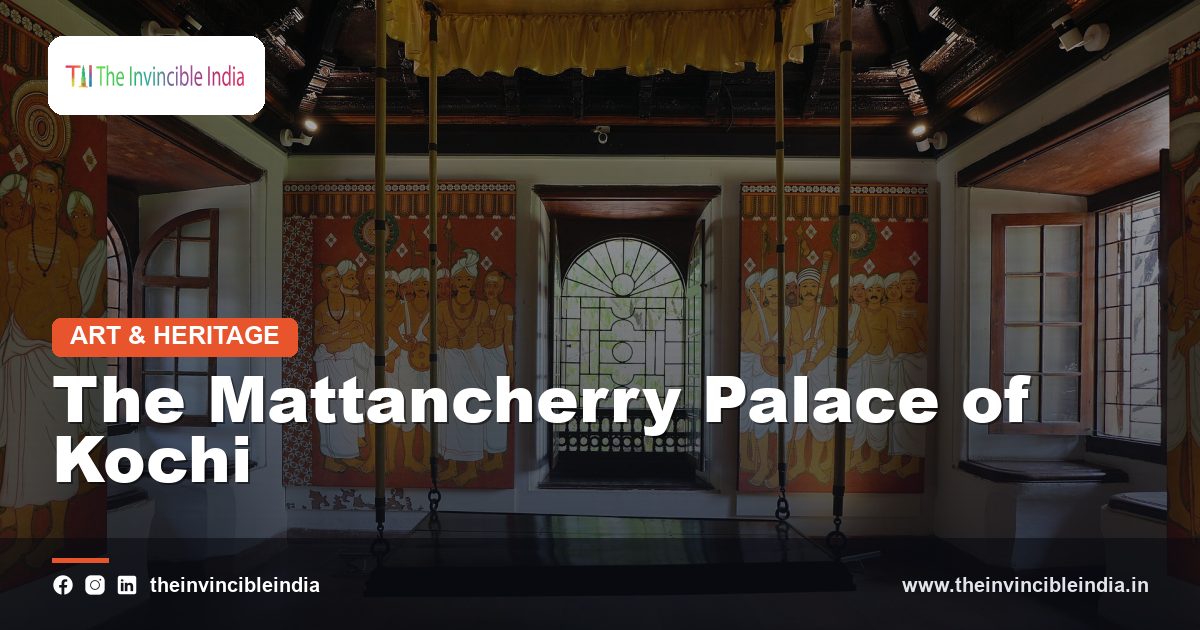
The Mattancherry Palace, popularly called the Dutch Palace, is a historic royal residence in the Mattancherry quarter of Kochi, Kerala. Traditionally said to have been built by the Portuguese in the sixteenth century as a gift for the Raja of Cochin, it later came under Dutch renovation, which gave it the name by which most visitors know it. Behind its plain exterior lies a Kerala-style quadrangular palace that holds some of the finest mural paintings in India. The palace belongs to the tradition surveyed in the guide to the royal palaces of India, and it now serves as a museum of the Cochin royal family. This guide explains its history, architecture and art.
Quick answer: The Mattancherry Palace, also called the Dutch Palace, is a sixteenth-century royal residence in Mattancherry, Kochi, Kerala, built in the Kerala nalukettu style. It was traditionally built by the Portuguese for Raja Veera Kerala Varma of Cochin and was later renovated by the Dutch. It is celebrated for its colourful Ramayana and Puranic murals and now houses a museum of the Cochin rajas under the Archaeological Survey of India.
Key Takeaways
- The Mattancherry Palace is a royal residence in Mattancherry, Kochi, Kerala, popularly called the Dutch Palace.
- It was traditionally built by the Portuguese in the sixteenth century as a gift for Raja Veera Kerala Varma of Cochin.
- The Dutch renovated the palace in the seventeenth century, which gave it the name Dutch Palace.
- The palace follows the Kerala nalukettu plan, a quadrangular building around a central courtyard.
- Its walls hold murals depicting the Ramayana and scenes from Hindu myth, among the finest in Kerala.
- The palace is today a museum of the Cochin royal family, maintained by the Archaeological Survey of India.
The sections below describe how the palace was built, what it contains and why it remains one of the best known monuments of Kochi.
Quick Facts
| Detail | Information |
|---|---|
| Location | Mattancherry, Kochi, Kerala |
| Also known as | Dutch Palace, Mattancherry Palace Museum |
| Type | Royal palace in Kerala nalukettu style |
| Traditional builders | The Portuguese, for the Raja of Cochin |
| Era | Sixteenth century, renovated by the Dutch in the seventeenth century |
| Notable features | Ramayana murals, coronation hall, courtyard shrine, royal museum |
What Is the Mattancherry Palace?
The Mattancherry Palace is a historic royal palace in Kochi, Kerala, built in the sixteenth century and now preserved as a museum. It is known as the Dutch Palace, although it was not built by the Dutch, and it was originally used by the rajas of Cochin as a residence and as a place for ceremonies. The building is modest in scale and plain in its exterior, but it hides a rich interior of carved wood, polished floors and painted walls. The palace combines the traditional architecture of Kerala with a few features that reflect the contact between local rulers and European traders. It is one of the most visited monuments of old Kochi. The Mattancherry Palace therefore serves as both an artistic treasure and a vivid record of the encounter between Kerala and the wider world.
Where Is the Mattancherry Palace Located?
The Mattancherry Palace is located in the Mattancherry quarter of Kochi, a historic port district in the state of Kerala. It stands near the waterfront, close to the old Jew Town with its Paradesi Synagogue and spice warehouses, and not far from Fort Kochi across the harbour. This district was the commercial heart of old Cochin, where Arab, Chinese, Portuguese, Dutch, Jewish and Indian traders met. The palace is reached by road from Ernakulam and by a short ferry or road journey from Fort Kochi. The surrounding streets are lined with shops selling spices, antiques and crafts, and they give a lively introduction to the history of the port. The location of the Mattancherry Palace thus places it in one of the most culturally layered neighbourhoods in India.
Why Is It Called the Dutch Palace?
The Mattancherry Palace is called the Dutch Palace because the Dutch East India Company renovated and extended it in the seventeenth century, after taking Cochin from the Portuguese. The name is somewhat misleading, since the building was already standing before the Dutch arrived, and its design is largely that of a Kerala palace. The Dutch repaired the structure and are said to have made additions that suited their relations with the Cochin rulers. Over time the label stuck in popular usage, and it became the common name for the monument. The palace is still officially known as the Mattancherry Palace, and many visitors use both names. The name Dutch Palace thus records a chapter of colonial history, even though the building remains fundamentally a Kerala royal residence.
Who Built the Mattancherry Palace?
The Mattancherry Palace is traditionally said to have been built by the Portuguese around the middle of the sixteenth century as a gift for Raja Veera Kerala Varma of Cochin. The Portuguese were then the leading European power on the Malabar coast, and they wished to win the favour of the Cochin ruler, who allowed them to trade and build forts. The gift is often described as a gesture of goodwill, and in some accounts it is linked to compensation for damage to a temple. Historians discuss the exact circumstances, and the details are known mainly through tradition and later records. The raja and his successors used the palace for ceremonies. The Portuguese origin thus makes the Mattancherry Palace a symbol of early diplomacy between a Kerala dynasty and European newcomers.
What Is the Nalukettu Plan of the Palace?
The Mattancherry Palace follows the nalukettu plan, a traditional Kerala architectural form with four blocks arranged around a central open courtyard. This plan is typical of the larger houses of Kerala, where the courtyard brings in light and air and serves as the focus of family life. At Mattancherry the courtyard holds a small shrine, and the surrounding blocks hold halls, chambers and corridors with sloping tiled roofs. The sloping roofs are an adaptation to the heavy monsoon rains of the region, and the deep eaves provide shade. The palace thus reflects the climate and customs of Kerala. The nalukettu form also gives the building a calm inward-looking quality. The Mattancherry Palace therefore stands as a fine example of how Kerala builders created homes suited to both the weather and the way of life.
What Materials and Features Give the Palace Its Character?
The palace is built of laterite, timber and clay tiles, materials that are typical of Kerala architecture and well suited to its humid climate. Laterite forms the walls, while carved wooden ceilings and beams support the sloping tile roofs. Inside, the floors are traditionally said to be made of a mixture of burnt coconut shells, charcoal, lime, plant juices and egg white, which gives them a smooth dark polish that looks like glass. The woodwork includes carved panels and ceilings that show fine craftsmanship. The wide verandahs and shuttered windows help keep the rooms cool. These materials and features give the palace its distinct character. The Mattancherry Palace therefore shows how local resources and skills were combined to create a comfortable and elegant royal home.
What Is the Coronation Hall?
The coronation hall is the principal ceremonial room of the Mattancherry Palace, where the rajas of Cochin are traditionally said to have been crowned. It is a spacious chamber with a carved wooden ceiling, polished floor and walls decorated with murals. The hall served as the setting for royal assemblies and rituals, and today it is preserved as part of the museum display. The coronation of the Cochin kings was an important event, linking the ruler to the traditions of Kerala kingship. The room also holds portraits and memorabilia of the royal family. Its quiet dignity contrasts with the busy streets outside. The coronation hall thus gives visitors a feeling for the ceremony and authority of the royal household that once used the palace.
What Murals Does the Palace Contain?
The palace contains a remarkable set of Kerala murals, painted directly on the walls in rich natural colours, depicting scenes from the Ramayana, the Puranas and other Hindu stories. The murals are among the finest surviving examples of the Kerala mural tradition and are often described as the highlight of the palace. The paintings cover the walls of several rooms, with the Ramayana cycle forming one of the most complete narratives. Their figures have large expressive eyes, flowing outlines and ornamented costumes. Scholars date the murals to a period after the palace was built, and the exact dates and painters are discussed. The murals bring the old stories to life in colour and movement. The Mattancherry Palace murals thus stand as a priceless record of Kerala’s classical painting art.
How Are the Kerala Murals Painted?
Kerala murals are painted on a prepared lime plaster wall using natural pigments drawn from minerals, plants and earth. The palette is limited to a few bold colours such as red, yellow, green, black and white, which are applied in flat areas with strong outlines. The painter first sketches the composition and then fills in the colours in stages, finishing with fine detail. The figures follow strict conventions, with face, posture and colour indicating character and mood. For example, noble heroes are often painted in green, and fierce beings appear in red. The art draws on the stage traditions of Kerala, including Kathakali, in its expressive gestures and costume. The technique thus shows how mural painting in Kerala combined discipline, symbolism and vivid colour in an art of lasting beauty.
What Stories Do the Ramayana Murals Tell?
The Ramayana murals of the palace narrate the epic story of Rama, from his birth and marriage to his exile, the abduction of Sita and the final return. The scenes are arranged in sequence along the walls, so that a viewer can follow the narrative in order. The epic is shown with a mix of dramatic and tender moments, from battles and journeys to moments of devotion. The painters used the standard visual language of Kerala art, with stylised figures and richly patterned costume. The murals serve as both illustration and devotional art, and they have long been studied as a window into the Ramayana tradition in Kerala. The Ramayana murals of Mattancherry thus carry an ancient story into the visual culture of the Cochin court.
What Other Mythological Scenes Are Painted There?
Besides the Ramayana, the palace murals depict scenes involving Krishna, Shiva, Vishnu and a range of Puranic tales, painted in the same classical Kerala style. Among them are scenes of Krishna’s childhood and his pastimes with the gopis, depictions of Shiva and Parvati, and images of the goddess in her many forms. Some rooms, including a bedchamber, feature lyrical and sensuous imagery that has drawn the attention of art historians. The variety of subjects shows the breadth of religious and literary culture at the Cochin court. The painters adapted classic stories to the shape of each wall, using borders and floral patterns to frame the scenes. These murals complete the palace’s decorative scheme. The other mythological scenes thus enrich the Mattancherry Palace as a gallery of Kerala devotion and imagination.
What Does the Museum Display?
The palace now houses a museum of the Cochin royal family, with a collection of portraits, royal robes, palanquins, weapons, coins and ceremonial objects. The portraits of the rajas of Cochin hang in the halls, giving a visual record of the dynasty across the centuries. The displays include articles used in royal ritual and daily life, and they illustrate the customs of the court. The museum also shows how the Cochin kings ruled as a small but important power on the Malabar coast, trading with many nations. The collection is arranged in the rooms of the palace itself, so that visitors experience the objects in their original setting. The museum therefore enriches the visit to the Mattancherry Palace, turning a beautiful building into a lively portrait of the Cochin royal household.
What Is the Courtyard Shrine?
A small temple stands in the central courtyard of the palace, dedicated to the goddess Pazhayannur Bhagavathi, the family deity of the Cochin royal house. The shrine reflects the custom that Kerala palaces include a place of worship within their precincts, tying royal life to religious devotion. The courtyard also gives light and a sense of calm to the palace. Visitors can see the shrine from the surrounding verandahs, although entry is usually limited to ritual use. The presence of the shrine reminds visitors that the palace was a family home as well as a seat of authority. The courtyard shrine therefore expresses the close bond between royalty and devotion in Kerala, and it gives the Mattancherry Palace a spiritual centre.
How Does the Palace Reflect Cultural Exchange?
The Mattancherry Palace reflects the cultural exchange that shaped Kochi, because it was linked to Portuguese gift-giving, Dutch renovation and Kerala craftsmanship. Kochi was a meeting place for many peoples, including Arabs, Chinese, Jews, Portuguese, Dutch and British, and each left a mark on the city. The palace shows this interaction in quiet ways, with a Kerala building raised under foreign patronage, kept by local rajas and repaired by European companies. The surrounding quarter also includes the Paradesi Synagogue, built in the sixteenth century, and old trading houses. This blend of cultures is one of the defining features of Kochi. The Mattancherry Palace thus serves as an emblem of the port’s cosmopolitan past and its tradition of openness.
How Is the Palace Protected and Visited?
The Mattancherry Palace is maintained as a protected monument by the Archaeological Survey of India, which also runs the museum within it. Conservation work focuses on the delicate murals, the woodwork and the floors, which need careful control of humidity and light. Photography inside the galleries is usually restricted to protect the paintings, and visitors should follow the posted rules. The palace is open to the public on most days, and a visit takes about an hour. It is easily combined with the Paradesi Synagogue, the spice markets and a walk through Fort Kochi. The cooler months from November to February are the most comfortable for visiting. Careful protection and respectful visiting together help preserve the palace and its murals for future generations.
The Mattancherry Palace Today
The Mattancherry Palace today stands as one of the most treasured heritage sites in Kochi, valued for its architecture, murals and history. It draws students of art, travellers and families, and it is often a highlight of a visit to Kerala. Its murals remain a key resource for the study of Kerala painting, while its museum preserves the memory of the Cochin royal house. The palace also anchors the heritage character of Mattancherry, along with the nearby synagogue, markets and old warehouses. For readers interested in India’s royal palaces, it offers a distinctive contrast to the grand palaces of Rajasthan, with its modest scale and rich interior. The Mattancherry Palace thus continues to tell the story of Kochi, a port city shaped by trade, faith and art.
Sources & Further Reading
- Archaeological Survey of India (asi.nic.in).
- Kerala Tourism, Government of Kerala (keralatourism.org).
Frequently Asked Questions
What is the Mattancherry Palace?
The Mattancherry Palace is a sixteenth-century royal palace in Mattancherry, Kochi, Kerala, popularly called the Dutch Palace. It was traditionally built by the Portuguese for the Raja of Cochin and later renovated by the Dutch. It is famous for its Ramayana murals and its museum of the Cochin royal family.
Why is the Mattancherry Palace called the Dutch Palace?
It is called the Dutch Palace because the Dutch renovated and extended it in the seventeenth century. The building was already standing before the Dutch arrived and is largely a Kerala-style palace. The name has remained in popular use.
Who built the Mattancherry Palace?
The Mattancherry Palace is traditionally said to have been built by the Portuguese around the middle of the sixteenth century as a gift for Raja Veera Kerala Varma of Cochin. The details are known mainly through tradition and later records. Historians discuss the exact circumstances.
What is the Mattancherry Palace famous for?
The Mattancherry Palace is famous for its Kerala murals depicting the Ramayana and other Hindu myths, painted in natural colours on the walls. It is also known for its nalukettu design and its museum of the Cochin royal family. The murals are among the finest in Kerala.
Where is the Mattancherry Palace located?
The Mattancherry Palace is located in the Mattancherry quarter of Kochi in Kerala, near Jew Town and the Paradesi Synagogue. It is a short journey from Fort Kochi. The area is known for spice markets and antiques.
Can visitors take photographs inside the Mattancherry Palace?
Photography is generally restricted inside the galleries and mural rooms to protect the paintings. Visitors should follow the rules posted at the entrance and by museum staff. Current arrangements should be checked before visiting.


