

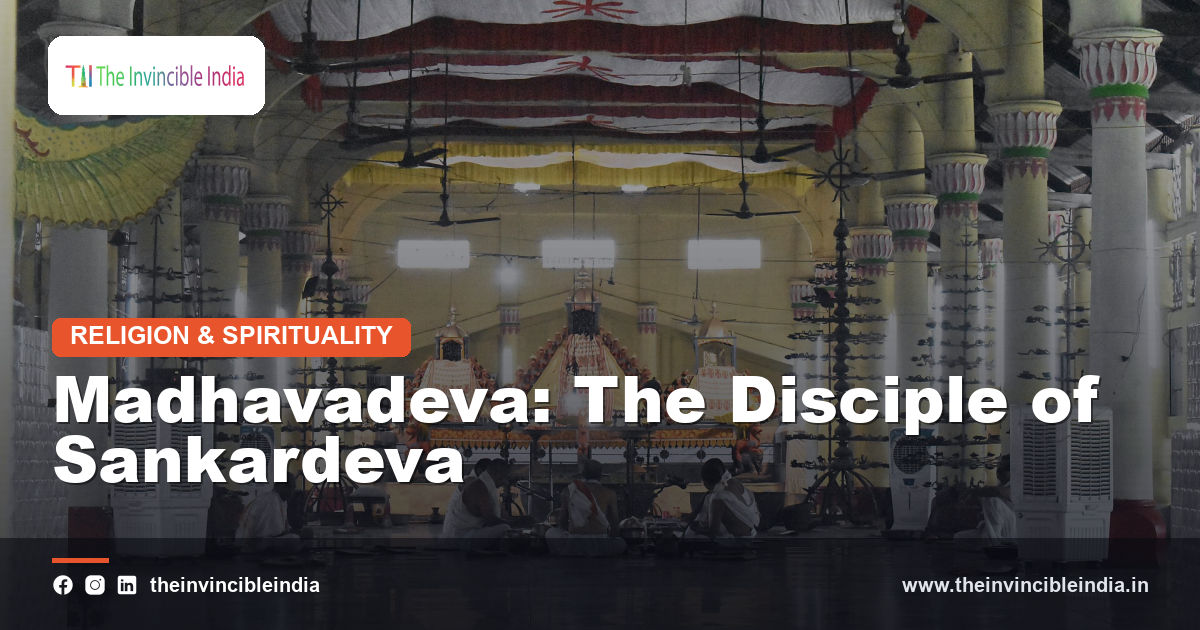
Madhavadeva, also spelled Madhabdev or Madhavdev and honoured as Mahapurush Madhavadeva, is revered in Assam as the chief disciple and spiritual successor of the saint Sankardeva. Traditionally placed in the sixteenth century, he is remembered as a poet, dramatist, devotional composer and organiser of the Vaishnava faith known as Ekasarana Naam Dharma, which centres on devotion to Krishna through the chanting of the divine name. His verses and songs are still sung in the prayer halls of Assam. This guide describes his life and works in general terms and notes where details rest on tradition. It also places him within the wider Bhakti movement of India.
Quick answer: Madhavadeva is a sixteenth-century Assamese Vaishnava saint, poet and dramatist who was the foremost disciple of Sankardeva and helped establish the Ekasarana Naam Dharma in Assam. He is best remembered for the Namghosha, a collection of devotional verses, for his borgeets and one-act plays, and for strengthening the satra and namghar institutions. He is honoured by devotees across Assam as a guru of the Neo-Vaishnava tradition.
Key Takeaways
- Madhavadeva, also written Madhabdev, was the chief disciple and successor of Sankardeva, the founder of Assamese Neo-Vaishnavism.
- Tradition places him in the sixteenth century, in the region of Assam and the neighbouring Koch kingdom.
- His best-known work is the Namghosha, a collection of devotional verses that is recited in namghars across Assam.
- He composed borgeets, which are devotional songs, and one-act plays in the Ankiya Nat tradition, written in the literary language Brajavali.
- He is traditionally remembered as a lifelong renunciant who devoted himself to his guru and to the growth of the faith.
- The Ekasarana Naam Dharma that he served teaches devotion to Krishna through listening to and chanting the divine name.
The sections below set out his life, works, teachings and present-day legacy in more detail.
Quick Facts
| Detail | Information |
|---|---|
| Also known as | Madhabdev, Madhavdev, Mahapurush Madhavadeva |
| Tradition | Assamese Neo-Vaishnavism (Ekasarana Naam Dharma) |
| Era | Traditionally the sixteenth century |
| Region | Assam and the neighbouring Koch kingdom |
| Guru | Sankardeva |
| Best-known works | Namghosha, borgeets, Ankiya Nat plays, Bhakti Ratnavali |
Who Was Madhavadeva?
Madhavadeva was an Assamese saint, poet and teacher who became the chief disciple and spiritual successor of Sankardeva. He is counted together with his guru among the two great figures of the Vaishnava revival in Assam, and devotees commonly speak of the two as Sankardeva and Madhavadeva in a single breath. His life belongs to the sixteenth century, according to the tradition of the region.
He is remembered for combining devotion with literary skill and organisational ability. Where Sankardeva laid the foundations of the faith, Madhavadeva consolidated it through writing, song and the care of its institutions. Taken together, these roles explain why he holds an honoured place in Assamese religious and literary life.
Where and When Did Madhavadeva Live?
Madhavadeva lived in the sixteenth century in the region that is now Assam, with strong ties to the neighbouring Koch kingdom in the lower Brahmaputra valley. Tradition associates his birthplace with the north bank area of the Brahmaputra, and the biographies of the community narrate his early years in a family of devotional leanings. Precise dates and places differ between the traditional accounts, so careful writers describe them in general terms.
This was an age of political change and cultural growth in the Brahmaputra valley, and the Vaishnava movement spread across many communities during it. Madhavadeva therefore stands at the meeting point of religious reform, regional language and local kingship, which gives his story a wider historical interest.
How Did Madhavadeva Meet Sankardeva?
According to the devotional biographies, Madhavadeva first met Sankardeva after an earlier life in a household devoted to the worship of the Goddess. The traditional account says that the two held a long discussion, after which Madhavadeva accepted the path of Vaishnava devotion and became the disciple of Sankardeva. This is a story told within the community, so it is best read as tradition and not as a verified historical record.
Whatever the exact details, the account expresses how the tradition understands the bond: a learned and sincere seeker finding a teacher who answered his questions. From that meeting onward, the two are remembered as inseparable companions in the work of spreading devotion across Assam.
What Is Ekasarana Naam Dharma?
Ekasarana Naam Dharma is the Vaishnava path taught by Sankardeva and Madhavadeva, centred on taking refuge in one supreme deity, Krishna, and on the practice of listening to and chanting the divine name. The word Ekasarana means taking shelter in one, and Naam Dharma means the religion of the divine name. The path is based on the Bhagavata Purana and the Bhagavad Gita.
Its practice is simple and open. Devotees gather to sing, listen to scripture and chant together, without the need for elaborate ritual or a priestly intermediary. Madhavadeva served this path through his songs, verses and plays, and through the guidance he gave to the growing community. The teaching therefore reached ordinary people in their own language.
What Is the Namghosha?
The Namghosha is the best-known work of Madhavadeva, a collection of devotional verses in Assamese that praise the divine name and teach the path of devotion. It is also known by the name Hazari Ghosha, a title that points to the roughly thousand verses traditionally ascribed to it. Devotees recite its verses in namghars, the community prayer halls of Assam.
The work is valued for its clear language and its gentle, direct tone. It presents the chanting of the name of God as the central practice of the faith and urges humility, steadiness and faith. Because it is memorised and recited by ordinary worshippers, the Namghosha has remained a living scripture, one that links the sixteenth-century saint with devotees of the present day.
What Other Works Did Madhavadeva Write?
Besides the Namghosha, Madhavadeva is credited with several other works in Assamese and in Sanskrit-influenced verse. Among the titles associated with him are the Bhakti Ratnavali, a work on the nature of devotion, the Janma Rahasya, which treats the birth of Krishna, the Rajasuya Yajna, and the Adi Dasama, a retelling of the early part of the tenth book of the Bhagavata Purana.
These works show a mind at home in both scripture and storytelling. They brought the stories and teachings of the Puranas to listeners who did not read Sanskrit, and they did so in verse that could be sung or recited aloud. This range of writing is one reason Madhavadeva holds an important place in the history of Assamese literature.
What Are Madhavadeva's Borgeets?
Borgeets are devotional songs of Assam, composed in set musical modes, and Madhavadeva is remembered as one of the two great composers of this form together with Sankardeva. The word means great songs. They are sung in praise of Krishna and express themes of surrender, longing and the greatness of the divine, and they are performed in the namghar and in temples.
The songs are written in Brajavali, a literary language that blends elements of Assamese with other eastern Indian speech, and they are set to ragas in the classical manner. Their gentle poetry and musical structure have kept them alive for centuries. Borgeets remain part of Assam’s devotional and cultural identity, and they are still taught to students of music and Sattriya art.
How Did He Contribute to Ankiya Nat?
Madhavadeva contributed to Ankiya Nat, the tradition of one-act devotional plays that Sankardeva began, by composing plays of his own on episodes from the life of Krishna. Titles traditionally associated with him include Arjuna Bhanjana, Chordhara, Pimpara Guchowa and Bhojan Behar. They are lively and often light in tone, with songs, dance and playful scenes drawn from Krishna’s childhood.
These plays were staged in the namghar, with a narrator and musicians, and are known in performance as bhaona. They combined entertainment with teaching, allowing ordinary villagers to learn sacred stories through drama. Madhavadeva’s plays are still performed in Assam, and they stand as a living part of the state’s theatre and devotional heritage.
How Did Madhavadeva Lead the Community?
Madhavadeva guided the Vaishnava community after the passing of Sankardeva and worked to keep the faith united and orderly. Tradition says that he took on this duty out of loyalty to his guru, and that he gave the movement a settled form through teaching, writing and the care of its institutions. He is therefore remembered as an organiser as well as a poet.
Leadership in this tradition is described as service rather than command. Madhavadeva is portrayed as humble and devoted, placing the guru’s mission above personal recognition. His steady work helped the movement pass from its founder to later generations of teachers, and this continuity is a large part of why Ekasarana remains active in Assam today.
What Are a Satra and a Namghar?
A satra is a monastic and cultural institution of Assamese Vaishnavism, and a namghar is a prayer hall where the community gathers for devotion. A satra is headed by a satradhikar and houses devotees who study, pray, perform music and dance, and care for the shrine. A namghar serves a village or neighbourhood as a place for chanting, scripture reading and community events.
These institutions grew in importance under the successors of Sankardeva, and Madhavadeva is remembered for helping to strengthen them. They became centres of learning and art, and the Sattriya dance and music traditions grew inside them. Today the satras, especially those on the river island of Majuli, are among the best-known living heritage sites of Assam.
Which Satra Is Associated with Madhavadeva?
The Barpeta Satra in the Barpeta district of Assam is the institution most closely associated with Madhavadeva. Tradition links its founding to him, and it was developed further by the teachers who followed. Barpeta is today an important centre of the Ekasarana tradition and a place of pilgrimage for devotees.
The satra is known for its large namghar and for its lively cultural life, including the performance of devotional music and the annual festivals that draw large numbers of worshippers. Visitors encounter a community that keeps the old practices alive, from the chanting of the Namghosha to the staging of traditional plays. The satra shows how Madhavadeva’s work continues in a real and active institution.
Why Is Madhavadeva Remembered as a Renunciant?
Madhavadeva is remembered as a renunciant because tradition describes him as having lived a life of celibacy and single-minded service to his guru and to the faith. In the devotional biographies, he gave up worldly ambition and devoted himself to worship, writing and teaching. Details of his daily life are preserved in the stories of the community and should be read with that in mind.
The image of a humble servant of the guru is central to how devotees see him. It reflects an ideal of devotion in which personal ambition is set aside for a larger purpose. For those who study the tradition, the portrait of Madhavadeva offers a picture of discipline, loyalty and quiet strength that continues to inspire respect.
How Did the Movement Reach Ordinary People?
The Vaishnava movement of Sankardeva and Madhavadeva reached ordinary people by using their own language, simple forms of worship and community gatherings. Instead of relying only on Sanskrit and elaborate ritual, the saints composed in Assamese and Brajavali, taught through songs and plays, and invited people of many backgrounds into the namghar.
This inclusive approach is a defining feature of the tradition. People from different communities of the Brahmaputra valley took part in its prayer and its arts. Madhavadeva’s verses, which are easy to memorise and sing, played a part in this reach. The result was a faith that was rooted in daily village life and that gave Assamese culture a shared devotional vocabulary.
How Is Madhavadeva Linked to Sattriya Culture?
Madhavadeva is linked to Sattriya culture because the music, dance and drama of the satras grew from the devotional works of the saints and their followers. The borgeets he composed, the plays he wrote and the musical traditions of the namghar became the basis of the Sattriya performing arts. Sattriya dance is now recognised among the classical dance forms of India.
The art form was preserved for generations by the monks of the satras and later brought to wider audiences. It carries the devotional spirit of the tradition into movement and music. In this sense, Madhavadeva’s creative legacy is not limited to written texts but continues as living performance, which is how many people today first come to know his name.
How Should Traditional Accounts Be Read?
Traditional accounts of Madhavadeva should be read as devotional biography, valuable for what they reveal about how the community sees him. Stories of his early life, his meeting with Sankardeva and his final years are told with reverence, and dates and details differ between the sources. They do not always meet the standards of modern historical records.
A respectful approach keeps two things in view. His surviving writings can be studied directly and give firm evidence of his thought and style, while the stories around his life express devotion and carry meaning of their own. Holding both together lets a reader honour the tradition while staying careful about specific historical claims.
Madhavadeva Today
Madhavadeva remains a living presence in Assamese religious and cultural life. His Namghosha is recited in namghars, his borgeets are sung in homes and satras, and his plays are staged in bhaona performances across the state. Devotees observe the anniversaries of the saints with prayer, music and community gatherings, and the satras of Barpeta and Majuli keep the tradition vivid.
For students of Indian culture, he offers a clear example of how a regional saint can shape language, art and community life. His example shows the strength of the Bhakti tradition in the Brahmaputra valley and its ability to unite faith with creativity. Readers who wish to learn more can explore translations of his works and visit the satras of Assam.
Sources & Further Reading
- Ministry of Culture, Government of India (indiaculture.gov.in).
- Sangeet Natak Akademi (sangeetnatak.gov.in).
Frequently Asked Questions
Who was Madhavadeva?
Madhavadeva was a sixteenth-century Assamese Vaishnava saint, poet and dramatist who was the chief disciple and successor of Sankardeva. He is honoured for the Namghosha, his borgeets and plays, and his role in organising the Ekasarana Naam Dharma.
What is Madhavadeva best known for?
Madhavadeva is best known for the Namghosha, a collection of devotional verses recited in the namghars of Assam. He is also remembered for his borgeets, his one-act plays and his work in strengthening the satras.
What is the relationship between Madhavadeva and Sankardeva?
Madhavadeva was the chief disciple of Sankardeva and became his spiritual successor. Devotees honour the two together as the founding figures of Assamese Neo-Vaishnavism.
What is the Namghosha?
The Namghosha is a collection of devotional verses in Assamese composed by Madhavadeva that praise the divine name and teach devotion. It is also known as Hazari Ghosha and is recited in namghars across Assam.
What is Ekasarana Naam Dharma?
Ekasarana Naam Dharma is the Vaishnava path of Assam that teaches devotion to one supreme deity, Krishna, through listening to and chanting the divine name. It was taught by Sankardeva and Madhavadeva and is based on the Bhagavata Purana.
Which place is most associated with Madhavadeva?
The Barpeta Satra in the Barpeta district of Assam is the institution most associated with Madhavadeva. Tradition links its founding to him, and it remains an important centre for devotees.


