

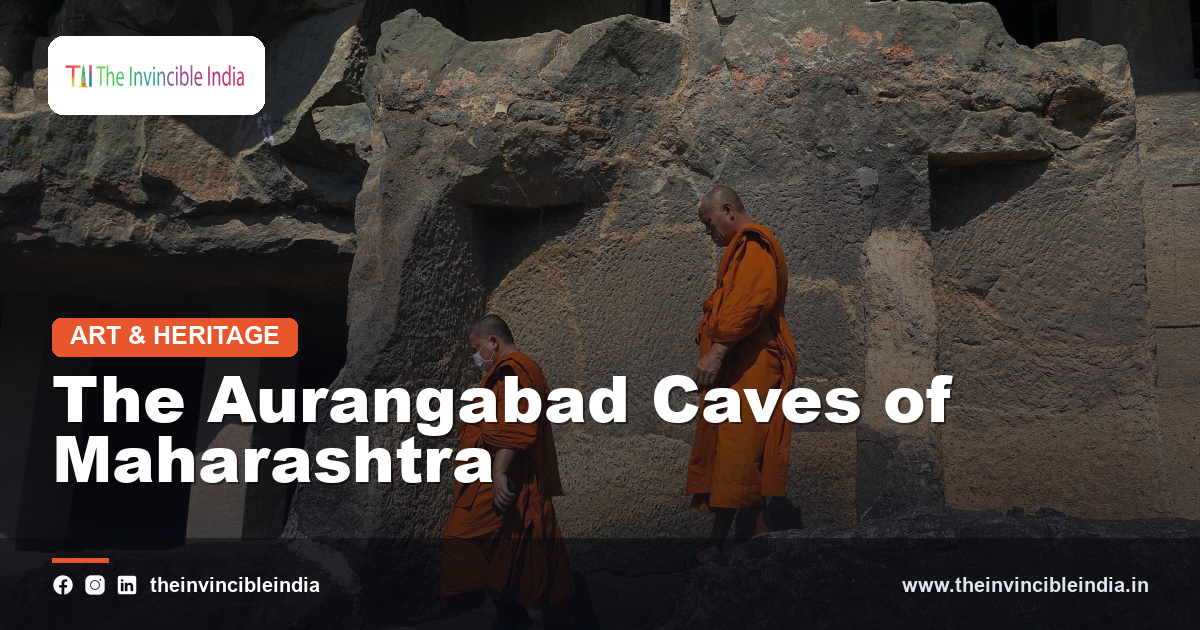
The Aurangabad Caves, also called the Aurangabad Buddhist Caves or the Aurangabad Leni, are a group of nine rock-cut Buddhist caves carved into a basalt hillside near the city of Aurangabad in Maharashtra, a city now officially known as Chhatrapati Sambhajinagar. Excavated in the Deccan some centuries after the earliest Buddhist caves of the region, they preserve a refined and late phase of Buddhist sculpture. Their elegant figures stand alongside the traditions explored in the guide to Indian sculpture, and they form a quieter companion to the better known caves at Ajanta and Ellora. This guide explains their history, layout and art.
Quick answer: The Aurangabad Caves are a group of nine Buddhist rock-cut caves in the hills north of Aurangabad (Chhatrapati Sambhajinagar) in Maharashtra, India. They are generally dated to about the sixth and seventh centuries CE, with a possibly earlier chaitya hall, and are known for graceful sculpture and Vajrayana-influenced imagery. Divided into a western and an eastern group, they sit within easy reach of Ajanta, Ellora and Daulatabad.
Key Takeaways
- The Aurangabad Caves are nine Buddhist rock-cut caves hewn from a basalt hillside in Maharashtra.
- They are divided into a western group of five caves and an eastern group of four caves, separated by a ravine.
- Most of the caves are generally assigned to about the sixth and seventh centuries CE, though one chaitya hall may be earlier.
- Cave 3 is known for richly carved pillars and Cave 7 for finely sculpted figures adorned with jewellery.
- Several caves show Vajrayana-influenced imagery, marking a late stage in Indian Buddhist art.
- The site lies near Ajanta, Ellora, Daulatabad and Bibi Ka Maqbara, so it is often visited as part of a wider heritage circuit.
The sections below describe how the caves were made, how they are arranged and what a visitor can still see today.
Quick Facts
| Detail | Information |
|---|---|
| Location | Hills north of Aurangabad (Chhatrapati Sambhajinagar), Maharashtra |
| Also known as | Aurangabad Buddhist Caves, Aurangabad Leni |
| Type | Rock-cut Buddhist cave monasteries and shrines |
| Number of caves | Nine, in a western and an eastern group |
| Approximate era | Mainly sixth to seventh centuries CE |
| Significance | Late Buddhist sculpture with Vajrayana influence in the Deccan |
What Are the Aurangabad Caves?
The Aurangabad Caves are a group of nine Buddhist rock-cut caves that were excavated into a basalt hillside in the Deccan region of Maharashtra. They functioned as monastic and devotional spaces, with prayer halls, shrines and cells where monks could live, study and meditate. The caves are not a single planned monument but a series of excavations made over a span of time, each with its own plan and decoration. What sets them apart is the quality of their carving, which combines slender, elegant figures with a calm and refined sense of design. They are less famous than the great cave complexes nearby, yet they offer an unusually clear view of how Buddhist art developed in the later centuries of its life in India. The Aurangabad Caves therefore deserve attention as a distinct and valuable chapter of Deccan rock-cut heritage.
Where Are the Aurangabad Caves Located?
The Aurangabad Caves are located in the hills just north of Aurangabad city, in the Marathwada region of Maharashtra. The city, now officially named Chhatrapati Sambhajinagar, lies on the Deccan plateau, and the caves overlook it from a ridge of volcanic rock that is typical of the region. The setting gave the monks both seclusion and easy access to a large settlement and to the trade routes that crossed the plateau. The caves are reached by a short road and a modest climb, and they stand in two clusters on either side of a natural ravine. Their position also places them within a day’s journey of the famous cave sites at Ajanta and Ellora and the hill fortress of Daulatabad. The location thus makes the Aurangabad Caves both easy to reach and well connected to the wider heritage of the Deccan.
How Old Are the Aurangabad Caves?
The Aurangabad Caves are generally dated to about the sixth and seventh centuries CE, although the dating of individual caves is debated among scholars. Most of the carved caves are attributed to this later phase of Buddhist excavation in the Deccan, while the chaitya hall known as Cave 4 is often regarded as earlier in character. The dating rests mainly on architectural style, sculptural style and comparison with datable monuments elsewhere, because few inscriptions survive to fix exact years. Some caves also appear to have been left unfinished, which adds to the difficulty of fixing a precise sequence. The wide agreement that the main phase belongs to the middle of the first millennium CE nevertheless gives a reliable general picture. The Aurangabad Caves thus belong to the closing centuries of large scale Buddhist cave making in India, a time of both refinement and change.
How Are the Caves Arranged?
The nine caves are arranged in two groups, a western group of five caves and an eastern group of four caves, separated by a ravine in the hillside. The western group contains Caves 1 to 5, and the eastern group contains Caves 6 to 9, a numbering used by the Archaeological Survey of India. Each group follows the common pattern of Buddhist cave monasteries, in which a pillared hall opens onto small cells and a shrine at the back. The two groups differ somewhat in character, because the western caves include the earlier chaitya hall and richly carved pillars, while the eastern caves hold some of the most refined sculpture. The ravine between them is crossed on foot, and the two clusters are usually visited separately. The arrangement into two groups therefore gives the site a clear structure that helps visitors understand its different periods and styles.
How Were the Caves Carved from Rock?
The caves were carved by cutting directly into solid basalt, working from the top of the planned space downward and from the front inward. Basalt is a dense volcanic rock that is hard to cut yet capable of fine detail, which explains both the effort of excavation and the crispness of the best sculpture. Craftsmen first shaped the outline of the hall and then separated pillars, cells and shrines from the living rock, leaving no joins or mortar. Figures were carved in relief on walls and doorways or as freestanding statues within the shrines. In several caves the unfinished surfaces still show tool marks and rough-cut areas, which reveal the stages of work. This method links Aurangabad with a long Indian tradition of rock architecture, and it shows how monolithic excavation allowed an entire monastery to be created from a single hill.
What Does the Western Group Contain?
The western group of five caves contains the earliest chaitya hall of the site and some of its most ornate pillared halls. These caves open onto a rocky terrace and follow a plan of a verandah, a main hall and a rear shrine, with monastic cells cut into the side walls. Cave 3, in particular, stands out for the richness of its carved pillars and for the figures and panels that decorate its interior. The group shows how the monks combined worship and daily life in one carved complex, with the shrine at the centre and living spaces around it. Some caves in this cluster are simple and plain, while others carry elaborate decoration, which suggests different patrons and different moments of work. The western group therefore offers an introduction to the character of the whole site, from early plainness to later richness.
What Is Special About Cave 3?
Cave 3 is among the most admired caves of the western group because of its large pillared hall and its richly carved supports. The pillars are decorated with figures and ornament, and they give the hall a rhythmic, almost architectural grandeur. Scholars have noted that its decoration reflects the sculptural taste of the time, with graceful forms and a strong sense of rhythm. Cave 3 also contains a shrine with a seated Buddha flanked by attendant figures, which forms the devotional focus of the hall. Some accounts describe scenes from the Jataka stories, the tales of the Buddha’s earlier births, carved in this cave, although the identification of individual scenes is a matter for specialists. The overall effect is of a spacious and carefully finished hall. Cave 3 thus serves as a good example of how sculpture and architecture worked together at Aurangabad.
What Is the Chaitya Hall of Cave 4?
Cave 4 is a chaitya hall, a prayer hall built around a stupa, and it is regarded by many scholars as the earliest cave of the Aurangabad group. Its plan is apsidal, with a long hall ending in a rounded end where the stupa stands, and a pillared aisle allows worshippers to walk around it. The stupa, a solid dome that symbolises the Buddha and his teachings, was the heart of early Buddhist worship. Cave 4 reflects an older tradition than the richly sculpted caves nearby, and its simpler forms recall earlier chaitya halls in the Western Deccan. The cave also shows how the site grew over time, since later caves introduced carved images in place of symbolic forms. Cave 4 therefore preserves a link between the earliest style of Buddhist cave architecture and the later, more image-rich phase at Aurangabad.
What Does the Eastern Group Contain?
The eastern group consists of four caves, numbered 6 to 9, and it contains some of the finest sculpture at Aurangabad. These caves lie across the ravine from the western cluster and are generally seen as part of a slightly later phase of work. They follow the familiar plan of a hall, shrine and cells, but their walls and doorways carry more varied and more elaborate figures. Cave 6 and Cave 7 are the best known, with carved shrines, attendant figures and decorated entrances that show a high level of skill. The eastern group also reflects stronger Vajrayana influences, with figures and themes that point to the developing tantric side of Buddhism. Together, the four caves form the artistic high point of the site. The eastern group thus completes the Aurangabad story, showing the refinement and the new ideas of the final phase.
Why Is Cave 7 So Famous?
Cave 7 is the most famous cave at Aurangabad because of its finely carved figures, in particular its elegant women adorned with jewellery and elaborate hair. The figures are often cited as an example of the beauty of Deccan sculpture, and they offer a glimpse of the dress and ornament of the period. The cave has a shrine with a seated Buddha attended by Bodhisattva figures, and its walls include a panel often described as showing the Bodhisattva Avalokiteshvara rescuing devotees from perils. Such images show the growing importance of compassionate saviour figures in later Buddhism. The carving is deep and confident, and the proportions are graceful. Visitors often regard Cave 7 as the highlight of the whole complex. It deserves its reputation because it combines technical skill, devotional meaning and a vivid human quality in a single carved space.
How Does Vajrayana Influence the Art?
Vajrayana influence appears at Aurangabad in the increasing importance of Bodhisattvas, female deities and complex iconographic forms. Vajrayana, sometimes called the tantric or diamond vehicle, is a later development of Buddhism that placed new emphasis on ritual, visualisation and a larger pantheon of divine figures. At Aurangabad this change can be seen in the carving of Bodhisattva attendants, in female figures associated with compassion and protection, and in a richer variety of poses and attributes. The shift is gradual rather than sudden, and the caves still preserve the central image of the seated Buddha. Scholars study these carvings to understand how Buddhist ideas changed during the middle of the first millennium CE. The caves therefore matter not only as works of art but also as evidence for the religious change that shaped Buddhist practice across India.
What Is the Buddha Imagery Like?
The Buddha imagery at Aurangabad centres on seated figures in shrines at the rear of the halls, usually flanked by Bodhisattva attendants. The Buddha is shown with a calm face, lowered eyes and a monastic robe, in a posture that expresses teaching or meditation. In some caves the Buddha sits on a throne with his legs hanging down, a pose seen at other Deccan sites, while elsewhere he sits cross-legged. Attendant figures such as Padmapani, the lotus bearer, and Vajrapani, the thunderbolt bearer, stand at either side, often carved with graceful bends of the body. The faces are serene and the proportions are slender. These images were meant to focus devotion and to teach through form. The Buddha imagery at Aurangabad therefore conveys both the stillness of meditation and the compassion of the Bodhisattva ideal.
How Do They Compare with Ajanta and Ellora?
The Aurangabad Caves are smaller and less elaborate than Ajanta and Ellora but belong to the same tradition of Deccan rock-cut art. Ajanta is famous for its paintings and its early and middle Buddhist caves, while Ellora is a larger complex that includes Buddhist, Hindu and Jain monuments. Aurangabad lies between them in character and sits in the same broad cultural region. Its sculptural style is close to that of the later Buddhist caves at Ellora, with similar slender figures and similar subjects. Unlike Ajanta, Aurangabad is known chiefly for its sculpture rather than for surviving paintings. Because it is quieter and less crowded, it also lets visitors study the carvings at leisure. The Aurangabad Caves thus complement the two great sites, and together the three give a full picture of Buddhist cave art in the Deccan.
What Other Heritage Sites Lie Nearby?
Several important monuments lie near the Aurangabad Caves, which makes the city a natural base for a heritage tour. Bibi Ka Maqbara, a Mughal-era tomb often called the Taj of the Deccan, stands in the city itself and recalls the style of the Taj Mahal on a smaller scale. Daulatabad Fort, an imposing hill citadel, rises a short distance away and tells a different story of Deccan history. The caves of Ellora lie close by, and the paintings and caves of Ajanta are a longer journey from the city. Together these sites cover Buddhist, Hindu, Jain, Sultanate and Mughal heritage in a single region. A visit to the Aurangabad Caves is therefore best understood as one stop in a rich cultural landscape, where each monument adds to the story of the Deccan across many centuries.
How Are the Caves Protected and Visited?
The Aurangabad Caves are protected as a monument of national importance under the care of the Archaeological Survey of India. Conservation work focuses on stabilising the rock, preventing water damage and keeping the carved surfaces clean and safe for visitors. Because the caves are cut from natural rock, monsoon seepage and weathering are constant concerns, and parts of the sculpture show wear and loss. Visitors reach the caves by a short road and then walk up stone steps to each group, so comfortable shoes and water are advisable. Early morning and late afternoon give the best light for viewing the carvings. Visitors should check current opening hours and entry rules before travelling. Careful conservation and respectful visiting together help ensure that the Aurangabad Caves survive for future generations to study and enjoy.
The Aurangabad Caves Today
The Aurangabad Caves today stand as a protected heritage site that draws scholars, pilgrims and travellers to the hills above the city. They remain valuable because they preserve a late and refined phase of Buddhist art that is less well documented than the earlier phases. Researchers continue to study the caves for what they reveal about patronage, iconography and the spread of Vajrayana ideas in the Deccan. For visitors the caves offer a calm and rewarding experience, with fine sculpture, quiet halls and wide views over the plain. Their modest scale makes them approachable, and their closeness to Ajanta, Ellora and Daulatabad makes them easy to include in a longer journey. The Aurangabad Caves thus continue to speak across the centuries, reminding visitors that India’s rock-cut heritage is both deeply spiritual and richly artistic.
Sources & Further Reading
- Archaeological Survey of India (asi.nic.in).
- Maharashtra Tourism, Government of Maharashtra (maharashtratourism.gov.in).
Frequently Asked Questions
What are the Aurangabad Caves?
The Aurangabad Caves are a group of nine Buddhist rock-cut caves near Aurangabad, now officially Chhatrapati Sambhajinagar, in Maharashtra. They were carved from basalt and include prayer halls, shrines and monastic cells. They are known for graceful sculpture and late Buddhist imagery.
How old are the Aurangabad Caves?
The Aurangabad Caves are generally dated to about the sixth and seventh centuries CE. One chaitya hall, Cave 4, may be somewhat earlier in character. Exact dates are debated because few inscriptions survive.
How many caves are there at Aurangabad?
There are nine main caves at Aurangabad, divided into a western group of five caves and an eastern group of four caves. A ravine separates the two groups. They are numbered 1 to 9 by the Archaeological Survey of India.
What is Cave 7 at Aurangabad known for?
Cave 7 is known for its finely carved figures, especially elegant women adorned with jewellery, and for its shrine with a seated Buddha and attendants. It is widely regarded as the artistic highlight of the site. Its sculpture shows the grace and detail of late Deccan Buddhist art.
How far are the Aurangabad Caves from Ajanta and Ellora?
The Aurangabad Caves lie within the same region as Ajanta and Ellora, with Ellora relatively close to the city and Ajanta a longer journey. Many travellers visit all three on a heritage circuit based in Aurangabad. Local travel arrangements should be checked in advance.
When is the best time to visit the Aurangabad Caves?
The best time to visit is generally from October to March, when the weather is cooler and comfortable for climbing the steps. Early mornings give the best light and fewer visitors. The monsoon brings greenery but also slippery paths, so extra care is needed.


