

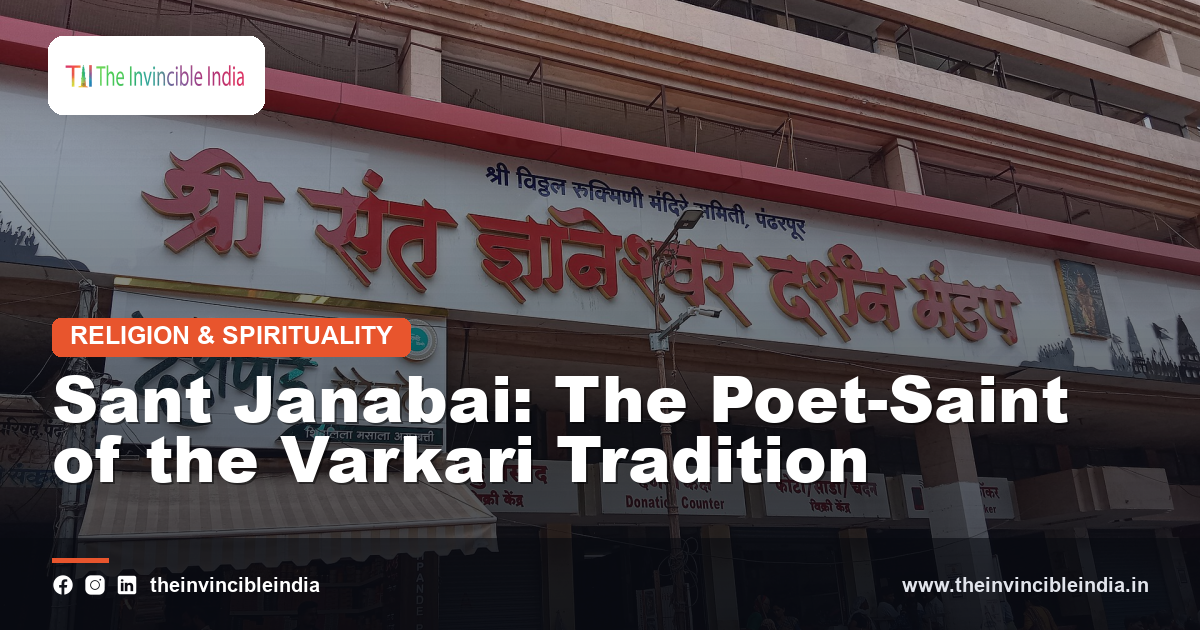
Sant Janabai, also written Jani or Janabai of Gangakhed and known in her own verses as Namyachi Jani, meaning Jani of Nama, is one of the best-loved women saints of the Varkari tradition of Maharashtra. Traditionally placed in the thirteenth and fourteenth centuries, she is remembered as a devotee of Vitthal of Pandharpur who lived in the household of the saint Namdev and expressed her faith in simple, moving Marathi verses called abhangs. This guide describes her life and verses in general terms and notes where details rest on tradition. It also places her within the wider Bhakti movement of India.
Quick answer: Sant Janabai is a medieval Marathi poet-saint of the Varkari tradition, remembered as a devotee of Vitthal of Pandharpur and as a member of the household of the saint Namdev. She is honoured for her abhangs, devotional verses that speak of faith, humility and the divine presence in daily work. Her life, placed by tradition in the thirteenth and fourteenth centuries, shows the reach of Bhakti among people of humble background.
Key Takeaways
- Sant Janabai, also known as Jani or Namyachi Jani, is a woman saint of the Varkari tradition of Maharashtra.
- Tradition places her in the thirteenth and fourteenth centuries and links her birthplace with Gangakhed in the Marathwada region.
- She is remembered as a servant in the household of the saint Namdev and as a lifelong devotee of Vitthal of Pandharpur.
- Her devotional verses are abhangs in Marathi, many of which describe the divine in ordinary household tasks such as grinding grain.
- Pandharpur, on the banks of the Bhima river, is the centre of the Varkari tradition and the destination of the annual wari pilgrimage.
- Her story is widely read as a sign that Bhakti was open to people of every background and gender.
The sections below set out her life, verses, themes and present-day legacy in more detail.
Quick Facts
| Detail | Information |
|---|---|
| Also known as | Janabai, Jani, Namyachi Jani, Janabai of Gangakhed |
| Tradition | Varkari sampradaya of Maharashtra |
| Era | Traditionally the thirteenth and fourteenth centuries |
| Associated places | Gangakhed, Pandharpur |
| Deity | Vitthal (Vithoba) of Pandharpur |
| Form of composition | Marathi abhangs |
Who Was Sant Janabai?
Sant Janabai was a Marathi poet-saint of the Varkari tradition, remembered as a devoted worshipper of Vitthal and a woman of humble background. She is traditionally placed in the thirteenth and fourteenth centuries, the age of Dnyaneshwar and Namdev, when the Varkari movement was taking shape in Maharashtra. Her verses survive in the form of abhangs and are still sung by devotees.
She is admired for the simplicity and sincerity of her devotion. In her poetry the divine is not far away but present in the grindstone, the broom and the daily round of work. Seen in this way, Janabai stands for a faith that values love and humility more than status or learning, and this quality explains her lasting place in the hearts of Varkaris.
Where and When Did Janabai Live?
Janabai lived, according to tradition, in the thirteenth and fourteenth centuries in the Marathi-speaking region of western India. Her birthplace is traditionally linked with Gangakhed, a town on the Godavari river in the Marathwada region, and her later life is linked with Pandharpur, the sacred town of Vitthal. Details differ between the traditional accounts, so they are best described in general terms.
This was a time when the Varkari movement was growing in Maharashtra under the guidance of saints such as Dnyaneshwar, Namdev, Eknath and others who followed. Janabai belongs to the early circle of this movement. Her story therefore offers a window into the social and devotional world of medieval Maharashtra and into the place of women within it.
What Does Tradition Say About Her Early Life?
Tradition says that Janabai was born into a poor family and that her parents were devotees of Vitthal. The accounts mention her father Damashet and her mother Karand, and they say that the family had a connection with Pandharpur. After the loss of her parents, the young Jani is said to have been brought to the household of Namdev, where she grew up and served the family.
These details come from devotional biographies and are told with reverence, so they should be read as tradition and not as documented history. What the stories convey clearly is the picture of a child of modest means who found shelter and spiritual guidance in a saintly household. That picture shapes how devotees understand her humility and her faith.
What Was Her Relationship with Namdev?
Janabai is remembered as a member of the household of Namdev, one of the foremost saints of the Varkari tradition, and she regarded him with deep respect as her guru. In many of her verses she signs herself as Namyachi Jani, Jani of Nama, a phrase that expresses both humility and devotion to the household where she served.
Namdev was a tailor by family occupation and a poet whose songs praise Vitthal, and his circle included people of many backgrounds. Within this setting Janabai learned the language of devotion and found her own voice. The bond between teacher and disciple is a recurring theme in her verses, and it reflects the Varkari ideal that the guru leads the devotee to the Lord.
Who Is Vitthal of Pandharpur?
Vitthal, also called Vithoba and Panduranga, is the deity of Pandharpur worshipped as a form of Krishna or Vishnu, usually shown standing with hands on his hips on a brick. Devotees of Maharashtra regard him with great affection and call him Mauli, meaning mother. He is worshipped together with Rukmini at the temple in Pandharpur.
Janabai addresses Vitthal in her verses as a close and loving presence, sometimes scolding, sometimes pleading and always trusting. This tender intimacy is typical of the Varkari tradition, in which the Lord is seen as a parent and friend as much as a ruler. Her poetry therefore helps readers understand why Vitthal is one of the most beloved deities of Maharashtra.
What Is the Varkari Tradition?
The Varkari tradition is a devotional movement of Maharashtra centred on the worship of Vitthal and marked by the practice of the wari, a pilgrimage on foot to Pandharpur. The word Varkari means one who makes the regular journey. Followers sing abhangs, chant the name of the Lord and travel in large groups, carrying the palanquins of saints.
The tradition is open to people of every community and rests on simple devotion, moral living and the company of fellow devotees. It grew through the teaching of saints such as Dnyaneshwar, Namdev, Tukaram and many others, including women such as Janabai. This inclusive character helps explain why the movement has endured for centuries and remains a vital part of Maharashtra’s cultural life.
What Are Janabai's Abhangs?
Janabai’s abhangs are short devotional poems in Marathi that express her faith in Vitthal and her feelings as a servant and devotee. An abhang is a verse form with a set rhythm that is easy to sing, and it became the main vehicle of Varkari poetry. Several hundred abhangs are attributed to Janabai, though the exact number and authorship of individual verses can vary in collections.
Her poems are admired for their frankness and warmth. They speak in the plain language of the household and treat the divine as a companion in everyday life. Because they are brief and musical, they are easy to remember and are still sung by Varkaris during the wari and in temples. They remain the clearest record of her inner life.
What Are Her Grinding Songs?
Her grinding songs are verses associated with household tasks such as grinding grain on the stone mill and pounding rice, in which she sings of the divine while she works. In Maharashtra, women have long sung while grinding, and Janabai’s verses belong to this tradition of work songs. They turn a hard daily chore into an act of worship.
In these songs the rhythm of the grindstone becomes the rhythm of the divine name. The images are simple and concrete, and they show how the sacred can be found in ordinary labour. Folk singers and devotional performers still draw on this style. For readers, the grinding songs are among the most vivid examples of how Janabai joined spiritual feeling to the texture of village life.
What Themes Appear in Her Verses?
The main themes in Janabai’s verses are devotion to Vitthal, humility as a servant, respect for the guru and the sense that the divine shares in everyday work. She also expresses longing for the Lord, joy in his name and an acceptance of life’s hardships with trust. Her tone ranges from tender to playful to deeply serious.
A recurring idea is that devotion does not depend on birth, learning or social standing. Janabai herself, in the traditional picture, was a servant with no formal education, yet she became a poet whose words are treasured. This gives her work a quiet strength. Her themes connect with the wider Bhakti message that sincere love of God is open to all people.
What Legends Are Told About Janabai?
Several legends are told about Janabai in the devotional tradition. One of the best known says that Vitthal himself helped her with household tasks such as grinding grain and carrying water because of her pure devotion. Another says that she was wrongly suspected in a matter and was vindicated by a miracle that showed her innocence.
These stories belong to the realm of tradition and faith, and they should be understood as expressions of reverence and not as verified history. They are told in the community to show how close the Lord is to a sincere devotee, whatever the devotee’s station in life. In this sense the legends carry a spiritual meaning that is more important than their literal details.
Why Is Janabai Important for Women in Bhakti?
Janabai is important because she shows that women took part in the Bhakti movement as poets and saints, and that their voices were preserved and honoured. In Maharashtra she is counted with other women of the Varkari tradition such as Muktabai, Soyarabai, Kanhopatra and Bahinabai. Together they form a distinct strand of women’s devotional literature.
Her life, as the tradition tells it, joined the challenges of poverty and service to a deep spiritual life. Many readers today find encouragement in this story of dignity and creativity. It also reminds students of Indian culture that medieval devotion was not limited to scholars and priests but was shaped by people from many walks of life, including women of humble background.
How Does Janabai Connect with Pandharpur?
Janabai connects with Pandharpur as the sacred town where her beloved Vitthal is worshipped and where, according to tradition, she spent a significant part of her devotional life. Pandharpur lies on the Bhima river, also called the Chandrabhaga, in the state of Maharashtra, and it is the destination of the great annual wari pilgrimage.
Pilgrims gather there in large numbers on Ashadhi Ekadashi and Kartiki Ekadashi, singing abhangs and offering prayers. Memorials and associated shrines in the region keep the memory of the saints alive, and local tradition honours Janabai as part of the circle around Namdev. The town therefore stands as a living centre of the faith that shaped her verses and gave them meaning.
How Are Her Verses Sung and Preserved?
Her verses are preserved through oral singing, collections of Varkari poetry and performances in the kirtan tradition. Kirtankars, who are devotional storytellers and singers, often include abhangs of the saints in their programmes, and many Varkari households know her songs by heart. Printed editions of the abhangs of the saints have also helped to spread her work.
Because the abhangs were passed on by voice for generations, small differences in wording and attribution exist across collections. This is common in the oral literature of the Bhakti tradition. The effort of scholars and singers to gather and sing these verses has kept her poetry accessible, and it continues to reach new listeners in temples, concerts and community gatherings.
How Should Traditional Accounts Be Read?
Traditional accounts of Janabai should be read as devotional biography, valuable for what they reveal about how the community sees her. Many of the stories, including the accounts of her parentage, her service and the miracles, are told in a devotional register. They do not claim to meet the standards of modern historical records, and the details vary between sources.
A respectful approach keeps two things in view. Her verses are real and can be read directly, which gives firm evidence of her voice and thought. The stories about her life express reverence and carry meaning of their own. Holding both together allows a reader to honour the tradition while remaining careful about specific historical claims.
Sant Janabai Today
Sant Janabai remains a cherished figure in Maharashtra. Her abhangs are sung during the wari, in temples and at kirtans, and her name is mentioned with respect alongside the great saints of Pandharpur. Shrines and memorials in Gangakhed and the Pandharpur region honour her, and her verses appear in school and university studies of Marathi literature.
For students of Indian culture, she offers a moving example of how devotion can arise in the humblest circumstances and speak across centuries. Her poetry shows the Bhakti movement at its most intimate and inclusive. Readers who wish to learn more can explore translations of Varkari poetry and, where possible, witness the wari to Pandharpur to see her tradition in action.
Sources & Further Reading
- Ministry of Culture, Government of India (indiaculture.gov.in).
- Sahitya Akademi (sahitya-akademi.gov.in).
Frequently Asked Questions
Who was Sant Janabai?
Sant Janabai was a medieval Marathi poet-saint of the Varkari tradition, remembered as a devotee of Vitthal and a member of the household of Namdev. She composed abhangs that are still sung in Maharashtra.
When did Sant Janabai live?
Tradition places Sant Janabai in the thirteenth and fourteenth centuries, in the period of Dnyaneshwar and Namdev. Exact dates are not firmly documented, so they are treated as traditional.
What is Sant Janabai best known for?
Sant Janabai is best known for her abhangs, devotional verses in Marathi addressed to Vitthal, including songs linked with grinding grain. She is also remembered as an example of humble devotion.
What does Namyachi Jani mean?
Namyachi Jani means Jani of Nama, the way Janabai signs many of her verses. It expresses her humility and her place in the household of the saint Namdev.
What is the Varkari tradition?
The Varkari tradition is a devotional movement of Maharashtra centred on the worship of Vitthal of Pandharpur. Its followers sing abhangs and make the wari pilgrimage on foot to Pandharpur.
Where is Pandharpur?
Pandharpur is a sacred town in Maharashtra on the banks of the Bhima river, home to the temple of Vitthal and Rukmini. It is the destination of the annual wari pilgrimage.


