

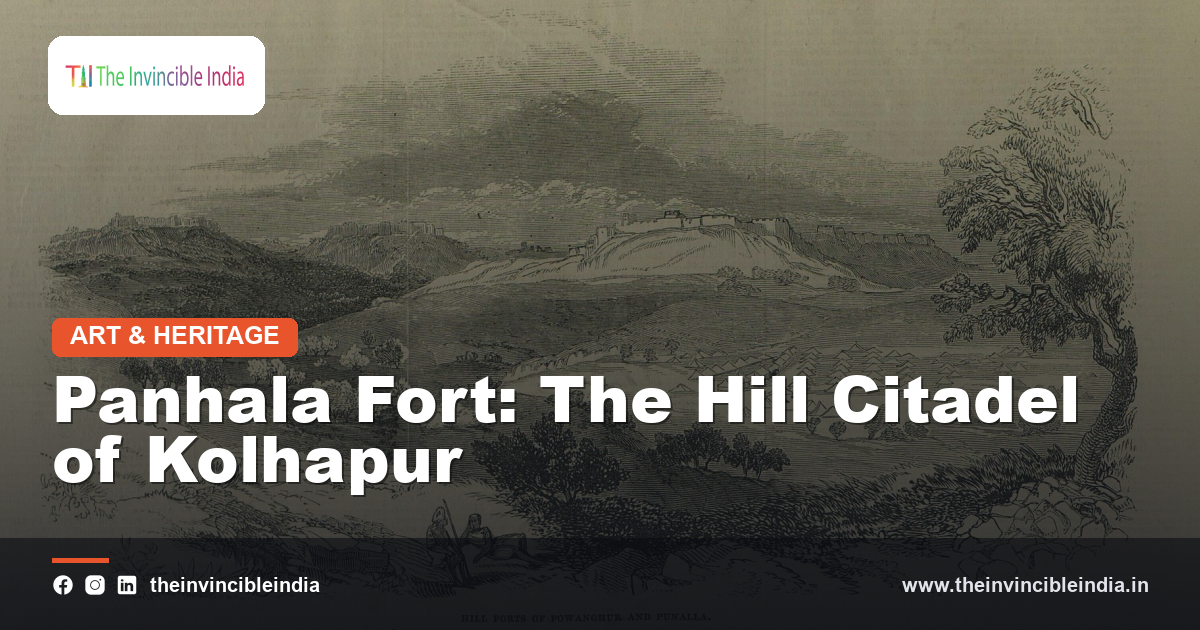
Panhala Fort, also known as Panhalgad, Panhala Durg or in older sources Pranalaka, is a vast hill citadel set on a plateau of the Sahyadri range about twenty kilometres from the city of Kolhapur in Maharashtra. Its walls, gateways and granaries preserve the layered history of the western Deccan, from early medieval rulers to the Adil Shahi sultans and the Marathas. It is one of the largest forts of its region, and it belongs to the family of mountain strongholds described in the guide to the great forts of India. This guide explains its history, architecture and lasting importance.
Quick answer: Panhala Fort is a large hill fort in the Sahyadri range near Kolhapur in Maharashtra, traditionally associated with the Shilahara dynasty and later held by the Yadavas, the Adil Shahis of Bijapur and the Marathas. It is closely linked with Shivaji and with the Maratha queen Tarabai, and it is known for its gateways, granaries and a hidden stepped well. In 2025 it was inscribed on the UNESCO World Heritage List as part of the Maratha Military Landscapes of India.
Key Takeaways
- Panhala Fort is a hill fort on a Sahyadri plateau near Kolhapur in Maharashtra, about twenty kilometres from the city.
- The fort is traditionally linked with the Shilahara king Bhoja II and the later twelfth century, though its history is layered over many periods.
- Panhala passed through Yadava, Bahmani and Adil Shahi hands before coming under Maratha control in the seventeenth century.
- Shivaji is closely associated with the fort, and its story includes the famous night escape to Vishalgad.
- Tarabai, the Maratha queen regent, made Panhala an important seat of power in the early eighteenth century.
- Panhala is part of the Maratha Military Landscapes of India, inscribed as a UNESCO World Heritage property in 2025.
The sections below describe how the fort was built, who held it and what a visitor can still see today.
Quick Facts
| Detail | Information |
|---|---|
| Location | Panhala, near Kolhapur, Maharashtra |
| Also known as | Panhalgad, Panhala Durg, Pranalaka |
| Type | Sahyadri hill fort |
| Traditional founder | Shilahara king Bhoja II |
| Notable features | Teen Darwaza, Andhar Bavdi, Ambarkhana granaries, Sajja Kothi |
| Significance | Major Maratha stronghold and UNESCO World Heritage component |
What Is Panhala Fort?
Panhala Fort is a large fortified hilltop citadel in the Sahyadri range of Maharashtra, built to guard the mountain routes between the Konkan coast and the Deccan plateau. It is not a single compact castle but a walled plateau that once held a small town, with gateways, bastions, granaries, wells, temples and residential buildings. Several dynasties strengthened and extended it over the centuries, so its architecture records many phases of military design. The fort also holds a special place in the memory of Maharashtra, because it is tied to Shivaji and to the Maratha struggle for independence. Today much of it is ruined, yet its walls and gates still convey the scale of the original citadel. Panhala therefore stands as one of the most important hill forts of western India, valued both as a monument and as a living piece of history.
Where Is Panhala Fort Located?
Panhala Fort is located on a plateau of the Sahyadri range in the Kolhapur district of southern Maharashtra, roughly twenty kilometres northwest of Kolhapur city. The fort stands at a strategic junction in the hills, overlooking the passes that link the coastal Konkan region with the interior of the Deccan. Because of this position, whoever held Panhala could watch trade and troop movements across a wide area. The surrounding landscape is rugged, with steep slopes, forested ridges and deep valleys that made direct assault difficult. A modern road leads up to the small town of Panhala, which still sits within the old fort walls. The location explains why Panhala was fought over for centuries, since it combined natural defence, long views and command of important mountain routes.
What Is the Meaning of the Name Panhala?
The name Panhala is generally understood in local tradition to derive from the Sanskrit name Pranalaka or Panhalaka, often explained as the abode of snakes or the home of serpents. This interpretation is common in popular accounts and is linked to the many snake legends of the Sahyadri hills. The fort is also called Panhalgad, using the Marathi word gad for fort, and in some older records it appears under variant spellings. Scholars note that the exact origin of the name is uncertain, and that several explanations have been offered, so the meaning is best treated as traditional rather than proven. What is clear is that the name has been attached to the hill for many centuries and is deeply familiar in Maharashtra. The name Panhala therefore carries a flavour of local legend as well as history.
Who Built Panhala Fort?
Panhala Fort is traditionally credited to the Shilahara ruler Bhoja II, who is associated with the later twelfth century. The Shilaharas were a dynasty that ruled parts of western India, and Bhoja II is remembered as a builder of several hill fortresses in the region. Tradition links him with Panhala, although the fort as seen today reflects much later rebuilding and extension. Historians therefore treat the Shilahara foundation as the earliest widely accepted layer, while noting that the details of the original construction are not fully documented. The earliest fort was probably simpler than the large citadel visible now. Later rulers added walls, gateways and storage buildings as the fort grew in importance. The founding by Bhoja II thus marks the beginning of a long process, in which many dynasties shaped Panhala.
How Did Panhala Pass Through Different Rulers?
Panhala passed through the hands of several powers after the Shilaharas, including the Yadavas of Devagiri, the Bahmani sultans and later the Adil Shahis of Bijapur. The Yadavas ruled much of the Deccan before the arrival of the sultanates, and Panhala formed part of their frontier defences. Under the Bahmani and Adil Shahi sultans the fort was an important military base on the southern edge of the kingdom, and many of its surviving structures are attributed to the Adil Shahi period. The fort’s shifting ownership reflects the wider political struggles of the medieval Deccan. Each ruler added to the defences or the buildings, leaving traces that archaeologists and historians can still read. The varied history of Panhala therefore makes it a valuable record of the changing powers that governed the western Deccan.
What Is Panhala's Link with Shivaji?
Panhala is closely linked with Shivaji, the founder of the Maratha state, who is traditionally said to have taken the fort from the Adil Shahi sultanate in the middle of the seventeenth century. The fort became an important Maratha base, and a famous episode of its history is the siege by the Adil Shahi general Siddi Johar, during which Shivaji slipped out of the fort at night in heavy rain. According to tradition he reached the fort of Vishalgad, while the commander Baji Prabhu Deshpande held off the pursuers at the pass of Pavan Khind. The story is celebrated in Maharashtra as a symbol of courage and strategy. Details of the episode are known mainly through later chronicles, so historians treat some elements carefully. The link with Shivaji thus gives Panhala a central place in Maratha memory.
Why Was Panhala Important to Tarabai?
Panhala became the seat of the Maratha queen regent Tarabai in the early eighteenth century, when she led resistance during a period of conflict and division. Tarabai was the widow of Rajaram, and she acted on behalf of her young son as the Maratha state faced pressure from the Mughal empire and from rival claimants within her own family. From Panhala she directed administration and military affairs, and the fort served as a refuge and capital. Later the centre of the Kolhapur branch of the Maratha ruling house moved down to Kolhapur city. Tarabai is remembered as a determined leader, and her association with the fort adds a distinctive chapter to its story. Panhala therefore stands as a rare example of a hill fort linked with a woman ruler of the Maratha world.
What Is the Teen Darwaza?
The Teen Darwaza, meaning the three gates, is one of the most striking gateways of Panhala and a fine example of fort entrance design. It consists of a sequence of three linked gateways arranged so that an attacker would have to pass through several defended stages before entering the fort. The gates are built of local stone and are attributed to the Adil Shahi period, and their arrangement shows the standard principle of staggered entrances meant to slow and trap enemies. Guard chambers and ramparts flank the passage, and the whole structure forms a strong defensive unit. The Teen Darwaza is also one of the most photographed parts of the fort because of its stout masonry and carved details. As a defensive and architectural feature, it shows how a single entrance could combine strength with careful design.
What Is the Andhar Bavdi?
The Andhar Bavdi, meaning the dark stepwell, is a hidden multi-storey well within Panhala Fort, attributed to the Adil Shahi period. It was built partly underground, with passages and chambers around a central well, which made it both a water source and a secret feature that was hard for an enemy to find. Because water is the most vital resource of any besieged fort, the Andhar Bavdi was a key part of the defences. Its design is often described as a maze of narrow corridors with stairs and hidden openings, and the name dark well reflects the shadowy interior. Local tradition also says that the structure helped protect the fort’s water supply from poisoning. The Andhar Bavdi therefore shows the ingenuity of the fort’s builders in solving the vital problem of water.
What Are the Ambarkhana Granaries?
The Ambarkhana is a group of large granaries within Panhala Fort, built to store grain for the garrison and the people who lived inside the walls. These stone storehouses are commonly said to be three in number and are traditionally known by the names of sacred rivers, though the naming is a matter of local tradition. They are sturdy buildings with thick walls and domed or vaulted roofs, designed to keep stored food dry and safe for a long time. A hill fort that expected a siege needed enough food to last many months, and the granaries show how seriously that need was taken. They are among the most substantial surviving structures of the fort. The Ambarkhana therefore gives a clear idea of the everyday logistics that supported a large mountain stronghold.
What Is the Sajja Kothi?
The Sajja Kothi is a former pavilion on the edge of Panhala Fort, associated with the Adil Shahi period and traditionally linked with the sultan Ibrahim Adil Shah II. It is a two-storeyed structure with balconies and arched openings, and it combines defensive and residential functions. In Maratha history the building became known for its use as a place of confinement for Shivaji’s son Sambhaji at one stage, according to tradition. The structure stands at a high point with wide views over the valleys, which made it a useful lookout as well as a comfortable retreat. Its Indo-Islamic arches and plain stone walls show the architectural taste of the Deccan sultanates. The Sajja Kothi thus illustrates how the fort contained civil and ceremonial buildings alongside its walls and gates.
What Temples and Other Monuments Are in the Fort?
Panhala Fort contains temples, tombs, reservoirs and the remains of palaces that together show the religious and civil life of the fort. Among the temples, the shrines linked with local deities and with Sambhaji are well known, and old stone buildings of the Bahmani and Adil Shahi periods survive near the walls. The fort also holds several water tanks, and the wide plateau includes sites of old residential areas. Together these monuments show that Panhala was not only a military post but also a settled community with places of worship and daily activity. Many structures are ruined or altered, but enough remains to suggest the original scale. The temples and other monuments therefore reveal Panhala as a living fortress town, where defence, worship and daily life shared the same hilltop.
How Was Panhala Built for Defence?
Panhala was designed for defence by combining steep natural slopes with strong ramparts, bastions and staggered gateways. The fort’s walls follow the edge of the plateau, taking advantage of cliffs and ravines so that attack was difficult from almost any direction. Along the walls, bastions allowed defenders to cover wide fields of fire, and gateways were set at awkward angles to slow any advance. Inside, storage buildings, wells and tanks ensured that a garrison could last through a long siege. The Rajdindi bastion and the Wagh Darwaza are among the notable defensive features. This careful combination of terrain and masonry was typical of the great hill forts of Maharashtra. Panhala’s defence design thus shows how builders turned the natural strength of the Sahyadri hills into a lasting military landscape.
Is Panhala Fort a UNESCO World Heritage Site?
Panhala Fort is part of the Maratha Military Landscapes of India, a serial property inscribed on the UNESCO World Heritage List in 2025. The property brings together a group of twelve forts associated with the Maratha military system, including well known sites such as Raigad, Rajgad, Pratapgad, Sindhudurg and others across Maharashtra and Tamil Nadu. Panhala is one of the components from the Sahyadri hill group. The inscription recognises the Marathas’ skill in using natural landscape for defence and the way their forts reflect a distinctive political and military tradition. It adds international attention to the fort and to the need for careful conservation. Panhala’s place in this World Heritage property thus confirms its importance as a representative monument of Maratha military heritage.
How Can Visitors Explore Panhala Today?
Visitors can reach Panhala by road from Kolhapur and explore the fort on foot, visiting the gateways, granaries, the Andhar Bavdi and the Sajja Kothi. A guide is helpful for finding hidden features and for understanding the stories linked with the fort. The monsoon season turns the plateau green and brings mist and waterfalls, while the cooler months from October to February are generally comfortable for walking. Sturdy shoes, water and sun protection are useful, and visitors should take care near unfenced edges. The small town of Panhala also offers simple places to eat and rest. Visitors are advised to check current access arrangements before travelling. A visit to Panhala rewards the traveller with both fine views and a strong sense of the Maratha past.
Panhala Fort Today
Panhala Fort today is a protected heritage site that combines history, scenery and living local tradition. Its ruined walls and gates draw students of history, trekkers and families, and its association with Shivaji and Tarabai keeps it central to the cultural memory of Maharashtra. Conservation work by heritage authorities aims to stabilise the walls, clear vegetation and protect fragile structures, while the new World Heritage recognition encourages careful management. The fort also supports a local community, whose small town sits within the old walls. For readers interested in the great forts of India, Panhala offers a clear example of how a mountain plateau could become a fortress, a capital and a symbol. Panhala Fort thus remains one of the most evocative monuments of the Sahyadri hills, valued for its history as much as its views.
Sources & Further Reading
- Archaeological Survey of India (asi.nic.in).
- UNESCO World Heritage Centre (whc.unesco.org).
Frequently Asked Questions
What is Panhala Fort?
Panhala Fort is a large hill fort in the Sahyadri range near Kolhapur in Maharashtra. It was held by several dynasties, including the Shilaharas, Yadavas, Adil Shahis and Marathas. It is closely associated with Shivaji and Tarabai.
Where is Panhala Fort located?
Panhala Fort is located about twenty kilometres northwest of Kolhapur city in the Kolhapur district of Maharashtra. It stands on a plateau of the Sahyadri range. A road leads to the small town of Panhala inside the old fort walls.
Who built Panhala Fort?
Panhala Fort is traditionally attributed to the Shilahara king Bhoja II in the later twelfth century. Much of what survives was added by later rulers, especially the Adil Shahis. The fort grew in layers over many centuries.
What is Panhala Fort famous for?
Panhala Fort is famous for its connection with Shivaji, including his night escape to Vishalgad, and for its monuments such as the Teen Darwaza, Andhar Bavdi and Ambarkhana granaries. It was also the seat of Tarabai. It is part of a UNESCO World Heritage property.
Is Panhala Fort a UNESCO World Heritage Site?
Yes, Panhala Fort is a component of the Maratha Military Landscapes of India, which was inscribed on the UNESCO World Heritage List in 2025. The property includes twelve forts associated with the Maratha military system. It recognises the forts as outstanding examples of landscape-based defence.
What is the best time to visit Panhala Fort?
The best time to visit Panhala Fort is generally during the monsoon for greenery and mist, or from October to February for comfortable walking weather. Summer can be hot on the open plateau. Monsoon visitors should take care on wet paths.


