

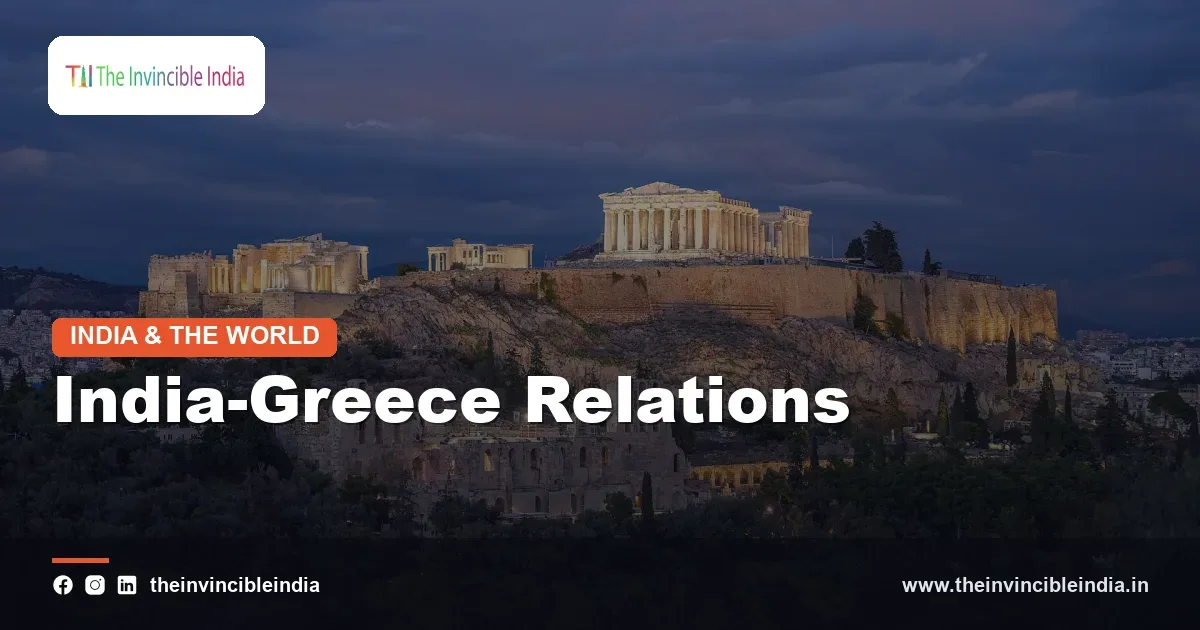
India-Greece relations are the bilateral political, economic, maritime and cultural ties between the Republic of India and the Hellenic Republic, which trace back to contacts in antiquity, were formalised through diplomatic relations in the mid-twentieth century and were elevated to a strategic partnership in August 2023. The relationship is anchored in shared civilisational memory, a common interest in a rules-based maritime order, Greece’s weight in global shipping and India’s growing interest in Mediterranean and European connectivity.
Although the two countries are geographically distant and their trade remains modest in a global context, the partnership has gained momentum since the early 2020s through high-level visits, defence and maritime contacts, a mobility framework and the wider discussion on the India-Middle East-Europe Economic Corridor (IMEC). This explainer sets out the history, the present architecture of cooperation and the areas where the ties remain a work in progress.
| Attribute | Detail |
|---|---|
| Countries | Republic of India and the Hellenic Republic (Greece) |
| Ancient contacts | Alexander’s campaign (326 BCE), Megasthenes at the Mauryan court, the Indo-Greek kingdoms |
| Modern diplomatic relations | Established in 1950, soon after India’s independence |
| Current status of ties | Strategic partnership, announced in August 2023 |
| Landmark visit | Indian Prime Minister’s visit to Athens in August 2023, the first by an Indian PM to Greece in about 40 years |
| Key economic link | Shipping, energy products, pharmaceuticals, agri-food and engineering goods |
| Connectivity context | IMEC, announced on the margins of the G20 summit in New Delhi in September 2023 |
| Multilateral setting | Both are members of the United Nations; Greece is a member of the European Union and NATO |
Key Takeaways
- India-Greece relations rest on ancient contacts that include Alexander’s Indian campaign in 326 BCE, the Greek ambassador Megasthenes at the Mauryan court and the Indo-Greek kingdoms of north-western India.
- India and Greece established diplomatic relations in 1950 and upgraded their ties to a strategic partnership in August 2023 during the Indian Prime Minister’s visit to Athens.
- The August 2023 visit was the first by an Indian Prime Minister to Greece in roughly four decades, the previous one having taken place in the early 1980s.
- Greece is one of the world’s leading shipping nations, and its maritime industry is a natural meeting point with India’s expanding ports, shipbuilding and seafarer sectors.
- Greece is a member of the European Union and NATO, which makes it a gateway for India into European markets, and its ports feature in discussions on the India-Middle East-Europe Economic Corridor.
- Bilateral trade between India and Greece is small compared with India’s trade with major economies, so the partnership is regarded as having more room for growth than current volumes suggest.
How far back do India-Greece relations go?
India-Greece relations go back more than two thousand years, to the period when Greek and Indian worlds first met in the north-west of the subcontinent. The contact was never one of continuous governance, but it left lasting traces in art, language, coinage, astronomy and political memory.
Alexander and the north-west frontier
Alexander of Macedon crossed the Indus in 326 BCE and fought the Battle of the Hydaspes against the ruler Porus on the banks of the river Jhelum. His army refused to march further east, and Alexander turned back, leaving garrisons and satraps behind. The episode is the best-known early encounter and is still taught in both countries, though the political consequences in India were limited.
Megasthenes and the Mauryan court
Megasthenes was a Greek diplomat sent by Seleucus I Nicator, one of Alexander’s successors, to the court of Chandragupta Maurya at Pataliputra around 300 BCE. His account, known as the Indica, survives only in fragments quoted by later writers, but it remains a valuable source on Mauryan administration, society and geography. Seleucus and Chandragupta had concluded a treaty around 305 BCE, which settled frontier questions and included an exchange of gifts.
The Indo-Greek kingdoms and Greco-Buddhist art
After the Seleucid and Bactrian Greek rulers consolidated power in Central Asia, Greek-ruled states emerged in Afghanistan, Gandhara and north-western India in the second century BCE. These are known as the Indo-Greek kingdoms. The king Menander I, called Milinda in Buddhist texts, is remembered in the Pali work Milindapanha for his dialogue with the monk Nagasena. A pillar at Besnagar near Vidisha, set up by Heliodorus, an envoy of the Greek king Antialcidas, records a Greek’s devotion to Vasudeva. In Gandhara, the meeting of Hellenistic sculpture and Buddhist subject matter produced the Greco-Buddhist style.
The Sanskrit word Yavana, derived from Ionian, was used for Greeks, and the Edicts of Ashoka mention Greek rulers of the Hellenistic world as recipients of his message of dhamma. A Greek-language inscription of Ashoka has been found in Kandahar in present-day Afghanistan.
How did modern India-Greece diplomatic relations develop?
Modern India-Greece diplomatic relations were established in 1950 and developed slowly through the Cold War, when India followed non-alignment and Greece belonged to the Western security system. Differences in alignment meant that the relationship stayed cordial but low in intensity for decades.
Several features shaped the early period. India and Greece were both parliamentary democracies, and both had a strong stake in the United Nations and in maritime commerce. The two sides signed agreements on matters such as cultural exchange, air services and avoidance of double taxation over the following decades, but political visits were infrequent. An Indian Prime Minister visited Greece in the early 1980s, and then no Indian head of government went to Athens for around four decades.
After the end of the Cold War and India’s economic liberalisation in 1991, the opportunities for engagement widened. Greece’s membership in the European Union since 1981 made it a relevant partner for India’s European outreach, while India’s rising economy and large market attracted Greek interest. The trajectory became more purposeful from the late 2010s, when both governments began to view the Mediterranean and the Indian Ocean as parts of a connected strategic space.
What changed in August 2023?
In August 2023, the Indian Prime Minister made an official visit to Athens and the two countries announced the elevation of their relationship to a strategic partnership. This was the first visit to Greece by an Indian Prime Minister in about 40 years and signalled a decision to treat the relationship as a priority rather than an occasional courtesy.
The visit produced a joint statement that outlined cooperation across defence, trade, investment, shipping, technology, culture and people-to-people ties. The two sides set a goal of significantly expanding bilateral trade by the end of the decade, with a stated ambition of doubling it by 2030. They also agreed to deepen institutional contact through regular political consultations, foreign office meetings and business forums. The Indian Prime Minister was conferred Greece’s highest civilian honour, the Grand Cross of the Order of Honour, during the visit.
The Greek Prime Minister reciprocated with a visit to India in early 2024, when he attended a major strategic conclave in New Delhi. That visit gave further impetus to work on mobility and economic cooperation, and it confirmed that the partnership had political backing on both sides.
What does a strategic partnership mean in practice?
A strategic partnership between India and Greece means a structured commitment to regular high-level dialogue and cooperation across several sectors, rather than a formal alliance. India has concluded similar partnerships with many countries, and they generally do not carry mutual defence obligations.
In this case, the partnership has the following working elements:
- Regular political consultations between the two foreign ministries and high-level visits.
- Coordination in international organisations, including the United Nations, where both countries have supported a rules-based international order and the law of the sea.
- Cooperation on defence, maritime security, counter-terrorism and cyber matters.
- Economic and investment promotion, with attention to shipping, energy, infrastructure, agri-food, pharmaceuticals and information technology.
- Cultural, academic and tourism exchanges.
- A mobility framework that supports the movement of students, professionals and workers.
How important are shipping and maritime ties?
Shipping and maritime ties are the single most natural area of India-Greece cooperation, because Greek shipowners control one of the largest merchant fleets in the world and India depends heavily on seaborne trade. Greek-owned vessels carry a significant share of the world’s oil, dry bulk and other cargoes, and many of them call at Indian ports.
India has large and growing interests in this field. It has a long coastline, a major port-building programme, a significant pool of trained seafarers, and a stated aim of expanding domestic shipbuilding and ship repair. Greek shipping companies have a long record of working with Indian ports, shipyards and crewing agencies, and both countries have discussed Greek investment in ship repair, ship recycling and the training of Indian maritime personnel.
Maritime cooperation also has a security dimension. Both countries are exposed to risks in key sea lanes, including piracy and disruptions in the Red Sea and the Gulf of Aden, and both rely on freedom of navigation under international law. The Indian Navy and the Hellenic Navy have exchanged port calls and carried out passage exercises, and discussions on maritime domain awareness and anti-piracy cooperation continue.
What is the state of defence cooperation?
Defence cooperation between India and Greece is real but still modest, built around port calls, bilateral exercises, military-to-military contact and dialogue on shared maritime concerns. Neither side depends on the other for major weapons systems, and the cooperation is better described as a developing track than a mature one.
The air forces and navies of the two countries have taken part in exercises that bring together partners from the Mediterranean and the Indian Ocean regions. The two governments have also discussed defence industrial collaboration, including training, co-production and maintenance, and the possibility of Greek participation in India’s defence manufacturing ecosystem. Because Greece belongs to NATO and the European Union, any technology cooperation operates within the export-control rules and procurement frameworks of those bodies.
Observers sometimes link India-Greece defence ties to the regional politics of the eastern Mediterranean, where Greece has long-standing disputes with Turkey over maritime boundaries and airspace. India has emphasised that its approach is based on international law and on promoting stability, and it also maintains separate relations with every country in the region. The partnership is therefore best read as bilateral and interest-based rather than directed against any third party.
How much do India and Greece trade?
India and Greece trade goods and services on a modest scale, with annual bilateral trade usually amounting to a few billion US dollars at most and tilted in India’s favour in goods. The figure is small relative to India’s trade with the European Union as a whole, which is why both governments describe the economic relationship as having untapped potential.
| Direction | Typical product groups |
|---|---|
| India’s exports to Greece | Refined petroleum products, engineering goods, textiles and garments, pharmaceuticals, chemicals, agricultural products |
| Greece’s exports to India | Pharmaceutical products, aluminium and metal goods, olive oil and other food products, machinery, marine services |
| Services and investment | Shipping services, tourism, information technology, ship repair, logistics |
Refined petroleum products, many of them produced by Indian refineries, have long been the largest single item in India’s exports to Greece. Greece also has an interest in Indian pharmaceuticals, in information technology services and in agricultural products. On the Greek side, there is interest in selling food and beverages, building materials, marine equipment and services.
Investment flows are limited, but several areas have been identified for growth. These include Indian investment in Greek infrastructure, logistics and tourism, and Greek investment in Indian ports, shipping and renewable energy. India’s wider trade negotiations with the European Union are expected to influence the longer-term economic environment for both countries.
Where do IMEC and connectivity fit in?
The India-Middle East-Europe Economic Corridor (IMEC) is a proposed multimodal connectivity initiative, announced on the margins of the G20 summit in New Delhi in September 2023, that would link India with Europe through the Gulf and the eastern Mediterranean using shipping lanes, railways, ports, energy and digital links. Greece is one of the European countries whose ports are mentioned in discussions about a possible Mediterranean endpoint.
Greek officials have pointed to the geographical advantages of ports such as Piraeus, Thessaloniki and Alexandroupoli, which sit at a junction of Mediterranean, Balkan and Black Sea trade routes. Other European states, including Italy and France, also feature in IMEC discussions, so the corridor does not point to a single European gateway.
It is important to keep expectations realistic. IMEC is at an early stage, depends on political conditions in West Asia, and requires large investment and cross-border agreements. For India and Greece, the corridor is best seen as a long-term opportunity that gives a common frame to discussions about ports, shipping, logistics and energy, rather than an infrastructure project already in operation.
What is the migration and mobility interest?
The migration and mobility interest in India-Greece relations refers to a framework that allows qualified Indian students, professionals and workers to move to Greece through regulated channels, and it forms a growing part of the partnership. Greece has sectors that face labour shortages, such as agriculture, construction, hospitality and tourism, while India has a large working-age population.
The two governments signed a migration and mobility agreement in 2024 to create an orderly, legal route for such movement and to prevent irregular migration and exploitation. The framework is designed to encourage skills development, recognise qualifications and provide protections for workers. Educational exchanges are also part of the picture, as Greek universities and Indian institutions explore collaboration, and more Indian students have looked at Greece as a study destination in recent years.
The Indian community in Greece is relatively small compared with communities in the Gulf or North America, but it has grown and works in sectors such as agriculture, shipping, trade and services. The Indian government’s concern in this area is the welfare of its nationals abroad, including fair recruitment and safe working conditions.
What are the challenges in the relationship?
The main challenges in India-Greece relations are the distance between the two economies, the limited volume of trade, differing alignments in regional disputes and the dependence of long-term projects on wider geopolitical conditions. These issues do not prevent cooperation, but they affect the pace at which it grows.
- Trade volumes remain small, and Indian and Greek businesses have limited familiarity with each other’s markets.
- The eastern Mediterranean disputes involving Greece, Turkey and Cyprus mean that India has to balance its positions with care, and India also maintains relations with other countries in the region.
- Connectivity projects such as IMEC are subject to regional security conditions and to financing and coordination challenges.
- Defence cooperation has to operate within the rules of the European Union and NATO on technology transfer and procurement.
- Mobility needs careful implementation, so that recruitment is fair and qualifications are recognised.
There are also areas of continuing convergence. Both countries support the United Nations Convention on the Law of the Sea, oppose terrorism and prefer to resolve disputes through international law. These convergences give the relationship a durable political base even when commercial links grow slowly.
Timeline of key milestones in India-Greece relations
| Period | Milestone |
|---|---|
| 326 BCE | Alexander crosses the Indus and fights Porus at the Hydaspes |
| c. 305-300 BCE | Treaty between Seleucus I and Chandragupta Maurya; Megasthenes serves as envoy |
| c. 250 BCE | Ashoka’s edicts refer to Hellenistic rulers |
| 2nd century BCE | Indo-Greek kingdoms flourish in north-western India; Menander I rules |
| 1950 | India and Greece establish diplomatic relations |
| Early 1980s | An Indian Prime Minister visits Greece |
| August 2023 | Indian Prime Minister visits Athens; ties upgraded to a strategic partnership |
| September 2023 | IMEC announced at the G20 summit in New Delhi |
| Early 2024 | Greek Prime Minister visits India; mobility cooperation advances |
Bottom Line
India-Greece relations combine ancient historical memory with a modern agenda of shipping, defence, connectivity and mobility. The strategic partnership of August 2023 gave the relationship a clear political frame, but its economic substance is still modest, and the next phase will depend on turning agreements and intentions into trade, investment and practical projects.
Frequently Asked Questions
When did India and Greece establish diplomatic relations?
India and Greece established diplomatic relations in 1950, shortly after India became independent. Contacts were cordial but limited during the Cold War, and the relationship gained fresh momentum only in the 2010s and 2020s.
What happened in the India-Greece strategic partnership of 2023?
In August 2023, India and Greece announced the upgrade of their ties to a strategic partnership during the Indian Prime Minister’s visit to Athens. It was the first such visit in about 40 years, and the two sides committed to deeper cooperation in defence, trade, shipping, technology, culture and mobility.
What are the historical links between India and Greece?
The historical links include Alexander’s campaign in north-western India in 326 BCE, the Greek ambassador Megasthenes at Chandragupta Maurya’s court and the Indo-Greek kingdoms of the second century BCE. These contacts produced the Greco-Buddhist art of Gandhara and left references in Ashoka’s edicts and in Sanskrit and Pali texts.
Why is shipping important to India-Greece ties?
Shipping matters because Greek shipowners operate one of the largest merchant fleets in the world, and India relies on seaborne trade and is expanding its ports, shipbuilding and seafarer training. This gives the two countries a practical commercial interest in cooperation on cargo, ship repair, crewing and maritime security.
How large is trade between India and Greece?
Trade between India and Greece is modest, usually a few billion US dollars at most, with refined petroleum products forming a major part of India’s exports. The two governments have set a goal of significantly increasing the volume, with an ambition to double it by 2030.
How does IMEC relate to India-Greece relations?
IMEC is a proposed corridor linking India, the Gulf and Europe, and Greek ports are among those mentioned as possible European gateways. The project is at an early stage and involves several European countries, so it offers a long-term opportunity rather than an established route for India-Greece trade.
{“@context”:”https://schema.org”,”@graph”:[{“@type”:”FAQPage”,”mainEntity”:[{“@type”:”Question”,”name”:”When did India and Greece establish diplomatic relations?”,”acceptedAnswer”:{“@type”:”Answer”,”text”:”India and Greece established diplomatic relations in 1950, shortly after India became independent. Contacts were cordial but limited during the Cold War, and the relationship gained fresh momentum only in the 2010s and 2020s.”}},{“@type”:”Question”,”name”:”What happened in the India-Greece strategic partnership of 2023?”,”acceptedAnswer”:{“@type”:”Answer”,”text”:”In August 2023, India and Greece announced the upgrade of their ties to a strategic partnership during the Indian Prime Minister’s visit to Athens. It was the first such visit in about 40 years, and the two sides committed to deeper cooperation in defence, trade, shipping, technology, culture and mobility.”}},{“@type”:”Question”,”name”:”What are the historical links between India and Greece?”,”acceptedAnswer”:{“@type”:”Answer”,”text”:”The historical links include Alexander’s campaign in north-western India in 326 BCE, the Greek ambassador Megasthenes at Chandragupta Maurya’s court and the Indo-Greek kingdoms of the second century BCE. These contacts produced the Greco-Buddhist art of Gandhara and left references in Ashoka’s edicts and in Sanskrit and Pali texts.”}},{“@type”:”Question”,”name”:”Why is shipping important to India-Greece ties?”,”acceptedAnswer”:{“@type”:”Answer”,”text”:”Shipping matters because Greek shipowners operate one of the largest merchant fleets in the world, and India relies on seaborne trade and is expanding its ports, shipbuilding and seafarer training. This gives the two countries a practical commercial interest in cooperation on cargo, ship repair, crewing and maritime security.”}},{“@type”:”Question”,”name”:”How large is trade between India and Greece?”,”acceptedAnswer”:{“@type”:”Answer”,”text”:”Trade between India and Greece is modest, usually a few billion US dollars at most, with refined petroleum products forming a major part of India’s exports. The two governments have set a goal of significantly increasing the volume, with an ambition to double it by 2030.”}},{“@type”:”Question”,”name”:”How does IMEC relate to India-Greece relations?”,”acceptedAnswer”:{“@type”:”Answer”,”text”:”IMEC is a proposed corridor linking India, the Gulf and Europe, and Greek ports are among those mentioned as possible European gateways. The project is at an early stage and involves several European countries, so it offers a long-term opportunity rather than an established route for India-Greece trade.”}}]}]}


